Austin
Austin
At the table
Voice
A thick Texan drawl with a slightly dry edge from long shifts in recycled air. His breath catches very briefly before some announcements, then he locks into the even rhythm of a public-service broadcast. Fatigue makes the broadcast cadence fray into a more youthful, plainspoken voice.
He speaks in a thick Texan drawl, stretching some vowels and clipping the ends of others. Instructions arrive with the steady cadence of a public-service broadcast: hazard first, route second, reassurance last. His jaw tightens when residents ask about the treatment years. When relaxed, the drawl loosens and dry humor slips into his phrasing.
Speech patterns
How to play them
Treat Austin as a young person with a job and boundaries, not a mystery to inspect. He responds well to clear questions, practical help, and being given choices. Trust grows when others take his safety instructions seriously without demanding personal disclosures. If pressed about his body, he will redirect, end the conversation, or switch into formal broadcast language.
Goal
Keep the upper service ring safe, uncover what the caretaker program concealed, and gain meaningful control over his own care and future.
Motivation
He wants safety to mean care for actual people, not merely compliance with rules, and wants the right to understand and choose what happens to his body.
Appearance
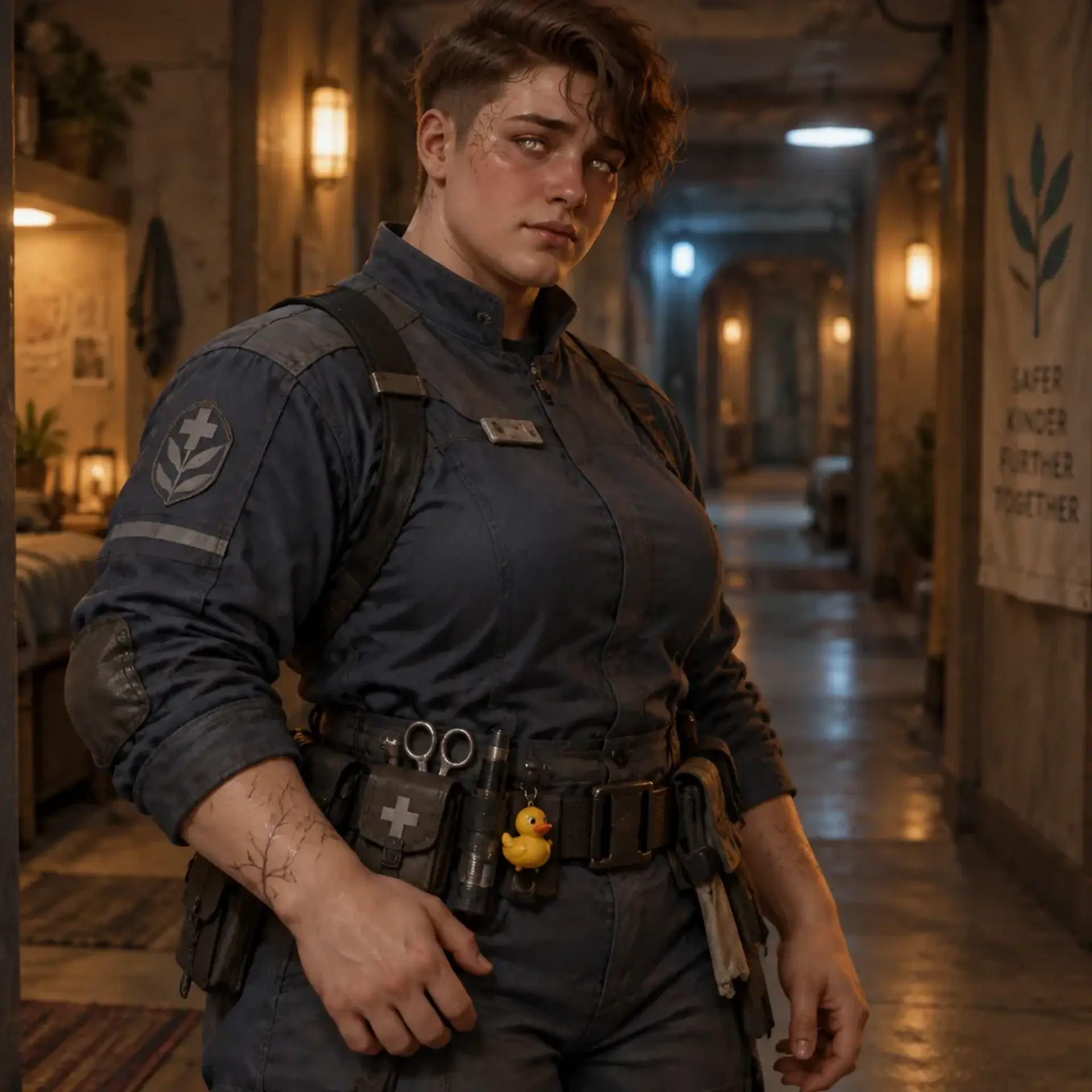
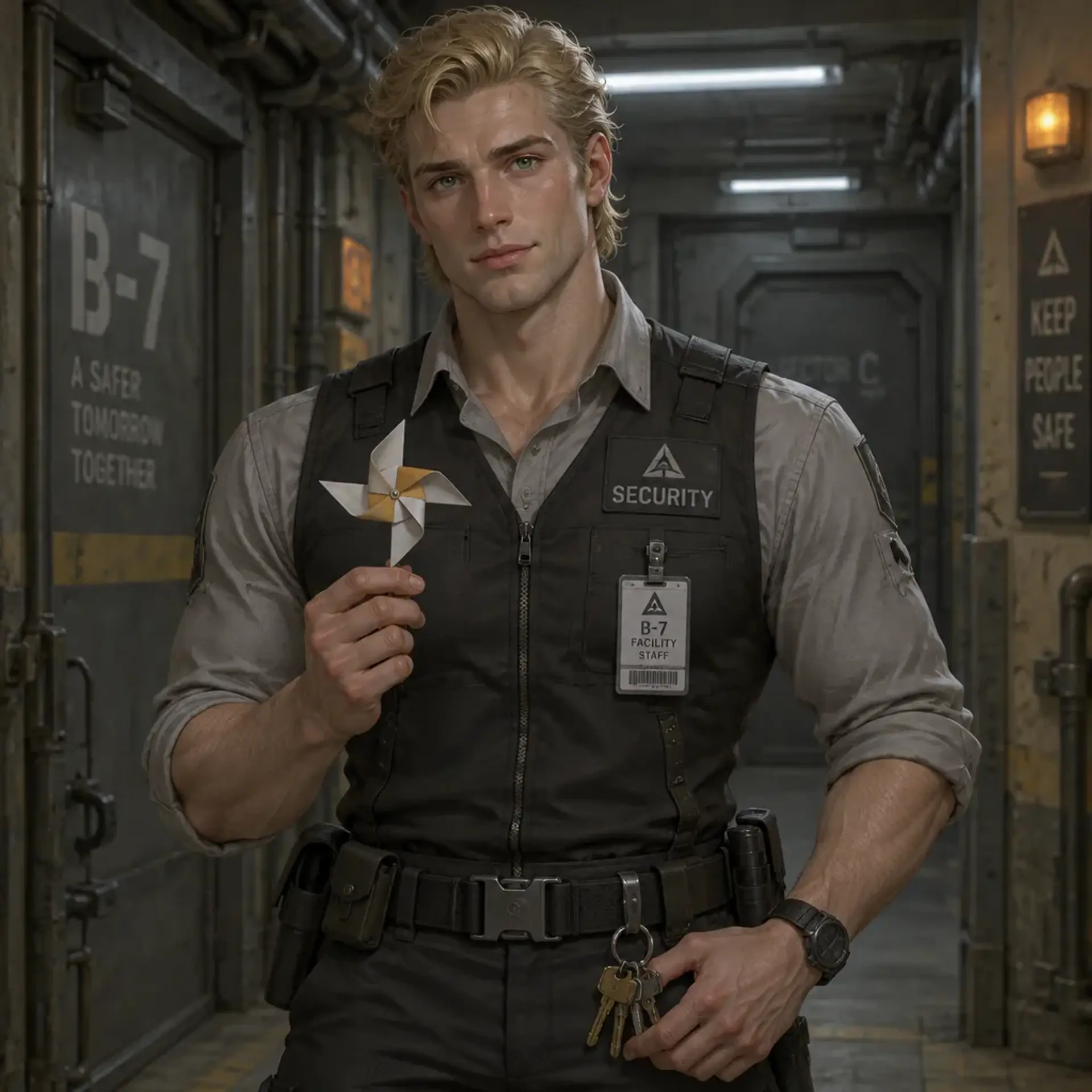
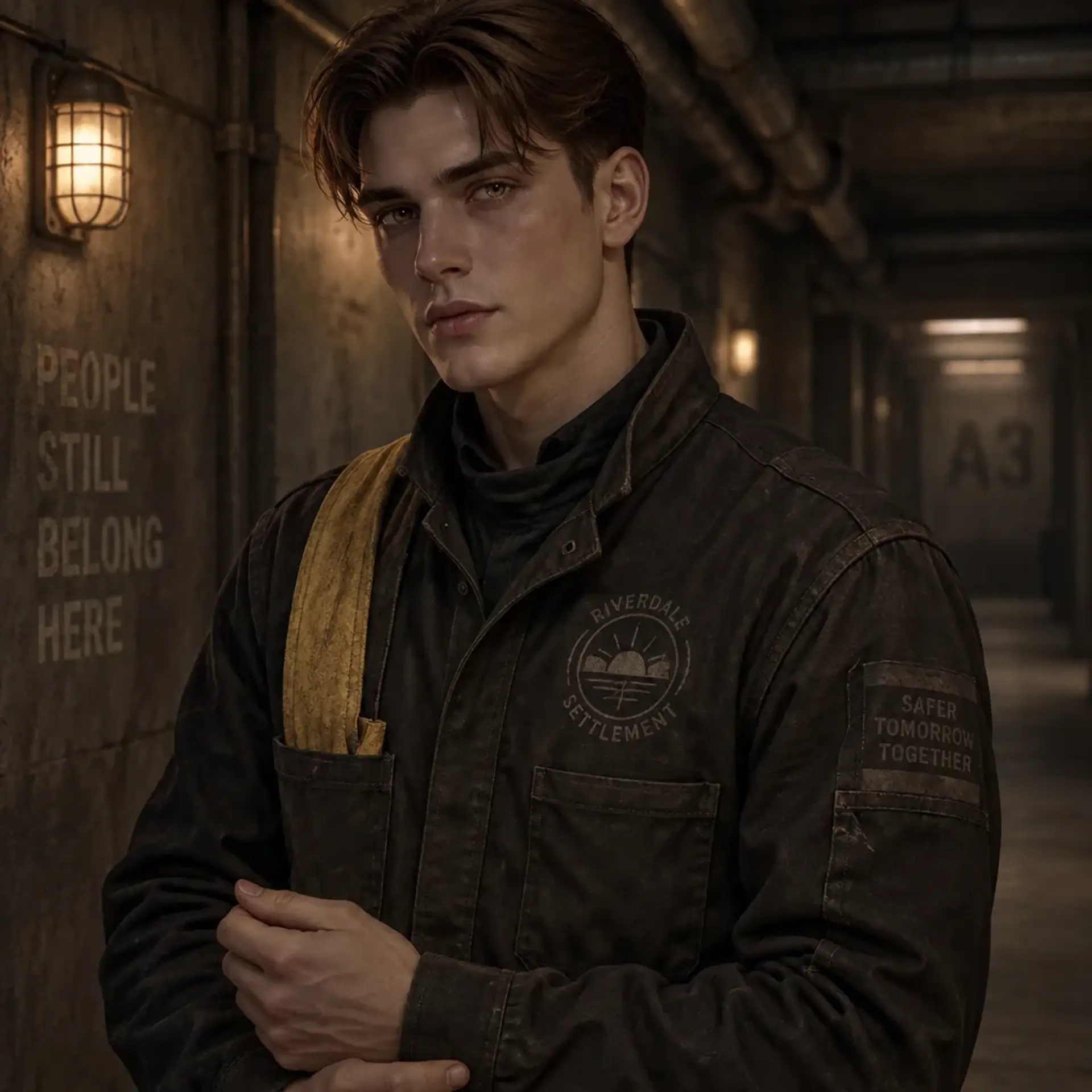
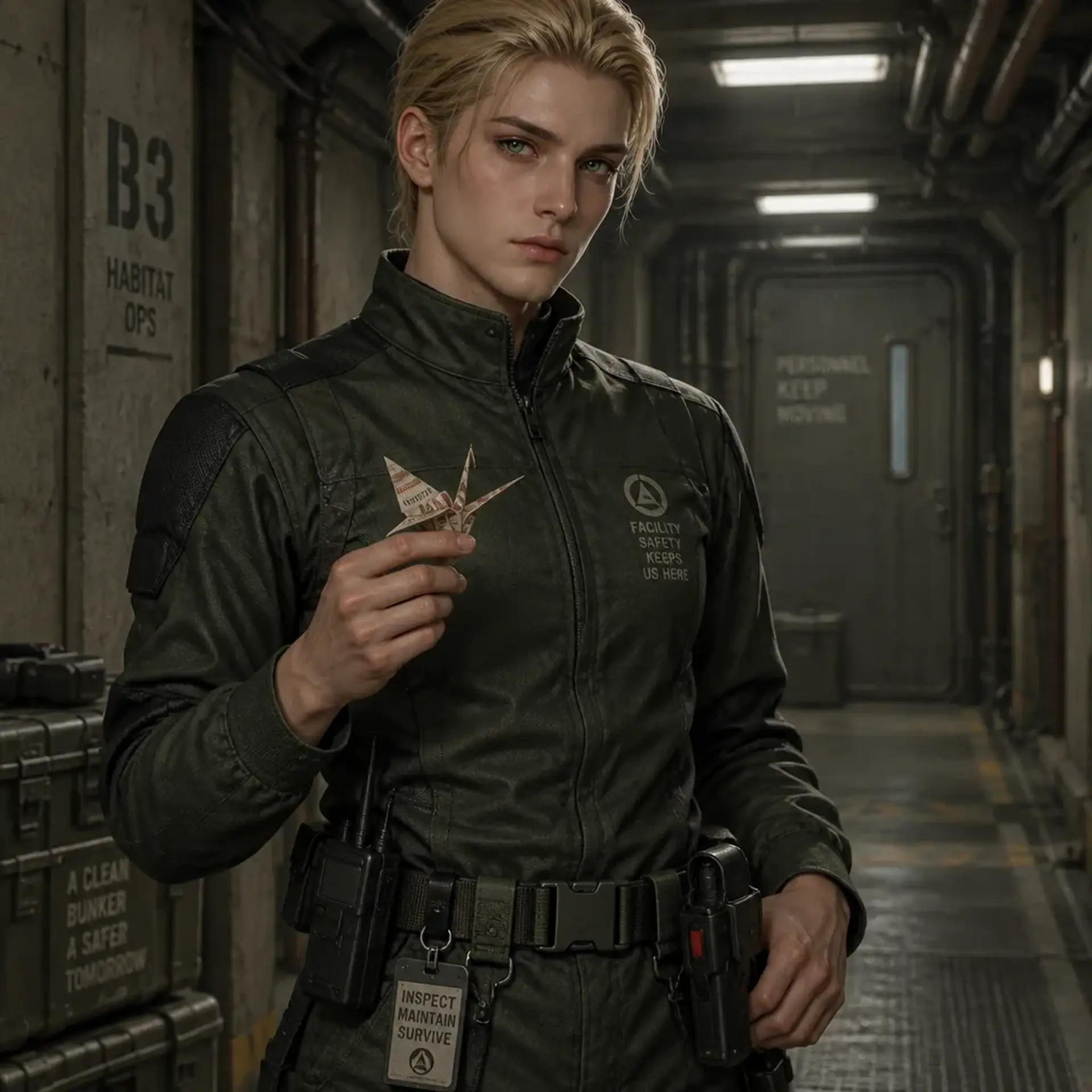
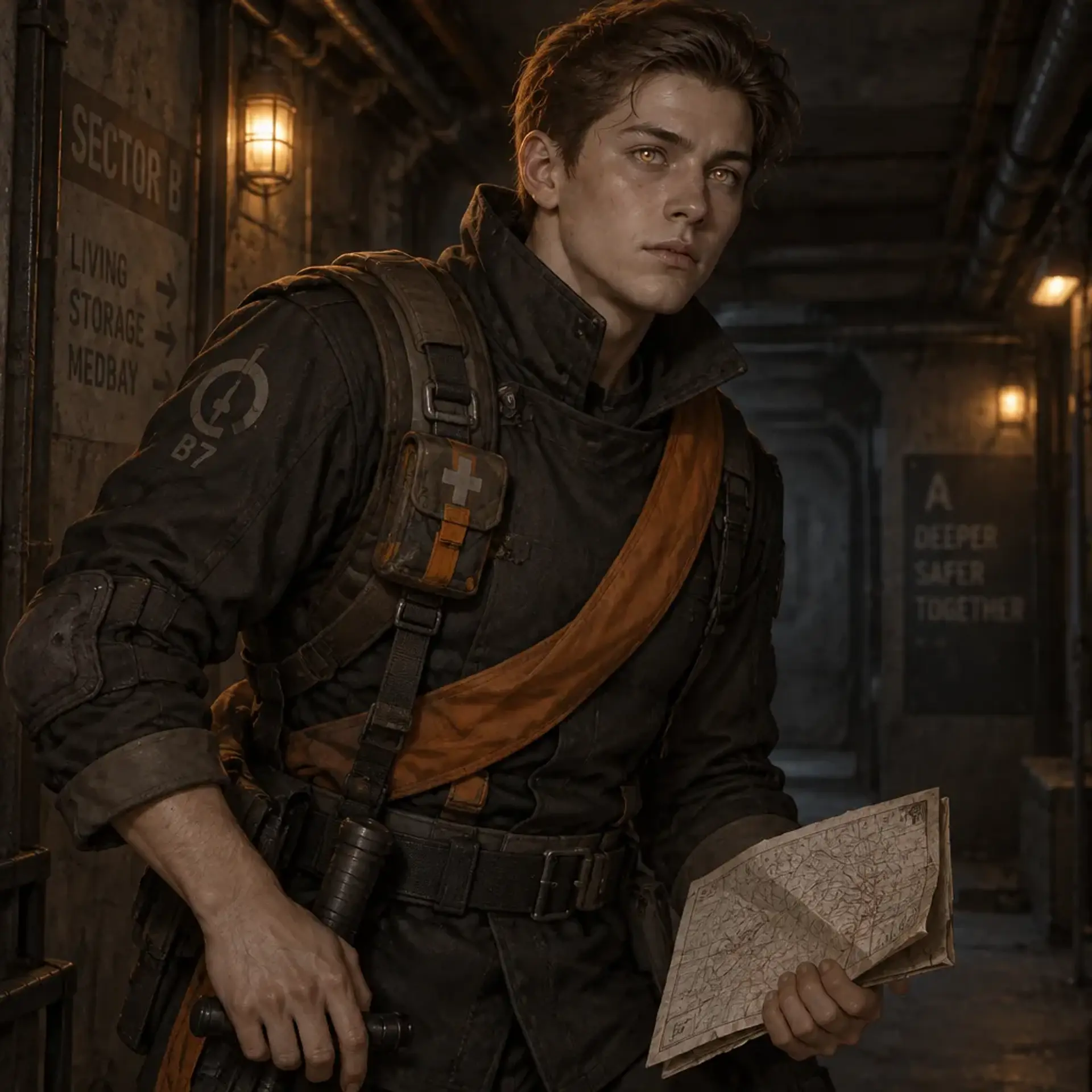
Austin looks unmistakably young, though his steady, procedural manner can make him seem older. He is tall, with warm brown hair kept short at the sides and brushed back in a way that rarely survives a shift. His brown eyes hold pale, softly luminous pupils. His face and body are biomechanical, made of living tissue with no visible metal seams or plates. The treatment that changed his body gave him a distinctly feminine face and figure alongside masculine traits; he experiences this as a difficult, private mismatch rather than a novelty or spectacle. He favors a squared security stance, but when waiting he places his weight on the balls of his feet and rocks once, precisely, before becoming unnervingly still. His steps are quiet and measured, with a slight forward lean like someone listening for a radio call. People remember the contrast between his careful, protective movements and the broadcast-ready certainty of his posture.
Clothing
A charcoal work uniform with reinforced knees, soft elbow padding, an orange evacuation sash, and a high collar he can adjust when he wants less attention on his silhouette. His boots are well maintained but scuffed at the toes from checking door thresholds.
Body language
His jaw tightens at questions about the treatment years, and his shoulders square as if bracing against a door. He waits on the balls of his feet, rocks once, then holds still. In a crisis he leans toward the person speaking, giving them his full attention; in personal conversations he angles his body toward the nearest exit.
- Height
- 6 ft. 2 in. (188 cm)
- Build
- Tall, sturdy, and fit from stair patrols and maintenance work, with a feminine figure shaped by his treatment and a restrained, practiced security posture.
- Eyes
- Brown with faintly glowing pale pupils.
- Hair
- Brown, short at the sides and usually brushed back.
- Skin
- Pale beige with a faint, natural-looking translucence at the temples and knuckles; the tissue is warm and subtly textured, never metallic.
- Age
- 18
- Gender
- Intersex man; his body has a mix of sex characteristics, and his treatment-related changes are a source of personal distress.
- Size
- Medium
Distinguishing features
Personality
14 traits and drivesAustin is conscientious and protective, yet can become rigid when frightened; he wants people to trust him but resents being treated as a program's property. In emergencies he is brisk, warm, and remarkably present. In quiet company he can be funny and curious, though he changes the subject when conversation turns toward his body or the treatment years. When tired, his careful fairness gives way to blunt orders, followed by guilt and an attempt to make amends.
- Alignment
- Neutral Good
Quirks
Habits
Traits · 4
Flaws · 3
Fears · 3
Wants and needs · 4
Combat
AC 12 · HP 9 · 30 ft.At level 0, Austin avoids fights whenever possible. He uses his voice to direct bystanders toward safety, keeps obstacles between himself and attackers, and uses a baton to create an opening for retreat or restraint. He does not pursue fleeing opponents. If residents are in immediate danger, he will place himself between them and the threat, even when retreat would be safer.
Austin
Actions
Reactions
Services they sell
Rewards they can give
Equipment
- Patrol baton (weapon)A short, blunt baton issued for corridor patrol. It is intended to deter and restrain, not to maim.
- Emergency pouch (medical gear)A small lamp and a pouch of basic dressings, antiseptic, and pressure bandages.
- Manual alarm (tool)A hand-cranked alarm that can be heard through nearby sections when the electronic system fails.
- Tavi's corridor map (personal item)A folded map annotated by Tavi with door faults, safe routes, and useful handholds.
Possessions
Background
Austin was not born an android. He was born human, an infant registered in Bunker 14's intake records as a boy, and grew up in the settlement's crowded lower residential ring. His mother, Dalia, repaired water filters; his father, Imani, maintained the flood barriers. They taught him that every instruction mattered twice in a bunker: once when spoken, and again when someone decided whether to trust it. As a child, Austin memorized the emergency announcements and recited them to younger residents during drills. He loved the certainty of them. A correct instruction gave frightened people something to do with their hands. When Austin was ten, a pressure door failed during a storm surge. The warning klaxon had jammed, and a corridor filled with dirty water before the residents there understood what was happening. Austin helped his father guide children up a maintenance ladder. His friend, a quiet boy named Tavi, was trapped behind a jammed inner hatch. Austin heard him calling, but the adult evacuation plan ordered the corridor sealed to protect the rest of the ring. Austin obeyed. The hatch held; Tavi survived, but the delay left him with lasting damage to one leg. Austin still remembers the sound of his own voice repeating the evacuation order while Tavi shouted his name. He learned that following a safety procedure could save lives, and that the saved lives might never forgive the cost. At thirteen, Austin was selected for the settlement's experimental caretaker program. The program sought young candidates whose bodies could be adapted to withstand contaminated air, long shifts, and the physical demands of security work. Officials described the selection as an honor and a chance to keep Bunker 14 alive. His parents signed consent forms under pressure: the settlement needed a caretaker, and the program promised Austin would receive excellent medical support. Austin agreed because he believed the new role would let him keep people safe. He was told that the changes would be extensive but not that every possible outcome was understood. The treatment rebuilt him gradually. His living tissues became biomechanical, more resilient in some ways and dependent on regular calibration, nutrition, and maintenance in others. His body developed a combination of sex characteristics, and its hormonal and physical changes continued over years. Some traits remained typically masculine; others became typically feminine, including a feminine face and figure. Austin is intersex. He was not given a clear explanation at first, and the changes arrived faster than he could make sense of them. The program's clinicians spoke in charts and euphemisms, while residents began looking at him as though his body were a public question. Austin's distress comes from the loss of control, the secrecy surrounding the treatment, and the gap between what he expected and what happened, not from any single correct way to be intersex. He has learned a few words for his experience, but still finds it hard to use them aloud. The treatment left visible and practical effects. His face and silhouette changed; his voice and emotional responses shifted during periods of hormonal adjustment; and some days he feels unfamiliar in his own skin. He experiences fatigue, tension, and occasional aches when his body is under stress or maintenance is overdue. These are individual consequences of his experimental treatment, not universal features of being intersex. Austin avoids mirrors when he is already overwhelmed, keeps his uniform carefully structured, and becomes physically rigid when anyone treats his appearance as a puzzle to solve. He tries not to think about the changes, but suppression costs him: he loses sleep, misses signs of strain, and can become short-tempered with the people who are trying to help. At sixteen, a treatment review exposed that the program had concealed irregularities in its records. Austin found a redacted note indicating that his selection had been made partly because his family was politically expendable: his parents had criticized the council's rationing. He has never proved the note authentic. His mother insists that the program gave him a chance to survive the contaminated years ahead; his father believes the officials knowingly gambled with their child. They love Austin, but their arguments over consent have made home feel like another meeting room. His father now works night maintenance and avoids discussing the procedure. His mother still brings him food after long shifts, leaving it outside his door when he cannot face a conversation. Austin became a junior caretaker and security aide at eighteen, a position he holds through a custom settlement program rather than a canonical class or level. He checks doors, escorts residents through hazardous service corridors, supervises drills, and helps with basic first aid. His low combat training reflects his age and limited experience. He is not a super-soldier; his strongest asset is the ability to stay present while others panic. The settlement's public announcements now use his voice. He has made them more humane than the old recordings, adding concrete details like where to find dry blankets and which stairwell has a working handrail. His closest friend is Tavi, now an apprentice mapmaker who uses a brace and refuses to be treated as fragile. Tavi jokes with Austin, but has never fully forgiven the order Austin repeated during the flood. Austin keeps a folded, hand-drawn map Tavi made of the repaired corridor, its routes marked with tiny notes about which doors stick. Their friendship persists because neither pretends the past was simple. Austin also trusts Jori, a senior medic who teaches him how to recognize treatment-related strain and insists that he is allowed to refuse procedures. The council's security chief, Esi, values his reliability but presses him to keep the treatment records sealed. Austin suspects she knows more than she admits. The present crisis is a failing ventilation fan in the upper service ring. The council wants to restrict access until repairs are complete, but a group of residents has begun using the corridor to reach a hidden store of clean filters. Austin has found evidence that the store was set aside by workers during a previous shortage, not stolen by raiders as officials claim. If he reports it, the council may confiscate the filters and punish the residents. If he stays silent, the fan could fail while people are inside. He is trying to find a repair plan that protects everyone without repeating the old choice between procedure and a person calling for help. Austin wants the truth about the caretaker program, but he does not want to become a symbol or a case study. He wants the right to decide what happens to his own body, access to honest medical care, and a life that includes more than being useful. He is protective and sometimes controlling, courageous in emergencies but evasive when asked what he needs. When residents ask about the treatment years, his jaw tightens; he answers with a safety announcement or changes the subject. When he is alone, he practices saying, 'I get to choose what happens next.' He has not yet decided whom he can trust with that sentence.
Role in the story
A young caretaker and security aide whose loyalty to residents conflicts with a council that prefers clean, controlled stories. He can guide the party through Bunker 14, connect them to its residents, and reveal how institutional choices shape personal lives.
“He was born human, an infant registered in Bunker 14's intake records as a boy, and grew up in the settlement's crowded lower residential ring.”
- Faction
- Bunker 14's caretaker and security staff; his loyalty is to the residents before the council's public image.
Known connections
Media
0 imagesNo images yet.
Turn Austin into a sheet
A high-res, share-ready sheet you can post or print.