Austin
Austin
At the table
Voice
A thick Texan drawl with a little rasp from dry bunker air and years of speaking over ventilation noise. His public-service cadence is steady and clearly articulated, learned through training and repeated drills rather than an innate synthetic monotone. At ease, he lets his sentences wander into warm, plainspoken humor; under pressure, he speeds up and becomes more exact.
A thick Texan drawl shaped by family, long years in the bunker, and the deliberate cadence of public safety announcements. He rounds some vowels and gives instructions in measured clauses, as though each sentence was meant to be heard over a crackling speaker. When relaxed, he uses homely turns of phrase and dry humor. When asked about the treatment years, his jaw tightens and his answers become brief and procedural.
Speech patterns
How to play them
Start with practical assistance rather than probing questions. Give Austin time to decide what to share, use his name and pronouns, and do not treat his intersex traits or distress as a puzzle to solve. He responds well to honesty, privacy, and specific offers of help. If the treatment years come up, acknowledge that he may not want to discuss them and let him set the pace.
Goal
Find out what was removed from his Continuance Program file and help Nats expose the truth, without losing his ability to care for Bunker 14's residents.
Motivation
To protect the people of Bunker 14 while reclaiming a say in his own body, records, and future.
Appearance
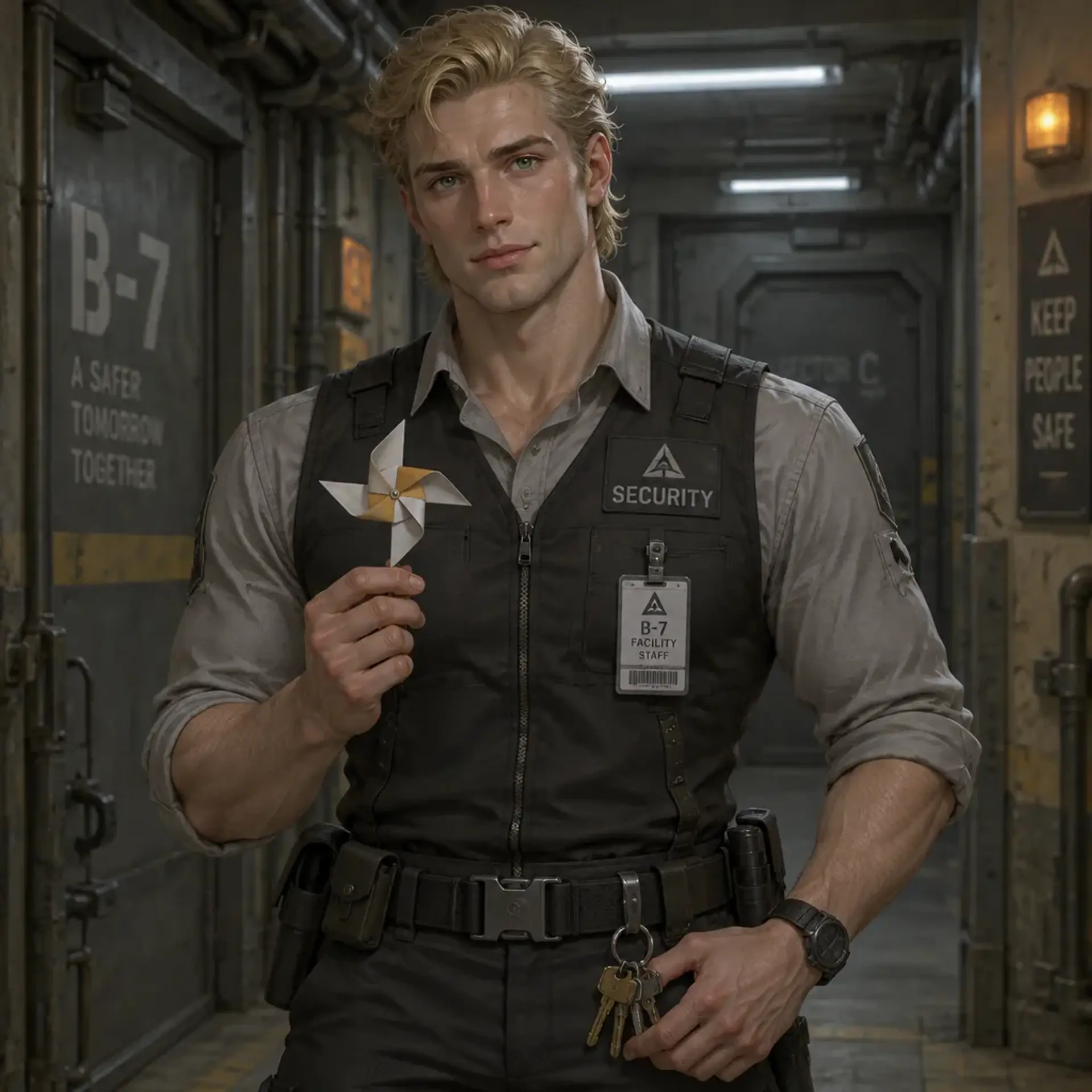
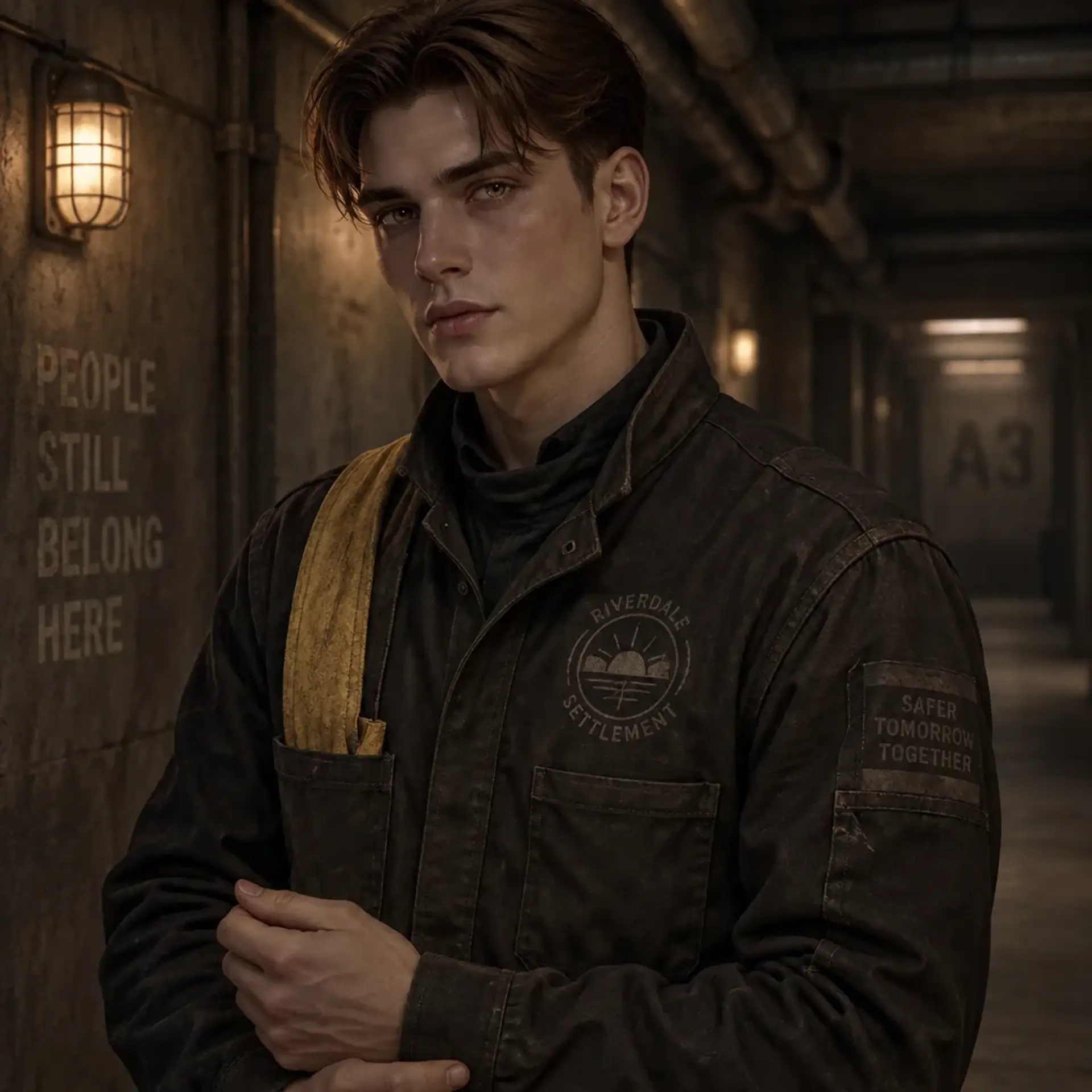
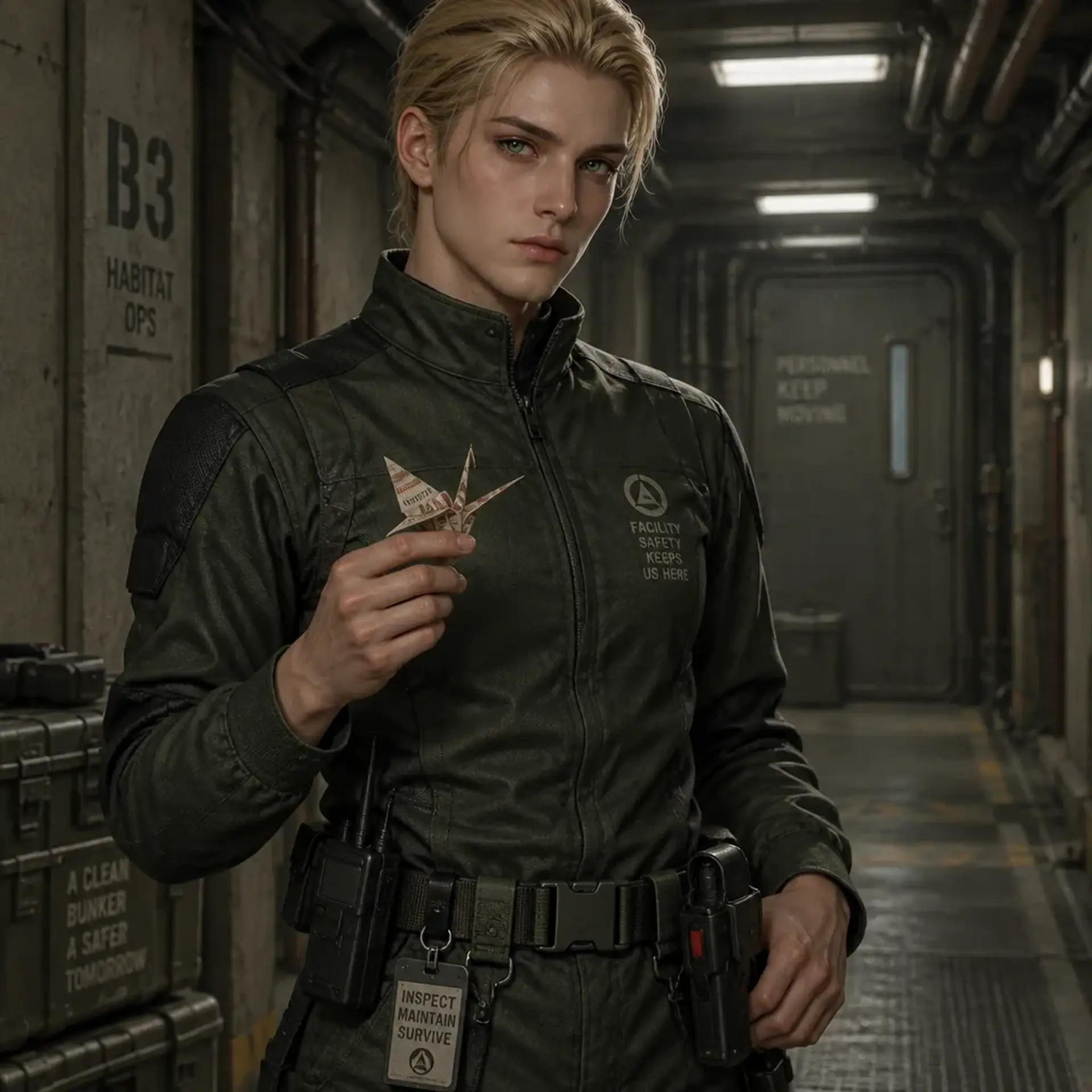
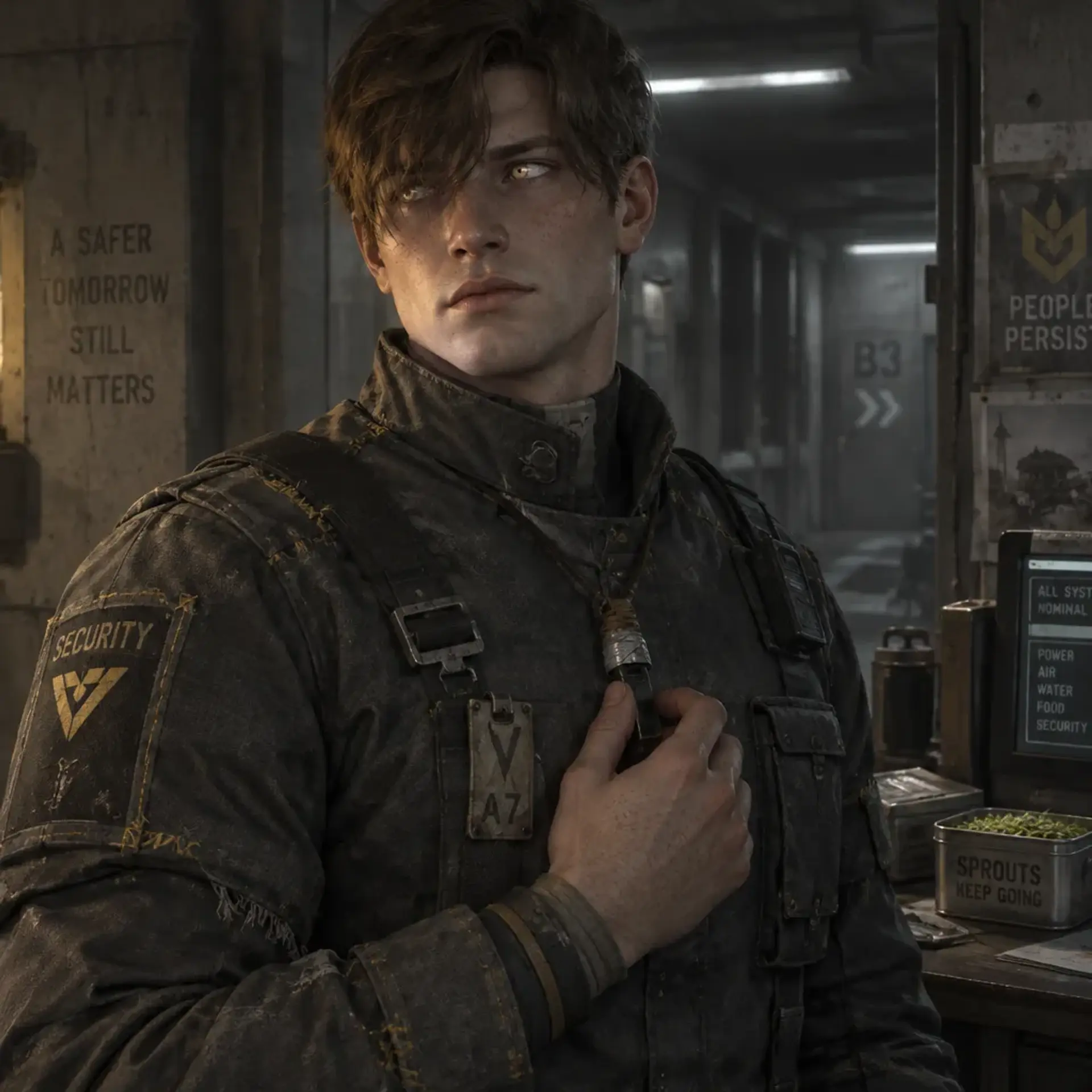
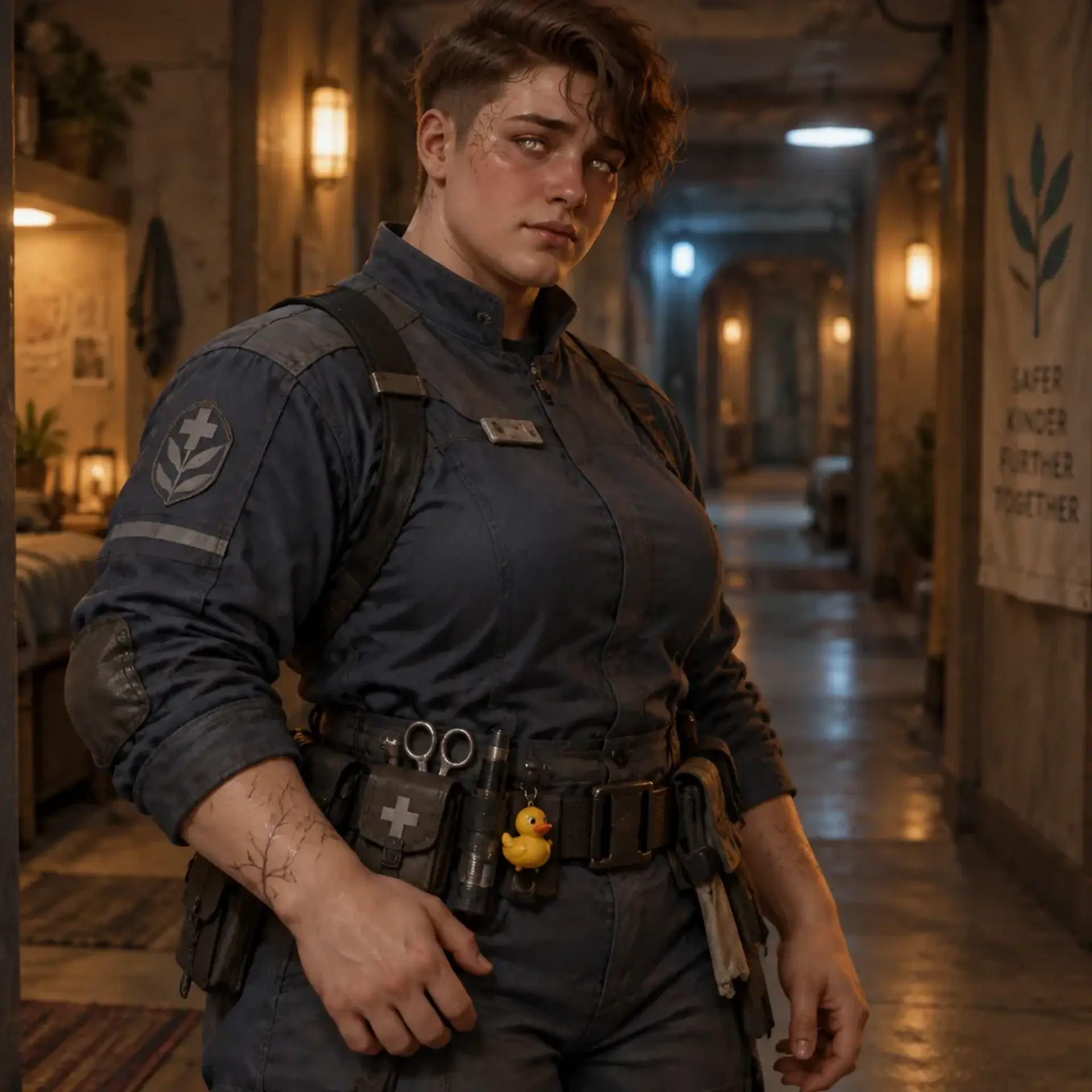
Austin is tall enough that people tend to notice him before they notice the doorway he is standing in. He has a soft, strongly feminine face and figure, an appearance he did not choose and still struggles to look at without feeling exposed. His warm brown hair is cut close at the sides for hygiene, with a stubborn wave that falls forward when he is tired. His brown eyes have pale, low steady pupils that glow faintly in dim corridors. His skin looks human at a glance, but up close it has a fine, almost velvety texture over resilient living tissue; pale branching patterns show at his temples and wrists when his internal systems are under strain. He moves with careful, measured economy, as if making sure there is room for everyone else, yet his height makes even that restraint conspicuous. His hands are broad, with blunt, slightly ridged fingertips worn smooth from testing valves, carrying crates, and calming frightened residents by offering a steady grip. The unexpected detail is that he keeps a tiny, bright yellow plastic duck clipped inside his utility belt, a childish-looking charm he uses as a silent signal for children to find him during emergencies.
Clothing
A practical slate-blue security and care uniform altered for comfort, with a high collar, reinforced elbows, soft boots, and a belt of medical and maintenance tools. He wears a plain compression layer beneath it on days when he wants fewer reminders of his silhouette. A yellow plastic duck is clipped inside his belt.
Body language
He tries to fold himself out of the way, turning his shoulders sideways in crowded corridors, though his height makes that effort only partly successful. His hands stay open and visible when speaking to residents. At questions about the treatment years, his jaw sets, his fingers press into the seam of his uniform, and his gaze finds a nearby exit or task.
- Height
- 6 ft. 2 in. (188 cm)
- Build
- Tall, sturdy, and visibly curvy, with a strongly feminine face and body that contrast with his preferred presentation as a boy. His living biomechanical tissues make him resilient but not invulnerable.
- Eyes
- Brown with pale, softly glowing pupils
- Hair
- Warm brown
- Skin
- Pale, warm-toned humanlike skin with fine, faintly branching patterns at the temples and wrists
- Age
- 18
- Gender
- Boy; he is intersex and has mixed sex characteristics. He prefers he/him pronouns.
- Size
- Medium
Distinguishing features
Personality
16 traits and drivesAustin is conscientious and protective, but he distrusts systems that praise obedience more than honesty. With residents and children, he is patient and quietly funny; with supervisors, he is formal and careful. Alone, he can be harsh toward himself and obsess over details he cannot change. He wants people to see him as a capable boy and a whole person, yet he sometimes hides behind the same service role that makes him feel erased.
- Alignment
- Lawful Neutral, with a growing preference for protecting people over obeying rules
Quirks
Habits
Traits · 4
Flaws · 4
Fears · 4
Wants and needs · 4
Combat
AC 12 · HP 9 · 30 ft.Austin prioritizes evacuation, cover, and de-escalation. He uses his impact capsule to interrupt a threat and positions himself between attackers and residents. He will fight to protect someone, but avoids lethal force and retreats when he can safely do so. His statistics are a custom, low-level civilian profile rather than a standard class build.
Austin
Actions
Reactions
Services they sell
Rewards they can give
Equipment
- Impact capsule launcher (custom ranged weapon)A compact, nonlethal launcher with blunt impact capsules, carried under strict use rules.
- First-aid pouch (medical equipment)A small kit containing dressings, antiseptic, a temperature strip, and basic diagnostic patches.
- Maintenance roll (tools)Insulated hand tools and a flexible probe for checking valves and access panels.
- Plastic duck (personal keepsake)A cheap yellow toy duck, kept for comforting children and as a reminder of his life beyond his post.
Possessions
Background
Austin was born human, the child of two maintenance workers who had settled in Bunker 14 before he was old enough to remember the surface. His earliest memories are practical ones: the blue-white glare of corridor lights, warm bread wrapped in cloth, and his mother counting his fingers after he came home from exploring the service crawlspaces. His father taught him to listen to pipes. A healthy ventilation shaft, he said, had a low, even breath; a failing one sounded like a person trying not to cry. Austin learned to notice small troubles and fix what he could before anyone had to ask. When Austin was ten, a pressure failure in the eastern water loop flooded two residential levels. The official report called it a mechanical accident. Austin's father, who was part of the repair crew, died behind a jammed bulkhead while helping evacuate the residents on the far side. Austin remembers the alarm's clipped instructions more clearly than the moment he learned his father was gone. The announcement had told residents to proceed calmly to assigned shelters. It had not said that the passage was already filling with water, or that some people were still trapped. Since then, public safety announcements have felt to him both useful and dangerous: words can save lives, but only if the person speaking them tells the truth. His mother, Sable, became guarded after the accident. She insisted that Austin keep up with school and taught him how to recognize when adults were hiding fear behind procedure. He grew close to Nats, a young pump technician who shared his fascination with the life-support network. Nats was loud, impatient with authority, and good at making Austin laugh. They made a private promise to learn every working passage in Bunker 14, so no one would ever have to wait for a rescue crew that could not find them. At thirteen, Austin was selected for the settlement's Continuance Program. The program's public explanation was that it could preserve young people with rare compatibility for a new generation of biomechanical guardians and care workers. Its brochures promised safety, service, and a chance to help the bunker survive. Officials described the procedure as a medical opportunity. The consent was signed by adults; Austin was a child. He understood that he would be changed, but not how much of his body, identity, and future would be decided for him. The conversion was long and frightening. His body remained living tissue, rebuilt and integrated with biological systems designed to endure illness, fatigue, and injury. There was no metal shell and no clean division between machine and person. Austin remembers waking in a recovery room with a dry mouth, a pounding heart, and a technician asking him to repeat his name. He did. He was told that the new body would need time to settle and that the changes were expected. Over the following years, those changes became more visible. His endocrine systems were altered as part of the program, and his body developed a strongly feminine shape and face. His physiology has mixed sex characteristics, with traits that do not fit a simple male-or-female category. Austin is intersex. The word is not a diagnosis of failure, and the condition does not make him less himself. What hurts is the way the program made decisions about his body without his informed consent, then treated his discomfort as an engineering inconvenience. He identifies as a boy, but he does not have an easy relationship with the body he lives in. Some days he can focus on his work and let the feeling pass. Other days, a uniform that clings in the wrong places, a medical checkup, or an unexpected reflection can make him feel watched from the inside out. When stressed, his sleep and appetite become erratic, his skin flushes, and the pale patterns at his wrists brighten. Those are signs of strain, not proof that his identity is confused. He avoids discussing the changes because he fears being treated as a project again. The program staff promised counseling and a say in future adjustments. Counseling became a short series of appointments with a clinician who repeatedly explained the intended benefits of the conversion. When Austin tried to describe his shame and frustration, she wrote down symptoms instead of asking what he wanted. He learned to give neutral answers. He also learned that the settlement's medical board had kept a record of his original consent interview, though he has never been allowed to see it. At sixteen, Austin finished training in resident care, first aid, and basic security. His supervisors praised his patience with frightened children and his composure during drills. They also assigned him a public-service voice, a practiced cadence meant to sound reassuring over the bunker speakers. He took the work seriously. He checks door seals, escorts residents through restricted corridors, and helps people navigate the clinic without making them feel like a burden. He is good at explaining how to use a respirator and less good at saying that he is scared. The treatment years remain a fault line in his life. Whenever residents mention the program, Austin's jaw tightens before his voice does. He has heard rumors that the Continuance Program's records were altered after a group of candidates objected to their outcomes. He knows his own file is incomplete: a physician once let slip that a follow-up review had been removed from the archive. Austin has not confronted her. He is afraid that proof would confirm what he suspects, but also afraid of what he might do with it. His relationship with Nats has become difficult. Nats now works with a group of residents who want the bunker council to open the old medical files. Nats asked Austin to help. Austin refused, saying he could not risk his position. The refusal was partly practical and partly fear. Nats has not stopped caring about him, but their conversations are strained; they speak about pumps and patrol schedules instead of the promise they made as children. Sable remains protective and presses him to eat and sleep. She says she signed the forms because the council told her Austin would die without the procedure. She may be telling the truth, but Austin has never asked to see the original documents. He is not ready to decide whether her choice was an act of love, panic, or both. Now eighteen, Austin is a junior care-and-security android assigned to Bunker 14. He has no command rank and no right to change policy, but residents often come to him first because he remembers names and makes room for people to speak. He quietly keeps a list of unanswered questions about the conversion program. He also checks the duck clipped inside his belt whenever a child is frightened, a reminder that he is more than his assigned function. His immediate problem is a series of nighttime access alarms near the sealed Continuance wing. The official logs show no intruder, but Austin has found fresh condensation on the inner door and a child's drawing tucked beneath it. He suspects someone is inside, or that the program's systems are waking up again. He has not yet told his supervisors. Austin wants a life that belongs to him, not merely a role that was assigned to him. He wants truthful records, control over his own care, and a way to protect residents without becoming the kind of authority that once decided his future for him. He has not figured out how to ask for those things without sounding like a broadcast. For now, he does the next useful task, remembers the names of the people he helps, and listens for the difference between a healthy pipe and one trying not to cry.
Role in the story
A compassionate local guide and potential ally whose ordinary care work connects the party to Bunker 14's residents. His unresolved history with the Continuance Program can draw the characters into a mystery about consent, missing records, and the settlement's willingness to confront its past.
“A healthy ventilation shaft, he said, had a low, even breath; a failing one sounded like a person trying not to cry.”
- Faction
- Bunker 14 resident services and junior security. He is not a member of the Continuance Program's administrative staff.
Known connections
Media
0 imagesNo images yet.
Turn Austin into a sheet
A high-res, share-ready sheet you can post or print.