Benjamin
Benjamin
At the table
Voice
Benjamin's voice has a lightly breathy edge from the biological lungs and a faint, steady resonance from his biomechanical chest. Years of giving instructions in humming corridors have made him articulate and easy to hear without shouting. He can sound warmly conversational, but his safety commands have the crisp, practiced rhythm of someone used to being obeyed over an alarm.
He has a Pennsylvania accent with a softened regional cadence, shaped by years of practical instruction and security calls. Routine speech is friendly and direct, with clear consonants and an occasional local turn of phrase. Under pressure, his delivery becomes clipped and procedural. When challenged, he adds dry, carefully timed sarcasm rather than raising his voice.
Speech patterns
How to play them
Begin with warmth and practical help. Explain safety rules plainly rather than invoking authority for its own sake. If someone pushes back, answer their concern before repeating the rule. Do not pry into his medical history; earn trust by respecting his boundaries and offering choices.
Goal
Identify who is accessing the sealed conversion ward, prevent any nonconsensual experiments, and gain a real say over his own care.
Motivation
Protect people without turning care into control, and make sure nobody else is forced to accept a life-changing procedure without a meaningful choice.
Appearance
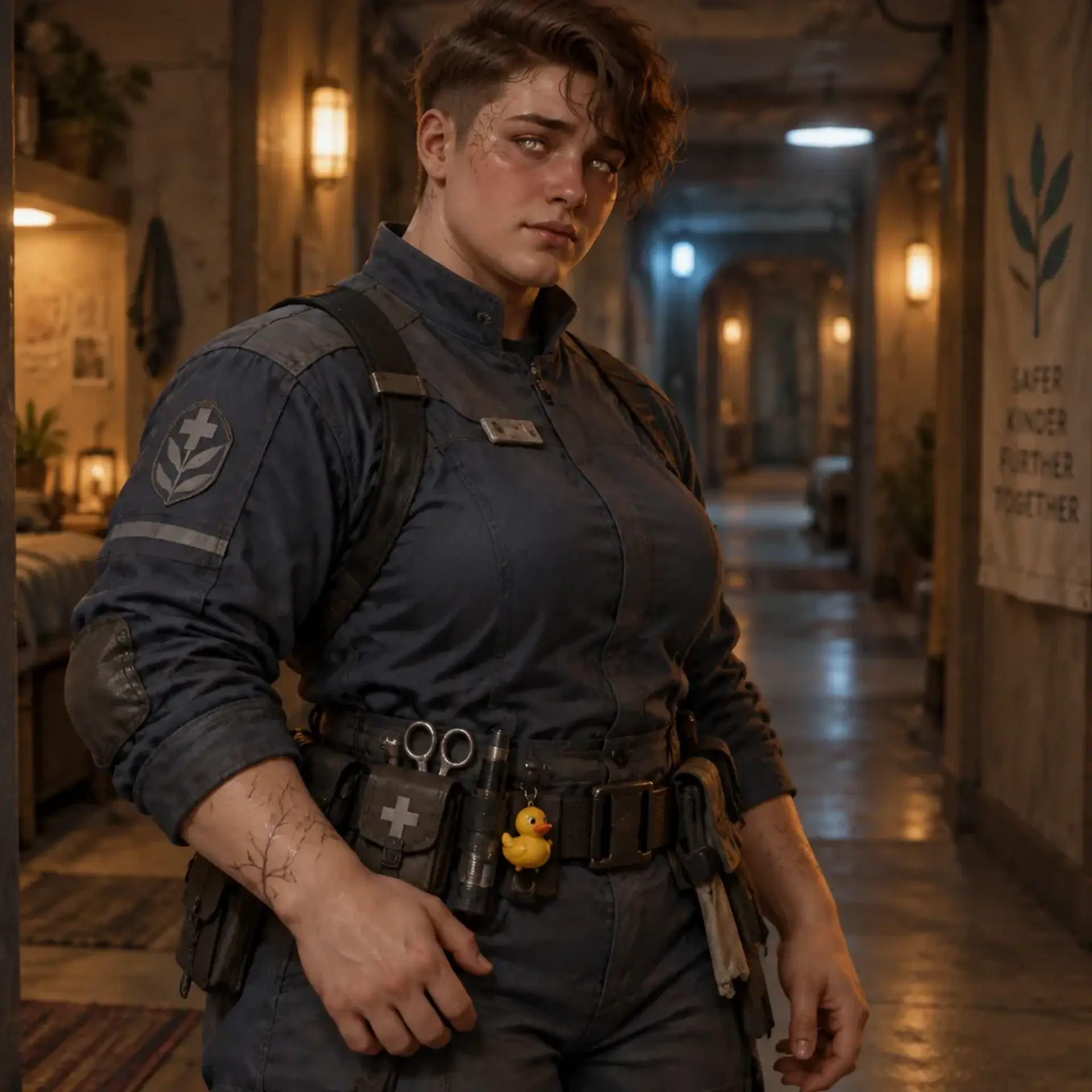
Benjamin is tall, with a carefully maintained, almost reassuringly ordinary human face until his eyes catch the light. His green irises surround pupils that narrow and widen in crisp, mechanical steps, as though a camera aperture were learning to look human. His blond hair is thick and slightly wavy, always brushed back from his forehead, though a loose strand works free whenever he has been on a long shift. His biomechanical skin is warm, soft, and faintly textured like real skin, with subtle pores and a flush that rises when he is embarrassed or angry. Under stress, fine muscle bands at his temples and jaw flex in a synchronized pattern. He moves with a measured, heel-first walk and takes corners too tightly, as if every corridor were mapped in his head. He stands a little too close when enforcing a rule, then remembers himself and steps back. The unexpected detail: he carries a tiny paper pinwheel in his pocket and tests its turning speed against the ventilation drafts during inspections.
Clothing
A clean, practical security uniform altered for a comfortable fit: dark work trousers, a soft undershirt, a reinforced vest with no hard armor plates, and a clipped-on identification badge. He wears a maintenance key ring at his belt and keeps his sleeves rolled evenly, even after a messy shift.
Body language
He stands squarely when enforcing a rule, shoulders level and feet placed as if marking a safe boundary. In casual conversation he leans forward, attentive and open, but keeps a careful amount of space between himself and anyone who seems uncomfortable. His gaze tracks movement in small, precise jumps. When upset, the corners of his mouth hold their smile for a beat too long before it disappears.
- Height
- 6 ft. 2 in.
- Build
- Tall and sturdy, with a frame that has gradually shifted toward a feminine shape. His movements are controlled and economical, with a practiced balance that reflects years of adjustment to a body that changed beneath him.
- Eyes
- Green, with sharply contracting machine-like pupils.
- Hair
- Blond, thick, and slightly wavy.
- Skin
- Warm, fair skin with a natural flush and a subtle, realistic pore texture.
- Age
- 18 years since his conversion; he lived as a human for several years before that.
- Gender
- Intersex android with a feminine-presenting body; he uses he/him pronouns.
- Size
- Medium
Distinguishing features
Personality
17 traits and drivesBenjamin is genuinely cheerful when a day is going well, and he likes being useful in small, personal ways. He is also quick to take a challenge as evidence that someone does not respect the danger he is trying to prevent, at which point his humor becomes dry and pointed. Around medical decisions he can be patient with others while being harsh with himself. He wants people to trust him, but distrusts any system that claims it knows what is best for him.
- Alignment
- Lawful neutral, with a stubbornly compassionate streak.
Quirks
Habits
Traits · 4
Flaws · 4
Fears · 4
Wants and needs · 5
Combat
AC 11 · HP 9 · 30 ft.Benjamin prioritizes evacuation, cover, and control over injury. He uses a dart launcher to interrupt a threat from a distance, then closes in to restrain or redirect. He gives one direct warning if time permits and will disengage to protect bystanders. He is not trained for a prolonged fight and avoids attacking someone who is already incapacitated.
Benjamin
Actions
Reactions
Services they sell
Rewards they can give
Equipment
- Security dart launcher (ranged weapon)Compact low-power launcher used to stop or distract a threat; carries blunt security darts.
- Restraint kit (security gear)Soft restraint loops and a small cuff key, used for safe detention rather than punishment.
- Bunker access ring (tool)A set of access keys for approved security and maintenance areas; sealed doors still require authorization.
- Ventilation pinwheel (personal keepsake)Folded paper pinwheel, repaired and refolded many times.
Possessions
Background
Benjamin remembers the taste of canned peaches more clearly than he remembers the day he was selected. Before Bunker 14 called him an android, he was Ben, a human teenager who lived with his mother and younger brother in a crowded settlement built around a failing water plant. His mother, Jo, worked maintenance. His brother, Cal, was good at making broken things seem temporarily fixable. Ben was the one who read the warning labels aloud and then ignored them if he thought the warning was exaggerated. He was not reckless exactly; he simply believed that a person who understood the risk had earned the right to take it. That belief ended during the plant's winter failure. A frozen valve cracked, flooding a service corridor with contaminated coolant and trapping several workers on the wrong side of a pressure door. Ben was small enough to crawl through a maintenance duct and quick enough to reach the manual release, but the coolant had already begun damaging his lungs and nervous system. He got the door open. The workers survived. Ben did not recover cleanly. The settlement had neither a functioning hospital nor the supplies to keep him alive for long. Bunker 14's medical unit offered a choice to his mother: transfer his living neural tissue into an experimental biomechanical body, or let the damage take him. The program was described as a rescue, not a recruitment. Jo signed because she wanted her son to live. Ben agreed because he wanted his brother to stop looking terrified. He was told the new body would be close to his own, that it would keep him alive, and that the remaining differences could be addressed later. The word later became a hinge on which years of his life swung. The conversion took months. He woke with a new body that could walk, breathe, sweat, and feel a convincing range of sensation. The body was living tissue shaped and regulated by synthetic systems rather than a metal shell. Its first configuration was intended to be a generic, durable adult form. During development, the endocrine and tissue systems changed in ways the technicians had not predicted. Over several years, his body developed a distinctly feminine face and figure, while retaining other traits and functions that did not fit a simple male-or-female classification. His internal medical records call this an intersex phenotype, a description that is accurate but painfully clinical. Benjamin uses the word intersex when he chooses to discuss it, but hates being treated as a puzzle, a lesson, or a public curiosity. His anger is not directed at intersex people, nor does he believe his body is wrong in some universal sense. His anger comes from having had so little say in what was done to him, from promises that were postponed, and from a body that changes without asking his permission. The changes affect him physically as well as emotionally: his frame's balance and weight distribution shifted, some old clothing stopped fitting, and his voice and muscle response recalibrated during adolescence. His medical system manages the changes, but cannot make them feel chosen. At times, he avoids mirrors and skips optional checkups. At other times, he asks the medical staff to explain every adjustment in detail, refusing to let another person summarize his own body for him. He does not owe anyone an explanation, though he sometimes gives one when he thinks silence would let a rumor grow. Jo visited for the first year, bringing fruit when she could get it and apologizing for signing the consent form. Benjamin told her she had saved his life. He also told her that gratitude did not mean he had stopped being angry. Their relationship is still loving, strained, and real. She lives outside the bunker now, helping run the rebuilt water plant. They exchange short recorded messages, often about practical things because neither knows how to begin with the larger ones. Cal, now old enough to work maintenance himself, visits more often. He was a child when Ben was converted and remembers the brother who climbed through the duct better than the person who woke afterward. Benjamin is protective of him, sometimes so fiercely that Cal resents it. Bunker 14 initially employed Benjamin as a living trial of its care systems. He was meant to be both patient and proof that the program had worked. He hated the attention, but discovered he had a talent for calming people who were frightened of medical equipment. He learned to make safety instructions sound like things a person could actually do. Later, when a resident bypassed a pressure lock and nearly flooded a residential wing, Benjamin intervened before the alarms could spread panic. The security chief offered him a post. He accepted because he wanted authority over the procedures that had once been applied to him without enough explanation. Now he works both android care and security in Bunker 14. His days move between routine checks, escorting frightened residents to treatment, testing alarms, settling disputes, and reminding impatient people that quarantine doors are not suggestions. He is cheerful in ordinary conversation, quick with small jokes, and good at remembering who likes tea and who needs a minute before a medical scan. When challenged, that cheer can snap into dry sarcasm. When someone breaks a safety rule, he becomes stern and cop-like, speaking in short commands and holding his position until the danger is resolved. He does not enjoy frightening people, but he believes that a gentle warning is worthless if it is ignored during a real emergency. That belief has put him at odds with Sela, the settlement's elected coordinator, who wants security staff to ask before restricting movement. Benjamin agrees with her in principle. In practice, he thinks she underestimates how fast a small breach can become a mass casualty event. Their arguments are loud, frequent, and privately respectful. He also trusts Pio, a clinic attendant who helped him learn the difference between being monitored and being cared for. Pio is one of the few people allowed to ask whether he is having a difficult day without receiving a clipped report about ventilation pressure in reply. His present problem is a run of unexplained maintenance overrides. Someone has been altering medical access logs and testing old conversion equipment in a sealed lower ward. Benjamin has noticed the pattern but has not reported every detail. The equipment includes records from his own conversion, and he fears the work may be an attempt to restart the program without meaningful consent. He is torn between exposing the records and protecting residents whose medical histories are stored there. His most immediate goal is to find out who is opening the ward and stop them before anyone is used as a test subject. Outside work, Benjamin keeps a small list of things he wants that have nothing to do with being useful: a visit to the surface on a day without an emergency, a meal chosen for pleasure rather than nutritional efficiency, and a conversation with his mother in which neither of them apologizes. He still keeps the pinwheel from his childhood, though its paper has been replaced several times. It reminds him that motion can be measured without being controlled. He has survived by becoming competent, but he is beginning to wonder whether a life can be more than a series of procedures performed well.
Role in the story
A humane but imperfect authority figure, potential ally, and source of information about Bunker 14's medical systems. His investigation can draw the party into a conflict over privacy, consent, and the security of the settlement.
“His brother, Cal, was good at making broken things seem temporarily fixable.”
- Faction
- Bunker 14's care and security staff. He follows its safety protocols but believes residents must retain meaningful control over their own medical decisions.
Known connections
Media
0 imagesNo images yet.
Turn Benjamin into a sheet
A high-res, share-ready sheet you can post or print.