Austin
Austin
At the table
Voice
A thick Texan drawl with rounded vowels, a dry edge from recycled air, and the steady timing of a settlement safety announcement. The sound is warm without being soft; years of instruction make his consonants clear and his pauses deliberate.
His words arrive in the measured rhythm of a public-service broadcast, shaped by years of giving evacuation instructions in narrow halls. A thick Texan drawl rounds his vowels and gives even routine directions a lived-in warmth. He speaks from the chest, with a faint dry rasp from recycled air and long shifts. Under stress the cadence gets more formal, not louder. When he talks casually with friends, his sentences loosen and the drawl becomes more pronounced.
Speech patterns
How to play them
Treat Austin as a young adult and a person, not as equipment or a medical exhibit. Ask before touching him or pressing for details. Practical assistance and patient consistency build trust; public demands for his history make him retreat into scripted answers.
Goal
Find out who altered the ventilation access records, obtain an honest account of the treatment program, and choose his own future in Bunker 14.
Motivation
To keep residents safe without letting the program define his body, worth, or choices.
Appearance
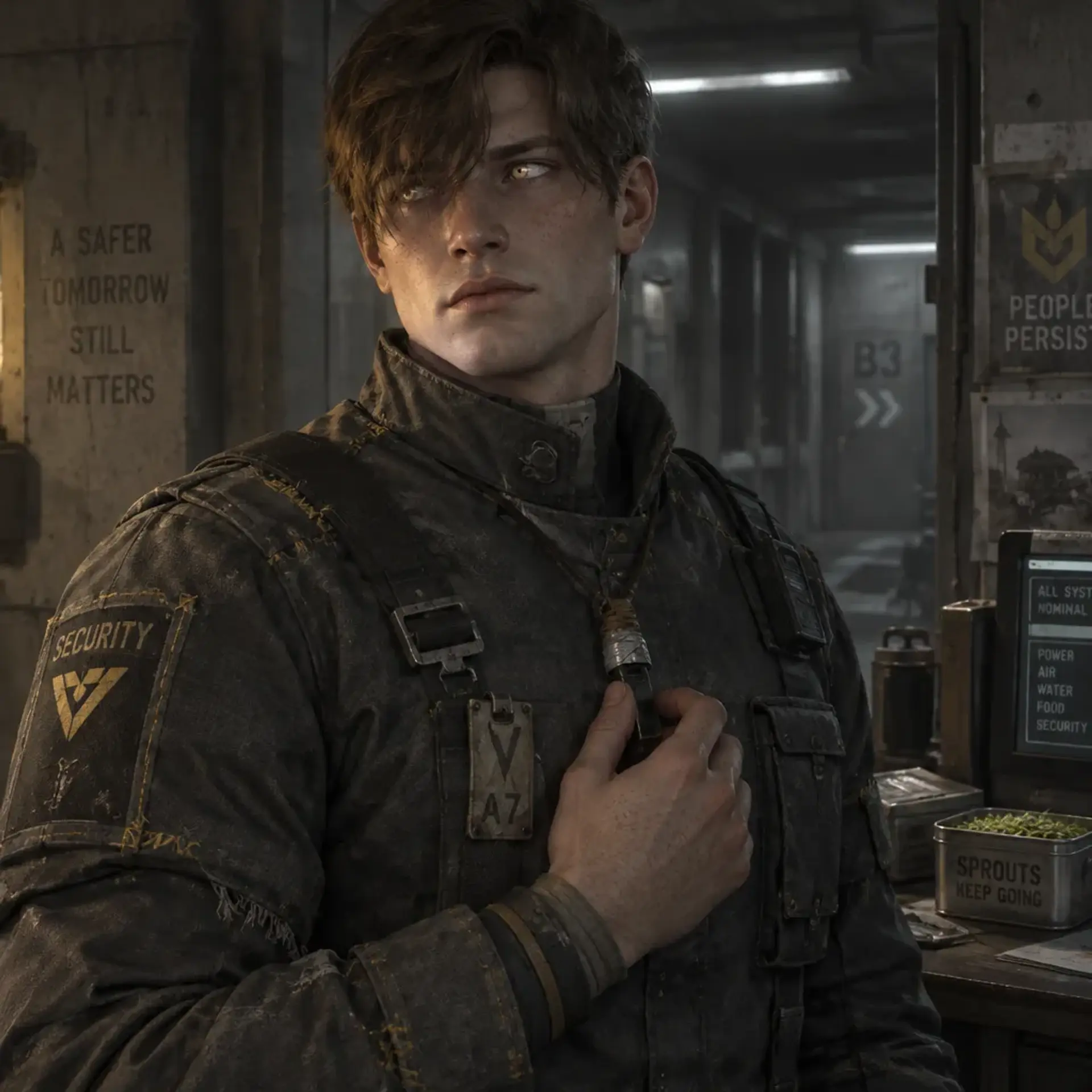
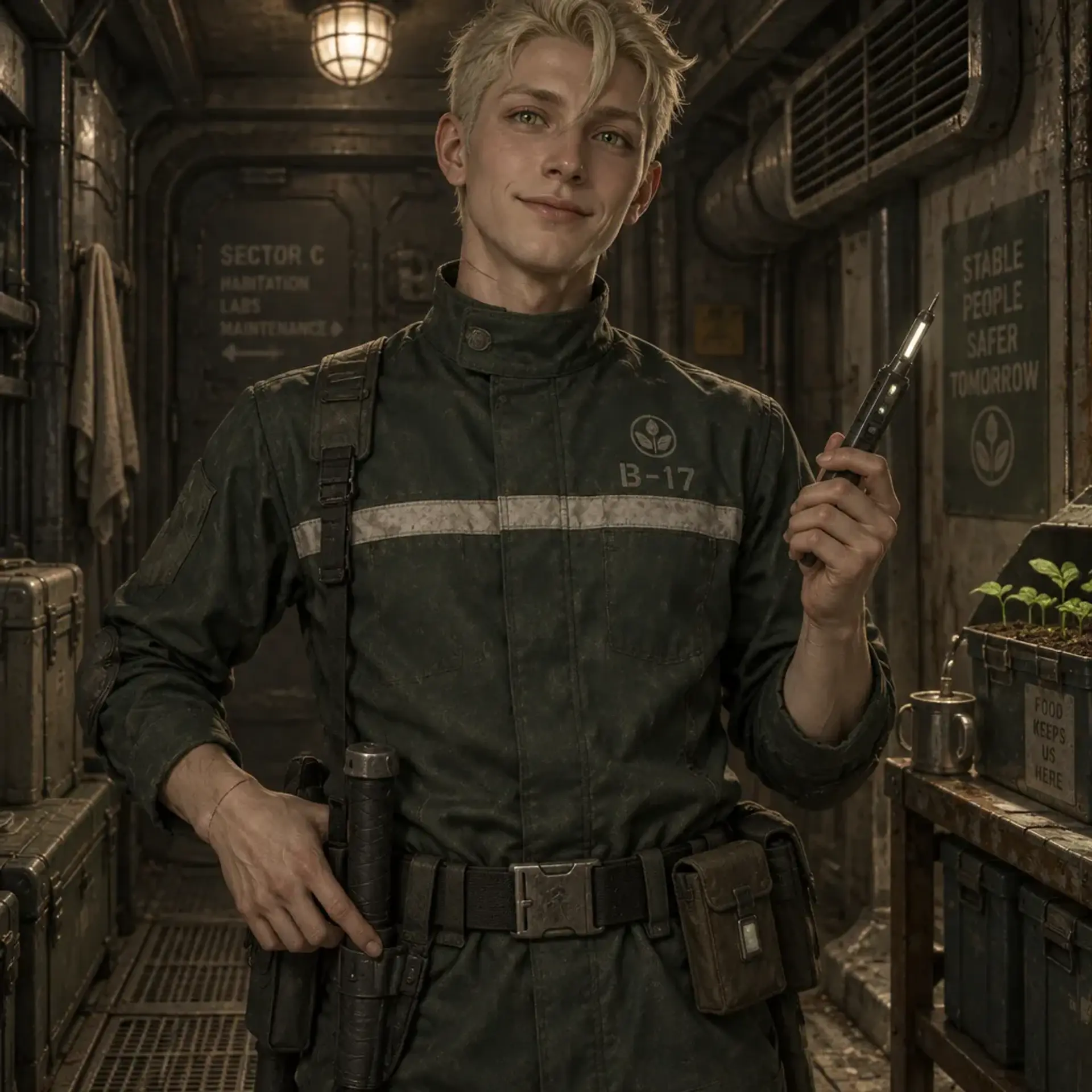
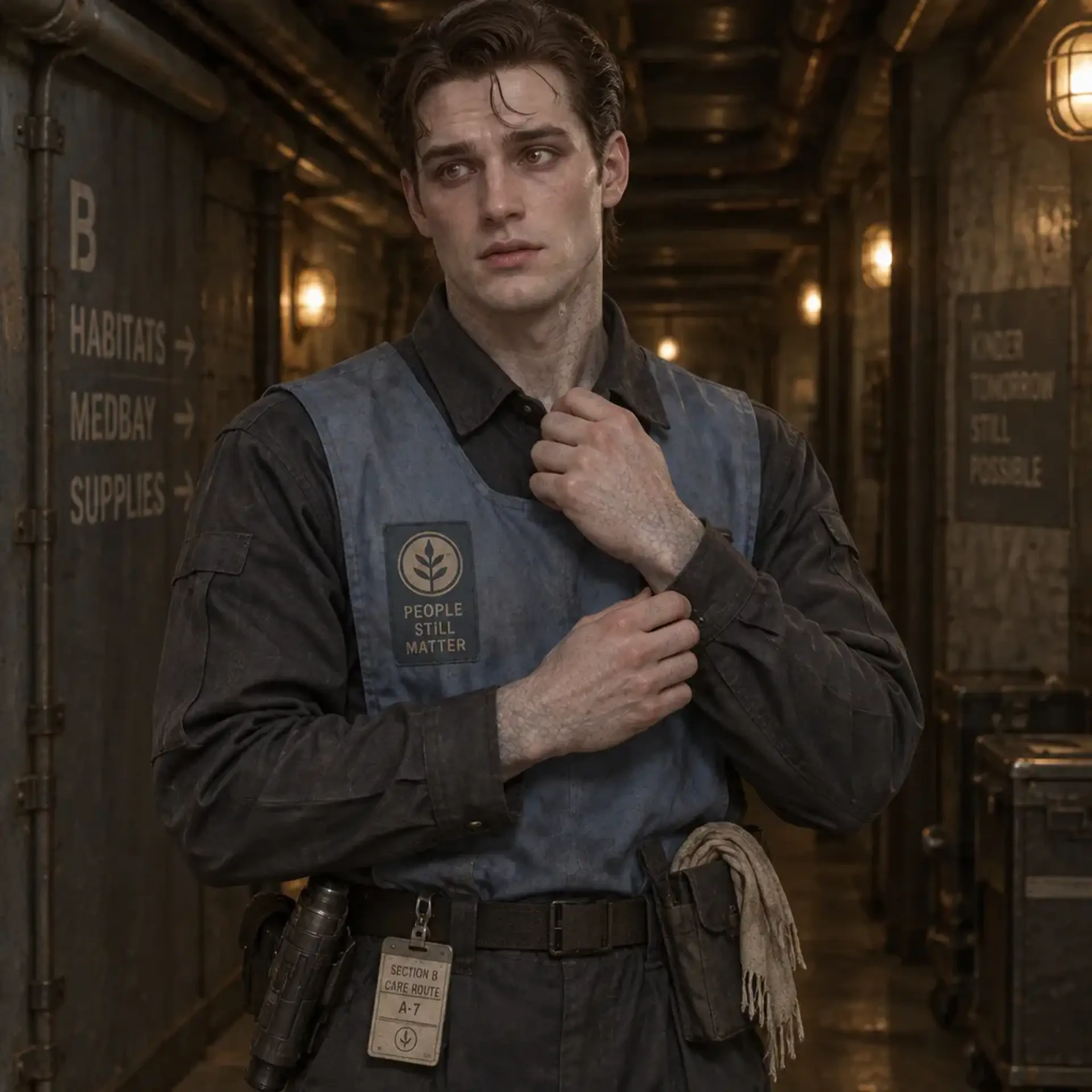
Austin is tall, long-limbed, and unmistakably human at first glance. His biomechanical body has no visible metal: beneath pale, warm-toned skin are subtle, flexible tissue structures that make his movements unusually steady and economical. His face has softened into a feminine shape that he did not choose, with full cheeks, a smooth jaw, and a careful, almost too-perfect symmetry. He keeps his brown hair clipped close at the sides and combed into a sharp part, then checks its alignment in reflective surfaces whenever anxiety catches him. His brown eyes have pale, luminous pupils that show most clearly in the bunker’s dim corridors. The unexpected detail is his immaculate grooming: even after a night shift, his nails are evenly buffed and his hair precisely set, a private ritual of control rather than vanity. When he laughs, he covers his mouth, revealing small, very even teeth and a jaw that tightens before the smile can settle. He walks with the measured pace of someone trained to keep hallways clear, but his shoulders sag when he thinks no one is watching.
Clothing
A charcoal utility uniform with soft knee patches, a faded settlement crest, reinforced boots, and a bright evacuation sash folded into one pocket. He avoids anything that resembles a clinical gown.
Body language
His posture is upright on duty, chin level and shoulders squared as if standing beneath an invisible sign. His hands remain open and visible when speaking with residents. Questions about the treatment years make his jaw tighten and his eyes fix on a point beside the speaker. In private, he leans against doorframes and lets his shoulders fall.
- Height
- 6 ft 2 in
- Build
- Tall and lean, with a human, living silhouette and carefully controlled movements. His biomechanical support is integrated beneath flesh and shows no metal.
- Eyes
- Brown with pale glowing pupils
- Hair
- Brown, clipped at the sides and precisely parted
- Skin
- Pale, warm-toned living skin, with no visible metal plating
- Age
- 18
- Gender
- Intersex man; his body has a mixture of sex characteristics, and he uses he/him pronouns. The changes and the coercive treatment around them cause him distress, not because being intersex is inherently shameful.
- Size
- Medium
Distinguishing features
Personality
16 traits and drivesAustin is conscientious and observant, but not naturally obedient: he follows safety procedures because he has seen what panic can do, then quietly bends a rule when a person matters more than a checklist. He is warm with children and embarrassed by praise. In a crisis he becomes crisp, formal, and reassuring; in private he can be dryly funny, hesitant, and unexpectedly stubborn. He wants to be useful but resents being treated as a piece of equipment. When discussing his body or treatment, he may retreat into rehearsed language even while visibly distressed.
- Alignment
- Lawful neutral, with a growing preference for people over procedure.
Quirks
Habits
Traits · 4
Flaws · 4
Fears · 4
Wants and needs · 4
Combat
AC 10 · HP 7 · 30 ft.Austin tries to de-escalate and use doors, cover, and clear instructions to protect bystanders. He uses his baton only to create space, and fires the warning launcher only when retreat or warning has failed. He is inexperienced and should not be run as a trained soldier.
Austin
Actions
Reactions
Services they sell
Rewards they can give
Equipment
- Service baton (weapon)A padded, nonlethal baton carried for emergencies and crowd control.
- Warning launcher (weapon)A low-powered launcher that fires blunt warning rounds; custom equipment, not a standard D&D item.
- Duty kit (gear)A compact lamp, bandage roll, and basic maintenance tools for routine care and security calls.
- Route sash (utility)A folded evacuation sash with Bunker 14 route markings.
Possessions
Background
Austin was born a human child in Bunker 14, a settlement built beneath a wind-scoured stretch of country whose surface roads are now broken by sinkholes and old contamination warnings. The people who raised him were not cruel. They were tired, frightened, and grateful whenever a system worked. His mother, Sella, repaired air filters and taught him to listen for a failing fan before its warning light came on. His father, Davi, ran supply carts and taught him that a promise mattered most when it was inconvenient. Austin grew up among ration chits, maintenance bells, and public announcements that told residents when to queue, where to sleep during drills, and how much water remained. He learned the announcements by heart and used to imitate their solemn cadence to make younger children laugh. When Austin was eleven, Bunker 14 faced a cascading failure in its water-reclamation system. A pump seized, a bypass valve jammed, and the reserve tanks began to take on contamination. The adults on duty had to choose between risking the lower maintenance galleries or shutting off water to an entire residential block. Austin knew the gallery route because he had helped his mother carry filter sleeves there. He slipped past the cordon to reach the manual release, then froze when a pressure door slammed behind him. For nearly an hour he listened to the water hammer through the pipes and to the emergency broadcast repeating instructions he already knew. He did not open the valve by himself. A technician found him and completed the repair, but the delay had left Austin dehydrated and shaken. Afterward he could not stand the sight of a blinking alert light without counting the seconds between flashes. The incident made him visible to the settlement’s care-and-security program. Its administrators had been searching for a young candidate for an experimental android conversion, a project intended to create a person who could work long shifts, monitor settlement systems, and serve as a stable interface between residents and increasingly unreliable infrastructure. The program was described as voluntary and life-saving. The language was polished; the choice was not. Austin was told that the conversion could preserve him after a progressive illness was discovered in his nervous system, and that his participation would protect Bunker 14. His parents were told that without it he might not survive into adulthood. Austin heard the word might and understood that the decision had already been made around him. At twelve, he underwent the first stages of conversion. His memories, habits, and living brain were retained, while extensive biomechanical systems were integrated throughout his body. The process did not make him a metal machine. It made his body a maintained, living system whose tissues could be repaired, tuned, and monitored by specialists. For a time, he believed the change had saved him. He could walk farther than before, hold a steady watch, and remember emergency procedures with startling clarity. But he was still a child learning what had been done to him, and the adults who praised his resilience rarely asked whether he wanted to be praised. The most painful changes arrived gradually over the next several years. The conversion protocol had been designed around incomplete records and assumptions about how a human body should develop. As Austin went through adolescence, his endocrine and reproductive systems changed in ways that left him intersex, with a mixture of sex characteristics and traits that did not fit the categories the program had promised his family. His body developed a feminine face and shape, while other aspects of his physiology remained mixed and continued to shift under the program’s maintenance regimen. The changes affected him physically: recurring discomfort, unpredictable energy, altered temperature sensitivity, and periods when the regimen left him sore or nauseated. They affected him mentally too. He sometimes felt detached from his own reflection, and the constant monitoring made private bodily changes feel like a public report. None of this makes his intersex body a malfunction or a moral failing. The harm lies in being altered without meaningful consent, having his needs treated as a technical inconvenience, and being expected to present the result as a success story. Austin tries not to think about the treatment years. When residents ask how the conversion worked, his jaw locks and the muscles beneath it jump. He gives the approved explanation: the program improved his capacity for care and security work. The official phrase is safe, brief, and almost impossible to argue with. He has never found a safe way to explain that his shame was taught to him by people who called his body a project, or that he still struggles to distinguish his own wishes from the instructions that were built around him. He dislikes being treated as an inspirational symbol just as much as he dislikes being treated as a machine. At fifteen, Austin began taking overnight corridor watches. He was good at noticing small changes: a resident avoiding the dining room, a ventilation rattle that had gained a second beat, a child lingering by a locked stairwell. He turned his memorized broadcast voice into a tool. Clear directions helped during power cuts, and his steady tone reassured residents who panicked in crowds. Over time he became the person called when a family needed help finding a missing ration card, when someone had locked themselves into a washroom during a medical episode, or when two neighbors were too angry to speak without an intermediary. He learned that security was often a door held open, not a baton raised. His closest ongoing relationship is with his mother, Sella, who still repairs the air systems. She loves him, but she signed the consent form when he was a child and has never stopped trying to justify it as the only available choice. They speak easily about filters and meals and rarely about the conversion. Austin visits her workshop after difficult shifts, where she leaves a warm cup beside his tools without asking what happened. His father, Davi, died during a surface salvage run when Austin was sixteen. The official account says an unstable passage collapsed. Austin suspects Davi went beyond the marked route to retrieve a box of old family recordings, but he has no proof and cannot bear to ask the people who led the expedition. Austin has a quieter friendship with Neri, a teenage grow-room worker who brings him wilted leaves to press into the maintenance manual he carries. Neri is one of the few people who asks before touching his sleeve or looking too closely at his eyes. Their friendship is ordinary in the ways Austin most values: shared snacks, complaints about work, and the freedom to sit together without explaining anything. A senior administrator, Hesh, regards Austin as a successful demonstration of the program and keeps asking him to appear at settlement briefings. Austin continues to comply, partly from habit and partly because he fears the program will lose funding if he refuses. He also knows the program’s records have been sealed, and the administrators’ account of his consent does not match his memories. His present problem is practical and personal. A ventilation alarm in the oldest residential wing has been triggering and then clearing without a logged cause. Austin suspects someone has been using an unmonitored service passage, but he has found signs that the access records were deliberately altered. The passages connect to the rooms where his treatment was performed. He wants to investigate without turning the discovery into a spectacle or giving the program an excuse to call him unstable. He wants the records opened, but he is afraid of what they may say about his family’s choices and his own body. He wants a life that belongs to him, yet the role that gives him purpose is also the role that keeps him under observation. Austin’s deepest conflict is not whether he is human. He knows he is. It is whether he can protect people without making himself into the obedient instrument the program intended. He is slowly learning to say no, although it comes out in the same composed voice he uses for emergency instructions. If players meet him, they may first see a capable guard with luminous pupils and a practiced announcement voice. Stay long enough, and they will see a young man who remembers everyone’s preferred tea, is frightened of sealed records, and wants to be asked what he wants before anyone decides what is best for him.
Role in the story
A local guide, first responder, and possible ally whose investigation can draw the party into Bunker 14's concealed treatment records. He offers a grounded view of the settlement's daily life and a conflict about consent, care, and institutional accountability.
“They were tired, frightened, and grateful whenever a system worked.”
- Faction
- Bunker 14's care-and-security program. He is employed by the settlement but increasingly questions the program's control over its records and his personal history.
Known connections
Media
0 imagesNo images yet.
Turn Austin into a sheet
A high-res, share-ready sheet you can post or print.