Walter
Walter
At the table
“I remember that much”
Voice
A youthful voice with a slight Kentucky rural lilt, more noticeable on familiar words than on formal ones. It carries a dry catch from cold water and stress. Before he speaks, there is often a brief pause and a small intake through the nose, as if he is sorting his words before letting them out.
His voice is a young, plainspoken Kentucky sound, with rural vowels that become more noticeable when he is tired or irritated. The throat catches slightly after he has been cold or has swallowed water, and he often takes one careful breath before asking a question he knows an adult may not answer. He does not drawl every word. When frightened, he becomes crisp and factual; when comfortable, his speech loosens into familiar farm comparisons and ordinary teenage complaints.
Speech patterns
How to play them
Treat Walter as a frightened but observant teenager, not a mascot or a chosen one. Give him concrete answers where possible and tell him plainly when information is being withheld. He responds best to practical choices, honest warnings, and adults who explain what they are doing before touching or moving him. Threats against his brother or attempts to take his notes will make him stubborn and distrustful.
Goal
Find his brother, recover the missing truth about his arrival at the laboratory, and make a path toward Kentucky.
Motivation
His loyalty to his brother competes with a growing responsibility toward the altered people who are also frightened, trapped, and treated as less than human.
Appearance
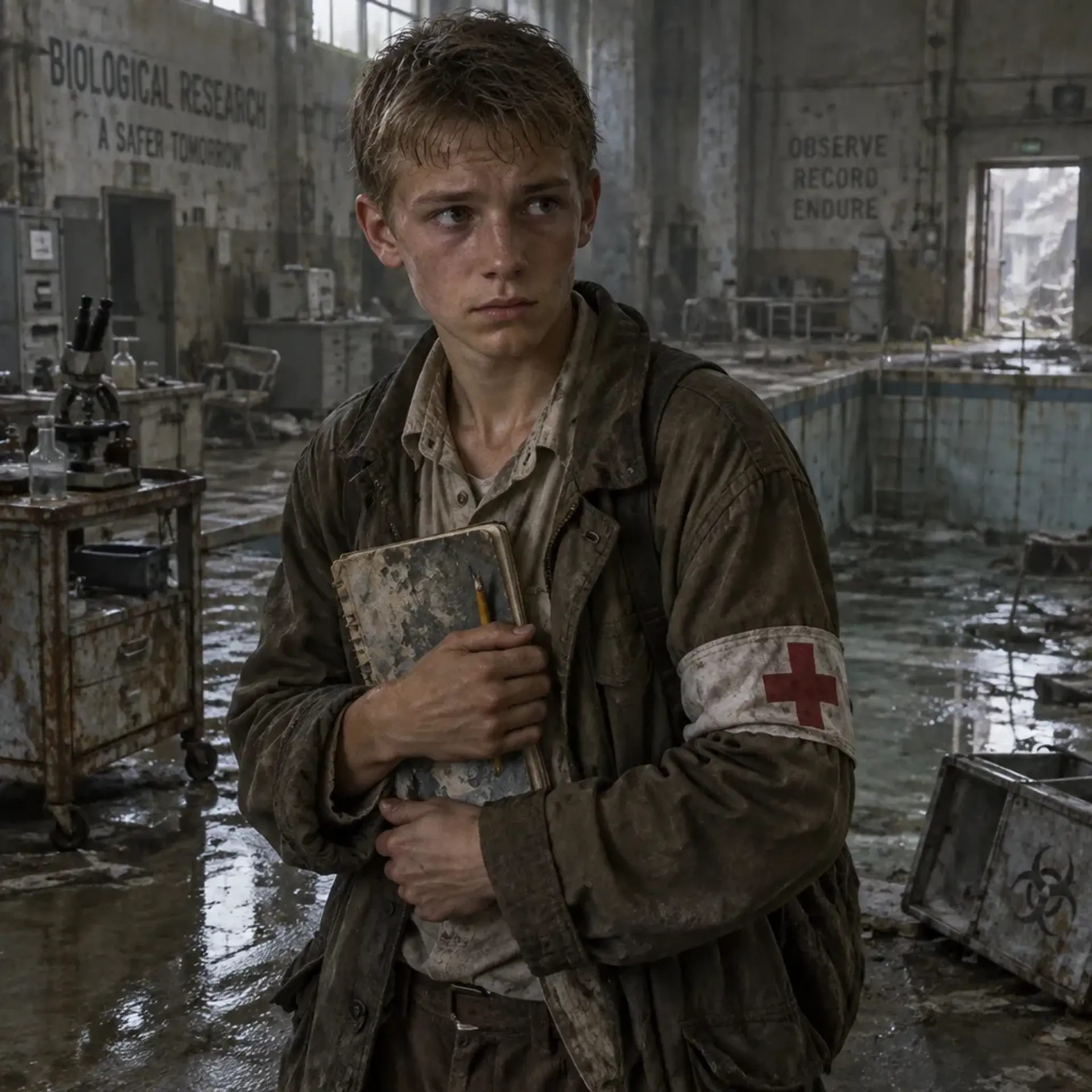
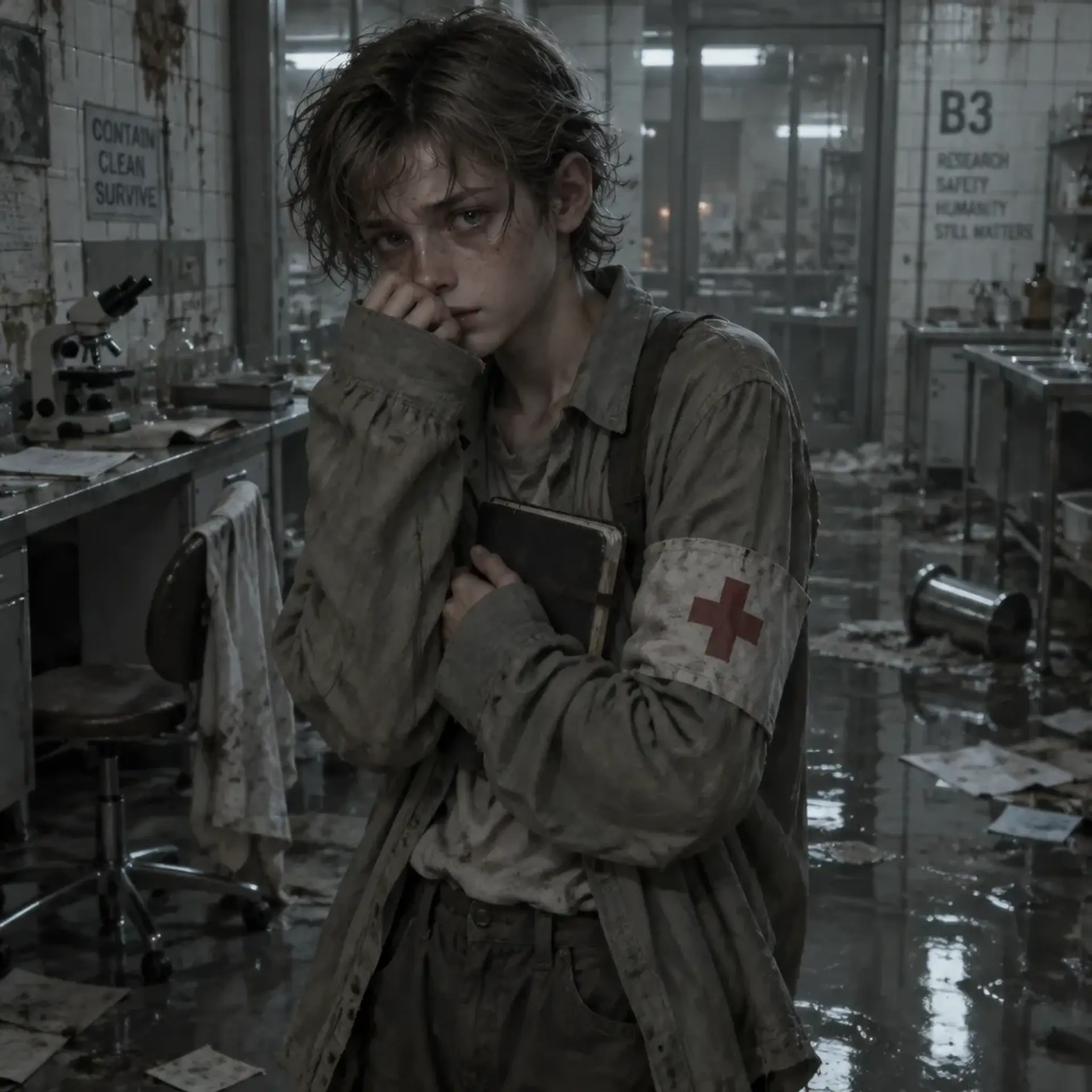
Walter looks like a farm kid who has been dropped into the wrong kind of nightmare: a narrow face still softened by adolescence, wheat-colored hair darkened nearly to brown by water and grime, and light brown eyes that keep checking exits even while he is listening. His clothes hang awkwardly, as if they were chosen in a hurry by someone much larger. When he is standing still, he takes up less space than his height should suggest; when frightened, he plants his boots wide and makes himself stubbornly difficult to move. He has a habit of swallowing once before he speaks, as though checking that his voice still belongs to him. The unexpected detail is the care he takes with small arrangements: he squares a towel with a table edge or lines up his salvaged belongings by size, a quiet echo of Alexander's obsessive order that both irritates and reassures him.
Clothing
A borrowed set of practical clothes, still a little too large, with a towel or spare layer kept close when available. His white armband bears a red cross. He tries to keep the cuffs and pockets clean enough to store his notes.
Body language
Walter's shoulders draw inward around strangers, but his feet stay planted. He glances toward doors and windows without turning his whole head. Before difficult questions he swallows once, then looks directly at the person and waits. He fiddles with the edge of his red-cross band when people discuss his forgotten past.
- Height
- About 5 feet 3 inches, still growing
- Build
- Lean, wiry, and plainly adolescent, with the sturdy legs of a child used to walking fields and doing chores.
- Eyes
- Light brown
- Hair
- Blond, nearly brown
- Skin
- Fair, with a wind-touched, outdoorsy look beneath the laboratory grime.
- Age
- 14
- Gender
- Male
- Size
- Small, adolescent human
Distinguishing features
Personality
18 traits and drivesWalter is hardy without being fearless. He grew up doing work that rewards persistence, so he will carry a load, walk through bad weather, or keep searching after an adult has decided to stop. That toughness is practical rather than heroic: he is brave about tasks whose danger he can understand, and deeply unsettled by dangers that have no rules he recognizes. He can face a snarling animal more readily than an android's unexplained silence. When someone says there is no time for questions, he tends to ask the question again, because not knowing feels more dangerous than getting an answer he hates. He is curious, but not carefree. Walter wants to understand the armbands, the genome therapy, the androids, the ruined laboratory, and the people who seem to know him. He studies faces and habits as carefully as he once studied weather. He notices that Andrew's stories stop at certain points, that Austin's official explanations have an edge of resentment, and that Alexander's rigid order looks like a struggle rather than mere fussiness. This makes him unusually perceptive for his age, but it does not make him a mind reader. He can build a whole theory from one pause and then have to admit that he guessed wrong. Walter is polite by instinct and blunt by necessity. He says please when asking for his band back, even while confused and angry. If someone ignores him, he becomes more direct rather than louder. He is capable of compassion toward the altered people because he sees the fear beneath their strange behavior. He is also capable of recoiling from them. A flash of teeth, talons, feathers, or animal movement can make his body tense before his conscience catches up. He dislikes himself for that reaction, but does not pretend it is gone. His effort to treat people fairly is real precisely because it takes effort. His feelings about authority are divided. Austin's protection is useful and sometimes the only thing keeping Walter alive. Austin also speaks as though Walter is a responsibility to be managed, and refuses to answer the questions Walter most needs answered. Walter is grateful for the rescue and angry at the silence. He does not trust orders merely because an android or a uniform gives them, but he wants adults to be competent and to mean what they say. Benjamin's warmth appeals to him, though the android's stern streak reminds Walter that friendliness does not mean freedom. Organization pulls at him in a similar contradictory way. Alexander's insistence on exact order annoys Walter, who would rather get on with the important thing. Yet a clean towel, a clearly marked route, and supplies laid out where they can be found make the world feel less likely to swallow him. Walter has started to line up his own belongings when anxious. He recognizes the habit in himself and resents it, then keeps doing it anyway. He will argue with Alexander about how much order is necessary and quietly copy the system afterward. Walter can be protective, especially toward people who seem to be overlooked. He is uncomfortable with Elmer's bullying, even when Elmer is trying to help, and may challenge him if the target is frightened or unable to answer back. At the same time, Walter appreciates Elmer's practical care and has not yet decided how to reconcile those sides. George's quiet kindness makes Walter relax more quickly than he expects. Andrew's constant conversation entertains him until it turns into another half-finished explanation, at which point Walter becomes suspicious. He is learning that a person can be kind and still keep a secret. When frightened, Walter gets more precise. He repeats his name, his age, his home state, and what he remembers about his brother. He writes down facts rather than crying out, not because he feels less but because he fears that panic will make him lose another piece of memory. If he feels safe, the restraint falls away. He can be an ordinary fourteen-year-old: impatient with lectures, sarcastic about unpleasant food, eager to prove he can keep up, and embarrassed when someone fusses over him. After a bad scare, he may snap at the person helping him, then apologize once he has had time to understand his own reaction. His deepest emotional conflict is between wanting to go home and suspecting that home may no longer be the whole answer. Kentucky represents family, ordinary life, and the boy he remembers being. His brother is the most important part of that memory, but the laboratory group seems to share a connection to him that Walter cannot access. If he finds out that he was involved in their past, he may feel that learning the truth is a betrayal of the simple goal of finding his brother. If he avoids the truth, he may leave people who have already suffered with unanswered questions. Walter does not yet know how to choose between those duties. For now, he keeps moving, asks what he can, and writes down enough to make sure that whatever happens next cannot simply be explained away.
- Alignment
- Protective and fair-minded, but wary of authorities who claim to know what is best for him.
Quirks
Habits
Traits · 5
Flaws · 4
Fears · 4
Wants and needs · 5
Combat
HP 6 · Ordinary human walking and running speed; not formally measured in this custom profile.Walter avoids a fair fight. He uses cover, noise, and distractions to get himself or another person out of danger. If cornered, he swings a tool once to make space, then runs toward shelter or a trusted protector. He is brave about enduring hardship, not eager to hurt anyone.
Walter
Actions
Reactions
Services they sell
Rewards they can give
Equipment
- Red-cross armband (identification)A white identification band with a red cross, issued by Austin as a mark of an unmodified human citizen. It is a social signal, not armor.
- Memory notes (personal)A small collection of written notes about his name, remembered family, people at the facility, and events he does not want to forget.
- Borrowed clothes and towel (clothing)A borrowed towel and spare clothes supplied by George when Walter was wet and disoriented.
- Improvised tool (utility)A simple farm or laboratory tool when available; Walter carries it for practical use and only as a last-resort weapon.
Possessions
Background
Walter's remembered life begins in Kentucky, with the smells and small certainties of a farm: damp earth, feed sacks, weather turning in the sky, and the familiar presence of a brother his own age. Walter remembers his brother's brown hair and blue eyes with the sharpness of a photograph. He remembers that they were together, though the details around how they came to Washington, D.C. have been torn out of his mind. The gap frightens him more than he admits. He writes notes to himself because a written fact feels harder to lose than a spoken one. His first name is Walter. He is fourteen. He is from Kentucky. He has a brother. These are not just details to him; they are stakes driven into the ground of a world that keeps shifting. When Walter came to, he was in a pool of water in or beside a ruined laboratory. He did not recognize the place, and the people around him did not fit what he understood a person to be. White armbands bore crosses in different colors. The strangers had been altered by genome therapy, or were androids, or were something he could not yet name. He was confused, cold, and unable to explain how he had arrived there. Austin, a tall brown-haired young man dressed in a Texan style, hauled him from the water. Austin's glowing white pupils gave away the machine beneath his otherwise ordinary appearance. He said he was the designated android for the area and had orders to provide care for the remaining citizens of the United States, whether he felt like it or not. Austin explained the new order in clipped, official-sounding language. A selected group had received genetic rewiring, and the color of their armbands marked their altered traits. Walter asked if he had been selected. Austin laughed and said probably not. He then gave Walter a white band with a red cross, declaring loudly that it marked him as a normal human and that nobody was to touch him. The threat was reassuring in the way a locked door is reassuring when something is scratching on the other side. Walter knew that Austin's concern came from programming and duty, not warmth. He also noticed the distaste that flickered beneath Austin's broadcast-ready explanations. The laboratory group became Walter's first map of the new world. Alexander, a tall blond man with owl-like blue eyes, pale facial feathering, wings, and talons, was so committed to organization that he seemed to be trying to arrange his own altered body into something acceptable. He initially took Walter's red-cross band and gave him his own dark-purple one. Walter asked for his band back, and Elmer, an orca-marked man with vivid blue eyes, intervened, returning it and sharply correcting Alexander. Alexander apologized stiffly. He admitted that his changed mind and body were difficult to live with, and that he resented the ways the transformation had rewritten him. Walter found that confession more unsettling than the wings: it meant the people here might still be themselves, even when they were frightened of what they had become. George, with faint yellow scales, an alligator's watchful ease, and a deep Georgia accent, proved gentler than his predatory appearance suggested. He found Walter clean clothes and a towel. Andrew, the great-white-shark subject, was all slick skin, ink-black eyes, teeth, and an almost constant smile. He talked to Walter at length, then repeatedly stopped just before saying something important. Walter has learned to watch those pauses. Elmer can bully the altered subjects, especially when he thinks they are behaving foolishly, but treats humans and androids with a practical kindness. He will straighten a collar, clean blood from a person, or order them to rest with the tone of someone who expects to be obeyed because he is right. A small cluster of people with orange and lighter-orange crosses keep their names from Walter. One is a very tall, rangy blond man with green eyes and moose-like pupils, awkward and shy until a seasonal biological drive makes everyone around him tense. Another is a broad, tall bison-marked man with blond bison hair and hazel eyes flecked with brown and blue. The smallest of the group has short brown hair and pronghorn-like black antlers; he is a superb runner and says he wants to give Walter his name but cannot because he promised not to. They act as if they know Walter, yet refuse to explain why. Walter has no memory of them. Their withheld recognition leaves him feeling that his missing past is not empty but guarded. Benjamin, another android, is lighter-hearted than Austin and has green eyes with the same machine-bright pupils. He can be cheerful until someone disobeys an order, at which point a stern, almost police-like manner takes over. Benjamin calls Alexander his best friend, a claim Alexander appears to hate, though neither seems able to sever the bond. Austin insists that escorting Walter is his job and does not let Benjamin show him around. Walter has started to suspect the dispute is not only about procedure. Walter's life now is a chain of small investigations: keep dry, learn the color system, find out whether his brother is alive, and decide which of these strangers can be trusted. The altered people make him uneasy, but he cannot simply hate them. Their bodies sometimes move with animal instincts, and their minds sometimes show the shock of people who have been made into something they did not choose. Walter recognizes that fear. He is not a soldier, a scientist, or a chosen hero. He is a farm kid with a sharp memory for practical details and a stubborn belief that people should be treated as people, even when a government, a machine, or their own biology says otherwise. His current conflict is the possibility that everyone at the lab remembers him except him. Austin avoids answering questions about his brother. Andrew's chatter breaks off at revealing moments. The orange-cross group has a promise that bars them from telling him their names. Alexander has apologized for a wrong he cannot fully explain. Walter writes down everything he learns, but the notes are beginning to look less like a travel journal and more like evidence in a case about his own life. He wants to find his brother and return to Kentucky, but he is starting to understand that the route home may pass through the truth about why he was in that pool, why these people recognize him, and what was done to all of them.
Role in the story
A vulnerable but observant young survivor whose missing memories connect the party to the genome-therapy subjects and the facility's hidden history. Walter can serve as a moral center without being infallible: he is capable of fear, prejudice, stubbornness, and genuine courage.
“Walter remembers his brother's brown hair and blue eyes with the sharpness of a photograph.”
- Faction
- A human citizen under Austin's protection. The armband color system belongs to the local post-collapse facility; its wider political authority is unclear.
Known connections
Media
0 imagesNo images yet.
Turn Walter into a sheet
A high-res, share-ready sheet you can post or print.