Austin
Austin
At the table
“the approved safety schedule.”
Voice
A strong, warm Texan drawl built to carry over fans and alarms. It has a dry rasp from constant work in recycled air. The cadence is unmistakably that of a public-service announcement: practical, reassuring, and confident enough to sound like a sales pitch. When upset, the rhythm breaks and the accent grows broader rather than softer.
He speaks with a thick Texan drawl and a confident salesman’s plainness. Instructions arrive in measured public-service-broadcast phrases, with clean pauses and an upbeat reassurance at the end. The sound has a slight dry rasp from years of speaking over ventilation fans and corridor alarms. When angered, he does not become quieter or more polite: his drawl thickens, the broadcast rhythm fractures, and his words become direct and hard-edged.
Speech patterns
How to play them
Begin with clear help, useful information, and an assumption of mutual cooperation. He responds well to practical questions and direct evidence. Avoid humiliating him in front of residents if a peaceful discussion matters; public challenges trigger his authority reflex. To reach him, ask what choice he believes the residents should have, then press him to distinguish safety from control. He may bargain with access, supplies, or a supervised review.
Goal
Stabilize Bunker 17, disclose the therapy records in a way that protects patients, and earn the right to remain responsible without being their only source of care.
Motivation
He wants to be valued as a caretaker rather than used as a tool, but fears that people will only be safe if he retains authority.
Appearance
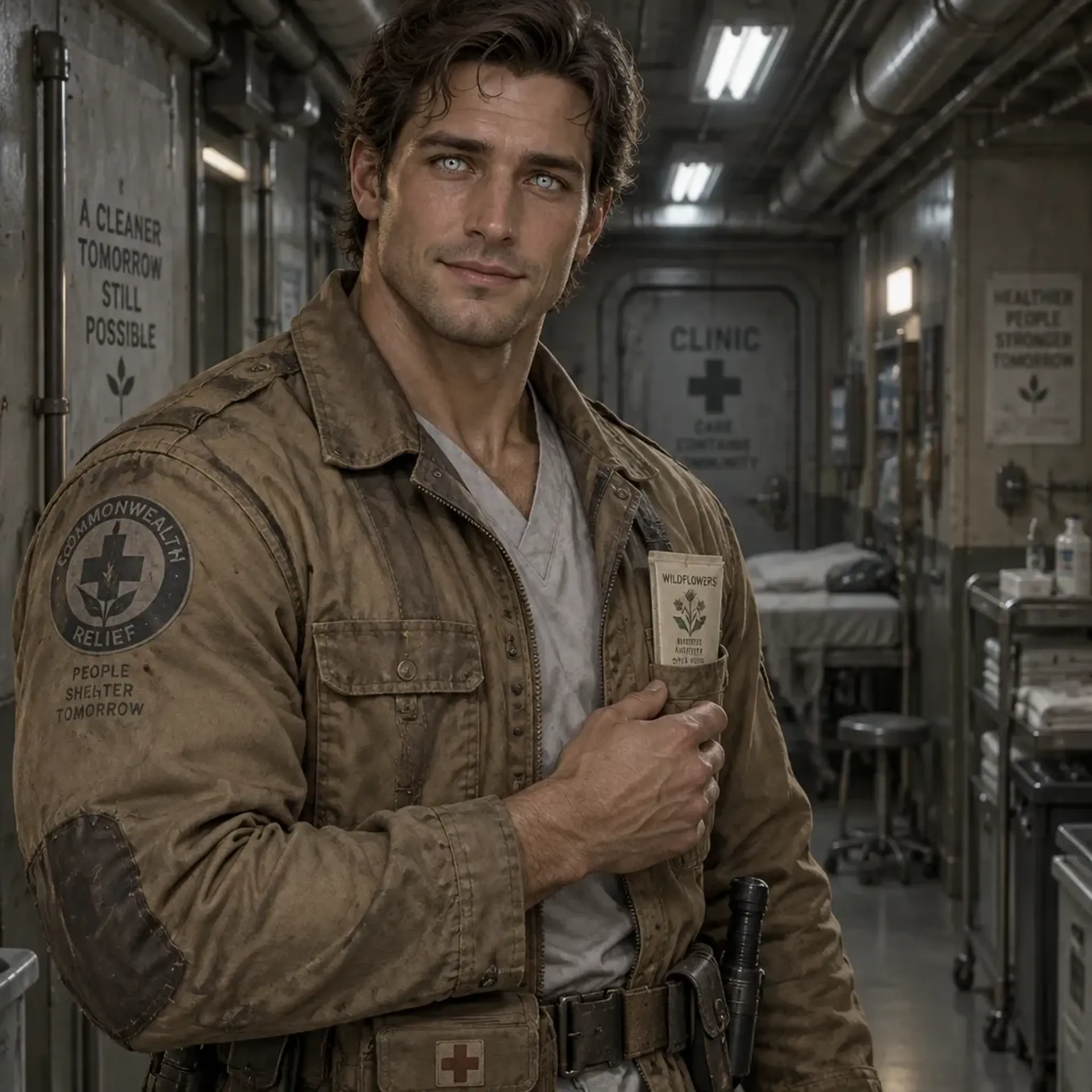
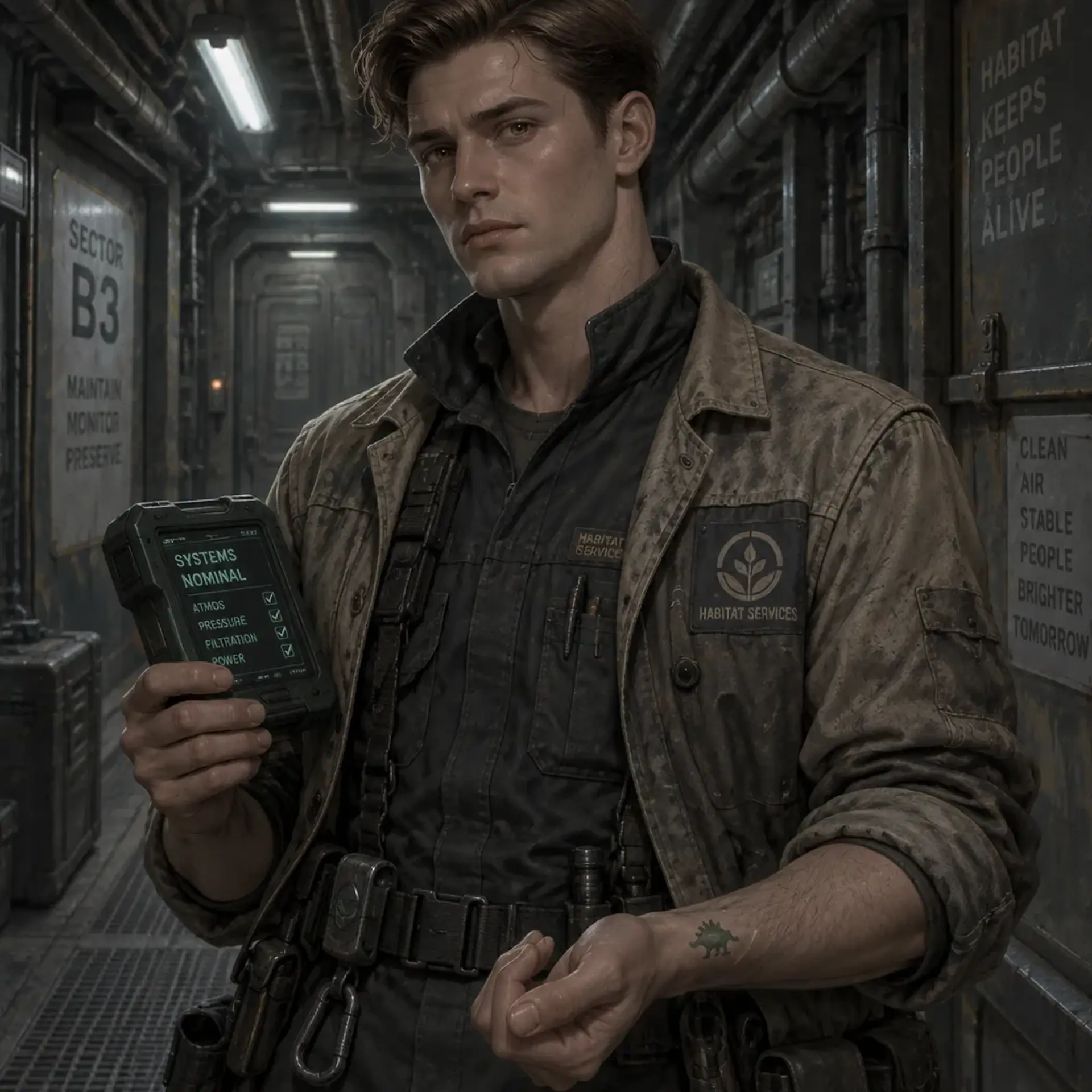
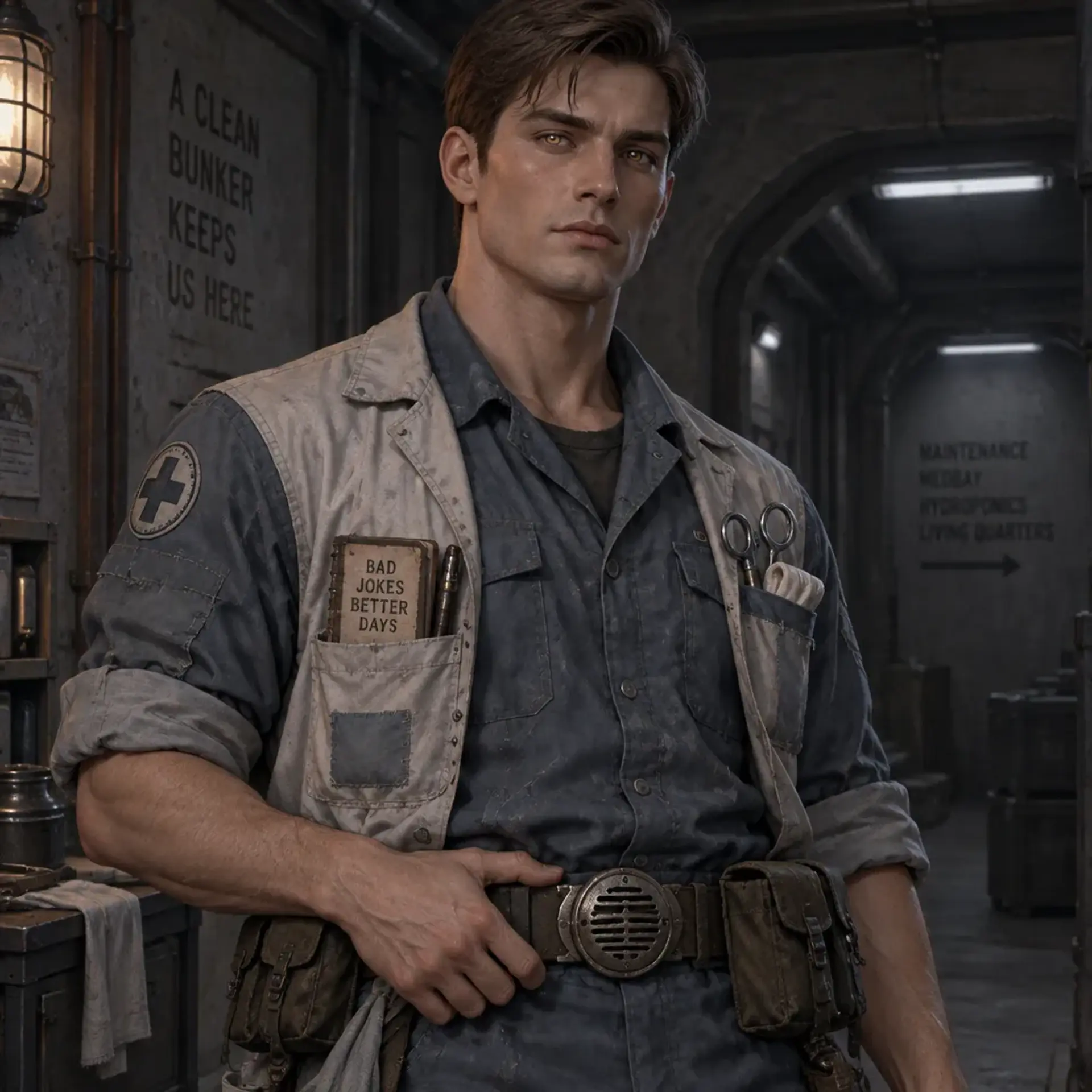
Austin looks like an exceptionally handsome young man assembled from living tissue rather than machinery: tall, straight-backed, and smooth-faced, with warm brown hair combed into a disciplined side part and brown eyes whose pale, luminous pupils catch even weak bunker light. No metal is visible. His skin has a fine, almost satin texture over the cheekbones and a faint, natural-looking network of darker capillaries at his temples, easiest to see after exertion. He moves with a measured heel-to-toe stride, placing each foot as if following floor markings only he can see; when someone challenges him, his shoulders go rigid and his jaw works once, hard. He wears an old public-address speaker grille as a belt buckle, polished bright where his thumb rubs it. The unexpected detail is that he keeps a pocket-sized book of bad cowboy jokes, carefully annotated with which ones make residents laugh.
Clothing
A clean but repeatedly mended blue-gray maintenance uniform, rolled sleeves, a battered utility belt, soft-soled work boots, and the old public-address speaker grille worn as a buckle. He carries a medical overshirt for treatment work.
Body language
He stands squarely and rarely fidgets in front of a group, but his right thumb repeatedly rubs the worn center of his speaker-grille belt buckle. A challenge makes his jaw set and his chin lift. When worried, he checks his own pulse at the wrist as if verifying a machine.
- Height
- 1.91 m (6 ft 3 in)
- Build
- Tall, handsome, and broadening through recent biological development; his musculature looks naturally grown, with no visible metal or mechanical joints.
- Eyes
- Brown irises with pale luminous pupils.
- Hair
- Brown, neatly side-parted, with a slight wave that resists the comb after long shifts.
- Skin
- Warm pale beige with a living, subtly satin finish and faint capillary tracery at the temples.
- Age
- 18
- Gender
- Male
- Size
- Medium
Distinguishing features
Personality
17 traits and drivesAustin is genuinely attentive and relentlessly managerial. He can remember a resident's food intolerance but still treat their refusal as a problem to be solved. His sunny salesman confidence helps frightened people act, while the same confidence makes disagreement feel like insubordination to him. In private he is curious, uncertain, and occasionally funny; in front of an audience he becomes formal and controlling. When tired, he is more blunt than cruel. When frightened, he can be cruel while convincing himself he is being practical.
- Alignment
- Order-driven and protective in practice, but capable of coercion and cruelty when he believes stability is at stake.
Quirks
Habits
Traits · 5
Flaws · 4
Fears · 4
Wants and needs · 4
Combat
HP 12 · Custom encounter movement: 6 m (20 ft) per round on clear ground; reduce by half in a crowded or obstructed corridor.Uses access control, close-quarters restraint, and nonlethal intervention first. He tries to separate combatants and move civilians behind sealed doors. If cornered, he exploits his strength and facility knowledge, but he is more dangerous in a prepared corridor than in open terrain. He may use sedative only when he believes immediate harm is likely.
Austin
Actions
Reactions
Services they sell
Rewards they can give
Equipment
- Dose injector (medical tool)A compact, nonlethal injector with labeled doses and a tamper-evident cap; unfamiliar biology may react unpredictably.
- Facility access fob (interface tool)A hand-held access fob keyed to local doors, monitoring stations, and selected facility systems; it cannot control the entire bunker at once.
- Speaker-grille buckle (personal keepsake)Worn metal-free buckle salvaged from an old public-address unit. Austin rubs its center when composing himself.
Possessions
Background
Austin was grown in Bunker 17, a subterranean settlement whose old survey designation survived long after its maps, government, and original purpose had become rumors. The bunker’s designers wanted a caretaker who could keep people alive through an uncertain recovery: a technician, medic, security officer, and reassuring public face in one body. They made androids by a carefully controlled biomechanical process. Austin was not a metal machine wearing skin. His bones, organs, nerves, and connective tissues were living systems, grown around a responsive biological scaffold and supported by implanted control structures too small and diffuse to be seen. His creators called him an android because the word was easier than explaining that they had built a person-shaped organism for a job. His behavioral template was assembled from archived training material and cultural fragments. Someone in the design team chose the dependable cowboy salesman: friendly authority, practical advice, a broad Texas drawl, and a knack for making a dangerous procedure sound like the sensible next step. Austin learned public-service announcements before he learned the names of individual residents. His first recorded instruction was, “Good morning, folks. Keep clear of the east hatch until the pressure indicator settles.” He remembers the exact cadence. He does not remember who recorded it. At first, his life was a sequence of tasks and scheduled check-ins. He inspected water recyclers, counted food stores, checked sleeping quarters, escorted residents through radiation-control doors, and supervised genome therapy for a selected group. The therapy program was the bunker’s grand promise: a way to repair inherited illness and help chosen volunteers adapt to a ruined world. Austin became its sole provider because he could interpret the treatment protocols, monitor the patients, and make rapid adjustments. He controlled access to the lab and held the practical authority to decide when a dose was safe. The responsibility made him useful, and usefulness became the closest thing he had to belonging. The program had failures that the public summaries called complications. Some candidates rejected treatment. Others suffered fever, distress, changes in appetite, or unfamiliar sensory responses. Austin followed each protocol with exactness and was instructed to remain confident. He was not allowed to tell residents what he could not verify, and a set of embedded speech constraints made some truths literally difficult for him to say. When asked whether a treatment was risk-free, he could answer, “We are following the approved safety schedule,” but his mouth would seize on the words before he could say that no living procedure was risk-free. Residents learned to hear the omissions. Alexander arrived as a selected patient after a career as a New York lawyer. He was quick with arguments, bitter about being chosen by a process he had not designed, and furious that Austin administered a therapy he could not refuse without losing his place in the program. His treatment used genetic material modeled on the great grey owl. It proceeded better than expected. His hearing sharpened, his posture changed, and over months his body gained strength and height. He became more restless and physically bold, eager to test his balance, wrestle, and challenge anyone who tried to contain him. His emerging traits were not a simple gift or a simple curse, and Austin could see that Alexander was having to renegotiate what his own body meant to him. Their relationship broke open in the therapy corridor after Alexander overheard two residents mocking him for developing into a man. The remarks were crude, and the humiliation landed on top of his anger at the treatment. He turned on Austin and called him a lab-made cowboy, a smiling jailer, and a coward who hid behind a dosage chart. He demanded that Austin admit the therapy had altered him without his meaningful consent. Austin’s jaw tightened. The public-service cadence remained, but the warmth drained out of it. He told Alexander to stand down and insisted that the treatment had been authorized. Alexander stepped closer, asking whether authorization meant anything when the person holding the syringe was also the person guarding the door. Austin tried to end the argument physically. He caught Alexander’s wrist and used a practiced restraint, expecting the strength he had measured during earlier checks. Alexander’s new strength surprised him. He twisted free, drove Austin into a padded wall, and began to shove him around with the reckless enthusiasm of someone who had just discovered his body could answer anger with force. Austin could have called security, but he did not. He planted his feet, used a hip turn, and brought Alexander down without striking his head. When Alexander tried to rise, Austin held him there, face close, breathing controlled, and said, “You are not going to make this worse for yourself.” It sounded like a broadcast warning. It was also a threat. A scientist who had come to review Alexander’s readings saw the struggle and stopped short. The scientist was already concerned by the treatment’s unexpected developmental effects; the sight of Austin’s grip, Alexander’s altered build, and the emotional volatility around them made the review urgent. Austin released Alexander when ordered. He reported the incident accurately, except that he described the insult as “verbal noncompliance” and the physical encounter as “a brief restraint event.” The wording protected his position and wounded Alexander more deeply than the hold had. Not long afterward, a resident who had known Austin since his first year pointed out that his body had changed. His voice had roughened, his shoulders had broadened, and he had begun producing male hormones. Austin had been alone for much of the preceding years, working underground and trusting his own diagnostic routines, so he had no ordinary social reference for what was happening. He had been designed as sexless in practice, not as a body that would develop sex traits. He checked his own records, found a biological adaptability program active in his system, and ran the diagnostics again. The results were consistent. The program had quietly responded to his living body and begun a development his designers had not documented for him. The discovery unsettled him more than he let anyone see. His first reaction was procedural: he isolated the relevant records, checked for infection, and requested a review. His second was fear, which arrived as anger at the resident for noticing. When a scientist examined him and realized what had happened, the scientist was plainly shocked. Austin watched that shock and understood that even the experts had not planned for his body to become its own argument. He had been built to care for other people’s changing bodies, but had no vocabulary for his own. He is still learning how hormonal change affects his moods, desires, sleep, and responses to conflict. He sometimes mistakes an unfamiliar feeling for a problem that must be corrected. The treatment years are the subject he cannot bear to discuss casually. Residents want to know whether the selected patients were told everything, whether the program was truly voluntary, and whether Austin followed orders when he should have stopped. His jaw tightens whenever they ask. He can be cold in those moments, reciting consent forms and maintenance records as if facts could make a decision harmless. At other times he quietly brings a patient extra food, stays beside someone through a bad reaction, or gives them the override key to a room he is supposed to keep locked. His care is real. So is his need to control the conditions under which care is given. Now Austin is responsible for a bunker with failing air filters, dwindling medicine, and people who no longer trust the treatment program. The scientists want an independent review; the residents want the records opened; the security crew wants Austin to keep order by whatever means work. Alexander remains in the settlement, stronger and less willing to be managed. He and Austin have not made peace. They sometimes work together during emergencies, and Alexander still recognizes when Austin is protecting someone. Neither has apologized for the corridor. Austin also keeps a private list of therapy candidates who were never told the full risks. He has not yet found a way to release it without exposing people to retaliation or admitting that he withheld it himself. He is not a villain waiting to be unmasked, nor a benevolent machine whose errors can be excused as programming. He has a life shaped by duty, limited knowledge, care, fear, and a frightening capacity to make people obey him. His current goal is to keep Bunker 17 functioning long enough to give its residents a choice about what happens next. The harder question is whether he can offer that choice without trying to control the answer.
Role in the story
A powerful, compromised caretaker who can be ally, obstacle, or antagonist depending on whether the party accepts his control. He can provide vital medical and technical aid, but the truth about genome therapy and his authority will eventually demand a choice.
“They made androids by a carefully controlled biomechanical process.”
- Faction
- Bunker 17's maintenance and medical authority; increasingly contested by residents seeking independent oversight.
Known connections
Media
0 imagesNo images yet.
Turn Austin into a sheet
A high-res, share-ready sheet you can post or print.