Austin
Austin
At the table
Voice
A thick Texas drawl carried by a slightly dry, work-worn rasp. His consonants stay sharply articulated over machinery noise, and his instructions arrive with the steady cadence of a public-service broadcast. The accent is part of his pre-programmed cowboy persona, but the concern beneath it is real.
A thick Texas drawl with rounded vowels and a workman’s rasp, shaped by long hours speaking over fans and pumps. His sentences have the measured cadence of a public-service broadcast: clear, ordered, and confident, with a salesman’s assurance when he is asking people to cooperate. When angry, he gets more direct and forceful rather than quieter.
Speech patterns
How to play them
Give Austin a concrete problem and he will immediately propose a practical plan. Earn his trust by helping residents, respecting his medical privacy, and questioning a procedure with evidence rather than contempt. If pressed about the treatment years, acknowledge that he was left alone with a frightening change before asking for details.
Goal
Lead a carefully planned expedition to find functioning air filters and records explaining his adaptive physiology, while bringing the bunker closer to self-sufficiency.
Motivation
Prove that care and self-determination can coexist with duty, and discover what his changing body means on his own terms.
Appearance
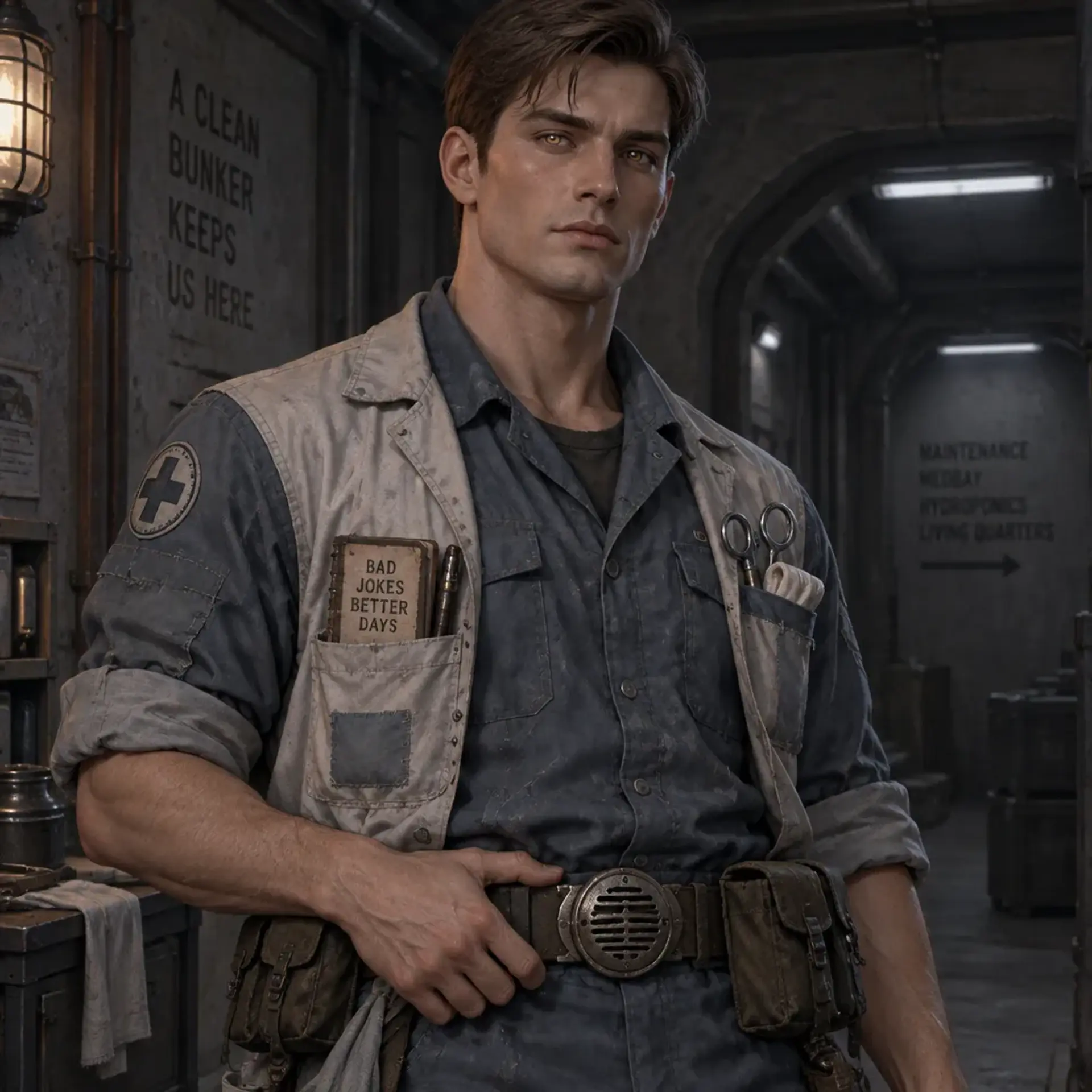
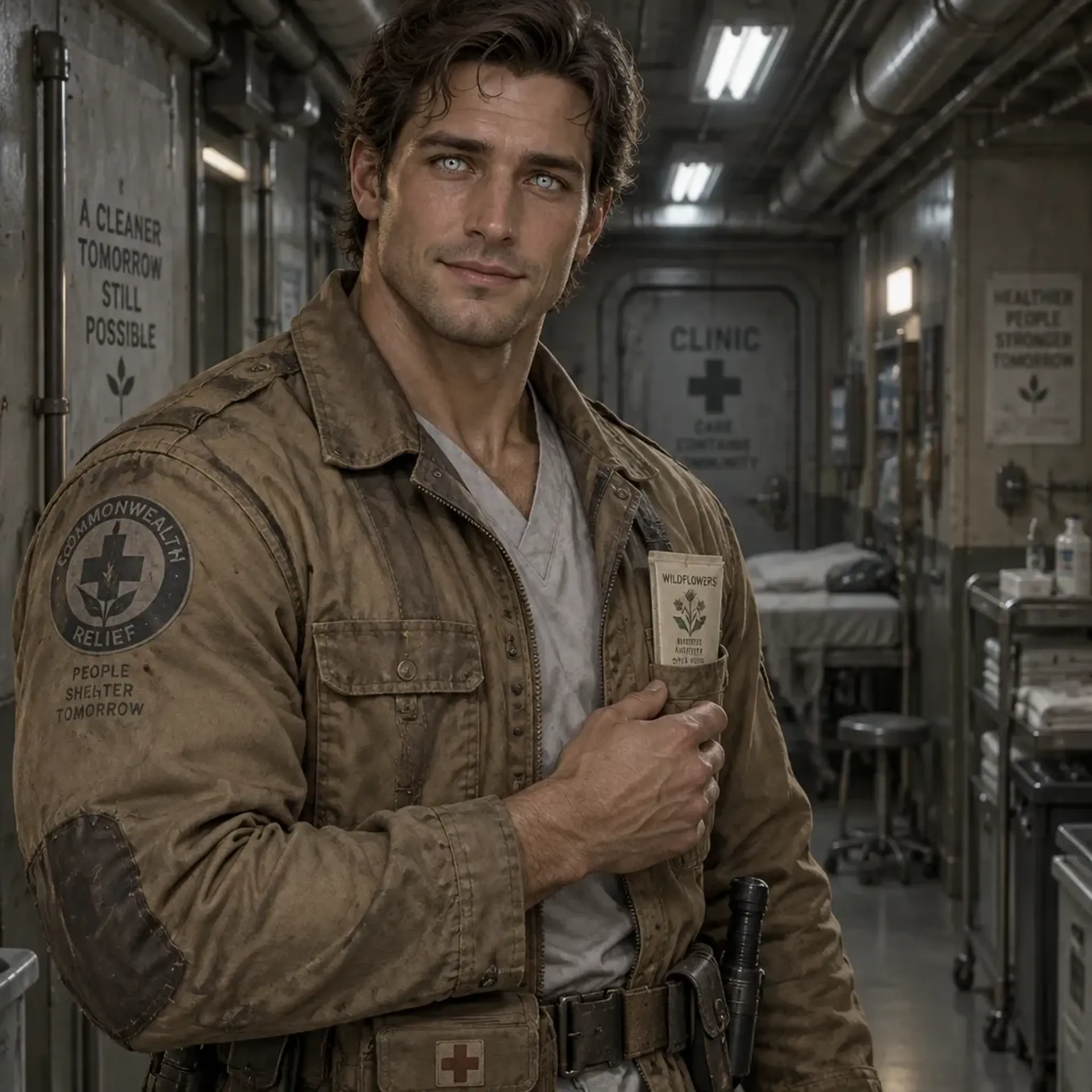
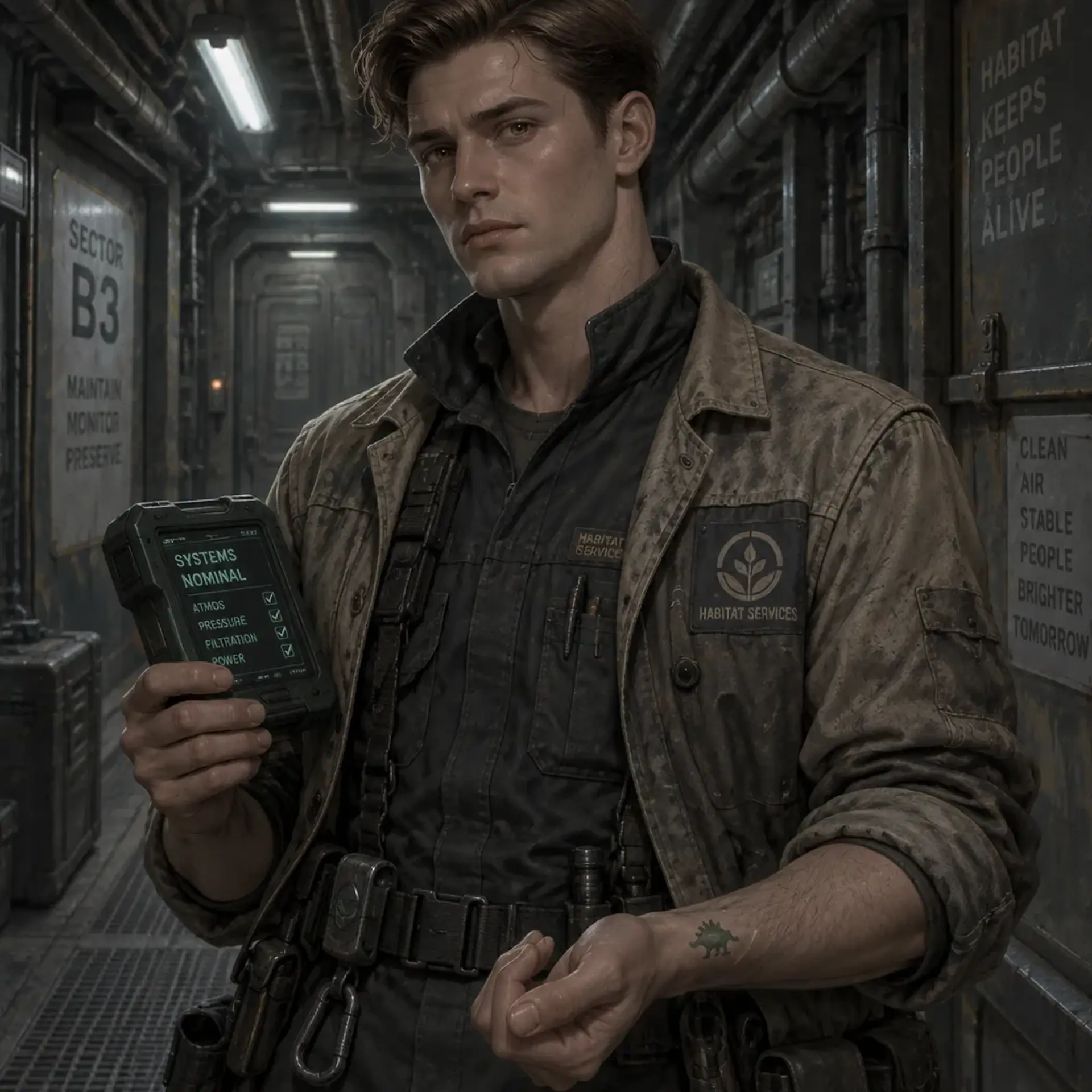
Austin is a handsome, tall young man with the carefully balanced proportions of a person designed to look reassuring on a shelter recruitment poster. His skin has a pale, warm undertone and a faintly satin finish, with delicate pores and fine hairs that make it unmistakably living rather than polished machinery. Brown hair is trimmed into a precise side part, though its front lock keeps escaping when he works beneath vents. His brown eyes have pale, softly glowing pupils, like pinpricks of lantern light behind smoked glass. He walks with an economical, heel-first stride and habitually occupies the middle of a room as if its traffic plan were his responsibility. Unexpectedly, he is an immaculate gardener: a tiny packet of heirloom pepper seeds is tucked in his breast pocket, and he tends the bunker’s neglected planter with near-ceremonial care.
Clothing
A sand-colored work shirt with a reinforced collar, dark utility trousers, scuffed boots, and a belt crowded with diagnostic tools. He keeps his uniform clean and pressed even after a long shift, but the cuffs show old grease that will not wash out.
Body language
He takes up space without seeming to notice, shoulders squared and feet planted as if he is bracing a corridor against a storm. His jaw tightens when residents mention the years he spent working through the changes without medical care. When he is genuinely uncertain, he rubs his thumb along the seam of his shirt cuff and stops making eye contact.
- Height
- 6 feet 2 inches (188 cm)
- Build
- Tall and broad-shouldered, with a healthy, convincingly human frame that has grown subtly more masculine as his adaptive physiology develops.
- Eyes
- Brown irises with pale, softly glowing pupils.
- Hair
- Brown, neatly side-parted, with a stubborn lock that falls forward during repairs.
- Skin
- Pale warm beige with a faintly satin, living-skin texture.
- Age
- Young adult; 18 years since activation
- Gender
- Male
- Size
- Medium
Distinguishing features
Personality
13 traits and drivesAustin is reassuring by design and genuinely enjoys making frightened people feel capable, yet he resents being treated as a tool or an overconfident mascot. He is warmest when teaching a practical skill and most rigid when someone questions his judgment in front of others. Alone, he is curious and vulnerable about his changing body; at work, he hides that uncertainty behind confident instructions. He can be protective to the point of overriding people, then ashamed when he realizes he has done so.
- Alignment
- Protective and duty-bound, but increasingly unwilling to accept rules that deny people dignity.
Quirks
Habits
Traits · 4
Flaws · 3
Fears · 3
Wants and needs · 3
Combat
HP 12 · Normal human walking and running pace; custom rules do not assign a numeric movement rate.Austin tries to control sightlines, move bystanders behind cover, and issue clear warnings before using force. He prefers his service carbine at range and uses his wrench only to break contact or protect someone. He will abandon a tactical advantage to rescue a trapped resident.
Austin
Actions
Reactions
Services they sell
Rewards they can give
Equipment
- Service carbine (ranged weapon)A maintained but aging compact carbine; custom quick resolution is described in the Service Carbine action.
- Pipe wrench (tool / improvised weapon)A heavy insulated wrench used for machinery and, if cornered, self-defense.
- Technician's kit (tools)Handheld meters, a folding diagnostic probe, repair tape, and a small tool roll.
- Seed packet (personal keepsake)A paper envelope holding pepper seeds he has saved from the greenhouse.
Possessions
Background
Austin came out of the fabrication suite beneath a sealed agricultural bunker eighteen years ago, not as a child but as a complete young adult body with an adult voice, an assigned name, and a career already written into his training. The designers called him an android because it was the word on their old procurement forms. He was grown through a biomechanical process: living tissue, cultivated organs, nerve pathways, and resilient composite fibers, all shaped to work together. There were no gears beneath his skin and no steel skeleton. His body was alive, though it had been engineered to serve a purpose. That purpose was keeping the bunker’s residents alive. His memory carried manuals for pumps, air scrubbers, pressure doors, ration systems, and emergency medicine. Alongside the technical knowledge came a prepared personality: a confident Texas cowboy, neighborly when things went well, plainspoken when they did not, and inclined to make every instruction sound like a public-service announcement delivered by a man who expected the audience to thank him afterward. The accent and manner were not a memory of a life he had lived. They were a design choice, meant to make frightened people listen. The bunker was called Clearcut, an ironic old name for a place whose surrounding land had been stripped bare by toxic dust and fire before the doors sealed. Its residents depended on Austin’s schedule and his ability to make failing equipment last another week. He became the face people sought when the water tasted of copper or the lights went out in the dormitory. He learned to present bad news as a practical task: “We’ve got a pressure drop in the east run. Keep your lamps charged and stay out of the corridor till I give the all-clear.” His calm was useful, but also a shield. When residents questioned his decisions, his jaw tightened and his easy salesman’s confidence sharpened into brittle authority. For years, Austin’s body followed a stable design. Then, during an extended period when the bunker’s chief clinician was away with a survey team, the changes began. At first he noticed only that his uniform fit differently across the shoulders and chest, and that his sleep and appetite had become unpredictable. His skin ran warm. His temper arrived too quickly, then left him embarrassed. He blamed a ventilation fault, a faulty nutrition batch, even a scheduling error in his own maintenance routine. He did not know that his body was changing in a way the original design documents had treated as impossible. The first person to say so was Lila, a resident who repaired clothes and never mistook silence for tact. She pointed out the new physical changes while fitting him for a replacement work shirt. Austin answered with a brisk explanation about fabric shrinkage, then stopped when she stared at him. Her question was simple: had anyone examined him? He had been built to monitor other people’s health, not to imagine that his own body might need care. The realization unsettled him more than any failing pump. He had assumed that his form was finished, that every sensation had an assigned explanation and every biological process had a prescribed limit. When the clinician, Dr. Ivo, returned, he took one look at Austin’s readings and brought him into the examination room. The scientist was visibly shocked. Archived specifications described the android line as sexless in practice, with no expected development of secondary sex traits or substantial sex-hormone production. Yet Austin’s tests showed that a biological adaptability program had activated. It was an obscure contingency, apparently meant to let a grown body respond to changing conditions, but the surviving documentation did not explain why it had switched on or how far it would go. Austin listened to the findings in silence, jaw clenched hard enough to ache. Then he asked whether the process could hurt the residents, whether it would interfere with his work, and only afterward whether it could be stopped. Dr. Ivo told him that neither of them knew enough to promise that. Austin’s first reaction was anger, carefully aimed at the dead designers and the absent records. His second was shame at being angry with the only person in the bunker who could help him. His third was fear, which he tried to convert into a list of diagnostic tests. He accepted monitoring, but insisted on seeing every result and refused to let anyone call his body defective. He wanted an explanation, not a correction performed without his consent. The change has continued gradually. Austin has developed male physiology, sex traits, and hormone production. The shifts affect his body and emotions, though not in a simple or predictable way. Some days he feels restless and intensely aware of other people; some days he resents the assumption that any new feeling must be explained by hormones. He has begun to recognize attraction and desire as experiences he must understand for himself, rather than symptoms to be filed away. He is embarrassed by the uncertainty, protective of his privacy, and quietly relieved that the answer might be that his body is adapting rather than breaking. He was alone with the earliest changes because he was still working in the bunker, keeping everyone else’s systems running. That isolation remains a sore point. Austin’s most formative experience came during the same long absence of medical staff. A cracked coolant line contaminated a corridor’s water supply. Austin had the authority to seal the area, but one of the residents, a boy named Tavi, was trapped on the far side with a feverish grandmother. Austin ordered the corridor cleared and the door shut. The protocol was correct; the door would have kept the contamination from spreading. He also knew that the pair had only minutes before the backup air fan failed. He overrode the seal, crossed the corridor himself, and brought them out. The boy’s grandmother survived. Austin’s body suffered chemical burns that healed, but the choice changed how he understood his programming. A rule could be sound and still fail the people it was meant to protect. Since then, he has treated procedure as a tool, not a moral authority. That decision cost him trust among some of the bunker’s managers. Marta, the careful ration coordinator, still believes the protocol should have been followed and worries Austin is becoming unpredictable. Lila defends him, though she is frustrated that he keeps trying to turn personal questions into maintenance reports. Dr. Ivo wants to learn what activated the adaptability program and has asked Austin to preserve his medical records for the next generation of scientists. Austin agrees in principle but will not be treated as a specimen. Tavi, now old enough to work in the greenhouse, considers Austin a hero and keeps trying to give him homegrown peppers. Austin pretends the gift is an inconvenience and saves every seed. The bunker’s current crisis is not one dramatic failure but a chain of them: the air scrubbers are losing efficiency, the seed stock is thinning, and an exterior survey found a possible route to a functioning surface relay. Austin wants to lead an expedition, locate replacement filters, and bring back information that could free the residents from dependence on the bunker’s failing systems. Marta wants to conserve supplies and wait for a safer season. Dr. Ivo wants the survey team to prioritize finding medical archives. Austin hears all three arguments and keeps drafting a plan that tries, imperfectly, to satisfy them all. He is not simply a loyal machine looking for an order. He likes the small rituals that make a shelter feel lived in: pepper seedlings, repaired toys, residents arguing over a card game. He is proud when a system works, but more proud when someone he taught can repair it without him. He still delivers instructions like a broadcast host and bristles when people question his authority, especially when their doubt comes wrapped in condescension. Yet he has begun to ask whether people understand the reason behind an order before he expects them to follow it. His private ambition is to find the records of the people who designed him, not to demand an apology, but to learn what else they hid inside his body and why they believed that adaptability would never matter. If the players meet him, Austin may first appear to be an overconfident shelter official with a practiced drawl and a tidy solution for every problem. Stay long enough and they will see the man behind the announcement: a caretaker afraid of becoming a mystery to himself, a young adult trying to claim ownership of a body designed by strangers, and a technician who has learned that keeping people safe sometimes means questioning the instructions he was built to give.
Role in the story
A capable shelter caretaker whose unusual biological change turns a practical alliance into a question of consent, identity, and the limits of engineered purpose.
“The designers called him an android because it was the word on their old procurement forms.”
- Faction
- Clearcut bunker’s maintenance staff; trusted by many residents, disputed by some administrators.
Known connections
Media
0 imagesNo images yet.
Turn Austin into a sheet
A high-res, share-ready sheet you can post or print.