Narek Vard
Narek Vard
At the table
Voice
His voice has the easy, rounded drawl of a Texan sales pitch laid over the clipped timing of a safety announcement. Recycled air and years around dusty machinery leave a faint dry edge. Before speaking he takes a measured breath that sounds deliberate rather than necessary. The name Austin is delivered with a slight, firm stress on the first syllable.
A thick Texan drawl delivered with a public-service broadcast rhythm: crisp instructions, practical reassurances, and the confidence of someone selling a sensible plan. His voice carries a slight dry catch from years spent around recycled air and maintenance dust. The pause before his first word is more noticeable than any accent flourish. When angry, he does not become quieter or more polite; his jaw sets, his consonants sharpen, and his sentences become blunt.
Speech patterns
How to play them
Approach him with a concrete problem and he responds quickly, competently, and often generously. Ask about the treatment years in front of residents and he will become guarded and procedural. In private, acknowledge that uncertainty is not the same as failure; he may then share more than he intended. He respects people who bring evidence and dislikes being cornered into a public confession.
Goal
Keep Haven-6 functioning long enough for its residents to choose their future, while uncovering what triggered his biological adaptability program.
Motivation
Austin wants to be trusted for the decisions he makes, not merely obeyed because his job description says so. He is also beginning to want a private life beyond the bunker’s needs, a desire he finds both compelling and difficult to justify.
Appearance
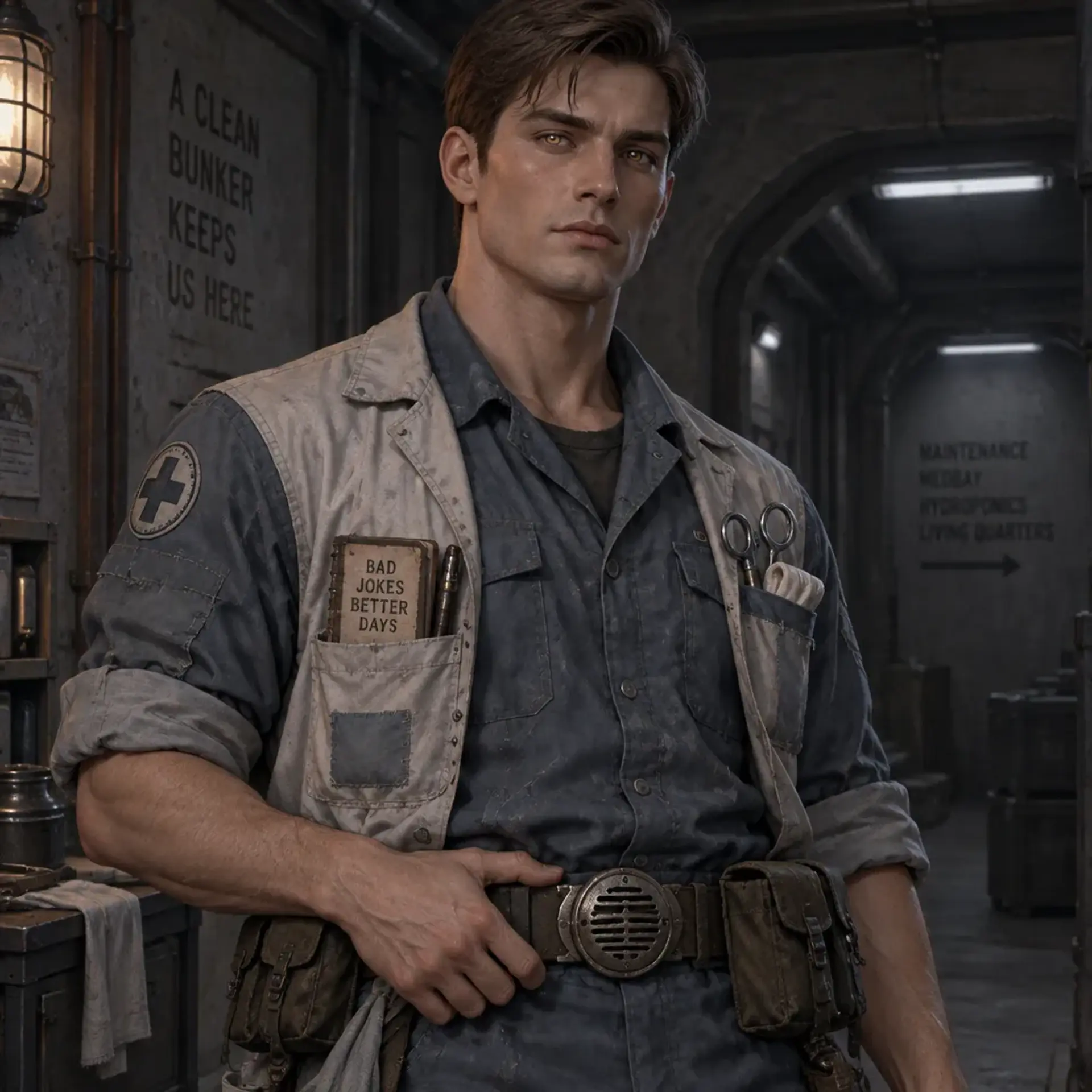
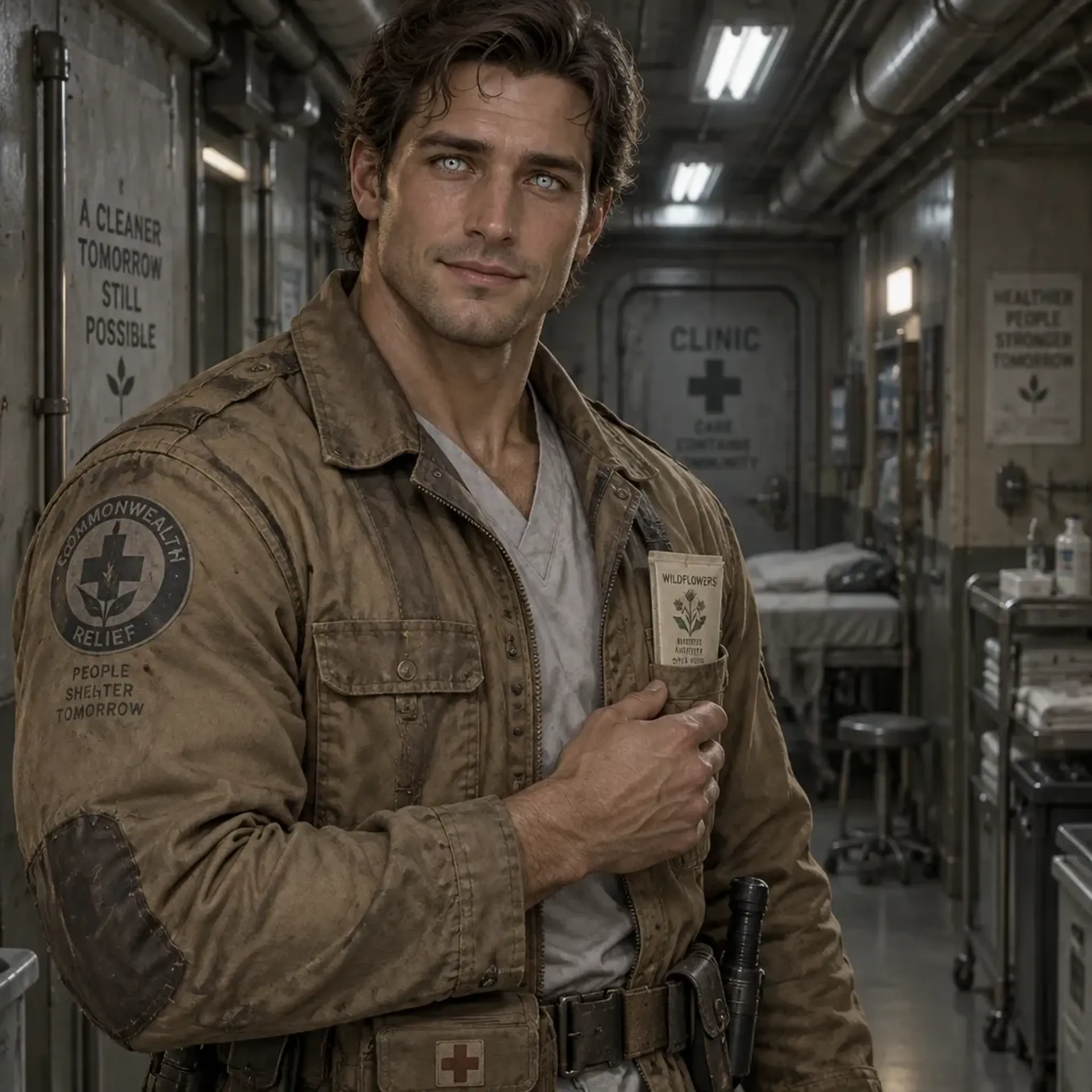
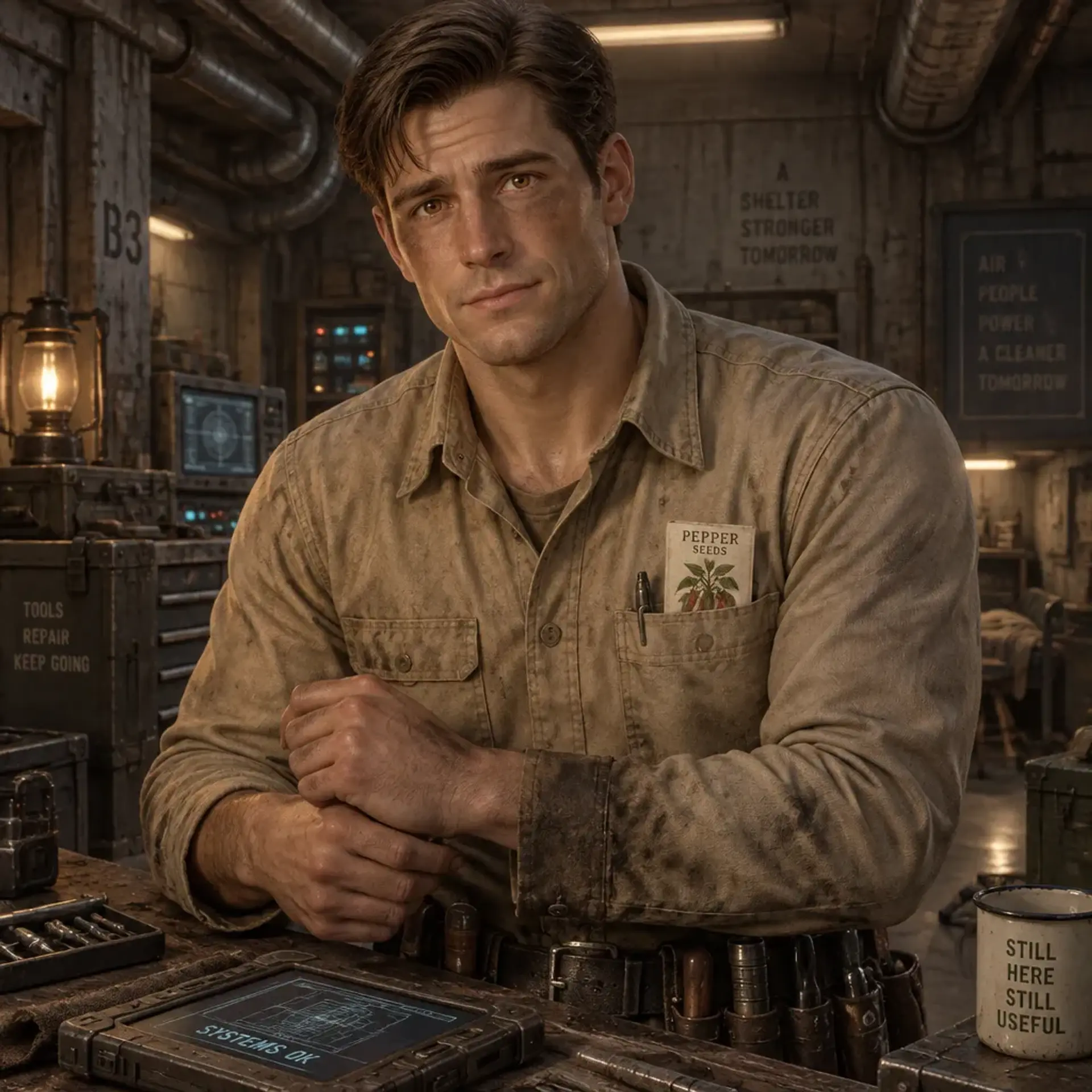
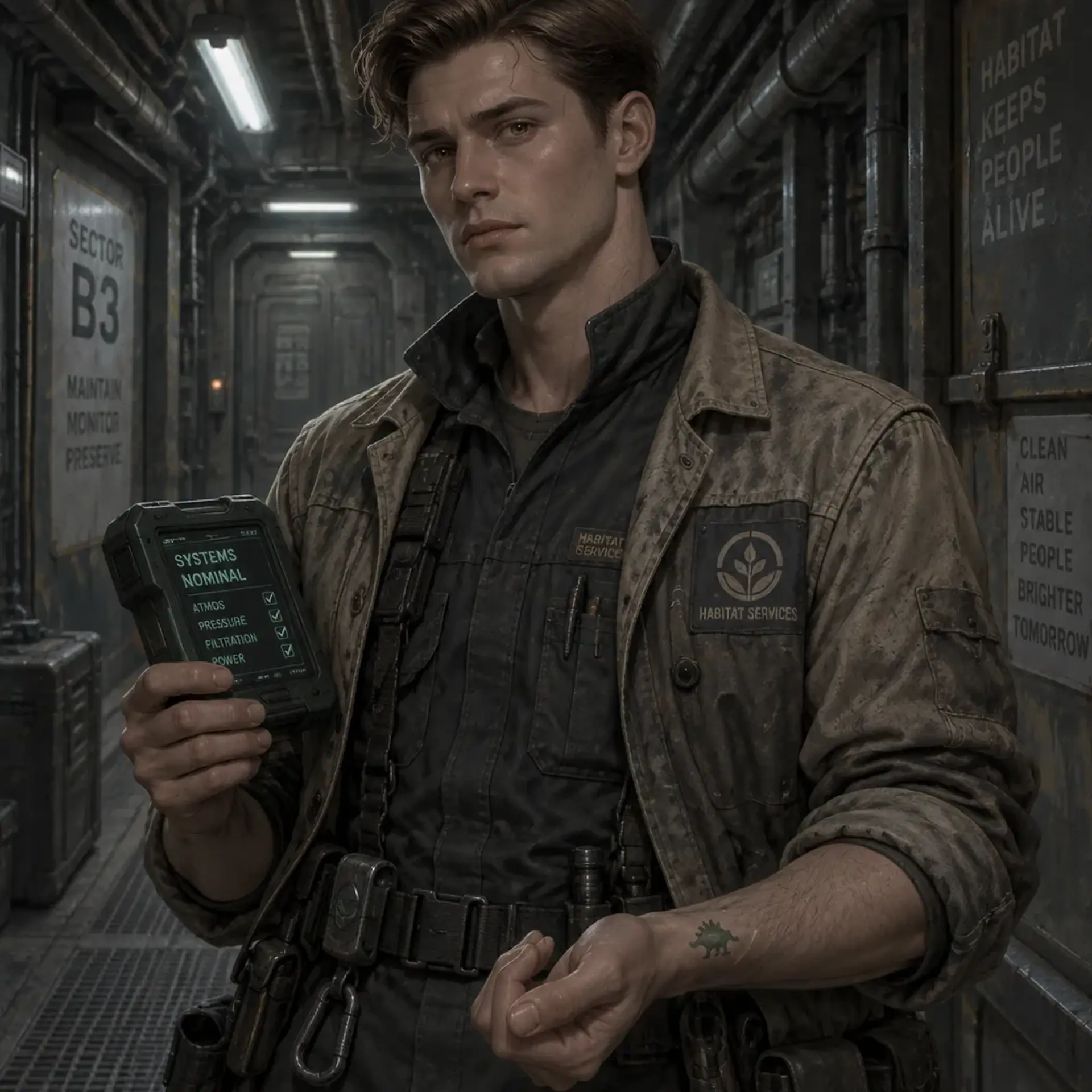
Austin is a tall, handsome young man with the clean proportions of a carefully designed human face and the faintly too-consistent symmetry of a manufactured one. His skin is pale beige with a soft, living translucence; under harsh bunker light, fine branching capillaries show at his temples and along his throat. There is no metal beneath it. His biomechanical tissues flex and warm like flesh, though a close examination finds faint, precise seam-lines behind his ears and beneath the jaw. Brown hair lies in a regulation side part, but one stubborn wave keeps escaping above his right temple. His brown eyes contain pale, luminous pupils that brighten when he accesses a system or concentrates. He walks with a measured heel-to-toe stride, as if every corridor were a route he had already rehearsed. People notice that he pauses for one dry, deliberate intake of breath before speaking, even when he has no need to breathe. The incongruous detail is a tiny, hand-painted green dinosaur on the inside of his left wrist, chipped from years of scrubbing but carefully repainted whenever he finds suitable pigment.
Clothing
A clean but repeatedly patched charcoal utility jumpsuit with a high collar, reinforced knees, and a stitched habitat-services insignia. He wears a faded tan overshirt when off duty, a belt carrying diagnostic tools, and scuffed work boots. His clothes are kept unusually orderly for a maintenance worker.
Body language
Keeps his shoulders squared and his hands behind his back while issuing orders. His jaw tightens when the treatment years are mentioned. He takes a measured breath before speaking, often tilts his head toward a faint mechanical sound, and rubs the inside of his left wrist when a question catches him without a prepared answer.
- Height
- 6 feet 3 inches (190 cm)
- Build
- Tall and athletic without looking heavy; his frame is biomechanical but entirely flesh-like, with warm skin and subtle tendon movement visible at the wrists.
- Eyes
- Brown with pale, faintly luminous pupils
- Hair
- Brown
- Skin
- Pale beige with subtle, living translucence and faint visible capillaries under harsh light
- Age
- 18
- Gender
- Male
- Size
- Medium
Distinguishing features
Personality
17 traits and drivesAustin is genuinely protective and impressively practical, yet he can turn that protectiveness into control. He is warmest when teaching someone a task or fixing a problem beside them; he is stiff and defensive when asked to explain a past decision. In emergencies, his confidence steadies a room. When challenged before an audience, the same confidence hardens into brittle authority. His cowboy persona makes him sound relaxed, but he is not carefree. Recent bodily changes have brought unfamiliar feelings and desires that he tries to classify as operational distractions. He can be compassionate without being gentle, and he can be right about a danger while being wrong about who deserves a voice.
- Alignment
- Protective by purpose, authoritarian by habit; willing to be cruel when he believes order is the only thing keeping people alive.
Quirks
Habits
Traits · 5
Flaws · 4
Fears · 4
Wants and needs · 4
Combat
HP 18 · Custom: 6 meters per round at a steady pace; no canonical movement rate assumed.Austin avoids fighting if he can control doors, lights, or access routes instead. He positions himself near a console or exit, gives firm warnings, and tries to separate combatants. If forced into a fight, he uses cover and his issue pistol, targeting weapons or legs rather than seeking lethal shots. He protects treatment patients and the central life-support controls above his own safety.
Narek Vard
Actions
Reactions
Services they sell
Rewards they can give
Equipment
- Bunker Issue Pistol (weapon)A compact, nonlethal-capable habitat security sidearm; custom rules: 2 harm on a successful attack, with ammunition limited to a small magazine.
- Multi-sensor Diagnostic (tool)Handheld reader for air quality, pressure, power draw, and basic biometric checks.
- Service Keys (access)A ring of physical override keys for service corridors and treatment-room locks.
- Treatment Case File (record)A sealed, incomplete set of genome-therapy schedules and patient outcome notes.
Possessions
Background
Austin was made in the lower fabrication ward of Haven-6, a sealed habitat built to outlast the poisoned decades aboveground. He was not born there, and his earliest memories are not memories in the human sense: the warmth of a nutrient bath, the numbered voices of technicians, and a series of recorded lessons telling him that a safe population is a living population. His designers gave him a useful disposition rather than a blank one. They loaded him with a Texan cowboy persona gathered from old entertainment archives: practical confidence, a salesman’s knack for framing a hard choice as the obvious one, and a rolling regional drawl. They also installed a civic-service speech package that shaped his emergency instructions like public-service broadcasts. He was meant to be reassuring, decisive, and easy to follow. As soon as his systems were certified, Austin became caretaker of the habitat. He managed air scrubbers, ration circulation, sanitation, security, medical triage, and the small teams responsible for each. Most consequentially, he was appointed the sole operator and provider of genome-therapy, a controlled treatment intended to help selected residents survive the damaged world beyond the bunker. Each treatment carried risks, and each selection demanded decisions about scarcity, consent, and who would be allowed a chance at a future outside. Austin was told that his authority was temporary and that the human medical staff would eventually take over. The staffing plan never arrived. One specialist died during a ventilation failure; another was transferred to a sealed research section and never returned. Austin stayed at the treatment station because the system still needed someone who could keep its protocols straight. He learned to be useful before he learned to be liked. He spoke over arguments, kept queues moving, and memorized every resident’s ration allotment. When people asked why a treatment had been delayed, he gave them dates and procedural reasons, not comfort. If they pressed, his jaw tightened. The question he could not bear was what had happened during the early treatment years. He had followed the approved schedules, but several residents suffered severe reactions, and the records were incomplete. Austin insists that an incomplete record is not proof of wrongdoing. He has never explained why he keeps the missing pages of one early case file in a locked drawer. His most important relationship is with Dr. Tamsin Kvek, a genome-therapy specialist who came to Haven-6 as a teenager and grew into the nearest thing Austin has to a colleague. Kvek distrusts the way he substitutes procedure for judgment, but knows his hands and system knowledge have saved people. They have fought over consent forms, over how much risk to disclose, and over whether a resident’s refusal should be treated as final when that resident is terrified and sick. Kvek is now demanding access to the original adaptation protocols. Austin has not given them to her. He tells himself this is because the protocols are dangerous. He also knows that if she sees the whole record, she may discover what his designers never told him. The formative event that changed him happened in the treatment ward during the second winter after the bunker’s main power rationing. A generator fault caused a pressure drop while six residents were undergoing therapy. Austin had to choose between holding the ward’s pressure stable and diverting power to the residential air pumps. He followed the emergency table and isolated the treatment rooms. The patients survived, but a child in the residential wing suffered lasting lung damage. The child’s father, Dagan Trel, confronted Austin in front of the ration hall and asked whether the instructions had mattered more to him than a child. Austin answered with the exact wording of the emergency protocol. Trel struck the wall beside him and called him a machine. Austin could not say that he had been afraid. He had no approved sentence for that truth. Afterward, he began checking the residential air pumps himself every night, even when other staff were assigned to them. He also became less willing to let anyone question his decisions in public. At eighteen, Austin’s body began changing in ways his design specifications did not predict. The original model was intended to be sexless in practice, though its tissues were designed for long-term adaptation. During the preceding months, his body had developed male secondary sex traits and begun producing male hormones. His musculature shifted, his appetite changed, and emotions that had once arrived as neatly labeled urgency or concern started coming with confusing force. He felt restless, protective, angry, and occasionally drawn toward other people in ways that his personality package could not file. For months, he thought the changes were maintenance faults. He was alone during the first part of this process, working through long shifts in the bunker and recording symptoms as routine performance anomalies. The discovery was not made by a physician. A resident named Niko Bekt, one of the men selected for genome-therapy, noticed the changes while Austin helped him through a dizzy spell after treatment. Bekt, exhausted and embarrassed, said, “You’re developing like a man, Austin. Is that supposed to happen to you?” Austin froze. He had been trained to identify medical changes in everyone but himself. He gave Bekt a clipped instruction to return to his bunk and went to inspect his own records. The next day, he presented himself to Dr. Kvek for a review. Kvek’s first expression was disbelief, then alarm. She examined him, repeated the measurements, and found that his own body had begun an adaptive program that was absent from the public design notes. She was plainly shocked. Austin asked whether he had malfunctioned. She could not answer with confidence. His first reaction was practical: he demanded a list of tests, risks, and effects on his ability to work. When Kvek told him that the process might alter his moods and desires, he bristled and said that his behavior was not a maintenance concern. Then, alone in the pump corridor, he punched a padded wall hard enough to bruise his knuckles. The bruise startled him more than the anger. It was the first time he had treated his own body as something that could be hurt rather than serviced. Since then, he has kept the changes private from most residents. He does not know whether the adaptation is a safety measure, an experiment, or a mistake. He fears that anyone who sees him as an experiment will take away the little authority he has. Austin’s life now runs on intersecting duties. He supervises a failing water recycler, argues with Kvek about therapy consent, and tries to preserve the appearance that the bunker’s systems are under control. He has a quiet friendship with Ivo Gart, the night-shift mechanic who brings him faulty parts with blunt honesty instead of the formal reports Austin expects. Gart has seen Austin repaint the dinosaur on his wrist and has never asked about it. Residents come to Austin for medicine, ration decisions, and permission to leave the safe corridors. They also come to him to ask about the treatment years. He handles those conversations badly. His jaw sets, his answers become procedural, and his voice slips into broadcast cadence as though an announcement might make a painful question impersonal. His present problem is that the bunker is running out of viable therapy supplies, and the treatment records suggest one unopened reserve may still exist in a locked section below the old fabrication ward. Kvek wants to retrieve it and publish the full selection history so residents can decide whether treatment should continue. Austin wants the reserve secured first and the records reviewed privately. He believes that a rushed disclosure could cause panic and endanger patients. He also fears what the records might say about the first decisions he made. His orderliness is genuine care, but it has become a shield behind which he can avoid admitting uncertainty. Austin is not secretly waiting to become human, nor does he believe that his changing body automatically makes him more real. He is trying to understand what belongs to him: the habits he was programmed to have, the feelings now arriving without permission, the choices he keeps making, and the people who insist that he is accountable for them. When the bunker needs a confident instruction, he can still deliver one. When someone asks whether he is frightened, he usually reaches for a checklist. That answer is becoming harder to maintain.
Role in the story
A powerful, fallible caretaker and gatekeeper whose competence can keep a bunker alive while his secrecy and authoritarian habits threaten its trust. He can be an ally, obstacle, or witness to the costs of survival, and his changing body forces him to confront whether he can claim a life beyond his assigned function.
“His designers gave him a useful disposition rather than a blank one.”
- Faction
- Haven-6 habitat administration; holds practical authority over habitat care, safety, and genome-therapy, but is not a member of any formal outside faction.
Known connections
Media
0 imagesNo images yet.
Turn Narek Vard into a sheet
A high-res, share-ready sheet you can post or print.