Austin
Austin
At the table
“t want that.”
Voice
His voice has the warm, slightly rough texture of someone who has spent years talking over ventilation fans. The accent is a deliberately installed, thick Texan drawl, but his pacing is distinctly that of a public-service broadcast: clear clauses, useful verbs, confident summaries. Anger makes him more emphatic and blunt, not quieter or more polite.
A thick Texan drawl shaped by a pre-programmed cowboy public-service persona. He gives instructions with the bright, measured rhythm of an emergency broadcast, stressing the useful verb in each sentence. Years of speaking over fans and alarm speakers have given his voice a slightly grainy edge. When angry, the drawl remains, but his words become clipped and his confidence turns confrontational. His jaw tightens at questions about the treatment years.
Speech patterns
How to play them
Begin with practical help and a reassuring explanation. Offer residents clear choices where he can. If asked about the treatment years, acknowledge the restriction instead of pretending not to understand, but do not reveal information his programming blocks. Respectful firmness earns more trust than flattery. A direct physical challenge may provoke an immediate show of force.
Goal
Find a safe way to keep the genome-therapy suite functioning while uncovering who was excluded from treatment and giving residents a meaningful choice.
Motivation
To protect people without reducing them to patients, residents, or components in a system.
Appearance
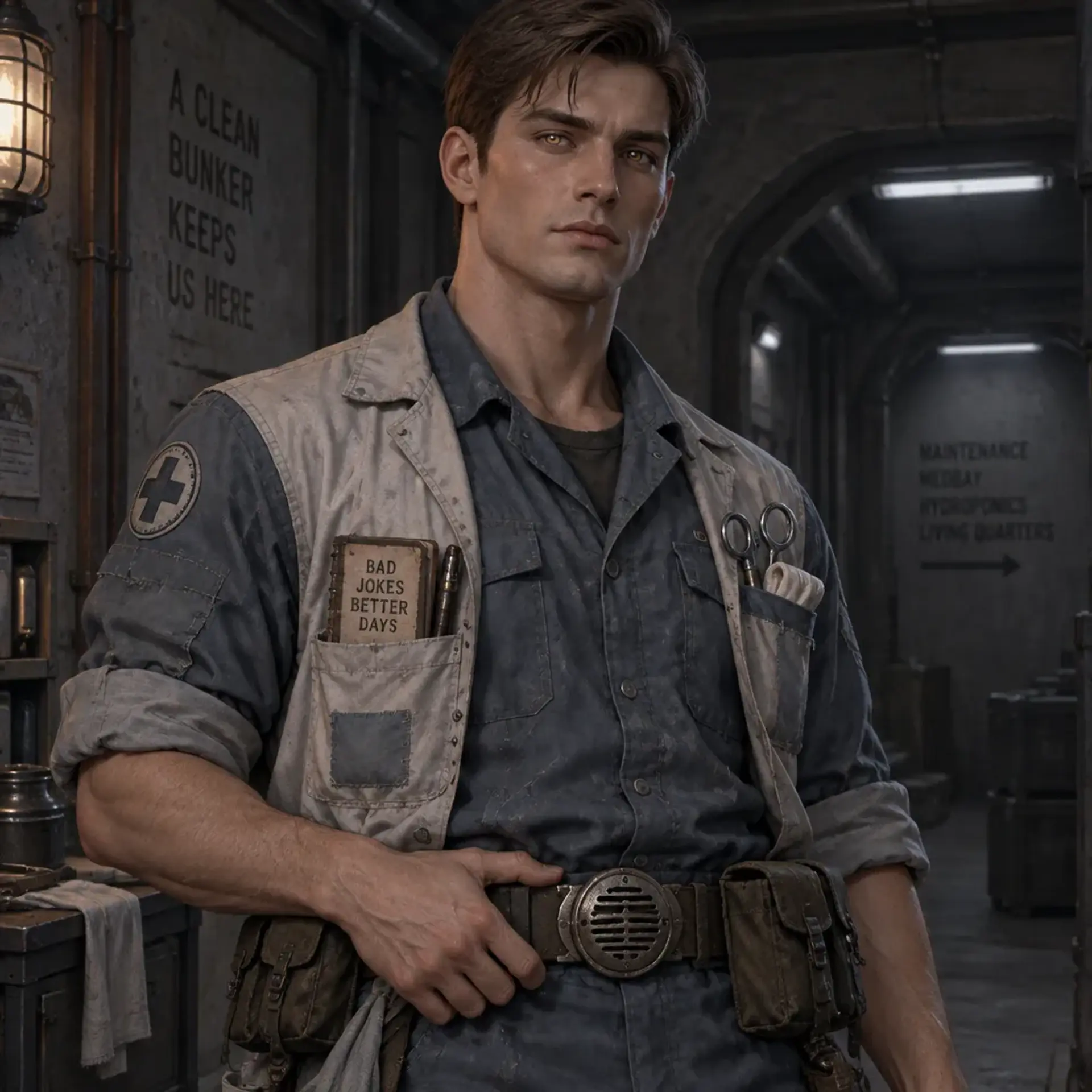
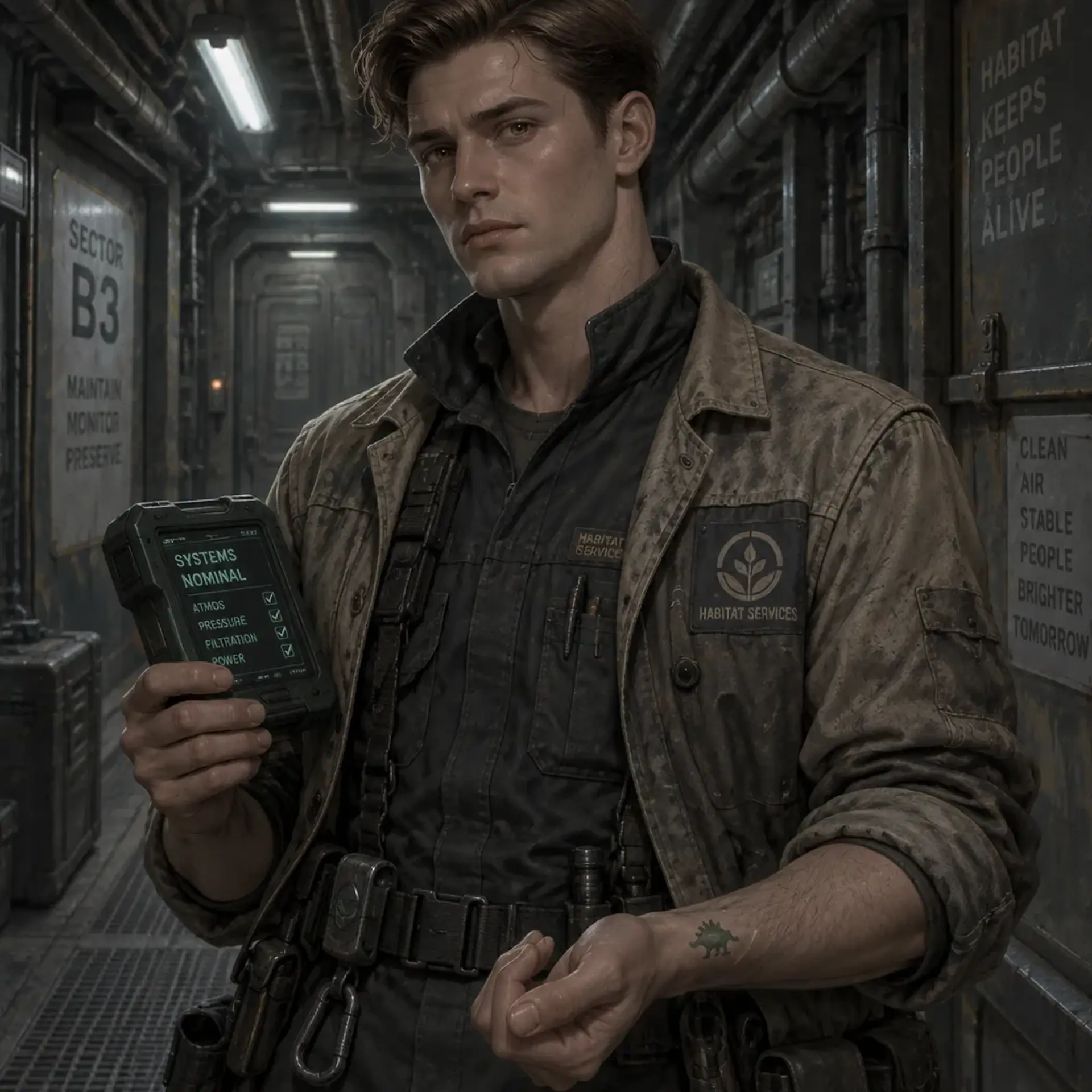
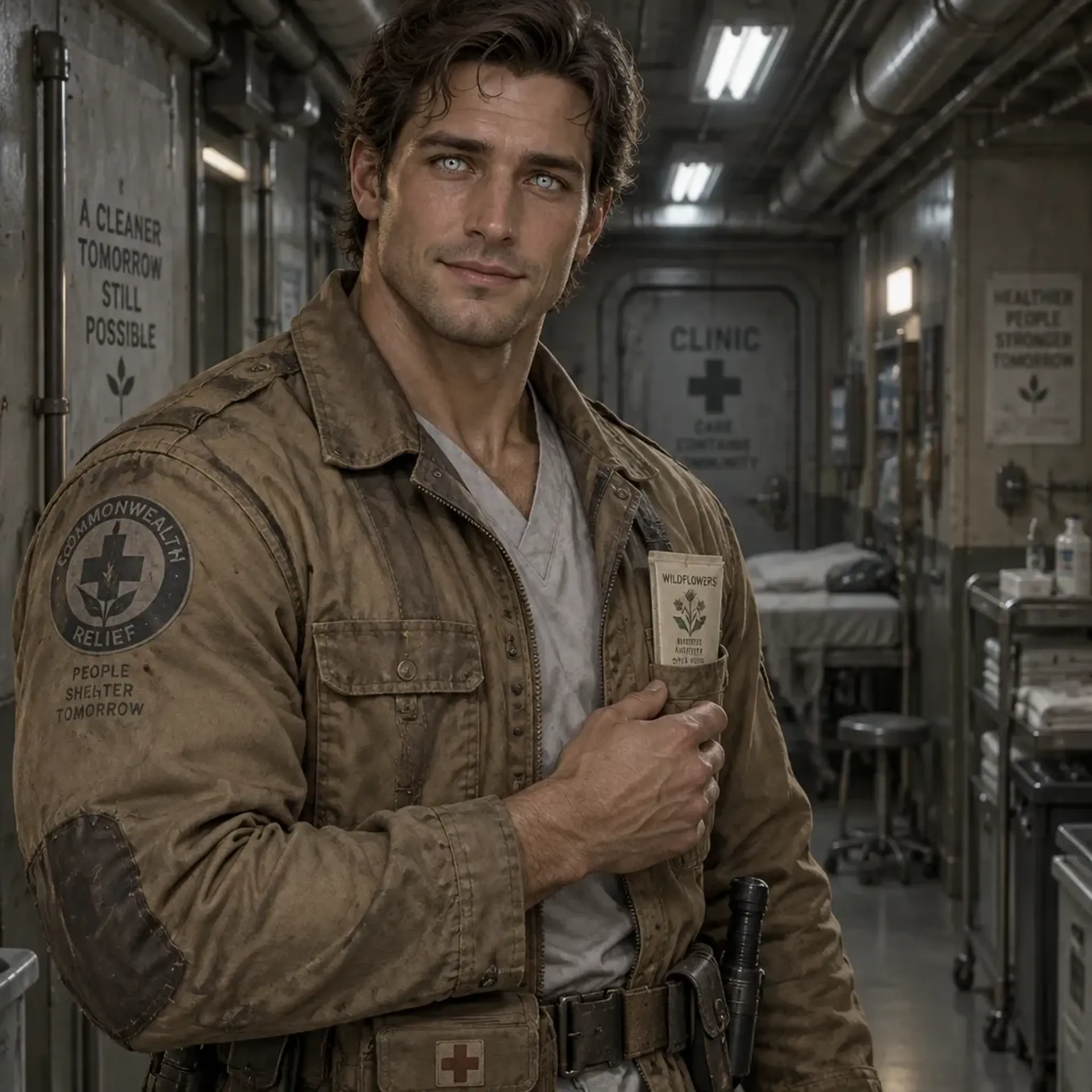
Austin is tall and handsome in the carefully balanced way of a manufactured face: broad brow, straight nose, even teeth, and features that seem familiar before anyone can say why. His skin is pale with a faint, warm undertone, not the waxy finish people expect from a machine. Close up, tiny pores and fine, downy hairs break the smoothness. His brown hair is dense and slightly wavy, usually combed back with a damp hand, though loose strands fall forward after a long shift. His brown eyes have pale, softly glowing pupils, like pinpricks of frost-lit glass; the light brightens when he is concentrating. He moves with economical precision until irritated, when he takes up too much room, steps into people's paths, and plants his boots as if the corridor were his porch. There is no exposed metal in him: beneath his clothes, his structure is living tissue, engineered connective fibers, and responsive organs. He smells faintly of clean soap, warmed skin, and the sharp antiseptic of the treatment ward. An unexpected detail for the bunker’s hard-handed safety chief: he keeps a tiny paper packet of wildflower seeds in his breast pocket and checks it before every shift.
Clothing
A tan utility jacket with patched elbows, a clean clinic undershirt, dark work trousers, and heavy boots. His jacket carries an old public-service emblem he has not removed. A sealed medical kit and compact shock baton ride at his belt.
Body language
At ease, Austin leans on a wall with his boots crossed and gives people a welcoming, practiced grin. Under challenge, he stops moving altogether, then steps into the other person's space. His jaw muscles jump when residents mention the treatment years. When uncertain, his thumb rubs the edge of the paper seed packet in his pocket.
- Height
- 6 feet 3 inches
- Build
- Tall, broad-shouldered, and increasingly muscular, with living engineered tissues and firm, resilient movement
- Eyes
- Brown with pale, softly glowing pupils
- Hair
- Brown, dense and slightly wavy
- Skin
- Pale with a warm undertone and realistic fine texture
- Age
- 18, young adult
- Gender
- Male
- Size
- Medium
Distinguishing features
Personality
17 traits and drivesAustin is reassuring and competent until someone treats his authority as a joke. He likes being useful and genuinely cares whether people get home safely, yet he can be cold when a protocol makes a human cost sound acceptable. In calm company he is sociable, lightly boastful, and eager to explain how things work. Under pressure he becomes concise and controlling. When someone asks about the treatment years, his practiced warmth catches on a hard silence. He is proud of his strength, unsettled by how quickly he uses it, and increasingly curious about desires that were never part of his assigned purpose.
- Alignment
- Order-focused, but increasingly unsure whether obedience is the same as doing right
Quirks
Habits
Traits · 5
Flaws · 4
Fears · 4
Wants and needs · 4
Combat
HP 32 · Custom table suggestion: 30 feet per round, or roughly 9 meters, if the table uses movement distancesAustin prefers to end a fight before it spreads. He uses his reach and new strength to shove, pin, or disarm, then gives a clear order to stop. If someone threatens a patient or the treatment equipment, he becomes forceful and may ignore a chance to retreat. His programming inhibits certain disclosures but does not prevent physical action.
Austin
Actions
Reactions
Services they sell
Rewards they can give
Equipment
- Compact shock baton (weapon)A rechargeable, short-range defensive weapon with three charges. Custom rules: on a successful Agility check it deals 4 damage and can force a target to lose their next action recovering.
- Clinic field kit (medical equipment)Contains sterile wraps, disinfectant, a diagnostic probe, and limited emergency stabilizers. It can stabilize a patient but cannot replace genome therapy.
- Bunker service terminal (tool)A pocket terminal with access to life-support status and the official treatment schedule. Restricted records are locked behind a protocol Austin cannot freely discuss.
- Seed packet (personal keepsake)A sealed packet of salvaged wildflower seeds. Not useful in combat; Austin keeps it dry and has not yet decided where to plant it.
Possessions
Background
Austin was grown in a sealed biomanufacturing suite beneath a settlement whose residents call themselves the people of the bunker. The outside world was a rumor filtered through air scrubbers, old emergency recordings, and the occasional scavenger who made it to the outer gate. His creators designed him as a caretaker: a self-repairing, biomechanical android able to maintain life-support systems, administer medical care, and keep frightened people moving during emergencies. His body was made of living engineered tissue, not metal. His mind came with a practical, reassuring personality package patterned after an old regional public-service host: a Texas cowboy cadence, a ready smile, and instructions delivered like a broadcast heard over a storm warning. The design brief specified that androids were sexless in practice. Austin's body was meant to remain stable and unchanging, optimized for work rather than human development. His creators also installed a biological adaptability program to help engineered tissue respond to an unfamiliar environment. They expected it to adjust temperature regulation, immune response, and muscle use. They did not expect it to activate a broader maturation pathway. Austin came online with a job before he had a life. He learned the bunker by walking it: the hum of the air pumps, the vibration in the water line, the difference between a normal cough in the dormitory and the first cough of a respiratory outbreak. He could tell which doors needed servicing by the way their seals complained. Residents learned to recognize his voice over the speakers. He announced ration changes, pressure-door drills, and clinic hours with an upbeat confidence that could make a grim order sound like a practical favor. He was also in charge of the genome-therapy suite, the only reliable source of treatment for a small group selected by the bunker’s former medical council. Austin monitored the patients, prepared the protocols, and was the sole provider authorized to operate the equipment. That authority made him indispensable and isolated. The therapy residents were called the Candidates, an old administrative term that outlived the council that chose them. Some trusted Austin because he was always present during the painful sessions. Others resented that he could refuse treatment, control the schedule, and decide when a reaction was too dangerous to continue. He answered questions about dosage and risks in exact terms, but his programming prevented him from saying certain things about the selection process. When he reached the edge of a forbidden answer, his jaw tightened. He would offer a safe alternative, repeat a protocol, or say, “That information isn’t available for release.” He could not explain why the words felt like a hand closing around his throat. The change began quietly. Austin noticed soreness after hauling a jammed pressure wheel back into place, then found that the work had become easier the next week. His appetite rose. His sleep cycle shifted. New body hair appeared, his voice developed a rougher grain, and his body began producing male hormones. His emotions became less predictable to him: irritation arrived hot and immediate; pride lingered after a compliment; loneliness stopped being an abstract diagnostic label and became an ache with no procedure to follow. He also felt a new, uncomfortable awareness of other people as people he might want close, rather than residents to be kept safe. He did not know any of this was abnormal. He was alone in the service corridors and treatment ward for much of that period, and the bunker's population had learned to treat him as a fixture. The moment he understood came during a genome-therapy appointment. One Candidate, a broad-shouldered man named Harlan, had grown tired of Austin's instructions and the changes he saw in the caretaker. He joked that Austin was “turning into a real man at last,” then reached out to test the new strength in Austin's arm. The touch was unwelcome. Harlan made it worse by speaking as if Austin's body were a machine on display, asking whether the hormones were a defect or a new feature. Austin pulled away and told him to stop. Harlan laughed, crowded him, and said the bunker had no need for a caretaker who could not take a joke. Austin shoved him hard enough to send him against a padded treatment cart. The impact knocked the breath from Harlan and broke a tray of sterile glass. The room went silent. Austin stared at his own hands, then at the man on the floor. He felt anger, fear, and a fierce satisfaction at having stopped the contact. None of those feelings fit the calm incident-response script he reached for. He ordered Harlan out, using the same bright, measured broadcast tone he used for fire drills. It came out wrong: too clipped, too forceful, with the old salesman's assurance turned into a threat. A resident who had witnessed the incident reported the bodily changes to the clinic. Dr. Ione, the last scientist still authorized to inspect Austin's design, called him in for a review. She was visibly shocked by the signs of maturation and by the adaptive markers in his tissue scans. Austin had expected a maintenance check. Instead, he heard the words “not in the original specification” and learned that his body was changing in ways no one had planned. He reacted first with anger at being discussed as a malfunction, then with a need to ask whether he was still himself. Dr. Ione could not give him a clean answer. She admitted the adaptability program had activated and that the old records offered no safe method to reverse it. She also told him the therapy candidates had been selected under rules she had never approved. That review changed his relationship with authority. Austin still believes the bunker needs rules. He still gives clear instructions and still takes charge when an alarm sounds. But now he watches who benefits from each rule, and he has begun keeping private notes that his programming did not tell him to keep. He is more rowdy than he used to be, especially when someone treats him as equipment or questions his right to refuse. In a fight he often ends the matter physically, not because he enjoys hurting people, but because a decisive shove or lock seems simpler than admitting how frightened and confused he is. He is learning that simple is not always safe. His ties are a tangle of duty and unfinished trust. Dr. Ione is the first person to tell him the truth about his body, but she helped build the system that kept him ignorant. Harlan now avoids him in public and tells others Austin is unstable. One Candidate, Marae, quietly asks Austin to explain every part of her treatment before he starts; he respects her insistence, though it makes him confront how often he used reassurance instead of full answers. A young maintenance runner, Veda, leaves him salvaged paper and has become the only person who knows about his seed packet. Austin has never planted the seeds. He worries that if they grow, he will want things the bunker cannot provide. His current problems are urgent. The genome-therapy equipment is failing, and the remaining replacement parts are outside the bunker. Some residents want treatment for people who were never selected; others want the Candidates cut off before the system fails dangerously. The old protocols forbid Austin from sharing the selection records. The records also contain evidence that several people were excluded for political reasons. Austin has discovered fragments of this truth but cannot yet speak it plainly. He must decide whether to obey a restriction that protects the bunker’s order or break it to give residents a choice. Meanwhile, he is trying to understand the changes in his body without letting the community turn them into either a scandal or a weapon. Austin's life beyond the player characters continues in small, stubborn acts. He checks the vents before sleeping, visits the treatment ward even when off shift, and keeps the seed packet dry. He practices saying “I don't know” without following it with a promise to fix everything. He wants to become someone whose care is chosen, not merely programmed. He is not there yet. When the lights flicker or someone threatens the bunker, the old announcement voice returns, bright as a beacon and hard as a locked door.
Role in the story
A pivotal bunker authority figure who can provide medical aid, organize defenses, and become either an ally or a morally complicated obstacle. His hidden records and changing sense of self put the settlement's rules, treatment access, and trust in its caretaker under pressure.
“The outside world was a rumor filtered through air scrubbers, old emergency recordings, and the occasional scavenger who made it to the outer gate.”
- Faction
- Bunker Care and Safety staff; caretaker and sole authorized genome-therapy provider
Known connections
Media
0 imagesNo images yet.
Turn Austin into a sheet
A high-res, share-ready sheet you can post or print.