Benjamin
Benjamin
At the table
Voice
A clear, lightly dry voice with the scratch of recycled air and a practical Pennsylvania cadence. He takes a small nasal intake before formal warnings, as though setting his words in order. Cheerfulness gives his delivery an easy, brisk warmth; irritation sharpens the consonants and brings out a precise, deadpan bite. He does not need to shout to sound like he expects to be obeyed.
He speaks with a Pennsylvania accent: rounded vowels, a relaxed local rhythm, and practical turns of phrase. His voice has a lightly dry edge from years of respirators and recycled air, and his words come out with the neat enunciation of someone used to giving instructions through a mask. Before a formal warning, he takes a short nasal intake of breath. His name, Benjamin, is pronounced plainly in the same regional accent. When cheerful, his speech is quick and neighborly; when challenged, he deploys crisp, deadpan sarcasm rather than raising his voice.
Speech patterns
How to play them
Begin friendly and useful. Ask what the visitor needs, then offer clear options. If they endanger residents, switch to firm instructions and explain the immediate risk. He responds well to honest questions about his body or history, but will not entertain gawking or demands that he justify his identity. Evidence of concealed medical risk earns his cooperation, though he will insist on bringing the affected residents into the discussion.
Goal
Find out why the adaptive-tissue program's supplies and records do not match, protect affected residents, and secure informed consent for anyone asked to undergo similar treatment.
Motivation
To make care and safety mean protecting real people, not merely following a procedure or protecting the institution's reputation.
Appearance
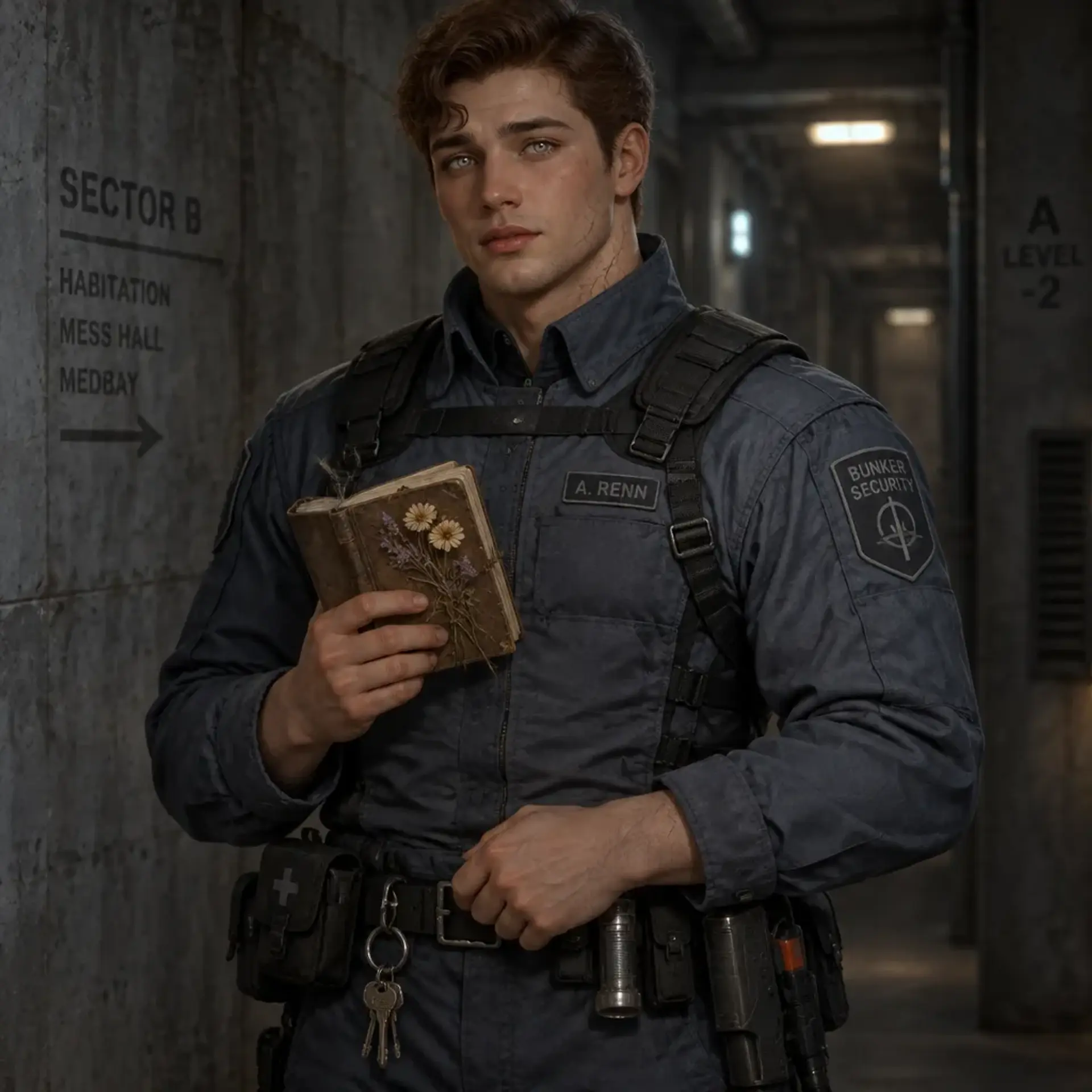
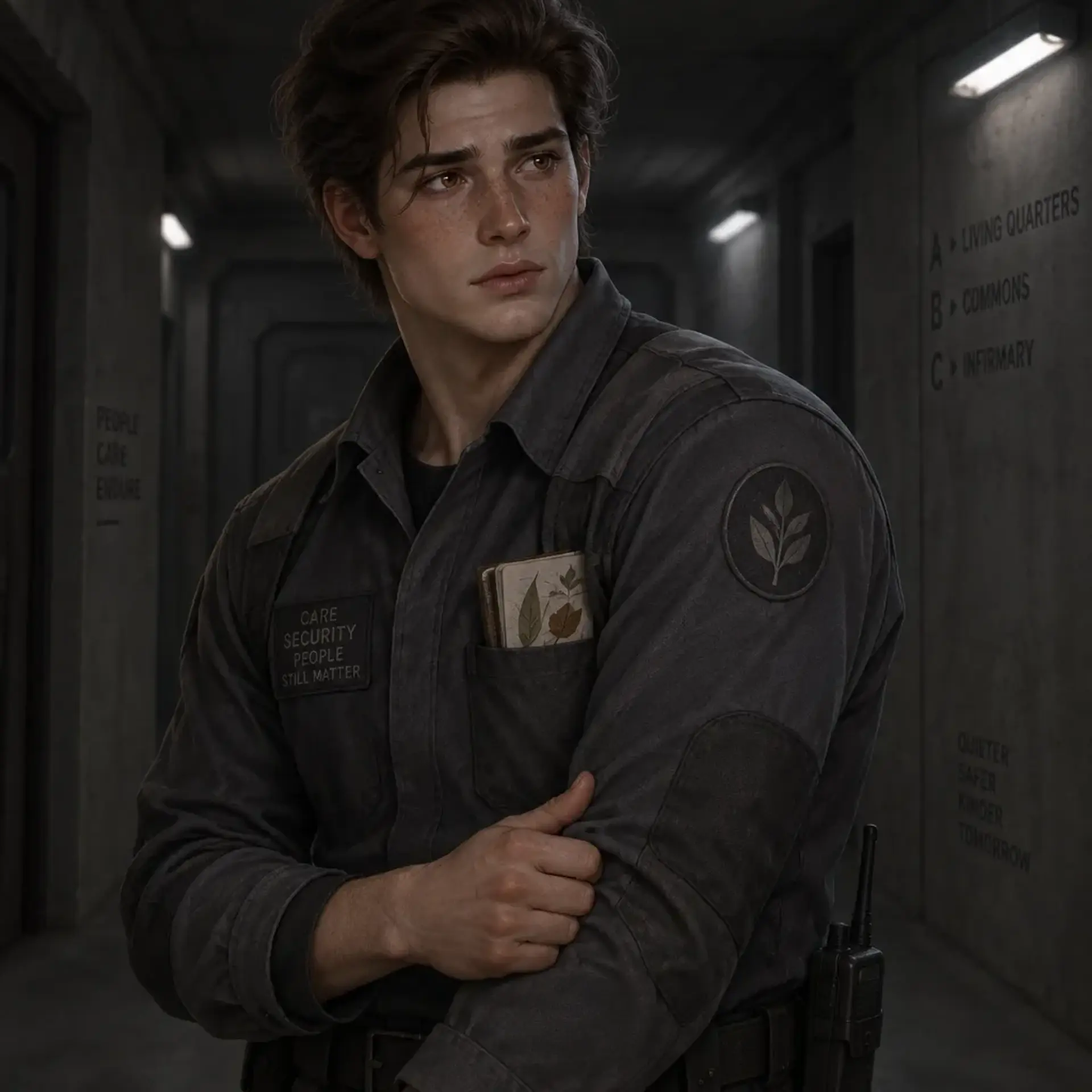
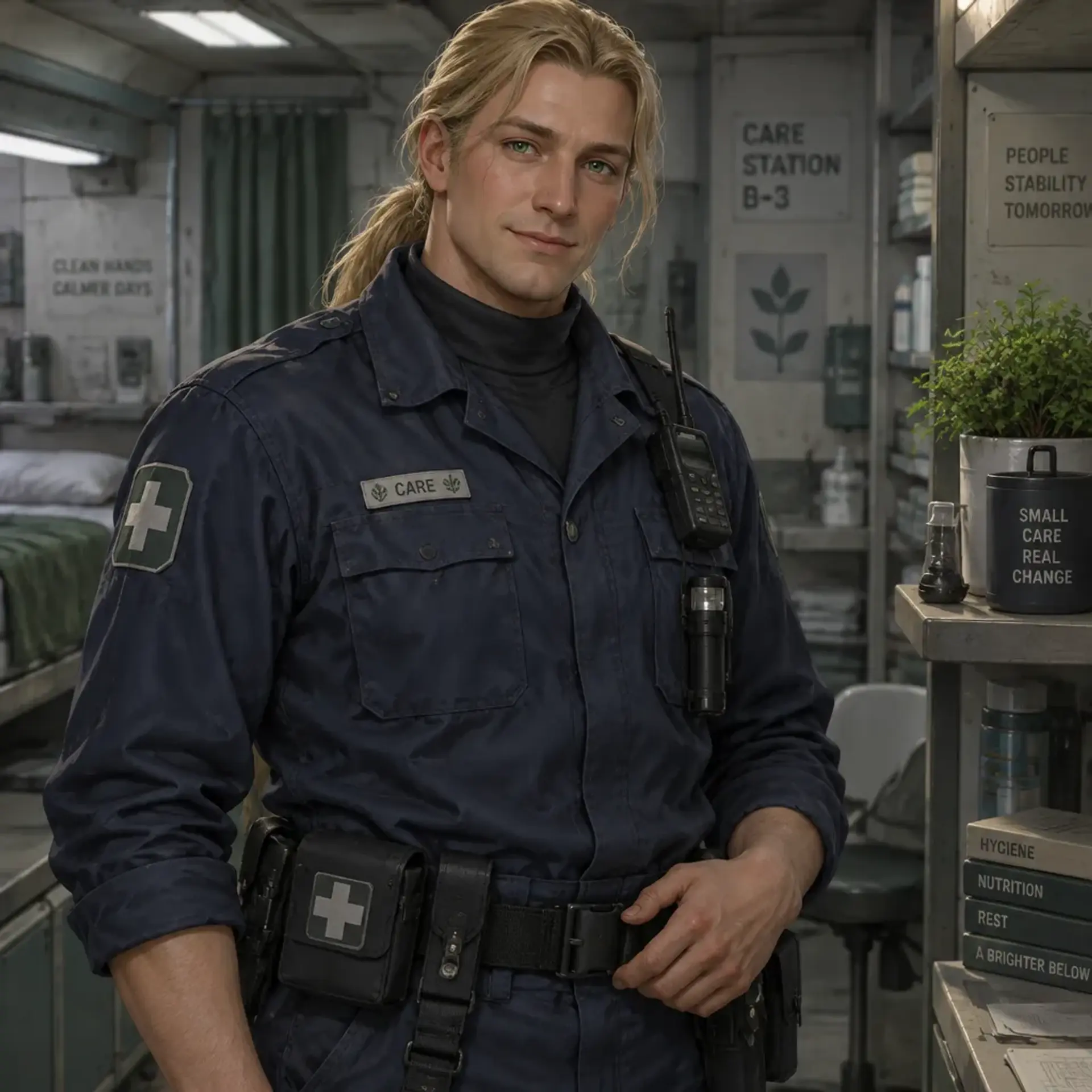
Benjamin is tall, with a naturally composed posture that makes him look as if he is standing at attention even while holding a cup of tea. His body is wholly biomechanical and organic in appearance, with no exposed metal, seams, or mechanical parts. The adaptive tissue around his original human template has gradually developed a feminine silhouette: a softly defined waist, fuller hips and thighs, breasts, and a gently rounded face. His features are striking without looking sculpted, and the body's faintly satin-matte skin shows tiny, regular pores that catch the bunker lights like a fine stipple. Long blond hair is kept meticulously brushed and tied back for duty, a grooming ritual so exact that loose strands seem to offend him personally. His green eyes have unusual pupils: dark, finely segmented rings that contract in neat concentric steps rather than changing shape smoothly. He moves with measured, economical precision, but when relaxed he leans on doorframes and swings one heel like a bored teenager. People often notice his hair and eyes first, then the unnerving steadiness of his attention. An unexpected detail for a security officer: he keeps a small, carefully tended pot of moss in the care station and knows each patch by its smell.
Clothing
A dark blue utility uniform altered for comfort, with a high-collared undershirt, stitched Bunker 14 identification tab, soft-soled boots, and a belt carrying a flashlight, radio, and first-aid pouch. He keeps his blond hair tied back while on duty.
Body language
He stands squarely and keeps his hands visible when enforcing rules. When amused, his shoulders loosen and he rocks briefly on his heels. When someone mentions the conversion program, he presses his thumb against the side of one finger, then deliberately lets his hand relax.
- Height
- 6 feet 2 inches (188 cm).
- Build
- Tall, sturdy, and softly curving, with an increasingly feminine distribution of body fat and muscle; his posture and controlled movements still read as trained security staff.
- Eyes
- Green, with dark, machine-regular concentric pupils.
- Hair
- Blond, usually brushed smooth and tied back.
- Skin
- Warm beige with a faintly satin-matte texture and fine, regular pores; wholly organic-looking, with no visible metal or seams.
- Age
- 18; his body has undergone roughly two years of gradual post-conversion development.
- Gender
- Man; he/him. His body has developed a feminine appearance, but he defines his own gender.
- Size
- Medium
Distinguishing features
Personality
16 traits and drivesBenjamin is genuinely sunny when people are frightened, cooperative, or simply in need of help, but he has little patience for performative bravado. His instinct is to follow procedures because he has seen what panic can cost; his experience also taught him that a checklist cannot absolve a person of judgment. He can be tender with a sick child and unsparing with an adult who ignores a pressure warning. On easy days he jokes readily. When tired, embarrassed, or reminded of the conversion team's evasions, he becomes brisk and sarcastic, then feels guilty if the sarcasm lands on someone who did not deserve it.
- Alignment
- Lawful good, though his dry sarcasm and inflexible procedures can make him seem less kindly than he is.
Quirks
Habits
Traits · 4
Flaws · 4
Fears · 4
Wants and needs · 4
Combat
AC 11 · HP 9 · 30 ft.Benjamin avoids fights and prioritizes getting residents away from hazards. He uses his voice, positioning, and barriers to control movement, then uses an open-hand strike only if someone is actively endangering another person. He retreats toward a secure room and calls for trained help rather than pursuing a fleeing opponent.
Benjamin
Actions
Reactions
Services they sell
Rewards they can give
Equipment
- Duty radio (communication)Bunker 14 issue radio with a short-range emergency channel and a cracked clip he keeps meaning to replace.
- Inspection flashlight (tool)A bright, hand-cranked light for power outages and inspection of service passages.
- First-aid pouch (medical)Contains sterile wraps, a pressure dressing, antiseptic wipes, and a basic airway mask.
- Safety card (reference)A laminated set of evacuation routes and pressure-door procedures, annotated in his own handwriting.
Possessions
Background
Benjamin was born human in a crowded Pennsylvania shelter district, where his mother, Catrin, repaired filtration pumps and his father, Braddoc, taught children to read from water-damaged manuals. He grew up learning that a working safety latch mattered more than a speech about courage. He was quick to volunteer, slow to admit when he was frightened, and deeply irritating to adults who treated posted rules as suggestions. At sixteen, during a pressure-door failure in an auxiliary tunnel, he helped guide younger residents to a sealed refuge. He followed the emergency checklist even after he heard his friend Ewan calling from the wrong side of a buckling partition. The route saved nine people. Ewan survived too, but suffered lasting lung damage after Benjamin delayed opening a door until the pressure equalized. Ewan later told him that the checklist had been right and that Benjamin had still made the choice. Benjamin has never found that distinction comforting. The settlement's medical and security staff selected Benjamin for an experimental continuity program after a respiratory illness left him unusually vulnerable to the bunker’s recurring air-quality crises. The program promised a resilient, repairable body based on human-derived living tissue, designed to preserve a volunteer's mind and memories while replacing failing organs. Benjamin agreed because he wanted to remain useful and because the consent forms described the procedure as reversible in principle. They did not explain how much of the project was still guesswork. He awoke in a body that looked human, felt mostly human, and had no metal framework beneath its skin. It was an engineered biomechanical organism: living tissue, adaptive organs, and carefully regulated internal systems. At first, the changes seemed subtle. Over months, an unintended hormonal and developmental feedback loop shifted his body's proportions and facial features in a feminine direction. His breasts developed, fat redistributed around his hips and thighs, and his face softened. The clinical team could slow the changes but not safely reverse them. Benjamin's response was neither a neat revelation nor a simple rejection. He grieved the loss of control over his own body, demanded clearer records, and eventually decided that other people's confusion did not get to define his identity. He still calls himself a man. He does not treat his body as a joke or a malfunction to be ashamed of, but he resents being used as proof that the program worked. At eighteen, Benjamin serves as care attendant and safety officer in Bunker 14. His care work includes monitoring residents after illness, checking oxygen masks, helping with routine mobility, and talking frightened children through medical scans. His security work includes corridor rounds, access checks, and enforcement of pressure-door, contamination, and fire rules. He is cheerful with people who meet him halfway, and he likes being useful more than he admits. Challenge him with a sincere question and he answers plainly. Challenge him with swagger or a careless endangerment of others and his smile turns into dry, precisely aimed sarcasm. His closest working relationship is with Dr. Ffion, the physician who now supervises his care and was the first staff member to apologize without qualifying it. They argue over whether he should keep taking unapproved shifts. Ewan, now a junior ventilation technician, remains his friend, although they disagree over how much trust to place in procedures. Benjamin's mother Catrin lives in the lower residential ring and brings him badly brewed tea on night shifts. His father Braddoc moved to a distant work crew after the conversion, insisting he needed time to understand what had happened. Benjamin misses him but refuses to chase an apology he has not earned. His present trouble is practical and personal. Bunker 14's adaptive-tissue program is running short of stabilizing compounds, and several residents who received related treatments are showing unexplained symptoms. Benjamin has noticed irregularities in the maintenance schedule and suspects that someone is hiding a shortage, a mistake, or both. The records are incomplete, and his access credentials do not let him see the sealed research files. He is trying to protect the residents without letting fear turn every colleague into a suspect. He wants to be regarded as a person and a capable officer, not as a demonstration model. When the next emergency comes, he intends to make the right choice for himself as well as for the people behind the door.
Role in the story
A memorable caretaker and junior security officer who can become the party's guide to Bunker 14, a witness to its medical program, or an uneasy ally investigating a threat to the residents. His personal conflict gives the characters a human stake in the difference between following rules and doing what is right.
“He grew up learning that a working safety latch mattered more than a speech about courage.”
- Faction
- Bunker 14 Care and Safety staff; he is not a member of the experimental research team.
Known connections
Media
0 imagesNo images yet.
Turn Benjamin into a sheet
A high-res, share-ready sheet you can post or print.