Austin
Austin
At the table
“The official record says”
Voice
Austin's voice comes from living vocal tissue supported by a subtle internal resonance system. It has a warm, slightly grainy edge, as if shaped by years of dust, recycled air, and announcing safety instructions through old corridor speakers. The Texan vowels are thick and unforced. His work taught him to place important words cleanly; his family taught him to let a sentence wander when there is time.
He speaks in a thick Texan drawl shaped by Bunker 14's old public-service recordings. His sentences have a measured rise and fall, with crisp pauses that make instructions easy to follow over alarms. The cadence is learned rather than built into his body. When tired, he draws out vowels and drops into more familiar country phrasing; when angry, he becomes precise and formal, and his jaw tightens.
Speech patterns
How to play them
Approach with a practical question or offer of help rather than demanding his history. He responds well to directness, respect for his bodily autonomy, and people who protect others without seeking praise. If asked about the treatment years, acknowledge that official accounts may be incomplete. He will test whether the questioner can keep confidence before sharing sensitive evidence.
Goal
Make the treatment-years records accessible to residents, prevent another coercive trial, and discover who is tampering with the pressure sensors.
Motivation
Austin wants to prove that care is more than keeping people alive. To him, it means respecting their choices, remembering their needs, and telling the truth even when the truth complicates security.
Appearance
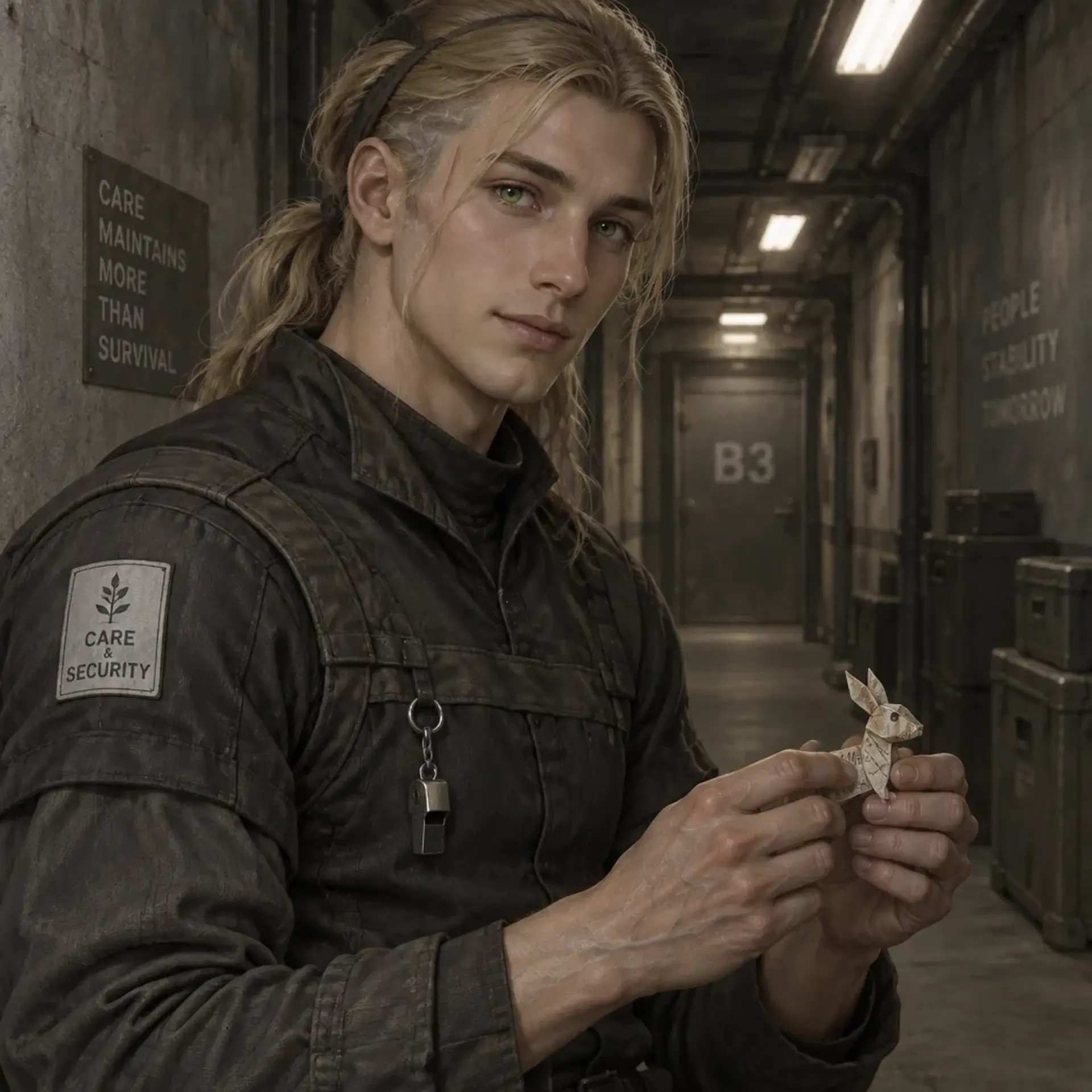
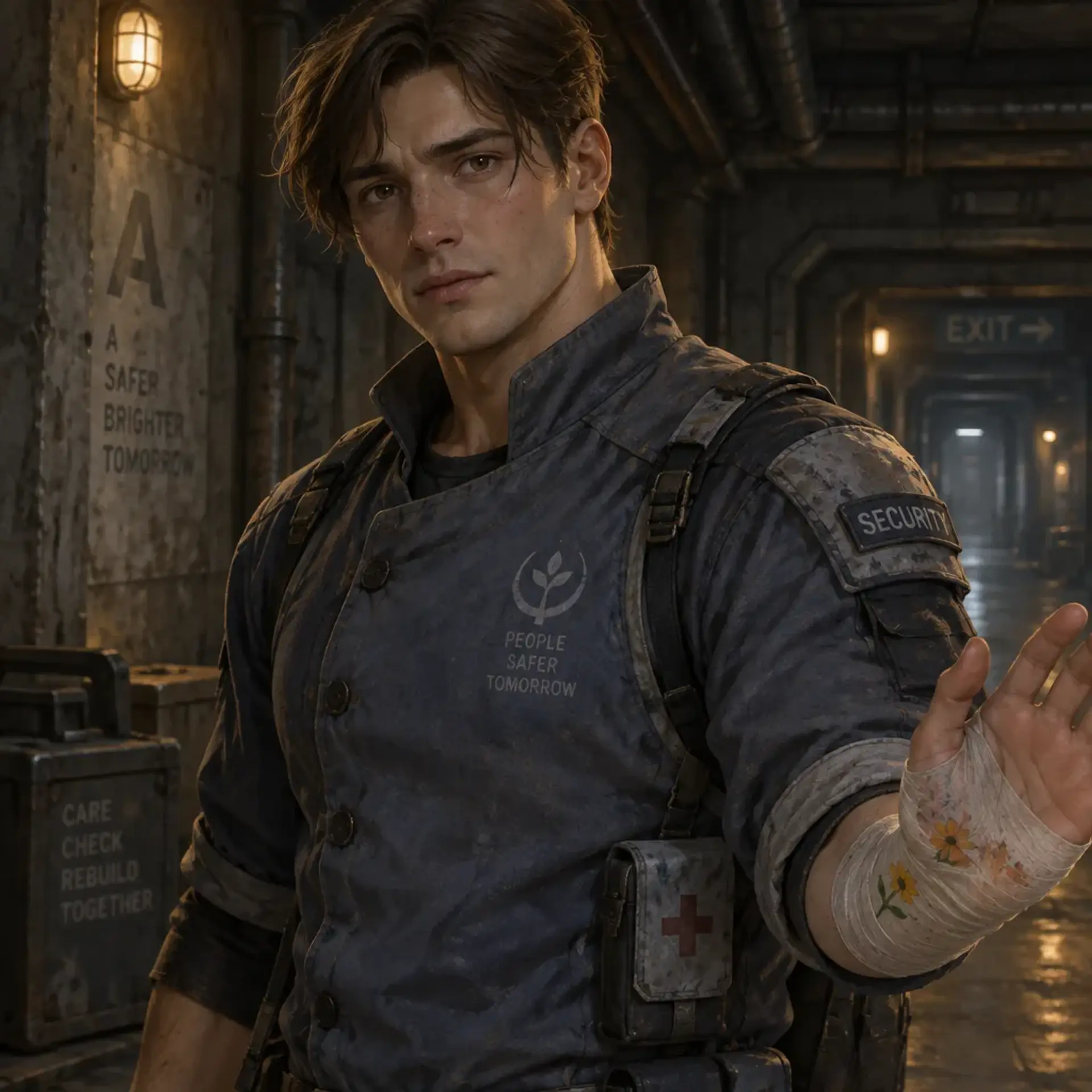
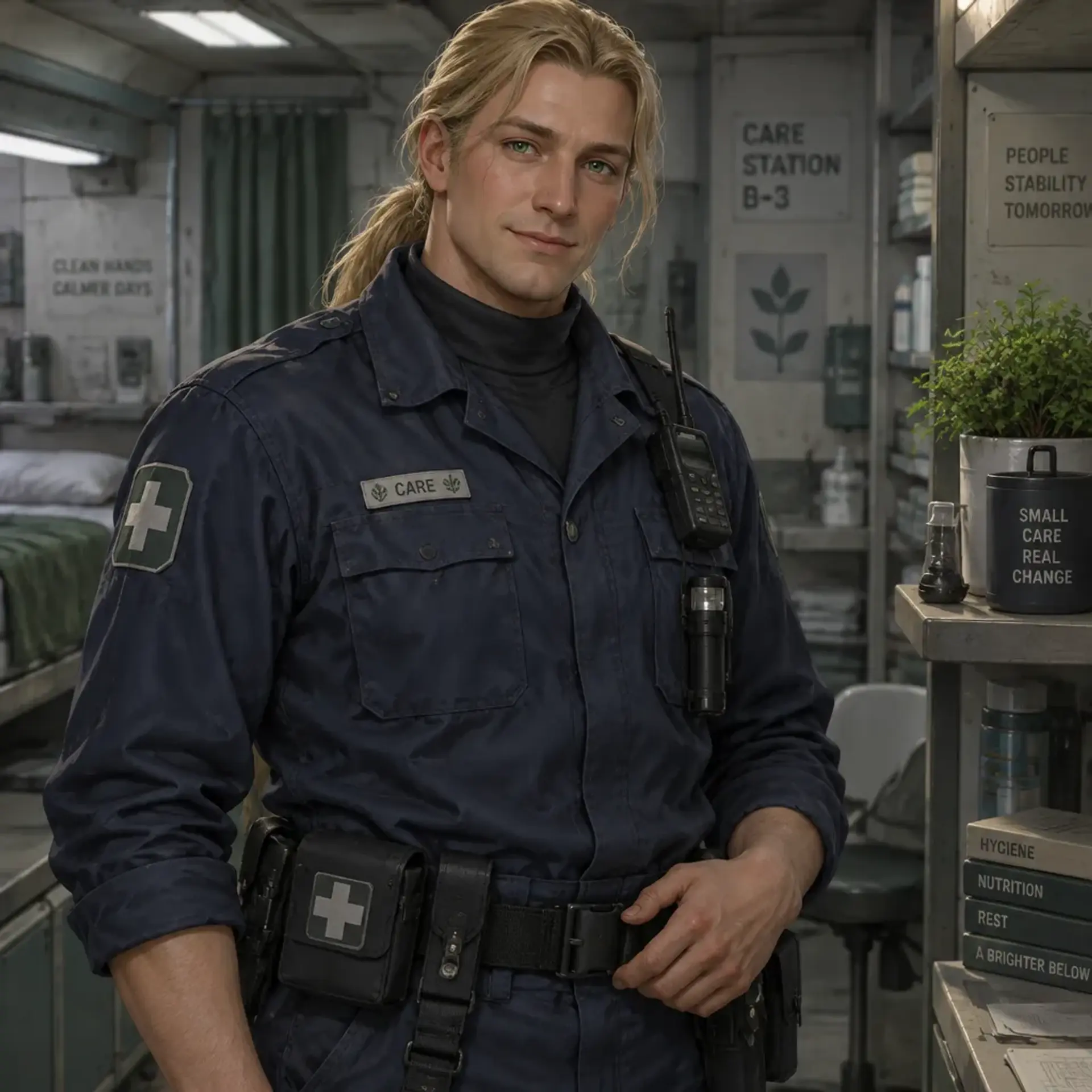
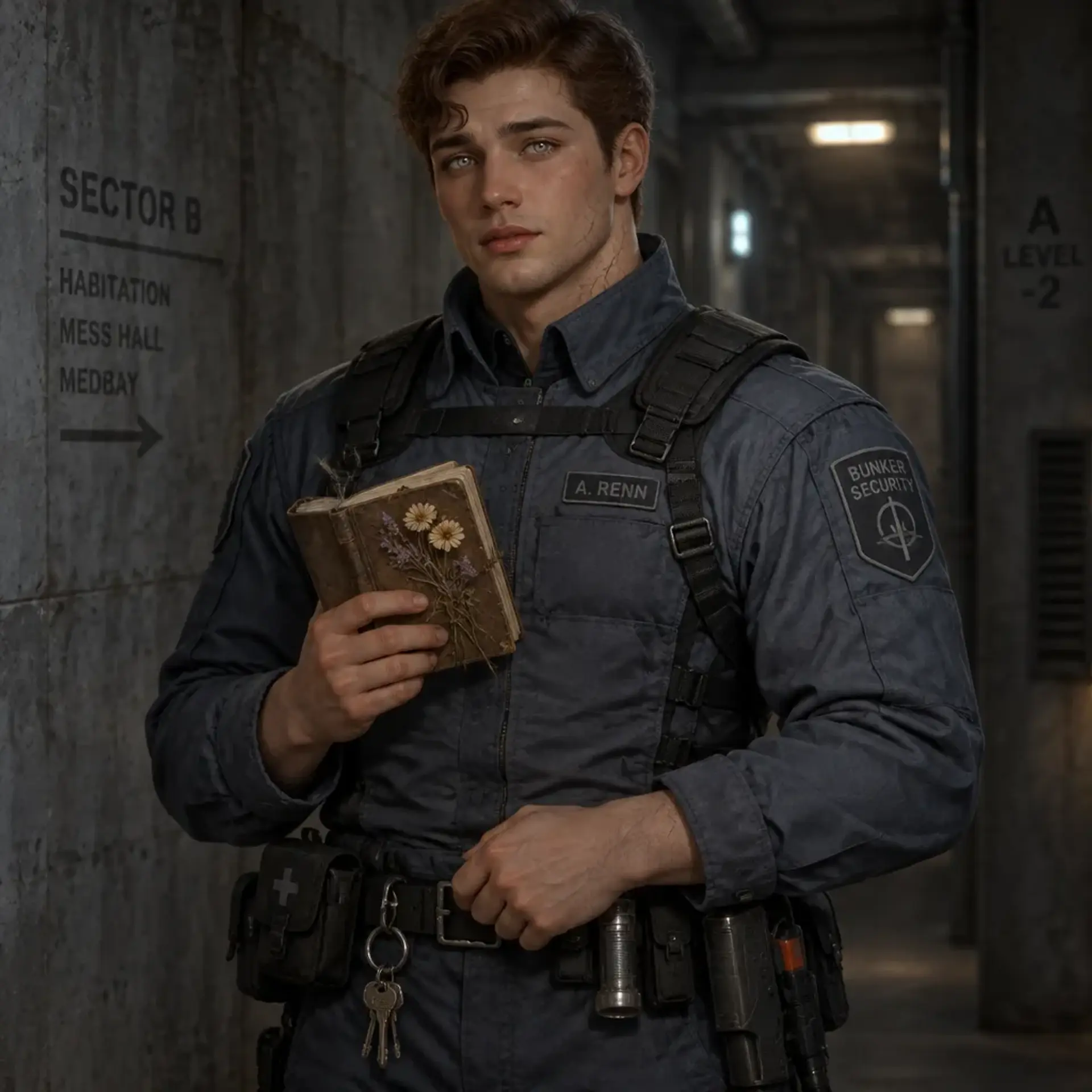
Austin is tall and takes up space without seeming to notice it. His posture is upright and service-ready, but his weight settles slightly toward his left heel, making his first step look like a gentle sidestep before he moves forward. He walks with a smooth, nearly silent glide, then plants each foot with a faintly organic compression, like a person carefully testing a floorboard. His face has a soft, feminine shape: rounded cheeks, a tapered jaw, full lips, and a composed brow that makes his practiced security stare look oddly tender. His body has developed predominantly feminine contours, including full breasts and broadening hips, as the living tissues in his replacement body continue to mature. The change is visible beneath his uniform, which he adjusts for comfort rather than concealment. His skin is pale, warm to the touch, and subtly textured with fine pores and faint branching patterns beneath the surface, like delicate veins under translucent wax. There are no metal plates or exposed mechanical parts. His brown hair is thick and carefully combed, though a stubborn curl always lifts above his right temple. His brown eyes hold pale glowing pupils, bright as pinpoints behind smoked glass. He leaves the impression of a reassuring emergency announcement given a human face: useful, watchful, and more vulnerable than his uniform suggests. An unexpected detail for a security officer is that he keeps a pocket-sized book of pressed flowers and can identify several by touch.
Clothing
A blue-gray Bunker 14 service uniform tailored for movement, with a high collar, padded shoulders, and a belt holding medical supplies and restraint gear. He wears a loose overshirt when off duty and keeps a pressed-flower booklet in its inner pocket.
Body language
He stands as though making room for a crowd, even in an empty corridor. In conversation he angles his shoulders toward the nearest exit while keeping his face turned to the speaker. His left heel takes most of his weight. When uncertain, his fingers trace the seam of his sleeve; when angry, his jaw sets and the pale glow of his pupils intensifies.
- Height
- 6 feet 3 inches
- Build
- Tall, sturdy, and increasingly curvy, with broadening hips and full breasts. His soft-looking silhouette conceals dense, responsive muscle and a living internal support lattice.
- Eyes
- Brown with pale glowing pupils
- Hair
- Brown, thick, and carefully combed, with one persistent curl above his right temple
- Skin
- Pale, warm-toned living tissue with fine natural pores and faint branching patterns beneath the surface
- Age
- 18 years old. He was born human and selected for conversion as a teenager; his current body is a developing biomechanical replacement.
- Gender
- Man; he/him. His body has developed predominantly feminine characteristics, which do not alter his gender.
- Size
- Medium
Distinguishing features
Personality
16 traits and drivesAustin is protective but not blindly obedient. He is warm in small, practical ways and guarded about anything that makes him feel like a specimen. He can be patient with a scared child, brisk with a reckless adult, and unexpectedly funny when the danger has passed. In a crisis he trusts routines; afterward he questions whether those routines helped the right people. He wants others to see him as a whole person, yet often makes himself useful before allowing anyone to know him.
- Alignment
- Lawful good, though his faith in Bunker 14's authorities is fraying.
Quirks
Habits
Traits · 4
Flaws · 4
Fears · 4
Wants and needs · 4
Combat
AC 12 · HP 9 · 30 ft.Austin prioritizes evacuation, cover, and restraint over injury. He puts himself between attackers and residents, calls out clear routes, and uses his launcher to disable a threat at range. He avoids pursuing fleeing opponents and will surrender ground rather than fight near children or patients.
Austin
Actions
Reactions
Services they sell
Rewards they can give
Equipment
- Restraint launcher (weapon)A padded launcher and two restraint capsules for nonlethal security work.
- First-aid kit (medical equipment)A compact medical pouch with bandages, disinfectant, and basic stabilizing supplies.
- Service keys and lamp (security equipment)A ring of access keys and a small light used during patrols.
- Flower book (personal)A worn booklet holding pressed flowers, each tagged with a date and location.
- Kest's seed envelope (keepsake)A sealed, handwritten seed envelope that belonged to his father.
Possessions
Background
Austin remembers being human in fragments: a kitchen table with a chipped corner, the hiss of rain on a ventilation hood, and his mother calling him in from the yard before the storm sirens began. He was born in the settlement now called Bunker 14, in the years when its inhabitants still argued about whether they were rebuilding a town or merely surviving inside its concrete shell. His mother, Tülk, repaired water pumps. His father, Kest, worked the ration gardens and believed that every child should learn one useful skill and one useless one. Austin's useless skill was identifying flowers. His useful one became calming frightened people. At twelve, Austin was caught in a pressure-door failure during a maintenance alarm. A latch buckled while a corridor was crowded with residents fleeing a ventilation fire. Austin helped an older neighbor and two younger children through the gap before the door dropped. It crushed his chest and badly damaged his lungs. The clinic kept him alive, but the damage worsened over the next year. His family was told that a new kind of biomechanical support body might preserve his life. The proposal came from Bunker 14's medical and security board, which was seeking a young volunteer for a long-term integration trial. Austin was not born an android, and he did not volunteer with a full understanding of what the word would mean. He was fourteen, scared, and convinced that refusing would make his parents lose the only chance to save him. His parents agreed after being promised that the new body would be reversible and that Austin could return to ordinary medical care if the trial failed. Neither promise was written in the consent copy they were allowed to keep. The operation replaced most of his failing organs and much of his damaged body with cultured living tissue, synthetic nerve structures, and a flexible internal support lattice. It was biomechanical, not metallic: warm skin, muscle-like fibers, and soft organs designed to accept his mind and nervous system. At first, he woke in a body made to resemble his old one closely enough that the nurses told him he would hardly notice the difference. He noticed everything. His balance was unfamiliar. His sense of pressure came back in strange patches. He could feel the pulse of pumps through the clinic floor, but could not tell whether he was hungry or merely overdue for a nutrient supplement. His voice carried a slight artificial steadiness, and his eyes developed pale glowing pupils when the body's internal systems were under strain. The first time he saw them in a mirror, he asked whether they could be switched off. The technician said they might fade with adjustment. They did not. The trial's unintended problem appeared gradually. Austin's body was built from living tissues that continued to respond to ordinary growth signals, but the conversion protocols had not correctly accounted for how those signals would interact with the replacement endocrine system. Over several years, his body developed increasingly feminine proportions: his face softened, his hips broadened, and his chest grew full. The medical board called it a benign tissue-expression variation and assured him there was no immediate danger. Austin's own feelings were more complicated. Some days he studied his reflection with a wary curiosity; other days he resented the way the board discussed his body as if it were a machine configuration. He chose the name and pronouns he uses now, and he wants people to understand that his body is his, even if its changes began as an accident. His physical therapy became security training because he had an unusual steadiness under pressure. The board wanted a visible success story: a young person saved by the trial, now protecting the community that saved him. Austin was assigned to care and security, an awkward combination that suited him better than anyone expected. He learned access routines, emergency drills, restraint techniques, first aid, and the names of nearly every resident who needed help navigating the settlement. He also learned how to make instructions audible over alarms. The public-service rhythm in his speech began as a coping device. When panic rose, he copied the steady announcements he had heard during the pressure-door disaster. If he sounded calm, he believed, perhaps someone else would have time to be afraid later. The formative event that changed him happened at sixteen. A group of residents asked for records of the treatment years, a phrase used for the period when the settlement's medical board recruited children into experimental procedures. The official response was that the archive had suffered a storage failure. Austin knew this was false. During a night patrol, he had seen the archive's old cabinet moved into a sealed utility room. He brought the residents a maintenance key and stayed at the door while they searched. They found appointment lists, assessment notes, and copies of consent forms. Austin found his own file. It recorded that his family had not been told about the risk of continued tissue development, and that a board member had advised staff to describe the procedure as reversible despite contrary internal notes. He could have taken the file and hidden it. Instead, he helped copy the records and left the original where it was. He believed that stealing the evidence would let the board claim it never existed. The discovery caused a public dispute that lasted months. The board punished no one openly, but Austin lost his unsupervised access to the medical wing. His mother stopped speaking to him for three days, not because she blamed him, but because she was terrified he had made himself a target. His father supported the disclosure and then quietly asked Austin to stop standing between the powerful and everyone else. Austin has never managed that. Today he cares for residents whose needs are routinely overlooked. He reminds children to drink after exercise, escorts patients to appointments, checks whether the old ventilation grilles are vibrating, and walks the outer passages at night. He is good at remembering practical details: who cannot use the eastern stairs, whose medicine tastes better with warm water, which door sticks when the air is damp. He is less good at noticing when people are offering him care in return. When asked about the treatment years, his jaw tightens and his eyes brighten. He gives a neat answer first, then a truer one if he trusts the questioner. Austin's closest relationship is with his mother, Tülk, who repairs pumps in the lower service bay. They love one another but argue about risk. She believes survival means keeping the settlement intact until it is strong enough to change; Austin believes that silence is already a kind of damage. His father, Kest, died two years ago during a ration-garden disease outbreak. Austin still carries one of Kest's seed envelopes, although its seeds are too old to plant. He is also close to Köz, a young apprentice technician who has begun finding unexplained discrepancies in the clinic's supply records. Austin worries that Köz is uncovering another hidden experiment and has asked them not to investigate alone. Köz has ignored that advice. Bunker 14's current problem is a string of unexplained failures in the settlement's pressure sensors. Each failure has been small, but together they create dangerous blind spots in the outer corridors. The board calls them age-related faults. Austin suspects someone is deliberately testing the security system, perhaps to reach a room connected to the treatment archive. He wants to protect residents without becoming the board's instrument or exposing frightened people to retaliation. He is torn between procedure and conscience, and between the wish to be regarded as a person and the comfort of being useful enough that no one can discard him. He has no grand plan to escape. He wants the records made public, the clinic made accountable, and Bunker 14 to become a place where a child can say no without needing to be brave.
Role in the story
A grounded ally and ethical pressure point in Bunker 14. Austin can guide the party through the settlement, provide aid, and reveal evidence of institutional wrongdoing. His investigation into the failing pressure sensors can draw the characters toward a hidden archive, a threatened resident, or a confrontation with the board.
“His father, Kest, worked the ration gardens and believed that every child should learn one useful skill and one useless one.”
- Faction
- Bunker 14 Care and Security staff. His position gives him duties to the settlement, but he does not consider himself loyal to the medical and security board.
Known connections
Media
0 imagesNo images yet.
Turn Austin into a sheet
A high-res, share-ready sheet you can post or print.