
What Do People Actually Make With AI D&D Generators?
I analysed 3,750 public AI-generated entities. What do people actually make with AI D&D generators? Mostly civilians, villages and taverns, not boss fights.
On 18 August I pulled the newest 750 public entities for each of five types off CharGen: NPCs, monsters, settlements, magic items and taverns. That is 3,750 records. I wanted one answer. What do people actually make with AI D&D generators when the effort cost of making it drops to nearly nothing?
The answer is not what the AI-slop argument predicts. People do not mass-produce dragons and demigods. They make barkeeps, villages and taverns. They make session texture.
This is the State of AI-Assisted TTRPG Creation 2026, my first annual report. I run CharGen, so I am close to both the tool and the people using it. That makes this useful and limited at the same time. I can count what people published. I cannot see the private prompts behind it, and I cannot claim that any single change caused any single shift. Every figure below is an aggregate across anonymised public entities. No creator and no individual entity is named.
The human default collapsed in five weeks
In mid-July, half of all AI-generated NPCs were plain Humans. Today a quarter are.
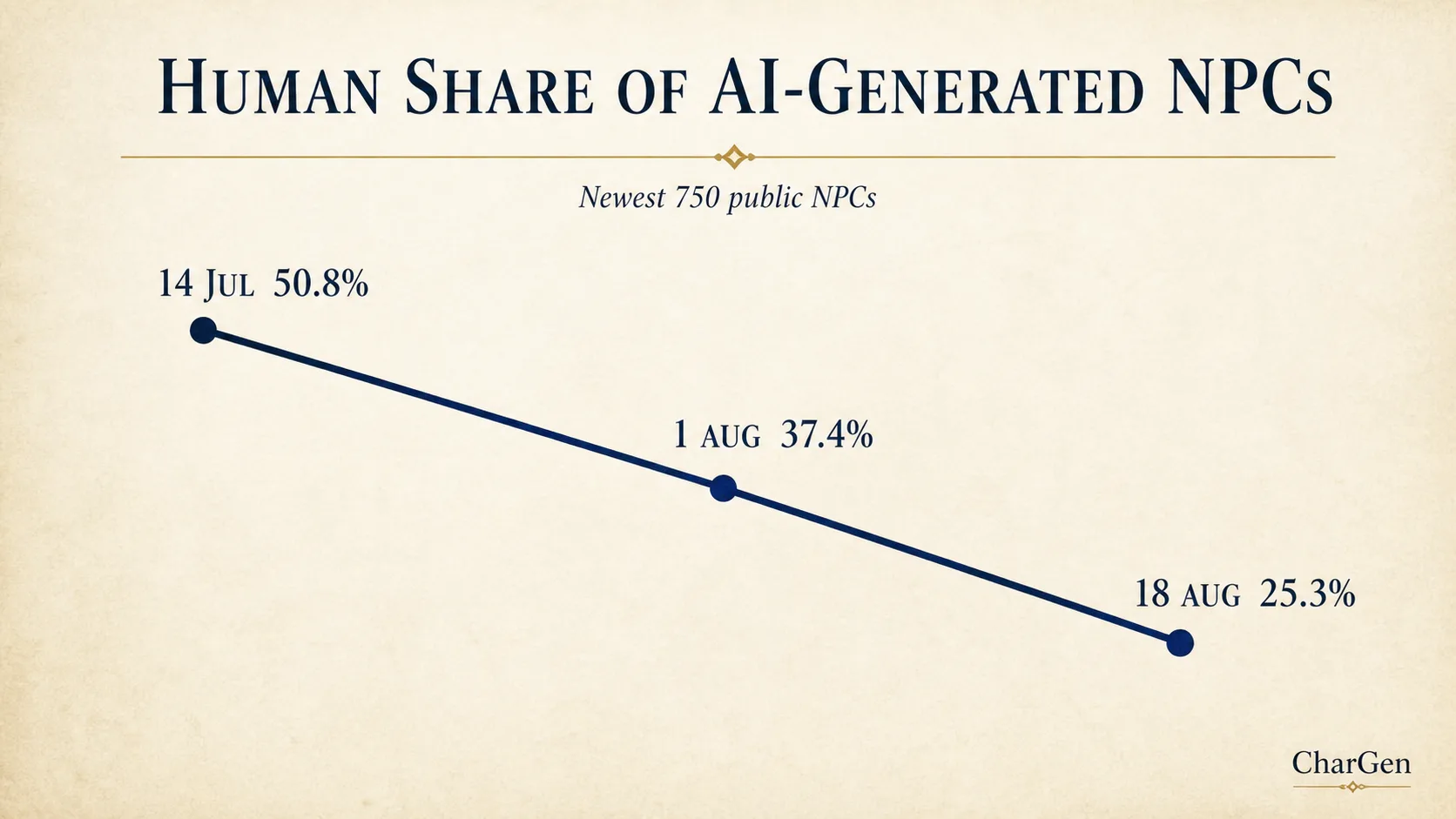
Human sits at 25.3% of the newest 750 NPCs. Tiefling is second at 11.9%. Rock Gnome takes 8.4%, and the clockwork Gearforged 6.5%. Dwarf, once the reliable runner-up, is down to 4.9%. The sample carries 123 distinct race labels.
I covered the first half of this drop in August's NPC data study and the original 50.8% baseline in July's. The short version: the human default is not shrinking because anything decided it should. It is shrinking because the labels are getting more specific. "Gold Dragonborn" and "Red Dragonborn" now appear as separate entries, at 3.2% and 2.8%. Splitting a category makes every piece smaller.
Read the three-month line honestly. The sample windows differ, the sample sizes changed from 500 to 750, and nothing here was randomised. This is a before-and-after comparison, not a controlled experiment.
| Metric | 14 Jul | 1 Aug | 18 Aug |
|---|---|---|---|
| Total public entities | 39,241 | 44,933 | 49,824 |
| Human share of NPCs | 50.8% | 37.4% | 25.3% |
| Two-word NPC names | 82.2% | 81.8% | 65.2% |
| Humanoid share of monsters | 42.6% | 22.8% | 31.7% |
| One-word settlement types | n/a | 51.0% | 37.1% |
| Median settlement population | 4,500 | ~1,200 | 1,100 |
Public AI-assisted creation runs at about 300 entities a day
CharGen's public gallery held 39,241 entities on 14 July, 44,933 on 1 August and 49,824 on 18 August. That is 10,583 new public records in 35 days, or roughly 300 a day.
Those are only the ones set to public by their creators. The real figure is higher. Even so, a single indie tool is producing a six-figure annual volume of shareable tabletop content.
What Game Masters actually generate
This is the part that surprised me.
Most NPCs are civilians
37.5% of the newest 750 NPCs are level 0. Another 11.7% are level 1. Nearly half the cast has no combat build at all.
Level 0 is not a player option. It is the tag for someone who does not fight: the innkeeper, the harbourmaster, the nervous clerk. Game Masters are spending their generation budget on the people the party talks to, which is where session prep time actually goes.
Monsters are rank and file, not set pieces
Only 8.4% of generated monsters carry a boss tag, and 2.4% a legendary one. Humanoid leads monster types at 31.7%, with Outsider at 11.1% and Monstrosity at 9.8%.
Humanoid was 42.6% in July and 22.8% at the start of August, so it has moved around a lot. I would not read a trend into three points on one field. What holds steady is the shape: people generate the encounter's supporting cast far more than its finale.
Settlements are villages, not capitals
The median population across 750 settlements is 1,100. The mean is 12,924, dragged up by a tail that reaches 480,000.
The 2024 free rules on D&D Beyond put villages up to about 1,000 people and towns from 1,000 to 6,000. So the median AI-generated settlement is the smallest kind of town, the sort of place with one temple, one smith and a reason for the party to stop. Town is the most common label at 11.9%, then Village at 9.1%. Metropolis manages 4.4%.
Generate an NPC or settlement freeThe tidy fields are turning into prose
Every structured field in the dataset is drifting away from being structured. This is the strongest pattern in the whole report, and it shows up in four places at once.
Class has stopped being a class. The 750 NPCs carry 444 distinct class strings. The 2024 Player's Handbook lists twelve classes. Plain "Fighter" is 2.0% of the sample, and "Fighter, Battle Master" beats it at 3.5%. Sorcerer leads outright at 11.1%. People are recording builds and subclasses, not picking from a list.
Challenge Rating has become a sentence. Across 748 monsters there are 319 distinct CR strings. Only about a third are a plain number. "CR 1" covers 25.1%, but the rest include "High", "Low", "Deadly", "Low to moderate", "Deadly solo boss" and "CR 3, 700 XP". A few are in German. CR is defined in the rules glossary as a single number for encounter maths, and it is the most spreadsheet-friendly field in a stat block. It is turning into a threat assessment.
Population is a demographic paragraph. Not one of the 750 settlements records a bare number. All 750 population values are distinct, because every one is written out as a description of who lives there and how they live.
Settlement types are compounding. Only 37.1% of type labels are a single clean word, down from 51.0% on 1 August. 35.9% now run three words or longer. The sample includes "Cloud-island metropolis and agrarian giant kingdom". There are 425 distinct type labels for 750 settlements.
I find this genuinely interesting as a product signal. I built these fields as dropdowns in spirit. People are using them as notes fields. When the cost of writing detail drops, detail is what people write.
Taverns solved naming; NPCs are drifting
95.9% of tavern names run three or more words. Only 3.7% are two words and 0.4% are one.
No other entity type in the dataset comes close to that level of agreement. "The Adjective Noun" formula and its cousins are near-universal across 750 taverns. Nobody generates a tavern called "Bill's". The convention is locked, and people follow it without being told to.
NPC naming is going the other way. Two-word "Firstname Surname" names held at 82.2% in July and 81.8% in early August. In the newest sample they are down to 65.2%, with three-plus-word names up to 24.3%. Epithets and titles are creeping in. Census style is losing ground to legend style.
Magic items sit closer to taverns. 68.8% of item names run three words or more, so the "Blade of the Weeping Moon" pattern is the default rather than the flourish. Item rarity shows real inflation: 58.7% of the newest 750 magic items are Rare, against 15.6% Uncommon and just 2.9% Common. The free rules suggest uncommon items suit tiers around levels 1 to 4. Almost nobody is generating those. Wondrous Item dominates the type field at 43.1%, ahead of weapons at 18.0%.
If you want a quick sanity check on your own loot table, that Rare-heavy split is worth a look. My magic item generator will happily give you Rare all day, because that is what people ask it for.
Tuesday is prep night
20.2% of the 3,750 sampled entities were created on a Tuesday. Sunday is second at 16.2%. Wednesday is the quietest day at 8.6%.
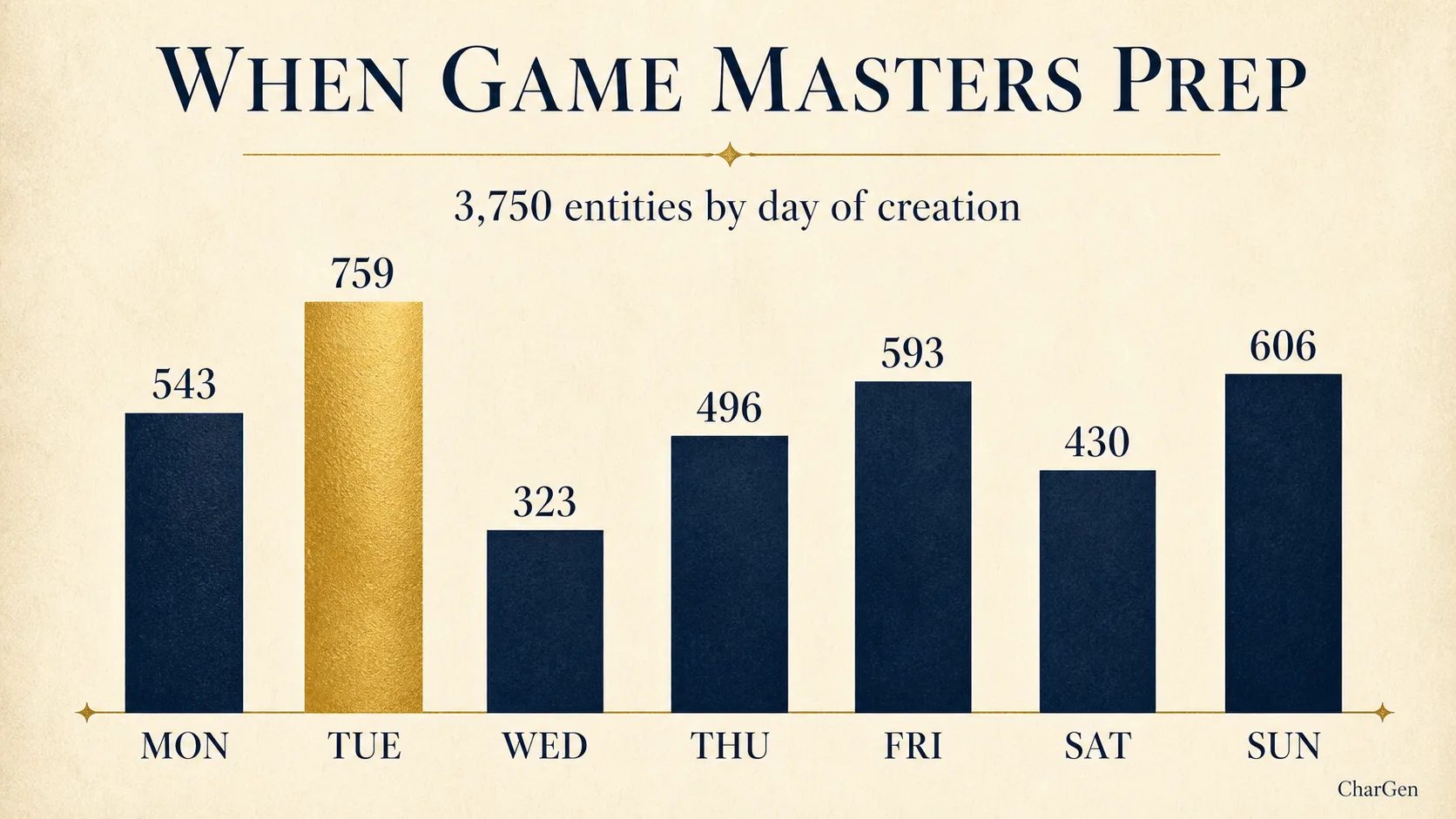
The rhythm matches the classic weekend-session cycle. Prep peaks two days after the table breaks up, while the last session is still fresh, and again on Sunday before the midweek game. The Wednesday trough is the night people are playing rather than preparing.
There is a caveat. Creation timestamps are recorded in UTC, so a late-evening Monday session in the Americas lands on Tuesday in this count. The weekday pattern is real. The exact day boundary is fuzzy.
A small core produces most of the output
The 3,750 entities come from 637 distinct creators. The ten most prolific account for 62.4% of that volume.
That concentration varies enormously by type. The 750 taverns come from 418 different people, so tavern generation is broad and casual. The 750 NPCs come from just 55, so NPC generation is deep and repeated. People dip in for a tavern. They come back again and again for a cast.
AI-assisted worldbuilding behaves like every other creative tool here. A passionate core produces most of what gets published, and a long tail visits once.
What I changed in my own prep after reading this
Three things.
I stopped generating monsters first. The data says my sessions need civilians more than they need threats, and my own prep notes agreed once I looked. I now build the NPC roster before the monster roster.
I stopped fighting the prose fields. I used to retype "1,100" over a population paragraph to keep my notes tidy. The paragraph is more useful at the table than the number. Ten months of my own tidying was wasted effort.
I moved my prep to Sunday. Not because Tuesday is wrong, but because Tuesday is when I was rushing. The data made the pattern visible enough to argue with.
If you want to check any of this against your own table, the settlement generator and token maker both sit on the free tier, which runs on gold and needs no card to start.
How I gathered the data
Samples come from CharGen's public entity API at api.char-gen.com/api/entities/public, read-only and unauthenticated, pulled on 18 August 2026. I took the newest 750 public entities for each of five types: NPC, MONSTER, SETTLEMENT, MAGIC_ITEM and TAVERN. That is 3,750 entities from 637 creators.
Sample windows vary by type, because the types have different volumes. NPCs span 10 to 18 August 2026. Monsters span 29 July to 18 August. Settlements span 10 July to 18 August. Magic items span 18 July to 18 August. Taverns stretch furthest, from 27 March to 17 August, because taverns are generated least often.
That variation matters. The NPC figures describe eight days. The tavern figures describe five months. Do not compare the two as if they cover the same period.
July and August comparison figures come from my earlier monthly studies, which used the same method at a smaller size of 500 per type, on 14 July and 1 August 2026. Sample size changed between studies, so treat the trend table as a rough direction rather than a measurement.
Everything is aggregate. No individual entity, creator or account is named or attributed anywhere in this report.
FAQ
What do people actually make with AI D&D generators?
Mostly ordinary things. Across 3,750 public entities, 37.5% of NPCs are level 0 civilians, the median settlement is a village of 1,100 people, and only 8.4% of monsters are tagged as bosses. Game Masters generate the supporting cast and the scenery far more than the set pieces.
What are the D&D NPC race statistics for 2026?
Across the newest 750 public NPCs on 18 August 2026: Human 25.3%, Tiefling 11.9%, Rock Gnome 8.4%, Gearforged 6.5%, Dwarf 4.9%. The sample holds 123 distinct race labels. Human was 50.8% five weeks earlier.
What is the median population of an AI-generated fantasy settlement?
1,100 people, across 750 settlements. The mean is 12,924, pulled up by a tail reaching 480,000. Under the 2024 free rules, 1,100 is the smallest size that counts as a town rather than a village.
Why are AI-generated Challenge Ratings so inconsistent?
Because people write them as descriptions. 748 monsters produced 319 distinct CR strings, and only about a third are a plain number. The rest range from "High" to full prose threat assessments. If you need CR for encounter maths, read the number and ignore the wording.
Are these statistics representative of all AI TTRPG tools?
No. Every figure describes public entities generated with CharGen, and only those a creator chose to make public. It is one large sample from one tool, not a survey of the hobby. Treat it as a well-documented snapshot rather than an industry census.
Can I reproduce these numbers?
Yes. The public entity API needs no key. Pull the newest entities per type and count the same fields. I publish the method with every study so the figures can be checked rather than taken on trust.
What I would watch next
Two figures are worth rerunning in a month. The human share of NPCs cannot keep halving, so where it settles will say more than the fall did. And the one-word settlement type share, at 37.1% and dropping, is the cleanest measure of whether structured fields keep turning into prose.
I will run this again in 2027 with a real year-on-year baseline. If you write about tabletop tools and want the underlying aggregates, the method above reproduces every number in this post.
Try the free generators