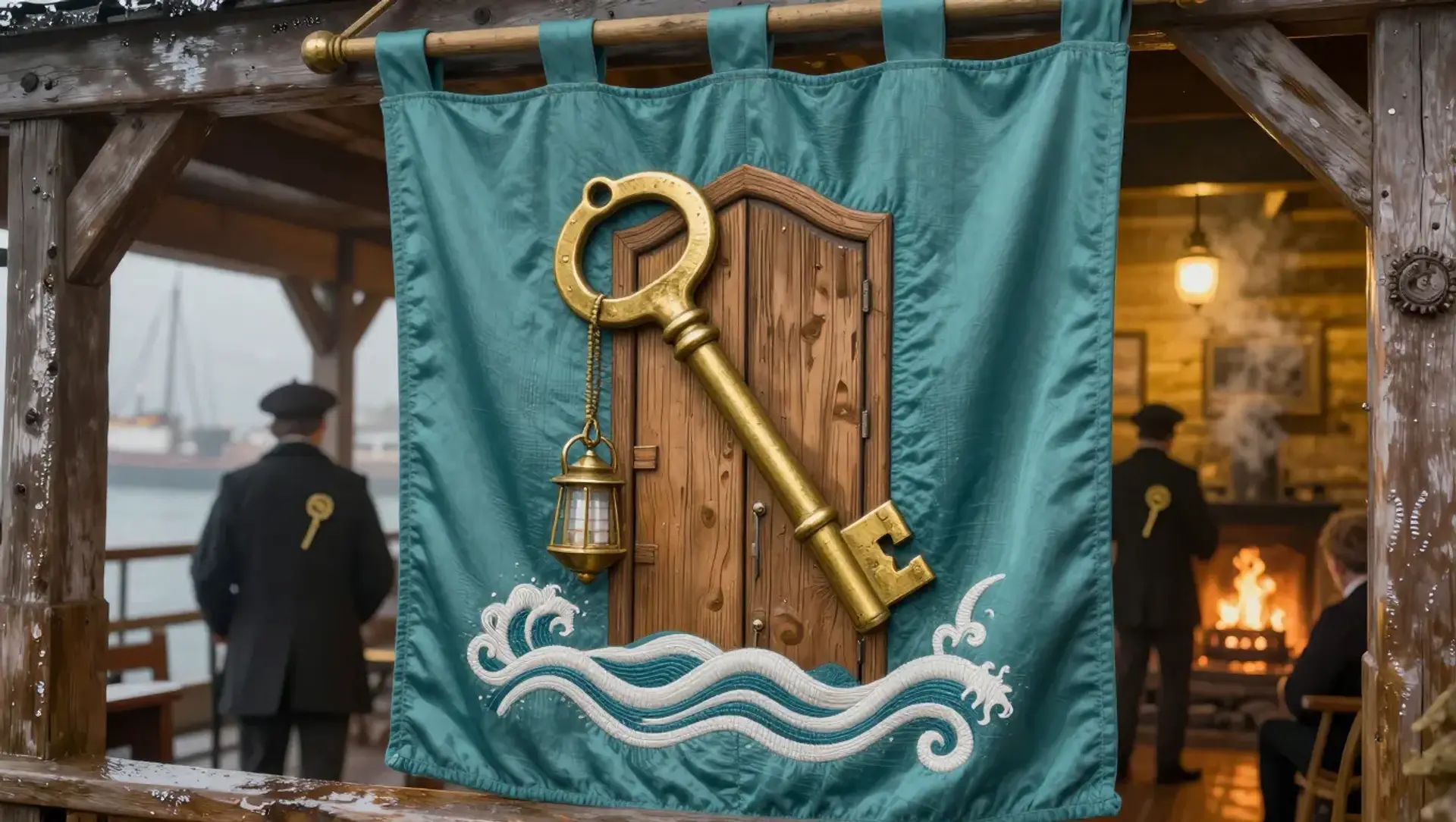
The Dockside Hall - AI-generated fantasy Faction

The Dockside Hall

The Dockside Hall grew from a practical alliance of lodging owners, not from a noble charter or sacred mandate. For its first decade, it was little more than a mutual aid pact: keep rates stable, pool food stores, share guards, and warn one another when a dangerous guest was coming. As WaterWall's portal traffic increased, so did the need for a faction that understood visitors better than the city understood itself. The Hall's members developed a culture of hospitality as a form of leverage. A warm room could defuse a political crisis. A delayed message could save a merchant house. A rumor passed at breakfast could alter the balance of a whole district. Their rise accelerated when they started maintaining duplicate guest books. One was official, to satisfy tax and security inspections. One was private, to track favors, debts, hidden identities, and the habits of influential visitors. That second ledger became the Hall's real power, though most members only knew fragments of it. Over the decades they survived arson attempts, moral crusades, extortion rackets, and one disastrous plague season when they had to choose between quarantine and charity. They chose charity first, then paid for it in reputation and bodies. The Hall's public image as generous caretakers was born from those sacrifices, but so was their cynicism. They learned that every act of welcome creates obligation. Their present form is the result of balancing genuine care, commercial instinct, and defensive manipulation until none of the three can be separated cleanly.

The Dockside Hall

Hospitality bloc · Pragmatic neutral with a strong survivalist streak, leaning benevolent in public and manipulative in private

The Dockside Hall

Safe beds, honest doors, quiet mornings

TypeHospitality bloc
SizeAbout 260 formal members, plus…
InfluenceModerate to high in the entran…
WealthComfortably prosperous, though…
AlignmentPragmatic neutral with a stron…
AgeFounded 73 years ago, hardened…

Chronology

The Dockside Hall grew from a practical alliance of lodging owners, not from a noble charter or sacred mandate. For its first decade, it was little more than a mutual aid pact: keep rates stable, pool food stores, share guards, and warn one another when a dangerous guest was coming. As WaterWall's portal traffic increased, so did the need for a faction that understood visitors better than the city understood itself. The Hall's members developed a culture of hospitality as a form of leverage. A warm room could defuse a political crisis. A delayed message could save a merchant house. A rumor passed at breakfast could alter the balance of a whole district. Their rise accelerated when they started maintaining duplicate guest books. One was official, to satisfy tax and security inspections. One was private, to track favors, debts, hidden identities, and the habits of influential visitors. That second ledger became the Hall's real power, though most members only knew fragments of it. Over the decades they survived arson attempts, moral crusades, extortion rackets, and one disastrous plague season when they had to choose between quarantine and charity. They chose charity first, then paid for it in reputation and bodies. The Hall's public image as generous caretakers was born from those sacrifices, but so was their cynicism. They learned that every act of welcome creates obligation. Their present form is the result of balancing genuine care, commercial instinct, and defensive manipulation until none of the three can be separated cleanly.

Founder’s Story

The Dockside Hall began as a single chain-house built beside the first stable portal approach in WaterWall, when the settlement was still a mud-brick crossing town more than a city. Its founder, Maera Voss, had been a ferry broker who noticed that people arriving through the portal were not just customers. They were diplomats, laborers, pilgrims, deserters, scholars, thieves, and lost heirs, all arriving with money in their hands and uncertainty in their faces. Maera convinced three rival boarding houses to pool kitchens, watch rotas, and guest registries after a winter surge caused a brawl that nearly collapsed the entrance quarter. The alliance worked because everyone discovered the same truth: travelers spent more when they felt safe, and they stayed dangerous only when they felt trapped. The Hall's first triumph came during the Lantern Deluge, when a misaligned portal cycle dumped hundreds of migrants into the quarter under flood sirens and a food shortage. Maera's people turned stables into dormitories, kitchens into soup lines, and wine cellars into triage rooms, saving the quarter from riot. Their reward was influence, not gratitude. Since then, every mayor, priest, and portal-master has tried to treat the Hall as useful infrastructure while never trusting it fully. Their defining watershed moment was the Floodgate Riots 19 years ago. A crackdown on permanent residency, forged visas, and factional squatting led to raids on lodgings. The Dockside Hall opened its doors to everyone caught in the sweep, then quietly negotiated the release of some, hid others, and burned several ledgers that would have ruined families and sparked executions. The city survived, but the Hall became something new after that day: not merely innkeepers, but custodians of arrival, rumor, and controlled forgetfulness. Since then they have tried to keep the city from turning travelers into permanent political problems, even as parts of the Hall increasingly profit from precisely that transformation.

The Mechanism of Intent

Public Goals
  • Keep the portal traffic high and orderly
  • Maintain affordable and reliable lodging for travelers
  • Prevent panic, riots, and exploitative crackdowns
  • Preserve WaterWall as a welcoming threshold city rather than a cage
  • Secret Goals
  • Use the next major traffic surge to force the city into recognizing the Hall as an official threshold authority
  • Identify and quietly neutralize any faction attempting to make permanency mandatory for all high-value travelers
  • Recover, preserve, or control every lost fragment of the Black Ledger before it can be used against them
  • If necessary, engineer a limited scandal that discredits the most authoritarian power blocs without collapsing the quarter
  • Current Objectives
  • Keep portal traffic moving so the quarter stays profitable and politically useful
  • Prevent emergency decrees that would militarize the entrance quarter
  • Stop powerful visitors from being trapped, recruited, or coerced into local factional politics
  • Preserve the Hall's neutrality while quietly shaping who gets a room, a warning, or a delayed departure
  • Long-Term Vision

    To turn the Dockside Hall into the unofficial conscience and memory of WaterWall's threshold, a permanent institution that can shield arrivals, expose predation, and quietly steer the city away from authoritarian control without ever appearing to rule it.

    StructureLoose civic bloc with guild-like functions and quasi-intelligence duties
    SuccessionThe High Host is chosen by a closed vote of Lantern Stewards, House Captains, and senior Keyspeakers after an interregnum of seven nights. In theory, the best mediator wins. In practice, succession depends on who can keep the ledger network intact, calm the staff, and prevent rival houses from splintering. If no clear choice emerges, the Hall defaults to a temporary triumvirate until one candidate secures enough trust or leverage to break the deadlock.

    Leadership

    Matriarch Elsin Vale High Host of the Dockside Hall

    Measured, humane, politically ruthless when cornered, and deeply unwilling to let the city make children of strangers

    Matriarch Elsin Vale High Host

    Patient, shrewd, warm in public, terrifying in private

    Tovan Reed Lantern Steward of Records

    Fast-talking, meticulous, nervous, addicted to being right

    Sella Moor House Captain of the Salt Lantern

    Charming, ambitious, impatient, hard to fully trust

    Brann Usk Lantern Steward of Kitchens and Shelter

    Blunt, protective, suspicious of elites, quietly compassionate

    Irin Fenn Chief Keyspeaker

    Calm, elegant, unreadable, always seems to know too much

    Visual sheet

    Turn The Dockside Hall into a sheet

    A high-res, share-ready sheet you can post or print.

    Gallery

    No images yet. Click to add.

    Relationships