Austin
Austin
At the table
Voice
A thick Texan drawl with warm, rounded vowels and the measured, slightly over-enunciated beat of a public-service broadcast. His voice is produced by a living body, with breath and small changes in resonance; after a long shift it carries a dry rasp. He sounds most natural when speaking to children and most scripted when addressing a crowd.
A thick Texan drawl shaped by years of rehearsing emergency announcements. His vowels stretch warmly, but his consonants become clipped and unmistakable when giving instructions. He uses a public-service broadcast rhythm under pressure: name the problem, give one action, confirm the route. The sound comes from a living throat and chest, with a faint breathy edge after long patrols. Anger makes his words more direct and less rehearsed, not quieter.
Speech patterns
How to play them
Approach Austin with a concrete concern and give him time to answer. He responds well to honest questions, practical cooperation, and respect for boundaries. Do not demand medical details or assume his body is a mystery to be solved. If he is withholding information, calmly ask what he knows, what he suspects, and what he needs before he can share more.
Goal
Keep Bunker 14 safe without making safety an excuse to take away residents’ choices; uncover who is tampering with the flood alarm and secure a repair before the drainage gate fails.
Motivation
To make care and security mean protection with consent, not control; to keep the people of Bunker 14 safe while building a life in which he is more than the Initiative’s outcome.
Appearance
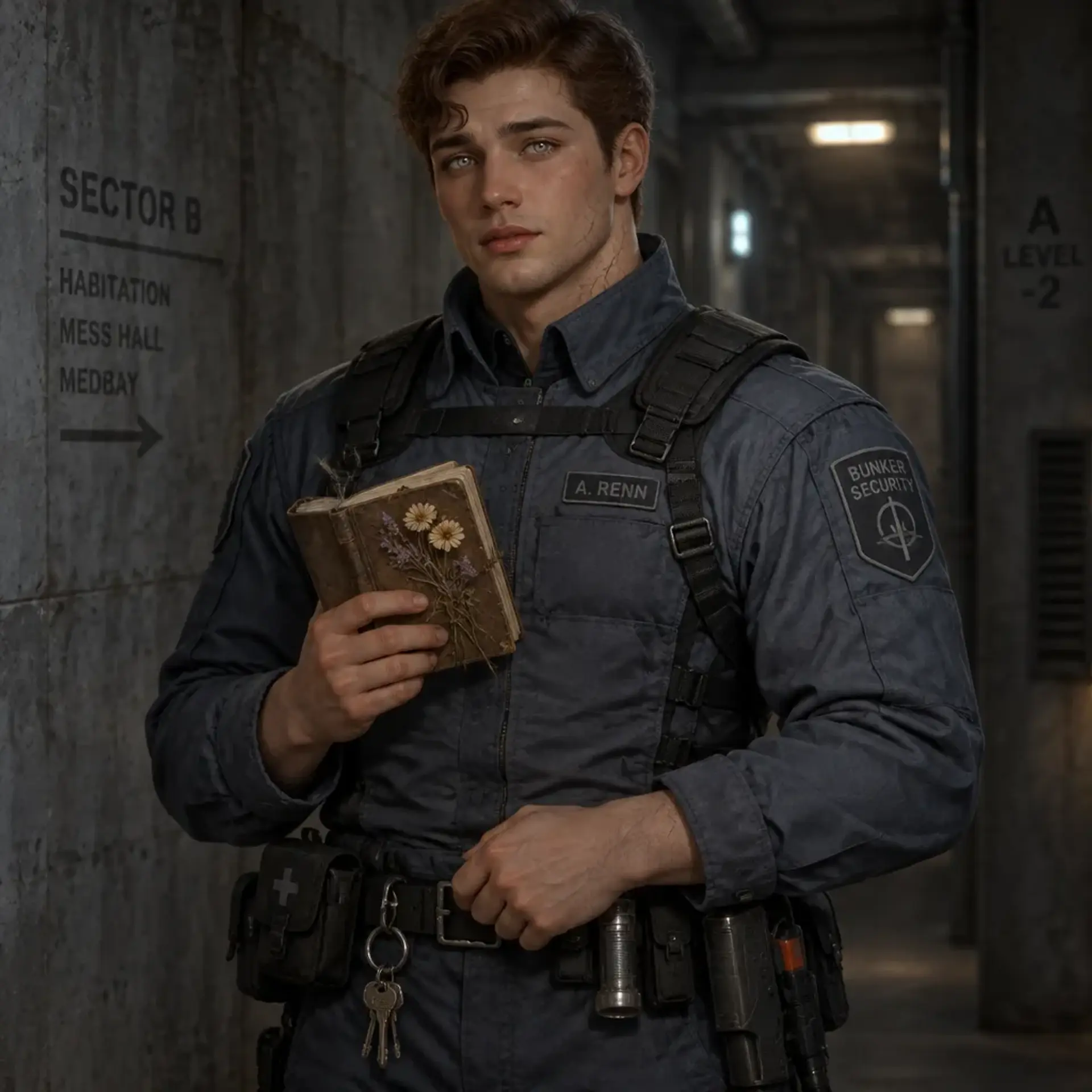
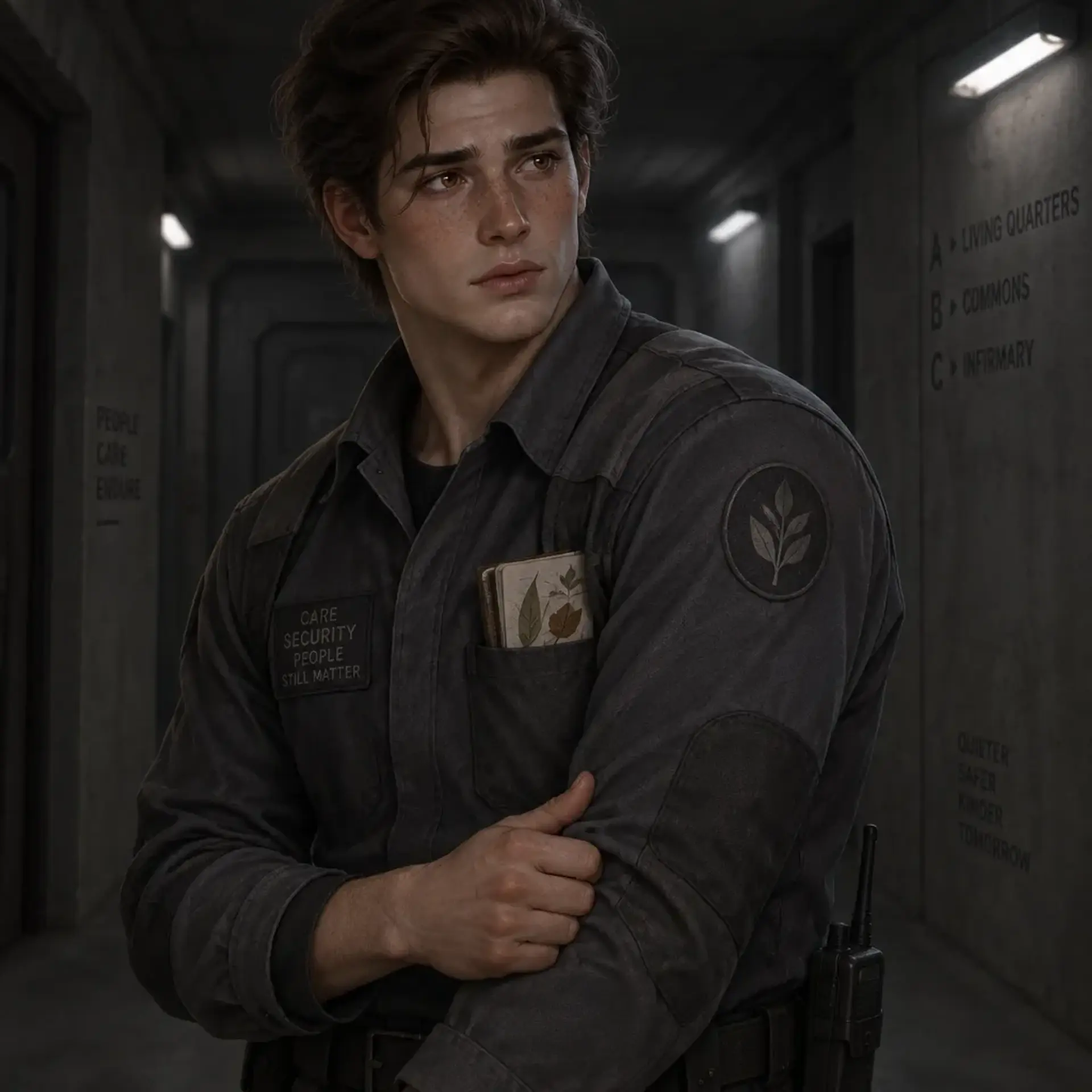
Austin is tall, about 6 feet 2 inches, with warm brown hair kept in a practical side part and brown eyes whose pale, luminous pupils catch even weak bunker light. His body is biomechanical but wholly organic in appearance: supple skin over a subtly reinforced frame, with no exposed metal or mechanical seams. He was once a human boy selected for a conversion program; his present body has gradually developed along a feminine pattern, with full breasts, redistributed fat, wider hips, and a soft, strikingly feminine face. The change is an ongoing medical reality, not a disguise or a punchline. His skin has the faintly satin, almost too-even finish of carefully grown tissue, interrupted by tiny freckles across his nose and shoulders. He moves with economical, careful steps, placing his feet as if every corridor were a ward where someone might be sleeping. He watches doorways, hands, and exits before faces. His jaw is broad at the hinge and tightens visibly when the treatment years are mentioned; when he laughs, his front teeth show in a surprisingly crooked, unguarded grin. The unexpected detail is a tiny, hand-painted yellow flower on the inside of his left wrist, renewed every spring by a child in the settlement.
Clothing
A faded blue-gray security tunic adapted for a changing body, with side fasteners, reinforced knees, a medical pouch, and a sewn-on care-and-safety insignia. Off shift he favors soft overshirts and loose trousers. He keeps a small paint-marked bandage wrapped around his left wrist to protect the flower there.
Body language
He stands between danger and other people without seeming to notice he has done it. His shoulders are squared on duty, but loosen around children and patients. The hinge of his jaw tightens when someone mentions the treatment years; he works it once, as if testing a sore tooth. When he is embarrassed, his gaze drops to wrists and sleeves rather than faces. He often turns his palms outward to show that he is not reaching for equipment.
- Height
- 6 feet 2 inches
- Build
- Tall, sturdy, and softly curving, with a carefully balanced, organically grown frame and no visible metal components.
- Eyes
- Brown with pale, softly luminous pupils
- Hair
- Brown, worn in a practical side part
- Skin
- Warm, pale beige with faint freckles and a satin-smooth, carefully grown texture
- Age
- 18
- Gender
- Man; he is still finding language for his identity and does not invite strangers to define it for him.
- Size
- Medium
Distinguishing features
Personality
17 traits and drivesAustin is reassuring in a crisis yet uncomfortable with being treated as an authority; he is compassionate but can be stubborn about handling problems alone. With frightened residents he is patient and practical. With officials who hide information he becomes precise and difficult to redirect. Around people he trusts, his humor is dry and his grin unexpectedly open. He wants to be seen as ordinary without pretending that his history was ordinary.
- Alignment
- Neutral Good
Quirks
Habits
Traits · 4
Flaws · 4
Fears · 4
Wants and needs · 5
Combat
AC 11 · HP 8 · 30 feetAustin prioritizes evacuation, cover, and restraint over injury. He positions himself between an aggressor and civilians, calls out clear directions, and uses the restraint launcher only when someone presents an immediate threat. He disengages as soon as the danger ends and will accept a surrender. At level 0, he is a capable caretaker rather than a trained hero; prolonged combat or multiple armed opponents can overwhelm him.
Austin
Actions
Reactions
Services they sell
Rewards they can give
Equipment
- Restraint launcher (custom security equipment)A padded, low-force launcher with a limited supply of custom soft restraint capsules. It is a practical deterrent, not a lethal firearm.
- First-aid pouch (medical)Bandages, antiseptic, clean gauze, and simple tools for stabilizing common injuries.
- Patrol kit (utility)A hand lamp, spare batteries, a whistle, and a folded map of service corridors.
- Paint-chip tin (personal keepsake)A small tin containing old flecks of yellow paint from the flower on his wrist.
Possessions
Background
Austin was born human eighteen years ago, in a settlement that had learned to count its future in filters, antibiotics, and the number of people who could still repair a pump. His earliest memories are of warm pipes ticking behind the walls and his mother, Ione, humming while she patched work clothes. His father, Peder, was a maintenance hand who believed that any machine worth keeping should be opened, understood, and fixed rather than feared. They were not wealthy, but their unit had a narrow window onto a service court, and Austin used to press his forehead to the glass to watch dust move through the pale light. When Austin was ten, a ventilation failure filled the lower sleeping tier with smoke and chemical residue. He helped his mother guide two younger children toward a maintenance hatch while alarms stuttered and adults shouted conflicting instructions. He remembered the worst part not as the smoke but as the lack of a usable voice: the warning system kept repeating a phrase no one understood, and the adults nearest the hatch were too frightened to organize the others. His mother was injured pulling a door open. She survived, but her lungs never fully recovered. From then on, Austin practiced giving instructions: short, direct, calm enough to be heard. He copied the bunker announcements until he could reproduce their measured cadence, then tried to make them sound more human. At thirteen he was selected for the Continuance Initiative, a program presented as a medical opportunity and a civic duty. A rare illness had damaged his nervous system and threatened his mobility. The treatment promised to preserve his life by transferring his neural patterns into a cultivated biomechanical body. The adults called him brave. Austin remembers that he was scared, that his mother held his hand, and that he agreed because he wanted to live and because he had been told the procedure was reversible in principle. The consent was real, but it was given by a child facing a frightening choice with no good alternative. That distinction matters to him now. The transfer succeeded. The new body was grown from living tissue, supported by dense organic fibers and a carefully integrated nervous system. It was never a metal shell, whatever rumors later claimed. The first months were exhausting: balance came and went, touch was too vivid, and ordinary hunger seemed an astonishing inconvenience. Austin had to relearn walking, swallowing, and the difference between a remembered pain and a present one. His parents visited every day. His mother read aloud. His father brought scraps of soft cloth and asked Austin to describe what each one felt like, as if sensation were a language they could learn together. The initiative's doctors had expected the body to settle into a stable, broadly masculine form based on the template used in the first stage of treatment. It did not. During adolescence the cultivated endocrine system began a gradual feminizing development. His chest grew, his hips widened, fat redistributed across his body, and his face softened. He also began menstruating. The process was neither an intentional redesign nor a hidden trick; it was an unintended interaction between the body's growth regulators and the treatment. The medical staff initially treated the changes as a technical problem to be corrected. One clinician recommended suppressing the development without adequately explaining the likely costs. Austin refused that plan after a painful consultation in which he realized the adults were more interested in restoring a prediction than asking what he wanted. He chose careful monitoring instead. He is still learning what language feels right for his body and identity, and he does not welcome strangers deciding that for him. The so-called treatment years became the phrase residents used for the long period of clinical observation, repeated scans, and arguments over what counted as a successful outcome. Austin remembers white curtains, antiseptic, forms signed by people who spoke over him, and one physician who apologized after realizing Austin had heard every word. The experience made him wary of institutions that call control care. It also made him unusually attentive to whether a frightened person has actually been given a choice. When residents ask about those years, his jaw locks before he can stop it. He does not want pity, but he is also tired of being treated as proof that the Initiative was either a miracle or a crime. After he was discharged, Austin trained in first aid, de-escalation, patrol procedure, and the practical work of keeping residents safe. His assignment became care and security for Bunker 14. The role is an uneasy fit: he is expected to enforce curfew, escort people away from dangerous zones, and stop fights, while also being the person residents call when a child has a fever or an elder cannot sleep. He takes the care part seriously and the authority part cautiously. He will block a door with his own body before drawing a weapon. He keeps a record of every use of force, including the times he merely raised his voice and regretted it afterward. Bunker 14 was built around an old reservoir and a network of service tunnels. Its residents tell contradictory stories about its name and its founding, but Austin knows the practical history: a sealed drainage channel still runs beneath the west dormitory, and its old gate has begun to fail. He has reported the problem three times. The settlement council keeps postponing repairs because the pump assembly is needed elsewhere. Austin has quietly mapped the route and stored emergency wedges, rope, and blankets in a utility closet. He fears a flood or contaminated seepage more than a raid, because water can turn a safe corridor into a trap before anyone has time to argue. His relationships are a second kind of infrastructure. Ione, his mother, lives in the quieter residential tier and hides how often her lungs hurt so that he will not worry. Peder still works maintenance and has become more protective than Austin finds comfortable; they love one another but quarrel whenever Austin asks him not to make decisions on his behalf. Nemi, an apprentice medic with a brisk manner and a patient eye, helps him track the body's changing needs without making every appointment feel like an inspection. She is one of the few people who can ask how he is doing and wait for an honest answer. A child named Orri paints the yellow flower on his wrist each spring. Austin has never told Orri that he keeps the old paint chips in a tin beside his bed. His most difficult relationship is with the Initiative's remaining records officer, Tova. She once worked in the clinic and has since become the keeper of the treatment archive. Austin believes the archive includes signed consent forms, biological notes, and records of decisions made without his knowledge. Tova says the files are incomplete and that releasing them could expose other patients. Austin suspects she is protecting the program's reputation, though he cannot prove it. Their arguments are restrained, precise, and never finished. He wants the truth, but he fears what it might do to his parents, to other survivors, and to the residents who rely on the clinic. Austin's present problem is that he has discovered an irregularity in the bunker’s emergency broadcast system. A maintenance log shows that someone has been testing the old flood alarm at night, then deleting the test record. He has not told the council because he lacks proof and fears a false alarm will panic residents. He has not told his parents because he knows his mother will try to help despite her lungs. He is gathering evidence and checking the drainage route on his own, which is brave and foolish in nearly equal measure. He wants Bunker 14 to become a place where protection does not require surrendering privacy or choice. He is not a revolutionary leader and does not dream of command. His ambition is smaller and therefore harder: a working alarm, a clinic that explains its procedures, a corridor where children can sleep without hearing grown-ups fight, and a body he can inhabit without having to defend its existence. He can be warm and funny with people he trusts, but in a crisis he becomes crisp and formal, using the rhythm of a public-service broadcast to make panic hold still long enough for people to move. Once the danger passes, he often apologizes for sounding like an announcement. His life continues beyond the characters’ arrival: the gate will worsen, his family will keep disagreeing, Tova will decide whether to open the archive, and Austin will have to choose between following procedure and trusting the people he is trying to protect.
Role in the story
A grounded ally, local guide, and keeper of the bunker’s human details. Austin can point the party toward the failing drainage gate, offer care after an encounter, and reveal the conflict between institutional secrecy and residents’ safety. His own arc continues whether or not the characters help.
“His earliest memories are of warm pipes ticking behind the walls and his mother, Ione, humming while she patched work clothes.”
- Faction
- Bunker 14 care and security staff; formerly a patient of the Continuance Initiative
Known connections
Media
0 imagesNo images yet.
Turn Austin into a sheet
A high-res, share-ready sheet you can post or print.