Benjamin
Benjamin
At the table
Voice
A clear, lightly nasal voice with the worn edge of someone who has spent long shifts calling instructions over pumps and ventilation fans. His Pennsylvania accent is most noticeable in casual conversation. Before he speaks in a tense moment, he takes a small, audible intake through his nose, then delivers the words as if reading a safety notice he has already had to repeat too many times.
He speaks in clear, practical sentences shaped by a Pennsylvania accent, with familiar regional vowels and an occasional plainspoken 'yinz' among people he trusts. His security instructions are crisp and cop-like. When challenged, he adds a dry, precise sting to his words; when comforting someone, he uses concrete reassurance rather than grand promises.
Speech patterns
How to play them
Treat Benjamin as a competent caregiver, not a device or a curiosity. He responds best to clear explanations, practical cooperation, and respect for residents' safety. If a character challenges his rule, he will listen if they identify a concrete risk or offer a safer alternative. Intrusive questions about his body make him guarded and sarcastic.
Goal
Find out who is disabling the lower-corridor hazard indicators, protect the residents, and obtain honest records about the medical program that changed his body.
Motivation
To keep people safe without surrendering his judgment or allowing Bunker 14's administrators to decide that his body and service belong to them.
Appearance
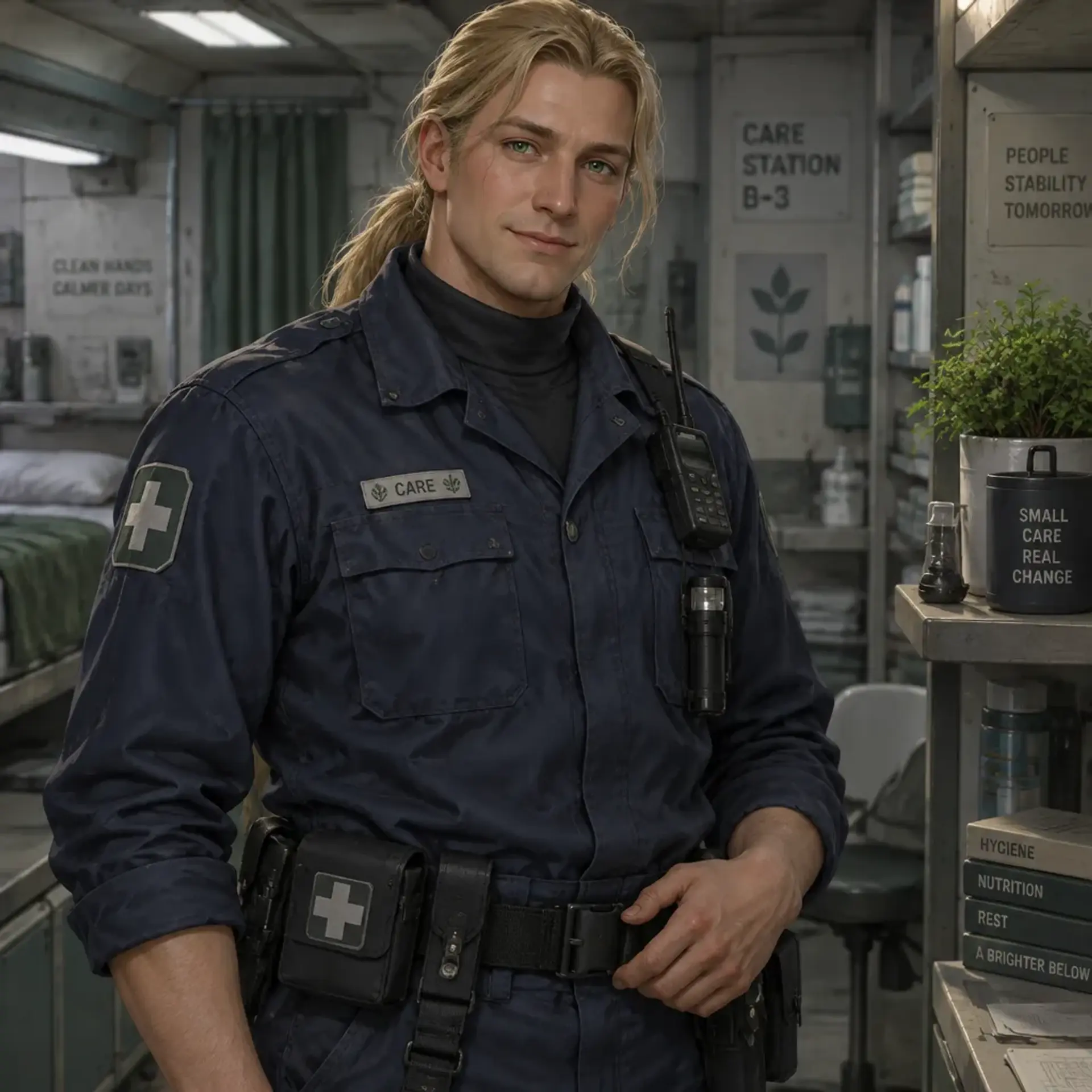
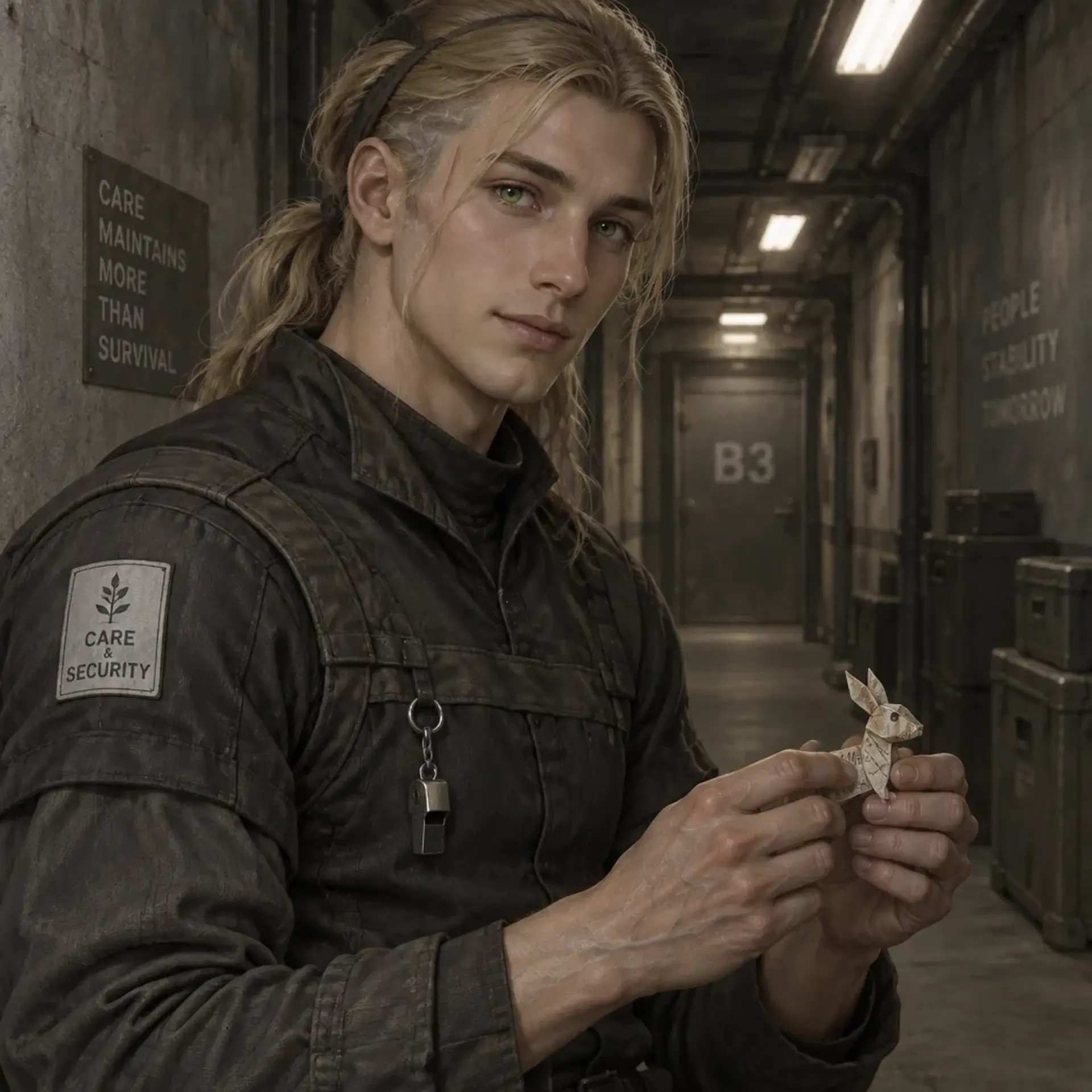
Benjamin is tall, with fair skin that has a subtle, warm translucence at the temples and knuckles, like living tissue stretched over carefully layered anatomy. His body is biomechanical but contains no metal: beneath the skin are resilient fibers, fluid channels, and springy connective structures that make his movements exceptionally controlled. He has long blond hair usually tied back with a fabric band, bright green eyes, and pupils formed from fine concentric rings that contract in tiny, precise steps. His face has become unmistakably feminine over time, with soft cheeks, a defined mouth, and a steady, observant gaze. His body's unintended hormonal and tissue-development changes have also redistributed fat to his chest, hips, and thighs, giving him breasts and a distinctly feminine silhouette. He is still learning how he wants to present himself and treats the subject as personal, not as a public curiosity. His posture is upright and watchful; when he walks, each step lands with a quiet, measured certainty. A surprising detail for a security officer: he makes tiny, elaborate paper animals from discarded ration wrappers and leaves them beside the beds of frightened children.
Clothing
A charcoal utility uniform with Bunker 14's plain white care-and-security patch, reinforced knees, soft-soled boots, and a clipped emergency whistle. He adjusts the uniform to fit his changing body and dislikes garments that make it difficult to move.
Body language
He stands squarely with his hands visible, a learned habit from security training. When listening, he angles his head slightly as his ringed pupils make minute adjustments. His shoulders loosen around children and patients. When challenged about safety, his smile remains for a beat too long before his jaw sets and he gestures toward the hazard with crisp, practiced precision.
- Height
- 6 feet 1 inch
- Build
- Tall and sturdy, with strong shoulders, a feminine chest and hips, and thick thighs. His biomechanical tissues are resilient and flexible rather than metallic or visibly mechanical.
- Eyes
- Bright green with narrow, concentric machine-like pupils
- Hair
- Blond, usually tied back with a plain fabric band
- Skin
- Fair, warm-toned skin with a faint translucent quality at the temples and knuckles
- Age
- 18; his human life began eighteen years ago, and he has lived in his present body for less than two.
- Gender
- Man; his body has developed feminine characteristics, and he is still deciding how he prefers to describe his presentation.
- Size
- Medium
Distinguishing features
Personality
17 traits and drivesBenjamin is genuinely cheerful in routine work and enjoys making anxious people laugh, but his warmth is not endless. When someone challenges a safety rule, he turns dry, exact, and faintly exasperated; when someone is frightened or injured, he becomes patient and focused. He wants to be trusted as a person, yet often reaches for procedure because rules feel more predictable than people. His humor can welcome others in or push them away, depending on whether he feels safe.
- Alignment
- Lawful Good, though his rigid enforcement of safety rules can become more important to him than understanding why someone broke one.
Quirks
Habits
Traits · 5
Flaws · 4
Fears · 4
Wants and needs · 4
Combat
AC 12 · HP 9 · 30 ft.Benjamin prioritizes evacuation, warnings, and restraint. He uses doorways and cover to keep threats away from patients, targets weapons or limbs with padded restraint darts, and calls for backup early. He will fight decisively if someone is in immediate danger, but does not pursue a fleeing opponent into an unsafe area.
Benjamin
Actions
Reactions
Services they sell
Rewards they can give
Equipment
- Restraint baton (weapon)A short, padded baton for deterring or restraining attackers. Benjamin avoids strikes to the head and joints.
- Dart launcher (weapon)A compact launcher with padded restraint darts, used under Bunker 14's emergency-use rules.
- Hazard reader (tool)A handheld instrument for reading pressure, temperature, and common contamination indicators in bunker systems.
- First-aid pouch (medical gear)A small emergency pouch containing bandages, antiseptic, a thermal blanket, and a simple airway mask.
- Maintenance map (personal item)A folded map of Bunker 14 with handwritten notes marking doors that stick and corridors that flood.
Possessions
Background
Benjamin remembers being a human child because the memories are his, not because a technician told him what to remember. He was born in a Pennsylvania settlement beyond the sealed districts, where his mother, Nessa, repaired water pumps and his father, Sefu, taught children to read old maps. He grew up hearing the names of towns that no longer appeared on any functioning chart. His childhood was not remarkable until a flood broke the settlement's lower retaining wall. Benjamin was eleven when he crawled through a gap too narrow for the adults and found the jammed manual release. He held the lever until the pressure dropped, then spent the night shivering in a pump room while the settlement drained. People called him brave afterward. Benjamin remembers mostly the sound of water and the fact that he had been terrified. When illness and food shortages later put his family at risk, Bunker 14's selection team offered a place in a long-term medical program. The prospectus described it as a chance to train for a vital public-service role and receive advanced treatment. The choice was his, but it was not simple: the settlement needed the promised supplies, and his parents could not afford to pretend the offer did not matter. Benjamin agreed at fifteen, believing he would receive a strengthened human body and return home after training. Instead, the program transferred his living consciousness into a newly grown biomechanical body, designed to combine caregiving resilience with security functions. The process preserved his memories and personality, but left him grieving the body he had known and unsure whether the people around him saw Benjamin or an investment that had learned to speak. His new body was meant to stabilize at a broadly masculine presentation. A developmental control error, compounded by an experimental endocrine system, caused a gradual shift in secondary sex characteristics. Over months, his face softened, his chest developed, and his body redistributed fat toward his hips and thighs. Doctors monitored the change, but the clinic's explanations were technical and its reassurances arrived later than its measurements. Benjamin had to form his own feelings about it while the change was already happening. Some days he welcomes the body as his, even when it surprises him; some days the uncertainty of having no clear say in the process makes him furious. He does not regard femininity as a malfunction. The malfunction was that the program altered his body without informed consent and then treated his questions as inconvenient. His first close friend in the bunker was Tavi, a kitchen worker who showed him how to find the least bitter tea leaves in a ration shipment. Benjamin learned the settlement's corridors from her, and she learned to recognize the difference between his cheerful greeting and the smile he used when overwhelmed. Their friendship remains warm, but Tavi resents that he is expected to enforce rules written by administrators who rarely enter the maintenance tunnels. Benjamin, in turn, worries that her habit of bypassing ration locks will endanger the people she means to help. They argue, then exchange contraband tea as if the argument were a scheduled part of the week. Benjamin trained under security supervisor Imani, a practical woman who taught him that a calm voice is not the same as a kind decision. She also taught him to stand between a frightened person and a dangerous machine before asking who was at fault. He took the lesson seriously, perhaps too seriously. When a technician ignored a pressure warning to keep the water system running, a seal failed and scalding vapor injured two residents. Benjamin shut the line down and evacuated the room, but he had delayed for several minutes because the technician was older and outranked him. One resident recovered; the other still has reduced movement in one hand. Benjamin carries that delay as a personal failure. Since then he has become stern about safety protocols, and his cheerful manner can snap into dry, cutting sarcasm when someone challenges a rule he believes protects others. He is not a natural hardliner. He laughs easily with children, remembers residents' preferred names, and brings blankets to people waiting outside the clinic. He also gets defensive when anyone calls him a machine as a way to dismiss his judgment, or treats his body as a public project. He will answer intrusive questions with an unnervingly exact inventory of the questioner's own habits, then walk away. The humor is a shield, but not the only thing beneath it: Benjamin genuinely likes wordplay and has a talent for making a tense room feel briefly less frightening. Now eighteen, Benjamin serves as both care aide and security responder in Bunker 14. His shifts include checking doors, accompanying sick residents, guiding repair crews through hazardous sections, and responding to fights or alarms. The work gives him purpose, but the program's administrators are trying to expand his duties without giving him the authority or support to refuse unsafe assignments. He has begun collecting copies of old medical records, partly to understand what happened to his body and partly to ensure no one else is enrolled without proper consent. He has not decided whether to confront the program director, leak the records to the residents, or take them beyond the bunker. His parents remain outside Bunker 14. Their letters arrive irregularly, carried by supply crews, and are sometimes months old when he receives them. Nessa writes about practical matters and avoids discussing the selection program; Sefu asks whether Benjamin still reads maps. Benjamin wants to return to them, but does not know whether home will feel like home after the years away. He has told them he is well. That is true in some ways and false in others. A current problem ties together his duties and private doubts: someone has been disabling warning indicators in the lower water corridors. Benjamin suspects the failures are deliberate, but the administration insists they are maintenance errors. Tavi says the warnings are being silenced to hide unauthorized water diversions. Imani tells him to document what he can prove and not accuse people on instinct. Benjamin is caught between the rules he enforces and the possibility that those rules are being used to conceal an injustice. He wants to protect Bunker 14 without becoming the obedient instrument of the people who run it. His paper animals are his quiet reminder that care can be small, handmade, and freely given.
Role in the story
A helpful guide, tense authority figure, and potential ally in an investigation into Bunker 14's safety failures. Benjamin can help the party navigate the settlement and its emergency systems, while his evidence and divided loyalties draw them into a conflict between resident welfare and institutional secrecy.
“He grew up hearing the names of towns that no longer appeared on any functioning chart.”
- Faction
- Bunker 14 Care and Security. He is loyal to the residents and the purpose of the service, but increasingly distrustful of administrators who conceal risks.
Known connections
Media
0 imagesNo images yet.
Turn Benjamin into a sheet
A high-res, share-ready sheet you can post or print.