
D&D Mystery Generator: Build Clues That Hold Together
Use a D&D mystery generator to draft a case, then check the motive, clue routes and magic before play. A worked example keeps the trail moving.
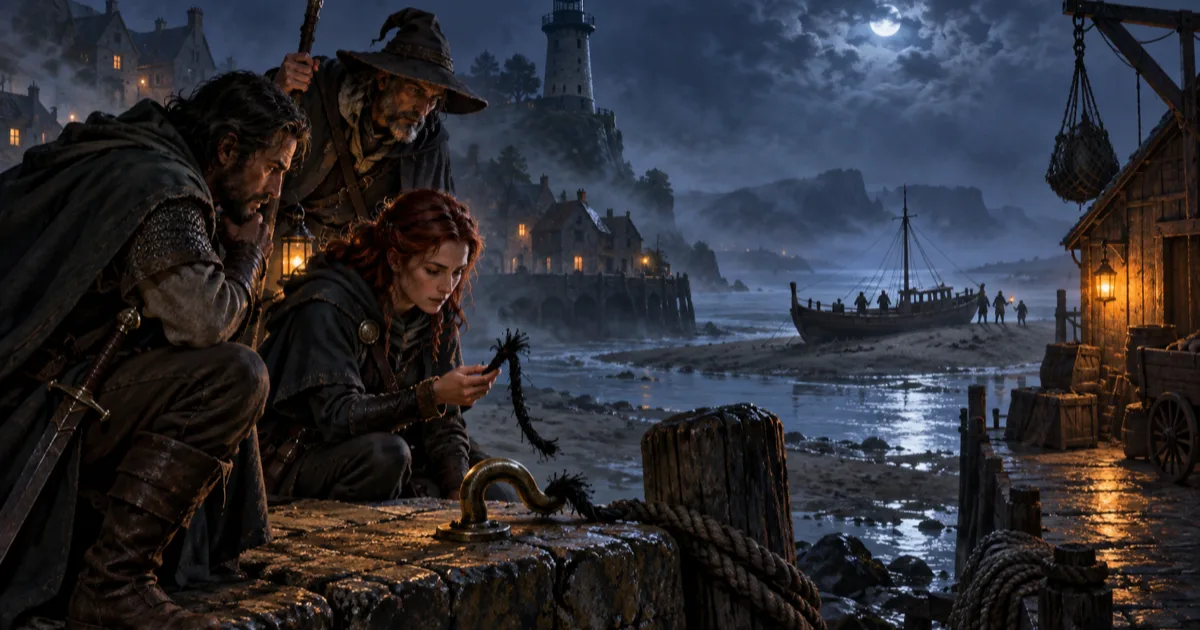
The ferry at Greyhaven ran aground after its lighthouse went dark for eighteen minutes. The crew survived. The harbour blames a ghost, but the lamp room shows signs of a careful hand. A D&D mystery generator can draft suspects and clues for this case. I still check whether its clues lead to a fair answer.
That review is the useful part of D&D mystery prep. A mystery can have a strong culprit and a good motive, then stop because one missed clue blocks every next scene. I build the answer first, map several routes to it, then check how my players can change the outcome.
Why D&D mystery clues need more than a clever answer
An ordinary adventure can keep moving when the party misses one room. A mystery often has a key conclusion. The players may need to learn who changed the signal, how the lamp went dark, or what the culprit hoped to gain. If one clue carries all three facts, one missed roll can halt the session.
I use the Three Clue Rule as a design check. Justin Alexander's version asks the GM to include at least three clues for any conclusion the players need to reach. It gives the party several chances to connect the case. It does not require them to follow one planned route.
The distinction matters. Three clues that all sit in one locked desk do not create three routes. They create one location with three objects. A useful clue can come from a witness, a physical trace, a record, or a choice made by a suspect. Those sources let players approach the same conclusion in different ways.
A clue can also support more than one reading. A keeper who lies about visiting the lamp room may hide a private debt. That fact makes the keeper interesting, but it does not prove they caused the blackout. I separate a suspect's secret from the case's answer. That stops every lie from becoming a false confession.
Start your D&D mystery generator draft with the truth
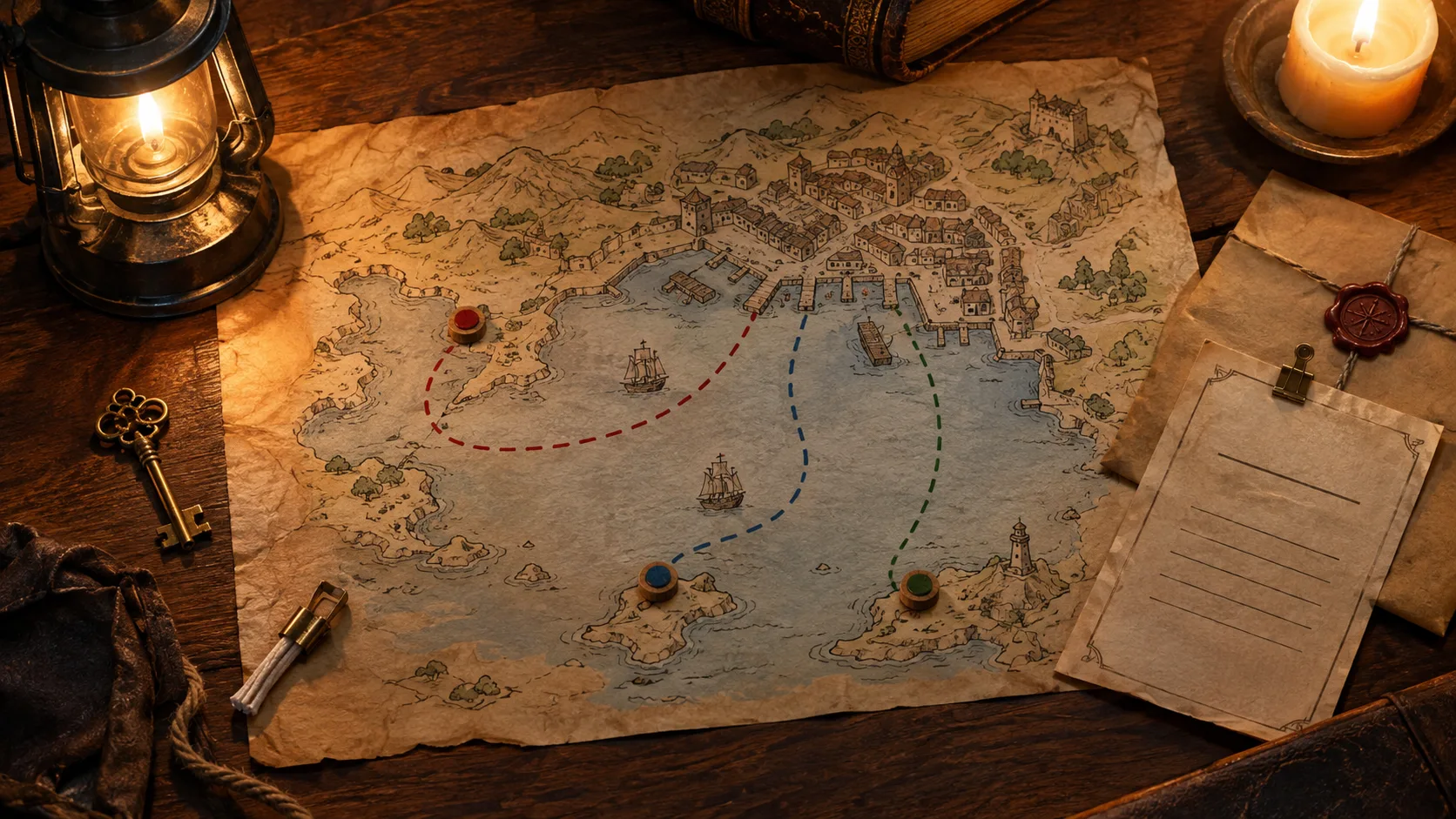
Here is the Greyhaven case in one paragraph. Harbour-master Pell used the lamp-room shears to cut the beacon wick. The light stayed out for eighteen minutes. He wanted an unregistered medicine boat to pass the harbour checkpoint during a local embargo. He agreed with its captain on two amber flashes from the south tower stair, then a turn into Fisher's Cut. Pell thought the inbound ferry was still at the quay and would wait for the beacon. It had already departed. Fog and a late tide carried it onto a sandbar. The crew survived, but the ferry lost a night and the town no longer trusts the lighthouse.
That paragraph gives me the action, motive, method, timing, intended result, and unexpected cost. It also tells me what Pell knows. He knows the boat's captain and their agreed signal. He believes the ferry is still in port. I can now write dialogue without giving him facts he never learned.
The other suspects need their own truths:
- Keeper Orla sold a measure of lamp oil to pay a family debt. She hid the sale because the town could dismiss her. She also saw Pell carry the lamp-room shears upstairs, but feared that reporting him would expose her own theft.
- Apprentice Lio left the tower during the blackout to meet a friend. He saw a second lantern, but he did not see who carried it.
- Pell authorised a medicine shipment before the embargo. The council rejected his request, so he chose to help the boat pass without permission.
Each person has a reason to hide something. Only Pell cut the wick. That gives the players several interviews with useful answers, even when a suspect is not guilty.

Give every required conclusion several clue routes
I write conclusions before I place clues. The table below shows three conclusions that keep this case moving. Each clue points to a conclusion, but none requires a single skill check.
| Conclusion | Clue routes |
|---|---|
| The beacon went dark on purpose | The wick has a clean shear cut, and the lamp-room shears have matching soot on their blades; the tower log records an eighteen-minute gap with no oil-pressure fault; the ferry lookout wrote that the light vanished in clear weather, without storm or spray at the tower |
| A medicine boat passed through Fisher's Cut | The council manifest lists three crates of medicine for the Greyhaven infirmary, then marks them as seized; a dockhand saw a covered boat with matching blue infirmary seals turn into Fisher's Cut after two amber flashes; a stamped empty crate with fresh channel mud was found by the cut |
| Pell planned the blackout and signal | The key register shows Pell borrowed the lamp-room key before the blackout; Orla saw him carry the shears upstairs and return after the light came back; a clerk found Pell's note to the captain, which names the two amber flashes and Fisher's Cut |
The clues use different sources. A character can inspect the wick, question a dockhand, compare the council manifest with warehouse stock, or interview the ferry lookout. A high Investigation result can reveal more detail, but it should not control whether the party finds the core information. The first conclusion has a physical trace, a written record, and a witness account. The second has cargo records, a dockhand, and a recovered crate. The third has an access record, Orla's testimony, and Pell's note.
I also give each clue a useful next step. The manifest points to the warehouse and infirmary. The dockhand can describe the boat's colour and turn into Fisher's Cut. The stamped crate sends the party to the channel bank. Pell's note leads to the captain, who can confirm the signal. A clue should do more than say, “Pell is suspicious.” It should tell the players where they can act next.
One clue can be subtle. A second can be direct. A third can confirm an earlier guess. The party may find all three and build confidence. They may find only one and follow a reasonable lead. Both outcomes keep the case in motion.
Separate evidence, secrets, and red herrings
I label each piece of information in my notes. Evidence supports a conclusion. A secret gives a suspect something to hide. A red herring attracts attention but still has a true explanation. These categories stop me from changing the answer when the players make a good guess.
Orla's missing oil is a secret. It can look suspicious because the lamp went dark. Her account book shows she sold it three days earlier. The sale explains her lie, but it does not explain the timing of the blackout. Lio's meeting is another secret. His friend saw the amber lantern near the tower, but could not see who carried it.
I avoid red herrings that depend on false facts. If a record is forged, I decide who forged it and why. If a witness lies, I decide what the witness fears. The players can then uncover the lie and learn something useful. A misleading clue that has no cause only wastes time.
The party should also be able to prove more than one point. Pell's key entry shows access. Orla's account places him with the shears. His note establishes the signal and route. The dockhand confirms that the boat used that route, while the manifest shows what it carried. If Pell denies these facts, the players can choose how to press him.

Test spells and player abilities before the session
Fantasy mysteries include tools that modern crime stories do not. Divination, shape-changing, invisibility, and speaking with the dead can change what the players can learn. I check the rules before I add a locked room, a silent witness, or a secret identity.
Use the rules version your group plays. The 2024 D&D Basic Rules spell descriptions explain what spells such as Speak with Dead and Zone of Truth can do. Speak with Dead allows up to five questions, but a corpse knows only what it knew in life. Zone of Truth does not force an affected creature to answer. Those details can shape an interview without making it pointless.
I do not add a random magical ward just to protect my planned reveal. If a character spends a spell slot and asks a sharp question, the spell should matter. It may confirm a suspect's name, disprove an alibi, or reveal what the victim noticed. The next problem can be proving the answer, finding the medicine boat, or deciding what the town should do with Pell.
Write down two or three likely player abilities. Think about what each one can reveal, what it cannot reveal, and which scene follows. Do not write a new immunity after the players choose a spell. That turns character choices into wasted resources.
Use CharGen to build the first outline
CharGen's Quest Generator has a Mystery option in the Quest Type menu. I can add a short case idea in Quick Description (Optional), then set the game system, difficulty, duration, party level, and theme. Generate Quest gives me an outline to review.
I treat the result as a working draft. I compare its hook, cast, scenes, and twists with my truth paragraph. If two suspects know the same secret, I decide whether that was intended. If every clue sits in one room, I move some clues to a witness or a record. If a twist changes the culprit, I update the earlier clues too.
The NPC Generator can help me add motives and mannerisms to a suspect. I keep those details separate from guilt. A nervous NPC is not automatically a liar. A polite harbour-master can still have a reason to hide the cargo record.
For player characters, a short D&D backstory generator guide can help connect one personal detail to a useful case hook.
If Campaign Studio Assistant is enabled for your account, its review flow can help turn an outline into a proposed quest. Choose Review actions. From a response, select Use as… and then Review as quest. Read the Review request. Change details or update the quote if the proposal misses your intent. Approve only after you have checked the proposed change.
The review step does not prove that a mystery is fair. I still check the answer, clue routes, and player abilities. It keeps an unreviewed proposal from becoming the campaign's new fact by accident.
Let the players choose what the answer means
A fair mystery does not need to end when the players name Pell. They can return the medicine, expose his choice, negotiate with the council, or help him find a legal route for the next shipment. Each option follows from the same facts.
I prepare one scene for the likely confrontation, then leave the players room to choose the form. Pell might explain the embargo and ask them to help. He might try to leave before the council arrives. The boat's captain might offer to carry medicine in exchange for safe passage. The party can change the outcome without changing who caused the blackout.
If the group misses a conclusion, give them a new route. A dockhand can bring the party a damaged crate. A patrol can find a second lantern at the warehouse. Pell can try to alter the ledger. The clue arrives because the situation moves, not because a narrator tells the players what to think.
I keep a short note beside each scene: “What can the players learn here?” If the answer is nothing, the scene may be colour without function. It can still stay, but it should not be the only route to a necessary fact.
A short D&D mystery prep checklist
Before I run an AI D&D mystery, I read the case once as a player. I cover the culprit's name and ask whether the visible clues point towards a consistent answer. Then I check these items:
- The culprit's method fits the location, timing, and available tools.
- Every required conclusion has at least three clues from different sources.
- Each suspect has a motive, a true secret, and a useful answer.
- A failed check changes the cost or timing, but does not erase the only clue.
- Likely spells and class features have clear, rules-based effects.
- The party can choose what to do after they learn the truth.
That review takes less time than repairing a mystery during play. It also makes generated writing easier to use. I can keep the names and scenes that fit, then replace the weak connections.
For a different kind of deduction session, see my guide to table-ready D&D puzzles. Puzzles ask players to work through a challenge. A mystery asks them to build a case from what their characters can learn. Some adventures need both, but each works better when its purpose is clear.
D&D mystery generator FAQ
How many clues should a D&D mystery have?
Use at least three clues for each conclusion the party needs to reach. A case with three key conclusions may need nine or more clues. Some clues can support more than one conclusion.
How do I stop a D&D mystery from getting stuck?
Put clues in different scenes and give each one a next step. Let a failed check add a cost, delay, or complication. Do not make a single die roll the gate to the whole answer.
Can I use an AI D&D mystery generator for a murder mystery?
Yes. Ask it for the timeline, suspects, motives, evidence, and likely scenes. Check the facts and rules before play. A murder mystery also needs a plan for magic that can question the dead or test a suspect's answers.
What if a spell solves my D&D mystery?
Use the spell's text for your rules version. Let it answer what it can. Then move the session to proof, motive, consequences, or the players' next choice.
Does CharGen have a D&D mystery generator?
The CharGen Quest Generator includes a Mystery quest type. Add a short description and generate an outline. Review its clues and suspects before you bring it to the table.
Open the CharGen Quest Generator, choose Mystery, and write one sentence about the incident. Decide the truth before you generate. Then check the outline against the clues, suspects, and player abilities you want at the table.
Draft a Mystery Quest