
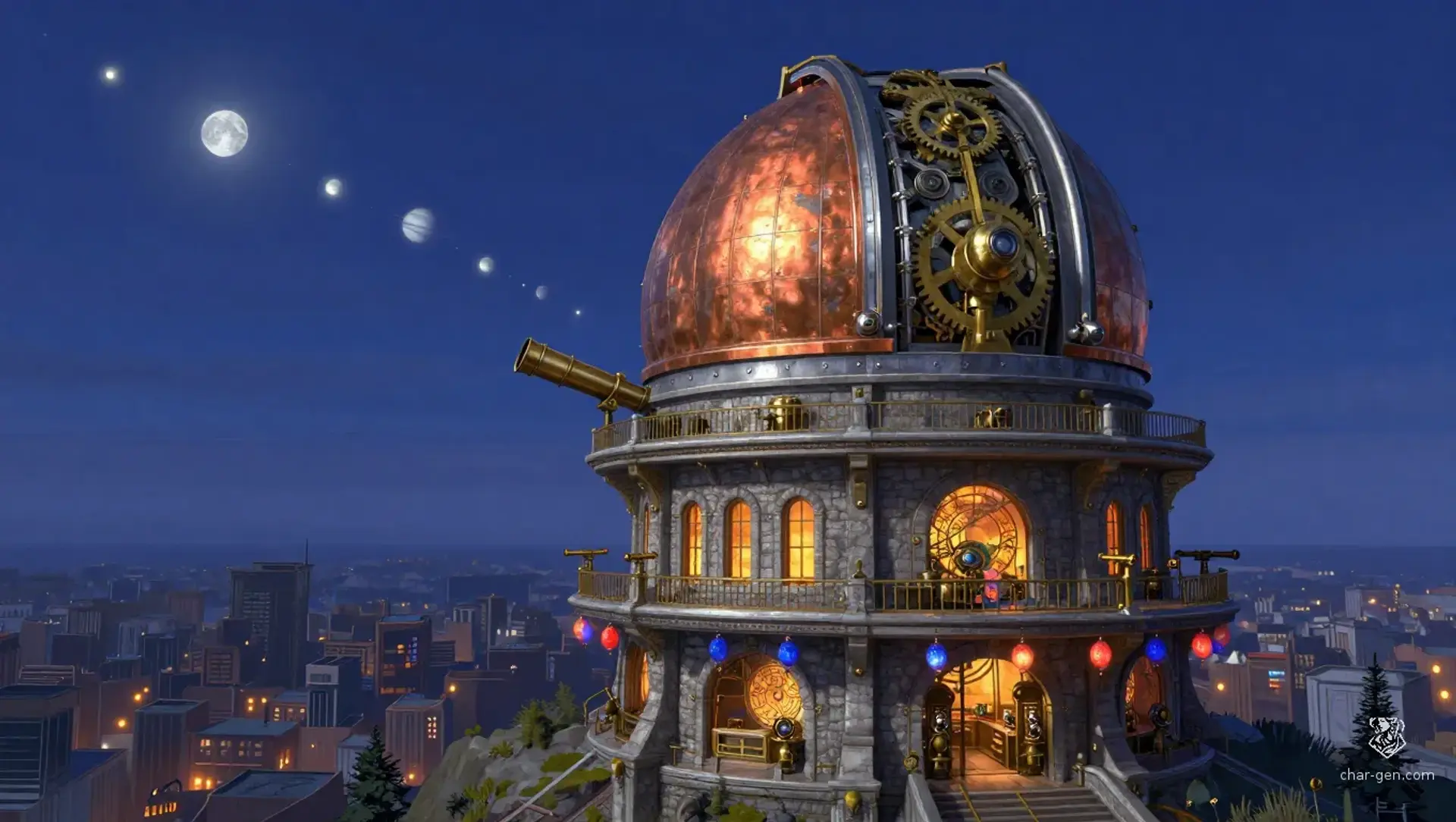
Star Tower
Known simply as the Star Tower, this grand observatory rises above the surrounding district on a reinforced hill of dressed stone. Its lower levels house archives, workrooms, visitor chambers, and a lecture hall, while the upper tower opens into vast viewing floors and a rotating dome crowned in copper. The place is famous as the site where the first astrologists proved that the lights beyond the world were not fixed signs in the heavens, but 13 other planets circling the same distant star. That discovery changed trade, religion, navigation, and the way people understood their place in the cosmos.
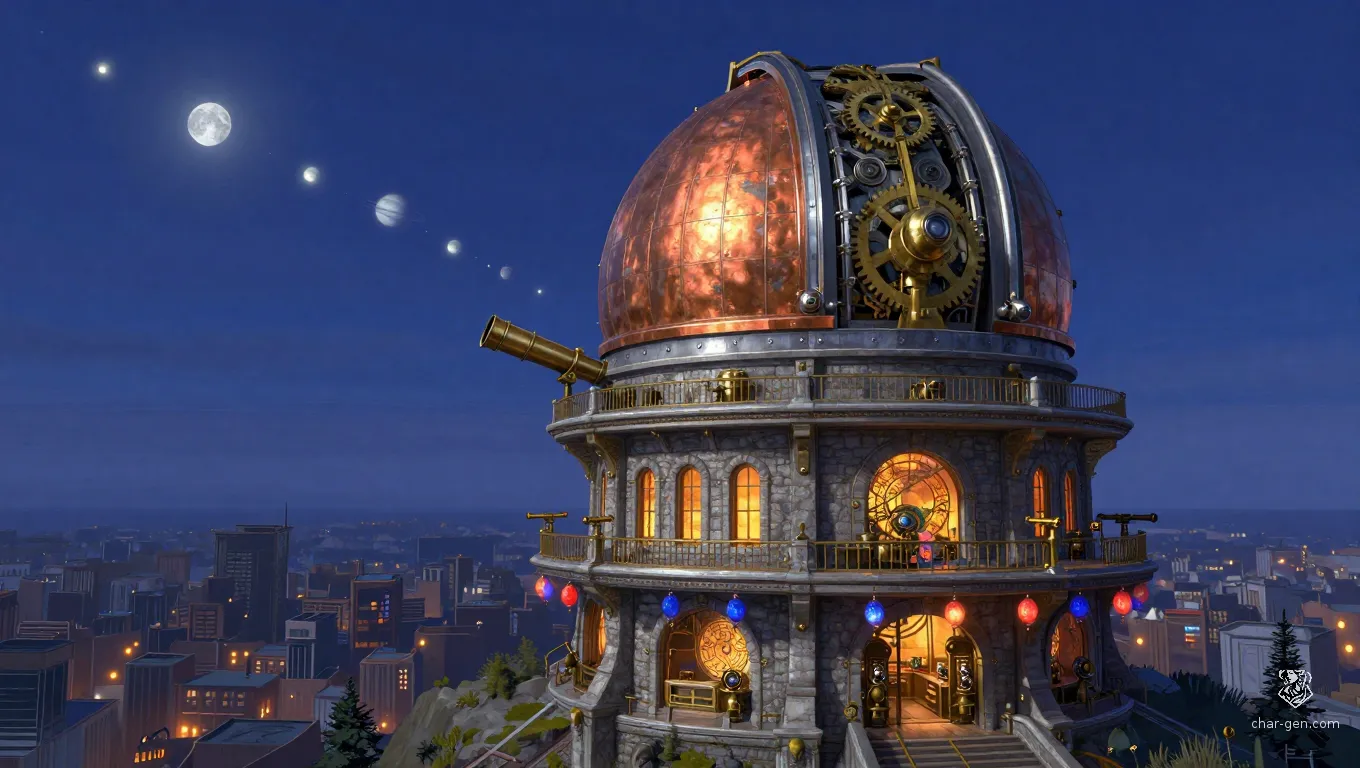
Star Tower
Quiet, focused, and slightly reverent, with the low hum of gears, the smell of oil and candle wax, and the constant sense that someone here is listening to the universe
Known simply as the Star Tower, this grand observatory rises above the surrounding district on a reinforced hill of dressed stone. Its lower levels house archives, workrooms, visitor chambers, and a lecture hall, while the upper tower opens into vast viewing floors and a rotating dome crowned in copper. The place is famous as the site where the first astrologists proved that the lights beyond the world were not fixed signs in the heavens, but 13 other planets circling the same distant star. That discovery changed trade, religion, navigation, and the way people understood their place in the cosmos.
Patient, exacting, curious, and quietly proud of their legacy
History
Star Charts and Archives
The observatory keeps a carefully maintained archive of sky charts, brass astrolabes, moving star maps, and sealed notebooks from the first generation of astrologists. Visitors may view public charts in the outer gallery, but the oldest records are kept in climate-controlled vault cabinets below the main dome. The most prized volumes describe the discovery of the 13 known planets and the long argument that followed over whether they were truly worlds or merely wandering lights.
Observing Floors
The tower is built for observation of both the night sky and the planes beyond it. Its upper ring contains a rotating platform of lenses, mirrors, and brass tracking arms that can follow a planet across the heavens without losing sight. During clear nights, apprentices call out coordinates from the sky room while the senior astrologist makes notes in a command chamber lined with chalk marks, orbital diagrams, and wax-sealed prediction slips.
Public Readings and Consultations
The observatory hosts consultations for nobles, sailors, caravan masters, and scholars who want omens, tide predictions, seasonal forecasts, or advice on auspicious travel dates. Most patrons leave with practical guidance and a small stamped chart. Wealthier clients sometimes request private readings, especially when planning expeditions to newly named regions or when they fear the influence of a particular planet.
Maintenance and Instrument Care
The lower workshops are devoted to maintaining the tower's instruments. Glass is polished daily, brass gears are oiled, and the great tracking lens is recalibrated after every storm. A pair of patient technicians handles delicate repairs, and the tower keeps a modest but constant budget for replacement lenses, ink, vellum, and rare lens-cleaning powders brought in from distant cities.
Denizens
Patient, exacting, curious, and quietly proud of their legacy
The current director of the tower, a disciplined scholar who speaks carefully and keeps meticulous records. She respects evidence above all else, but privately loves being proven wrong if the sky offers something wonderful.
A genial old mechanic who has worked on the tower's lenses and gears for decades. He knows every hidden panel, squeaking hinge, and bad repair in the building, and he treats the instruments like beloved pets.
A young chart-copyist with a memory for constellations and a talent for noticing impossible details. She is eager, curious, and more willing than she should be to stay awake all night for a strange celestial event.
Rumors & Plot Hooks
- 1.Some say the original discovery journals include an unrecorded 14th world that was erased from every public copy.
- 2.A planet marked in the oldest charts has begun to appear in the wrong place at the wrong time.
- 3.The tower's great lens sometimes shows figures standing on distant worlds, watching back.
- 4.A sealed room beneath the archive is said to contain the first telescope ever used here, still pointed at something no one can identify.
Classified Entry
Below the archive is a sealed chamber containing the earliest proof of the 13 planets, along with a private set of notes that suggest the astronomists noticed an unnatural gap in the heavens, as if something once orbited the star and was removed on purpose.
Turn Star Tower into a sheet
A high-res, share-ready sheet you can post or print.