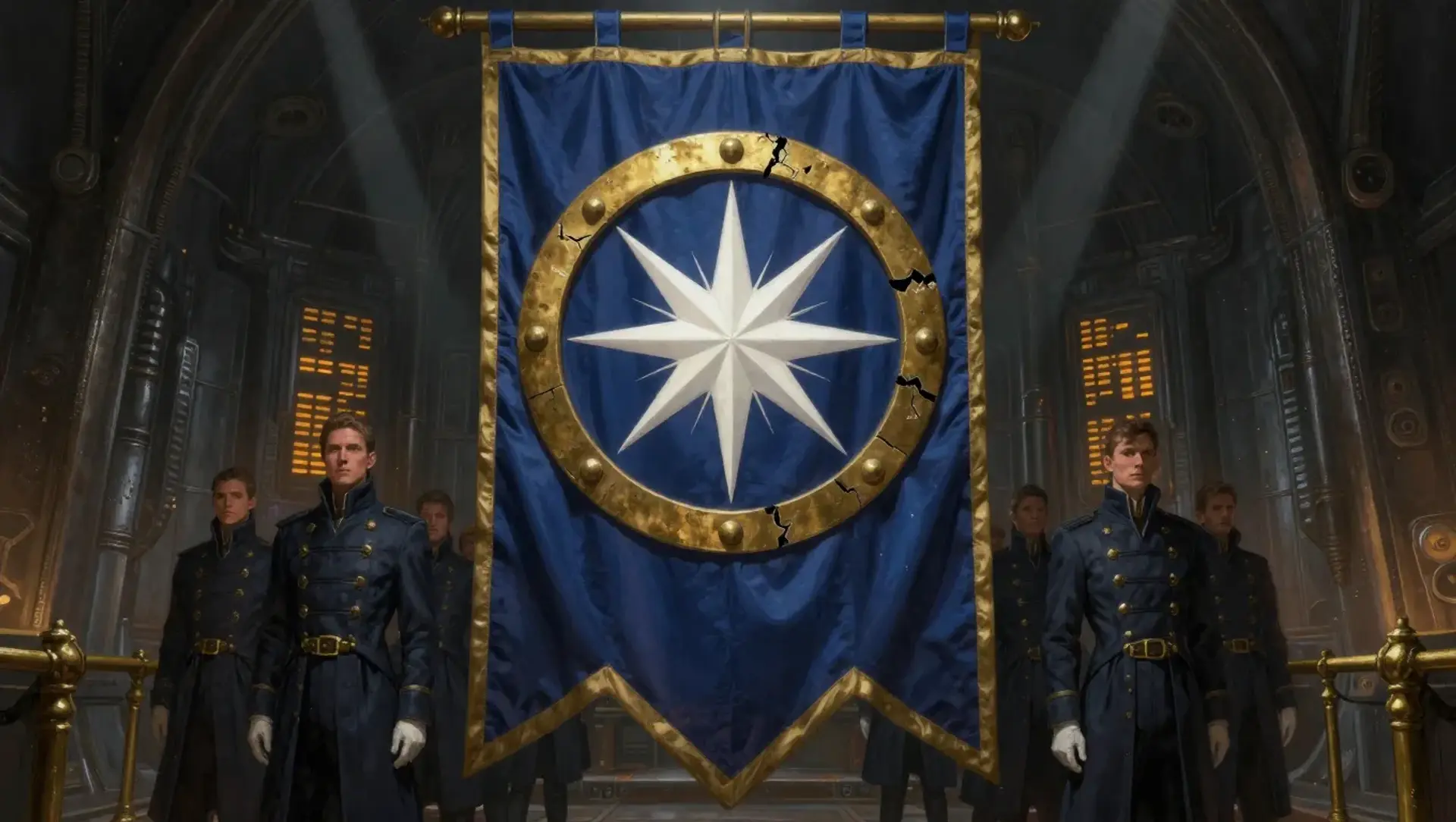
The Bridge Synod - AI-generated fantasy Faction

The Bridge Synod

After the Eternal Hope entered its long drift, the ship's early command structure failed in stages. First came the loss of external contact, then the loss of several navigation modules, then a wave of accidents that turned routine administration into triage. In the first decade, the Bridge Synod was not yet a faction but an emergency protocol enforced by those who could still speak for the ship. The watershed moment came during the Black Quiet, a five-day systems blackout in which public deck messages vanished, two sectors rioted, and one lower habitation ring was sealed to stop the spread of fire and panic. When the blackout ended, the council did not dissolve. Instead, it proved that it alone could keep the ship from fracturing. From then on, the Synod refined a doctrine of managed truth: never let the crew see the whole damage, never let one district know what another has lost, and never permit a crisis to become collective knowledge unless absolutely necessary. Over the decades, they replaced emergency improvisation with ritualized procedure. New titles were invented, archive access narrowed, ration policy hardened into law, and memory records were curated to emphasize continuity. Their triumphs were real. They prevented total civil collapse during three major hull breaches, restored partial power after the coolant drought, and brokered peace between hostile deck blocs more than once. Their setbacks were equally real. Every suppression created new resentment, every lie required a larger lie to support it, and every generation born under Synod rule inherited the assumption that truth is a privilege rationed like food. Today they are less a council than a machine for delaying catastrophe while pretending to command it.

The Bridge Synod

Ruling council · Lawful neutral with authoritarian leanings, outwardly protective and internally paranoid.

The Bridge Synod

Continuity is mercy.

TypeRuling council
SizeSmall at the top, vast in reac…
InfluenceVery high
WealthResource-rich in access, poor…
AlignmentLawful neutral with authoritar…
AgeOfficially 74 years as the rul…

Chronology

After the Eternal Hope entered its long drift, the ship's early command structure failed in stages. First came the loss of external contact, then the loss of several navigation modules, then a wave of accidents that turned routine administration into triage. In the first decade, the Bridge Synod was not yet a faction but an emergency protocol enforced by those who could still speak for the ship. The watershed moment came during the Black Quiet, a five-day systems blackout in which public deck messages vanished, two sectors rioted, and one lower habitation ring was sealed to stop the spread of fire and panic. When the blackout ended, the council did not dissolve. Instead, it proved that it alone could keep the ship from fracturing. From then on, the Synod refined a doctrine of managed truth: never let the crew see the whole damage, never let one district know what another has lost, and never permit a crisis to become collective knowledge unless absolutely necessary. Over the decades, they replaced emergency improvisation with ritualized procedure. New titles were invented, archive access narrowed, ration policy hardened into law, and memory records were curated to emphasize continuity. Their triumphs were real. They prevented total civil collapse during three major hull breaches, restored partial power after the coolant drought, and brokered peace between hostile deck blocs more than once. Their setbacks were equally real. Every suppression created new resentment, every lie required a larger lie to support it, and every generation born under Synod rule inherited the assumption that truth is a privilege rationed like food. Today they are less a council than a machine for delaying catastrophe while pretending to command it.

Founder’s Story

The Bridge Synod began during the first catastrophe of the Eternal Hope's drift. In the ninth day after the ship lost scheduled contact with its destination, a cascade of failures struck the navigation spine, several senior officers died, and three competing emergency chains issued contradictory orders. The original bridge crew, frightened and outnumbered by the scale of the crisis, gathered with the senior captains, security chiefs, and archive wardens in a locked command chamber. There, they made a brutal bargain: the ship could not survive a public struggle over command, and if the crew believed the situation was already lost, the Eternal Hope might tear itself apart faster than any mechanical failure could do it. They declared a temporary council to preserve order until stability returned. Stability never fully returned. Each successive emergency justified another extension of that temporary council until the Bridge Synod became the permanent heart of government. Their founding vow was simple and poisonous at once: keep the ship moving, keep the chain unbroken, and keep despair from learning the truth.

The Mechanism of Intent

Public Goals
  • Preserve the Eternal Hope
  • Maintain order and continuity
  • Protect the crew from panic
  • Keep the ship on course
  • Ensure that no district is abandoned to chaos
  • Secret Goals
  • Quietly determine whether the Eternal Hope can be stabilized or whether a controlled collapse is the only survivable future.
  • Preserve the Synod itself, even if the ship must be politically reshaped to do it.
  • Erase any record that the council has lost track of how many major systems are truly offline.
  • Convert emergency authority into a permanent social order before the next generation learns the difference.
  • Current Objectives
  • Keep the latest major propulsion and life-support failures hidden from the public decks.
  • Prevent any inquiry into the sealed archives from exposing the extent of the ship's deterioration.
  • Maintain the appearance of a functioning, continuous chain of command.
  • Contain rumors that the Eternal Hope has lost multiple navigational sectors and cannot safely complete its assigned route.
  • Identify and neutralize any officer, engineer, or recorder likely to trigger panic.
  • Long-Term Vision

    To transform emergency rule into a permanent civic architecture that can survive any crisis, even if that means replacing the old dream of the mission with a smaller dream of mere survival.

    StructureRuling council
    SuccessionSuccession is nominally by council vote, but in practice it requires endorsement from the security seat, archive seat, and ration office, plus enough whispered support from bridge captains to prevent civil fracture. This makes succession slow, secretive, and vulnerable to bribery or blackmail.

    Leadership

    Admiral Sera Vale First Navigator and Chair of the Bridge Synod

    Controlled, burdened, and deeply pragmatic, with a hidden streak of grief she will not allow anyone to witness.

    Admiral Sera Vale First Navigator

    Measured, coldly compassionate, and frighteningly decisive under pressure.

    Captain Orin Sable High Seat of Security

    Ceremonial, meticulous, and quietly ruthless.

    Warden Talia Merrow High Seat of Archives

    Patient, inquisitive, and unsettlingly hard to bluff.

    Prefect Joren Lask Rising bridge prefect and likely successor

    Charismatic, resentful, and impossible to fully trust.

    Recorder-Major Ilya Quen Chief Oath Clerk

    Soft-spoken, charming, and dangerously observant.

    Visual sheet

    Turn The Bridge Synod into a sheet

    A high-res, share-ready sheet you can post or print.

    Gallery

    No images yet. Click to add.

    Relationships