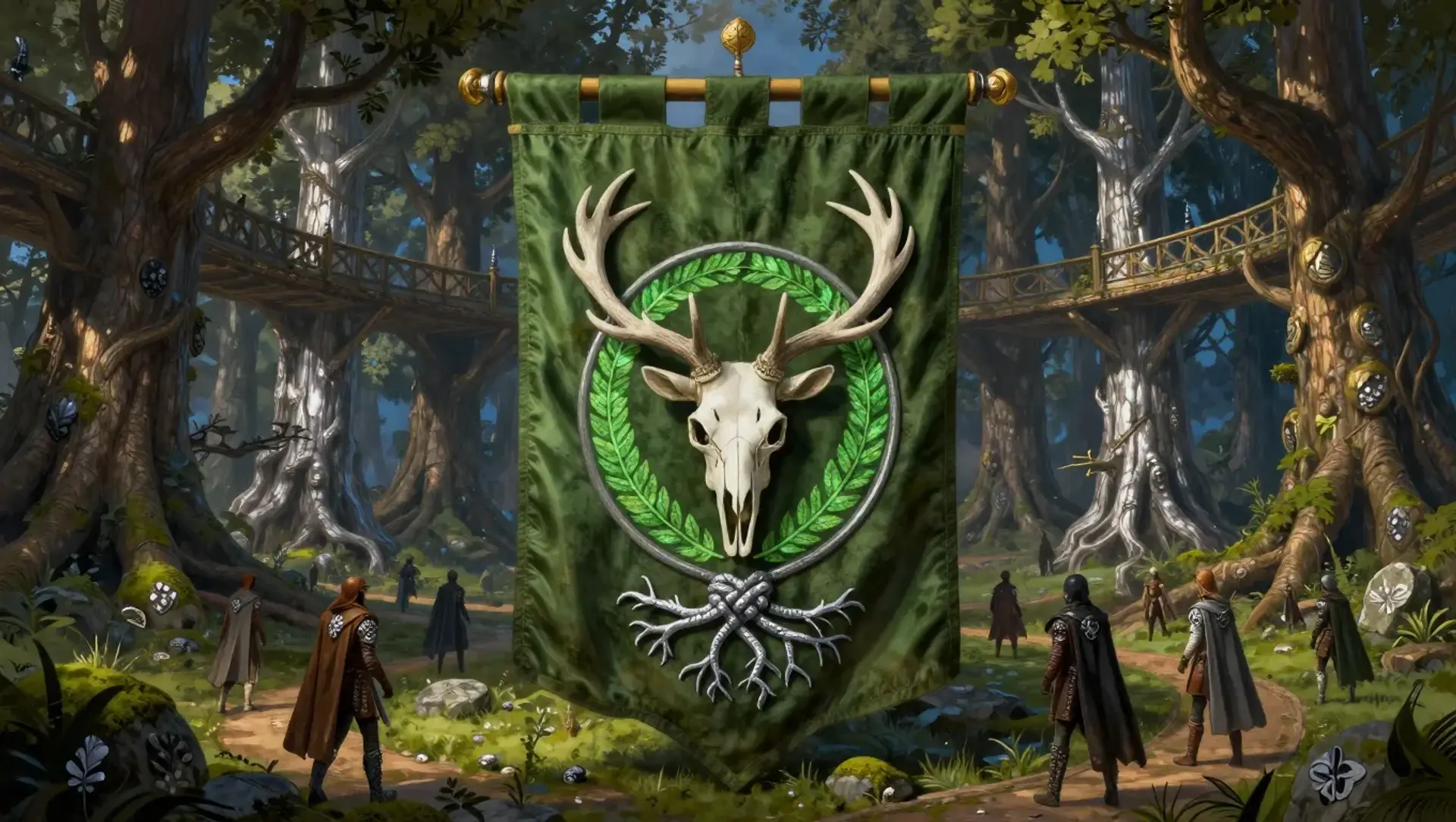
The Root-Crown Accord - AI-generated fantasy Faction

The Root-Crown Accord

After the Black Saw Season, the Root-Crown Accord grew from a survival pact into a true nation-within-the-woods. Their first century was marked by rebuilding, seed-saving, and the slow return of ancient paths that mortals thought lost. Their second great turning came during the Winter of Split Bark, when famine forced some elf families to accept grain from human caravans while others refused any contact. The resulting internal split nearly shattered the faction, but it also created their modern dual identity: outwardly diplomatic, inwardly suspicious of dependency. Their third defining moment was the Treaty of Three Rivers, where elf envoys allowed limited human passage in exchange for strict logging bans and burial protections. The treaty brought peace and trade, but later human land speculators forged copies, claimed more land than was granted, and provoked a retaliatory cycle of raids and lawsuits. In recent decades, the elves have been weakened by rising road networks, illegal timber extraction, and an unexplained blight in the western canopy. The faction now survives by balancing three incompatible instincts: isolation, stewardship, and preemptive resistance.

The Root-Crown Accord

Forest stewardship confederation with martial, diplomatic, and druidic branches · Neutral, with strong preservational instincts and a dangerous willingness to enforce old boundaries.

The Root-Crown Accord

The forest remembers what kings forget.

TypeForest stewardship confederati…
SizeSeveral thousand sworn members…
InfluenceRegional
WealthModerate in natural resources,…
AlignmentNeutral, with strong preservat…
AgeAncient by mortal standards, f…

Chronology

After the Black Saw Season, the Root-Crown Accord grew from a survival pact into a true nation-within-the-woods. Their first century was marked by rebuilding, seed-saving, and the slow return of ancient paths that mortals thought lost. Their second great turning came during the Winter of Split Bark, when famine forced some elf families to accept grain from human caravans while others refused any contact. The resulting internal split nearly shattered the faction, but it also created their modern dual identity: outwardly diplomatic, inwardly suspicious of dependency. Their third defining moment was the Treaty of Three Rivers, where elf envoys allowed limited human passage in exchange for strict logging bans and burial protections. The treaty brought peace and trade, but later human land speculators forged copies, claimed more land than was granted, and provoked a retaliatory cycle of raids and lawsuits. In recent decades, the elves have been weakened by rising road networks, illegal timber extraction, and an unexplained blight in the western canopy. The faction now survives by balancing three incompatible instincts: isolation, stewardship, and preemptive resistance.

Founder’s Story

The faction began when three elf lineages, the Root-Walkers, the Moonboughs, and the Ash-Singers, survived a catastrophe called the Black Saw Season. In that year, mortal war spilled into the High Forest, and a coalition of loggers, mercenaries, and rival nobles burned old growth to deny cover to their enemies. The elves answered separately at first, each defending their own groves, but the fires spread beyond lineage borders. According to their oldest songs, a young pathfinder named Aelthar of the Moonboughs led survivors to the Hollow Stag, a living ring of ancient yews at the forest's heart. There they swore the Root-Crown Accord, a pact that no single bloodline would own the woods again. They would guard the forest as a living whole, measure land by care rather than by conquest, and judge trespass by harm rather than by parchment. That founding choice saved them, but it also planted the faction's central contradiction: they vowed unity in order to survive, yet they preserved the old lineages that would later compete for authority.

The Mechanism of Intent

Public Goals
  • Protect the High Forest from overcutting, pollution, and magical exploitation
  • Maintain peace where possible and limit bloodshed
  • Preserve ancient groves, burial sites, and migratory corridors
  • Allow only negotiated passage through elven territory
  • Secret Goals
  • Expose and invalidate forged human deeds in the High Forest to force a legal reset of regional borders
  • Identify the source of the western canopy blight before it becomes an extinction event
  • Replace the current loose treaty system with a forest-wide covenant that gives the elves veto power over all major development
  • If needed, reclaim abandoned land by stealth and diplomacy before any open war begins
  • Current Objectives
  • Preserve the High Forest from industrial logging, uncontrolled settlement, and magical exploitation
  • Negotiate enforceable travel and stewardship protocols with nearby settlements
  • Identify and contain the cause of the forest's recent sickness in the western canopy
  • Keep internal schisms from becoming open civil conflict
  • Recover or conceal older treaty records that would embarrass current leadership
  • Long-Term Vision

    To restore the High Forest as a self-governing living domain where outsiders may travel, trade, and dwell only by consent, and where no authority can reduce land to mere commodity or line on a map.

    StructureConfederated forest nation
    SuccessionThe First Root is chosen by the Branch Moot from among three candidates nominated by different lineages. In theory, the choice requires consensus. In practice, it usually comes after months of bargaining, favors, and the quiet exposure of embarrassing secrets. If the office falls vacant suddenly, the Leaf Captains meet in emergency moot and can appoint an interim First Root for one turning of the moon.

    Leadership

    Saelith Moonsong First Root of the Hollow Stag

    Controlled, compassionate, and relentless when cornered. She appears calm, but every choice is a burden she carries visibly.

    Saelith Moonsong First Root

    Measured, patient, and quietly intimidating. Speaks softly, but never wastes a word.

    Thalanir Thornbound Leaf Captain of the Western March

    Sharp, proud, and openly contemptuous of human law. Sees compromise as a wound that never heals.

    Elyra Voss Keeper of Treaties

    Exacting, thoughtful, and frustratingly diplomatic. Can turn a conversation into a legal trap.

    Varis Underbough Scout-Master of the Hidden Paths

    Charming in private, ruthless in practice, and always several steps ahead.

    Visual sheet

    Turn The Root-Crown Accord into a sheet

    A high-res, share-ready sheet you can post or print.

    Gallery

    No images yet. Click to add.

    Relationships