
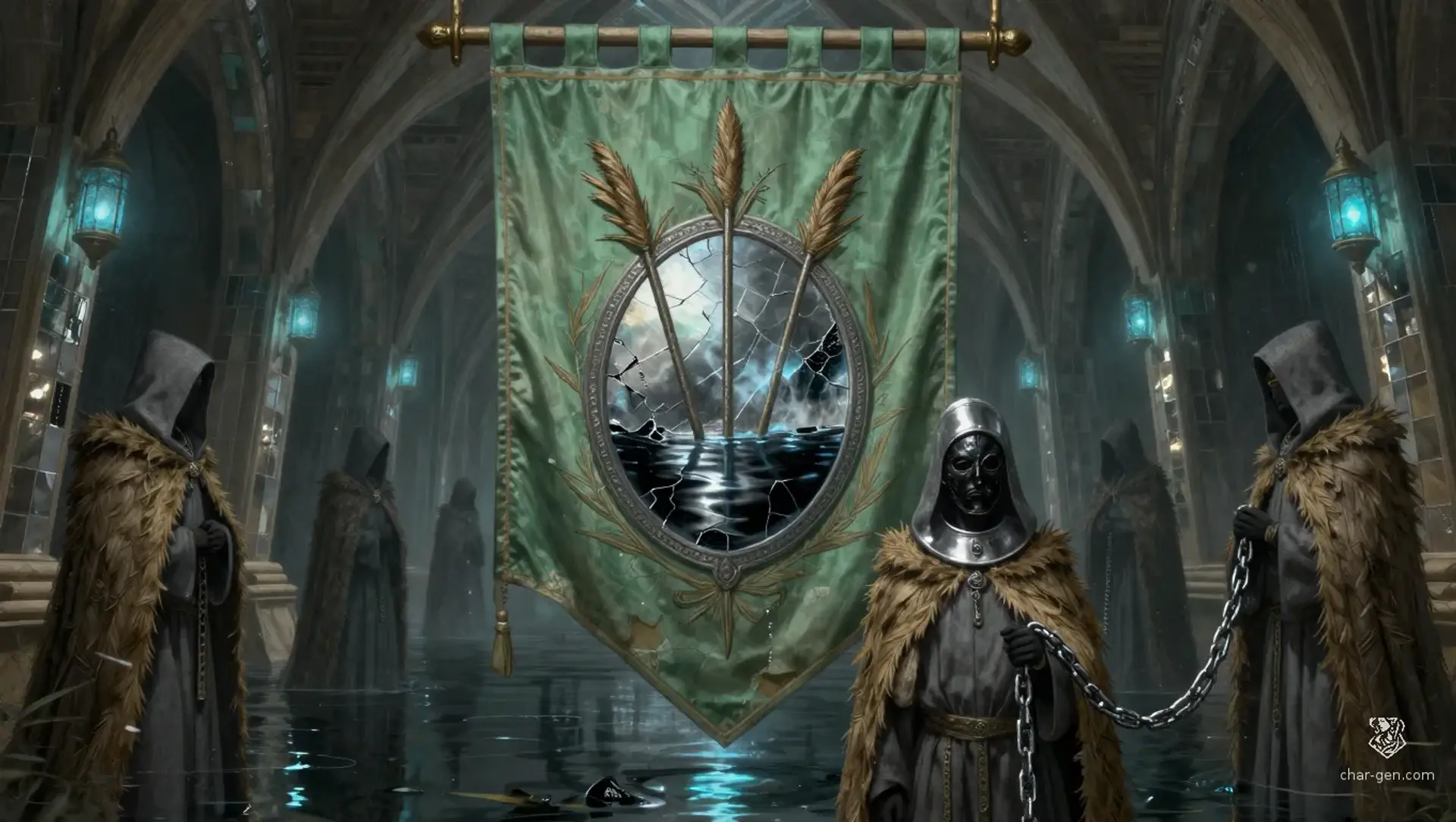
The Hall of Still Water
After the Sinking of Nine Lanterns, the group began as a rescue circle. Within a generation they became indispensable because they could do what local lords could not: preserve names, track drowned borders, and settle inheritance claims when the land itself changed. Their second age was expansion. They built satellite archive shrines in every major Mireglass settlement and standardized mirror-ink ledgers, which made trade and taxation possible across flooded territory. Their first setback was the Cinder Reed Plague, when a corrupted archive ink spread false genealogies through half the basin. Families were torn apart before the faction learned to quarantine records as carefully as bodies. Their greatest triumph was the Marsh Concord, a peace settlement brokered by their envoys that ended three years of canal warfare. Their greatest defeat was the Night of Split Reflections, when internal factionalism led them to destroy their own invasion maps and, in the confusion, lose their claim to several ancestral holdings. In the decades since, they have become a state within a state: respected for keeping the Mireglass alive, feared for how much they know, and resented for the quiet power that comes from deciding what the past was allowed to mean.
Archivist-protectorate and covert civic power · Lawful neutral with pragmatic, splintering tendencies toward mercy, ruthlessness, and quiet revolution.
The Hall of Still Water
“What the water takes, we remember.”
Turn The Hall of Still Water into a sheet
A high-res, share-ready sheet you can post or print.