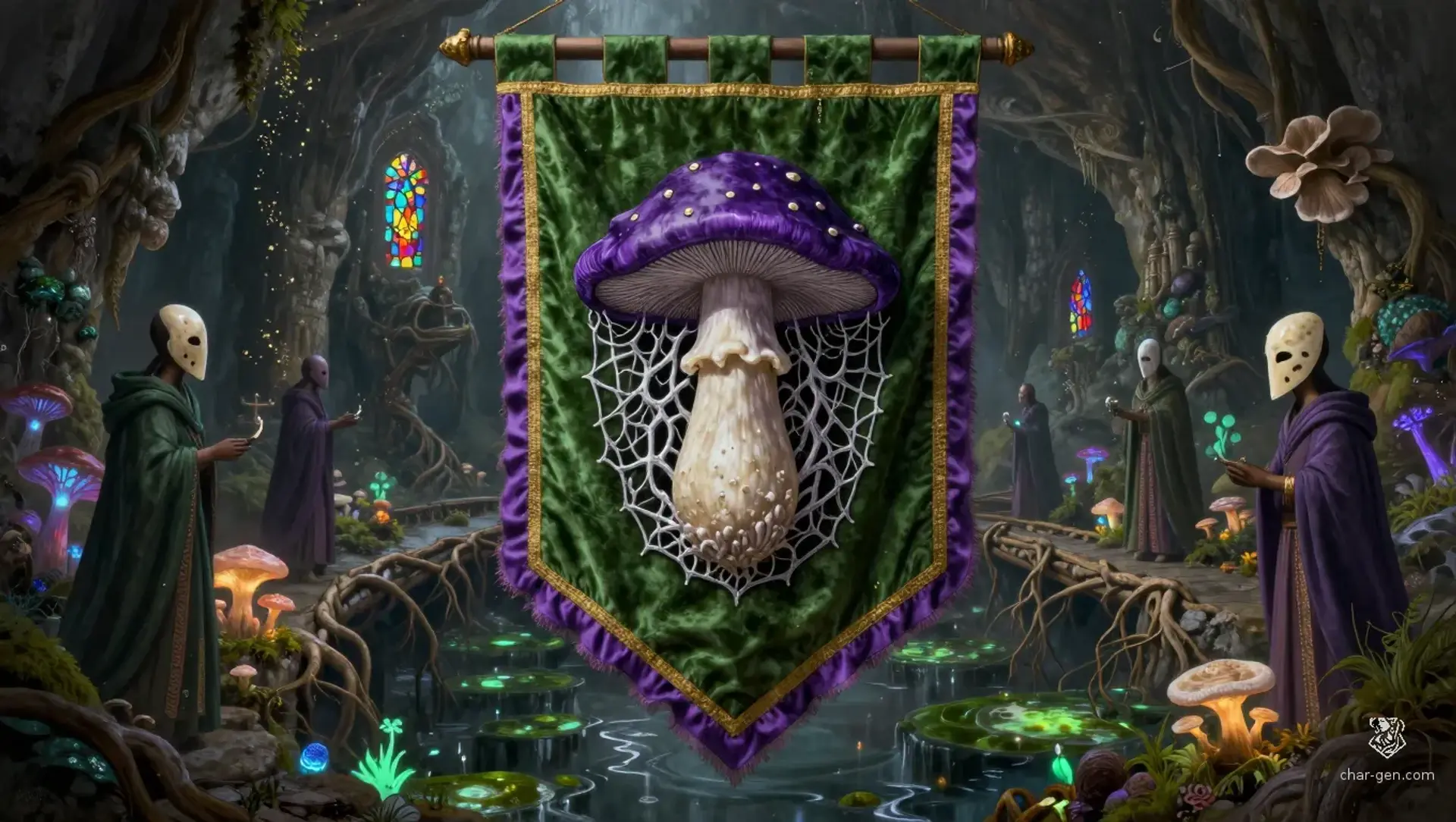
The Broodweb of the Hollow Bloom - AI-generated fantasy Faction

The Broodweb of the Hollow Bloom

For generations the Broodweb was a drifting pattern of isolated mycnoid circles connected only by couriers and instinct. The Gray Cinder Rot changed everything. Entire caverns collapsed, hunting tunnels turned poisonous, and a third of the old brood-lines disappeared. In the aftermath, three surviving circles met in a place where mineral water fell through the ceiling in luminous threads. They realized that spore-song could preserve not just feelings but instructions, maps, and warnings. The first Broodweb was literally woven from memory. Its first century was defined by rescue and consolidation. The faction became famous for guiding refugees through the deep roads and for healing the poisoned lands left by mining wars. Their great triumph was the Night of a Thousand Shelters, when they opened every spore-house they owned to thousands of stranded civilians during a region-wide collapse. Their great setback came later, when a conservative sovereign called the Deep Orchard tried to keep the Broodweb politically neutral. The decision protected them for a time, but it also left them unprepared for outside powers who learned to exploit their patience. The watershed moment came 180 years ago during the Hollow Bloom Schism. A hidden cadre of mycnoids attempted to fuse a hostile colony into the Broodweb by force, using memory spores to erase dissent. The plan was exposed after the new converts began speaking in fractured versions of the same voice. Civil war followed. Half the network burned, a sovereign was exiled, and the surviving leaders vowed never again to let unity become tyranny. That vow shaped the modern Broodweb: publicly compassionate, internally wary, and forever torn between communal harmony and coercive survival.

The Broodweb of the Hollow Bloom

Spore-bonded subterranean confederacy, part shrine, part refuge network, part living archive · Generally lawful neutral with quiet drifts toward neutral good in the public circles and unsettlingly pragmatic neutral evil in the hidden knots.

The Broodweb of the Hollow Bloom

Guard the seed, honor the dead, and let no one starve alone.

TypeSpore-bonded subterranean conf…
SizeMedium to very large depending…
InfluenceRegional in the underground, l…
WealthModest in coin, rich in knowle…
AlignmentGenerally lawful neutral with…
AgeAncient in origin, but reforme…

Chronology

For generations the Broodweb was a drifting pattern of isolated mycnoid circles connected only by couriers and instinct. The Gray Cinder Rot changed everything. Entire caverns collapsed, hunting tunnels turned poisonous, and a third of the old brood-lines disappeared. In the aftermath, three surviving circles met in a place where mineral water fell through the ceiling in luminous threads. They realized that spore-song could preserve not just feelings but instructions, maps, and warnings. The first Broodweb was literally woven from memory. Its first century was defined by rescue and consolidation. The faction became famous for guiding refugees through the deep roads and for healing the poisoned lands left by mining wars. Their great triumph was the Night of a Thousand Shelters, when they opened every spore-house they owned to thousands of stranded civilians during a region-wide collapse. Their great setback came later, when a conservative sovereign called the Deep Orchard tried to keep the Broodweb politically neutral. The decision protected them for a time, but it also left them unprepared for outside powers who learned to exploit their patience. The watershed moment came 180 years ago during the Hollow Bloom Schism. A hidden cadre of mycnoids attempted to fuse a hostile colony into the Broodweb by force, using memory spores to erase dissent. The plan was exposed after the new converts began speaking in fractured versions of the same voice. Civil war followed. Half the network burned, a sovereign was exiled, and the surviving leaders vowed never again to let unity become tyranny. That vow shaped the modern Broodweb: publicly compassionate, internally wary, and forever torn between communal harmony and coercive survival.

Founder’s Story

The Broodweb began as a migration line, not a nation. Three centuries ago, during a fungal blight called the Gray Cinder Rot, scattered mycnoid circles fled collapsing caverns and found one another around a drowned basalt ridge. There they discovered that the local spores could be linked into shared memory nets strong enough to carry fear, warning, and grief across miles of tunnels. The first sovereigns used that shared pain to save dozens of isolated colonies from starvation. When the blight finally ended, those colonies refused to separate again. They built the first memory gardens, the first treaty-vaults, and the first web sanctuaries where fugitives of any species could sleep under fungal watch. Their founder was not a single hero but a triad of elders who agreed on one principle: no brood should ever forget the cost of survival.

The Mechanism of Intent

Public Goals
  • Protect underground communities from collapse, famine, and predation
  • Preserve living history through memory gardens and song
  • Maintain safe passage between deep settlements
  • Offer sanctuary to the persecuted
  • Secret Goals
  • Select a successor who will preserve the sanctuary ideal without uncovering the First Kernel
  • Acquire enough leverage to force hostile powers into recognizing fungal refugee rights
  • Build a fail-safe web of alliances that can isolate any future would-be hive tyrant inside the colony
  • Identify and eliminate the hidden sect that wants to turn the Broodweb into a compulsory collective mind
  • Current Objectives
  • Stabilize the failing capillary caverns beneath their territory before the next flood season
  • Recover lost brood-memory from a sunken archive known only as the Black Throat Vault
  • Prevent a splinter sect from awakening an ancient fungal intelligence beneath the roots of a dead world-tree
  • Keep surface powers from learning how extensive their tunnel network really is
  • Negotiate legal recognition for their healing spores and burial rites
  • Long-Term Vision

    To become the quiet backbone of the underworld, a living network of sanctuary, medicine, and memory that outlasts kingdoms and keeps the deep places habitable long after surface empires fall.

    StructureConfederated colony-state with ritual leadership and semi-autonomous circles
    SuccessionA sovereign is not inherited by blood. When a sovereign dies or abdicates, the Circle Elders enter a three-day vigil and each presents one memory of the faction's greatest wound. The candidate who responds with the most sound plan for protecting the whole web is elevated, but only if two-thirds of the elders and one-third of the Sporewardens consent. This makes succession stable in theory and vicious in practice.

    Leadership

    Sovereign Velis Threetide First Sovereign of the Broodweb

    Graceful, deeply principled, and always listening for the harm underneath a promise.

    Sovereign Velis Threetide First Sovereign and public face of the faction

    Patient, ceremonial, and difficult to anger until a principle is violated.

    Elder Myrrh of the Pale Cap Diplomatic matriarch and keeper of treaties

    Warm, practical, and frighteningly observant.

    Threadkeeper Silt-Who-Remembers Archivist of forbidden memory

    Soft-spoken, persuasive, and absolutely convinced of their own necessity.

    Warden Brakk Sporeshield Commander of the Sporewardens

    Blunt, protective, and openly suspicious of nobility.

    Chirurgeon Luma of the Blue Root Master of medicinal cultivation

    Brilliant, cheerful, and capable of horrifying decisions with a smile.

    Visual sheet

    Turn The Broodweb of the Hollow Bloom into a sheet

    A high-res, share-ready sheet you can post or print.

    Gallery

    No images yet. Click to add.

    Relationships