
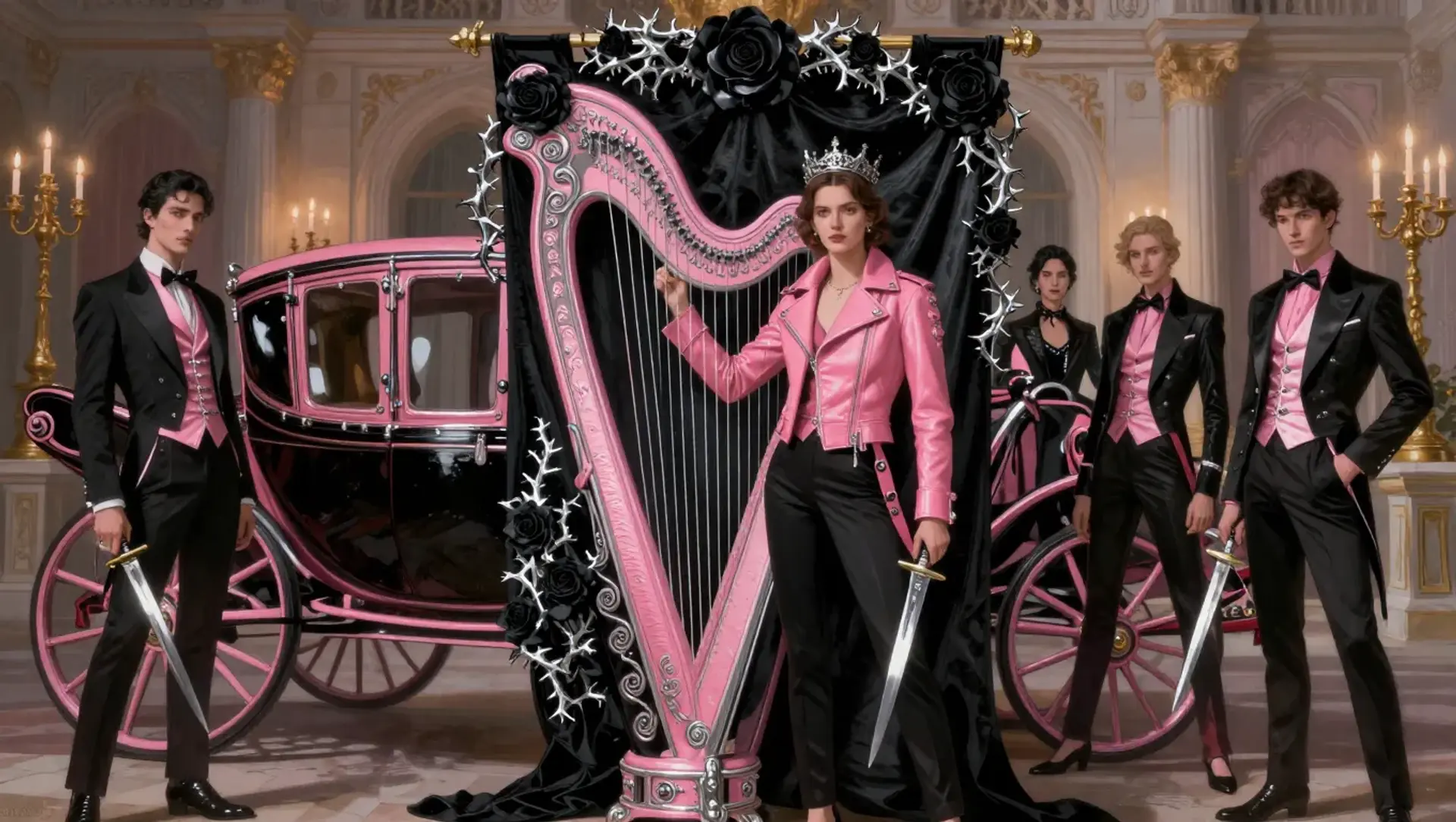
The Rose-Black Sextet
In the first decade, the sextet was little more than a scandalous novelty act. They wore black and rose-pink as a deliberate insult to conservative taste, and wealthy hosts loved them for the same reason they loved exotic wines and dangerous romances. Their founder, Serelith Vane, insisted that every performance should feel like a secret being whispered in a candlelit room. That aesthetic became their signature. Their second era began after the War of Broken Gates, when half the old nobility had new money and the other half had old grudges. The sextet adapted by becoming experts at social repair. They could make rivals smile beside one another long enough for a deal to be signed. They could also make the wrong remark at the wrong dinner and ruin a marriage. The troupe discovered that the richest clients did not merely want entertainment, they wanted a setting in which their power felt elegant. The third era was defined by the Midnight Conservatory Fire. Serelith vanished soon after, officially dead, unofficially retired, and possibly still alive under another name. Leadership passed to the current harpist, a dazzling elf known as Valcorin Leise, who expanded the troupe into a mobile intelligence machine. Under Valcorin, the sextet learned to treat every banquet as a battlefield, every encore as leverage, and every gift as an invoice waiting to mature. Today they are more feared than celebrated, but their invitations remain among the most coveted in the realm.
Traveling performance troupe and elite social influence network · Lawful evil, neutral evil, and lawful neutral in public, with the group’s practical morality bending toward greed, vanity, and leverage.
The Rose-Black Sextet
“We do not perform for the room. We define it.”
Turn The Rose-Black Sextet into a sheet
A high-res, share-ready sheet you can post or print.