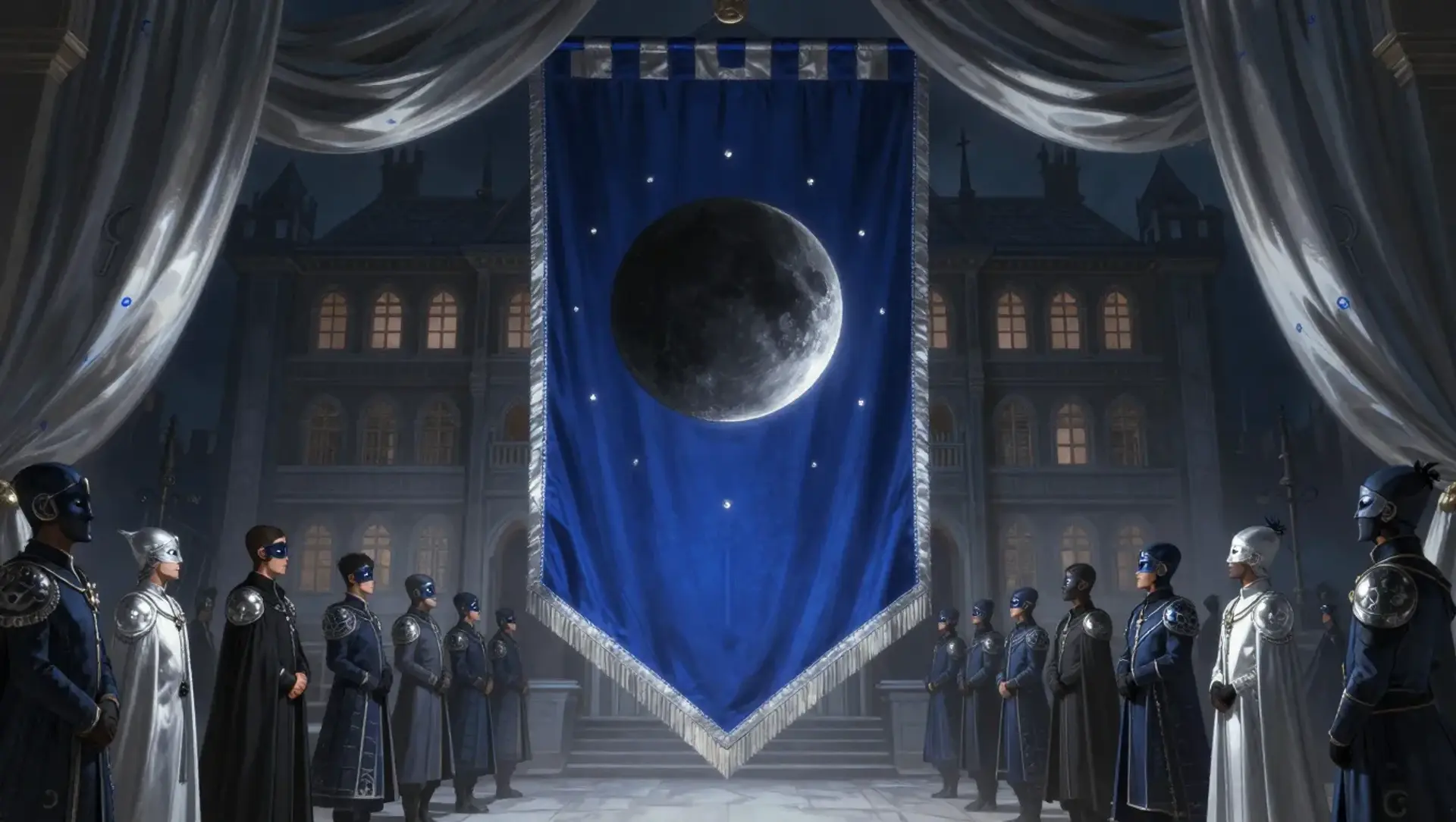
House Veyrath, Keepers of the Black Moon - AI-generated fantasy Faction

House Veyrath, Keepers of the Black Moon

For its first century, House Veyrath served as a practical instrument of reconstruction. It standardized tax records, reopened roads, negotiated the release of prisoners, and exposed several nobles who had profited from the war. Its efficiency made it indispensable, but also made it feared. During the Second Provincial Revolt, the house's then-leader, Lady Merial Veyrath, accepted emergency authority from the crown and used it to end the rebellion within one year. The watershed moment came at the Siege of Hollow Crown. Rather than storm the city, Merial sealed every gate, redirected grain shipments, and publicly offered amnesty to anyone who surrendered. Privately, she circulated forged evidence suggesting that the rebel leadership had already betrayed one another. The city surrendered without a battle. The victory transformed House Veyrath from royal administrator into a national power. Over the following generations, the house expanded its records offices into an intelligence service, its estates into a network of fortified waystations, and its legal privileges into an informal system of oversight above ordinary law. Its greatest triumph was the Treaty of Three Rivers, which ended a generation of border war. Its greatest setback was the Ashfall Scandal, when thousands of falsified convictions were discovered in a provincial archive. The family survived by sacrificing one branch, blaming a dead governor, and classifying the remaining evidence. Today, the house is more powerful than it has ever been, but its authority rests on a fragile balance between public legitimacy, royal dependence, provincial fear, and secrets that cannot remain buried forever.

House Veyrath, Keepers of the Black Moon

Noble House · Lawful Neutral

House Veyrath, Keepers of the Black Moon

What is hidden preserves what is sworn.

TypeNoble House
SizeHuge, with more than 1,500 dir…
InfluenceNational, with authority conce…
WealthExtremely wealthy, with income…
AlignmentLawful Neutral
Age312 years

Chronology

For its first century, House Veyrath served as a practical instrument of reconstruction. It standardized tax records, reopened roads, negotiated the release of prisoners, and exposed several nobles who had profited from the war. Its efficiency made it indispensable, but also made it feared. During the Second Provincial Revolt, the house's then-leader, Lady Merial Veyrath, accepted emergency authority from the crown and used it to end the rebellion within one year. The watershed moment came at the Siege of Hollow Crown. Rather than storm the city, Merial sealed every gate, redirected grain shipments, and publicly offered amnesty to anyone who surrendered. Privately, she circulated forged evidence suggesting that the rebel leadership had already betrayed one another. The city surrendered without a battle. The victory transformed House Veyrath from royal administrator into a national power. Over the following generations, the house expanded its records offices into an intelligence service, its estates into a network of fortified waystations, and its legal privileges into an informal system of oversight above ordinary law. Its greatest triumph was the Treaty of Three Rivers, which ended a generation of border war. Its greatest setback was the Ashfall Scandal, when thousands of falsified convictions were discovered in a provincial archive. The family survived by sacrificing one branch, blaming a dead governor, and classifying the remaining evidence. Today, the house is more powerful than it has ever been, but its authority rests on a fragile balance between public legitimacy, royal dependence, provincial fear, and secrets that cannot remain buried forever.

Founder’s Story

House Veyrath began with Ser Caldris Veyrath, a minor border knight during the War of Thirteen Banners. Caldris was not the strongest commander, but he understood that the armies destroying the kingdom were being supplied by forged orders, counterfeit seals, and contradictory claims of authority. He gathered scribes, couriers, hostage negotiators, and disgraced magistrates into a temporary office called the Night Table. Their purpose was to determine which commands were genuine and which were fabrications. When the royal capital fell, Caldris used the Night Table's records to expose the conspirators who had prolonged the war for profit. The restored monarch rewarded him with land, a hereditary title, and the right to inspect provincial offices in the crown's name. The first Veyrath emblem was supposedly painted on a black banner during an eclipse, though some family records claim the moon was originally a warning symbol used by the people Caldris defeated.

The Mechanism of Intent

Public Goals
  • Preserve the unity and lawful continuity of the kingdom.
  • Protect roads, borders, archives, and vital food supplies.
  • Prevent noble feuds, corruption, and foreign influence from destabilizing the crown.
  • Ensure that every person has a recognized legal identity and access to formal judgment.
  • Serve as an impartial administrative arm of the monarchy.
  • Respond quickly to famine, rebellion, invasion, and institutional collapse.
  • Secret Goals
  • Force the crown to renew House Veyrath's charter before the next succession, preferably with broader emergency authority.
  • Recruit enough reform-minded officials to control the transition while preserving the family's most important secrets.
  • Destroy the evidence connecting the house to the Ashfall Scandal before the Dawnless League obtains it.
  • Find a way to break or renegotiate the Moonvault pact without triggering whatever protection it provides.
  • Turn the Chartered Dependents into formal citizens with limited rights, reducing the chance of a mass uprising while preserving their service obligations.
  • Ensure that no foreign power discovers how dependent the kingdom's communications, food reserves, and legal records are on House Veyrath systems.
  • Current Objectives
  • Prevent a succession crisis after the sudden illness of the ruling matriarch.
  • Recover the original charter that defines the house's authority before a rival faction proves it was forged.
  • Stabilize the eastern provinces without allowing local governors to gain enough independence to become rival powers.
  • Contain rumors that the black full moon emblem represents a forgotten pact rather than ordinary heraldry.
  • Identify the person leaking sealed council minutes to reformist nobles and foreign agents.
  • Secure a marriage, treaty, or political adoption that will bind the next generation to the central royal government.
  • Long-Term Vision

    A kingdom where no civil war, foreign invasion, corrupt noble, or popular uprising can threaten continuity because House Veyrath has quietly embedded itself into every mechanism of government. The traditionalists envision a permanent supervisory aristocracy. The reformers envision a constitutional order in which the house becomes the kingdom's impartial guardian rather than its hidden ruler. Both visions require the old power structure to survive long enough to shape the future.

    StructureHereditary noble administration with provincial governance, legal authority, intelligence services, and extensive dependent networks
    SuccessionWhen the Keeper dies or formally abdicates, the Silver Crescent Council convenes a closed succession hearing. Eligible heirs must present a record of service, demonstrate knowledge of the charter, and receive at least four council votes. The crown may object but cannot directly appoint the Keeper without provoking a constitutional crisis. If no candidate gains sufficient support, the council appoints an interim Keeper for one year. During that year, provincial Moonwardens may submit competing claims, and the sealed archive is opened to test each candidate's loyalty. In practice, succession is decided long before the hearing through marriages, blackmail, patronage, and control of the Night Riders.

    Leadership

    Lady Varessa Veyrath Keeper of the Black Moon

    Gracious, incisive, disciplined, and emotionally guarded. She can make a threat sound like a courtesy and a confession sound like a legal footnote. Despite her severity, she has a genuine tenderness toward servants, children, and people who accept responsibility for their mistakes.

    Ilyra Veyrath Chosen heir and chief negotiator

    Controlled, observant, patient, and quietly compassionate. She asks precise questions and remembers every answer. Her politeness becomes frightening when she has made a decision.

    Darian Veyrath Younger royal relative and commander of the Night Riders

    Charismatic, daring, theatrical, and easily wounded by perceived disrespect. He is a gifted commander who sincerely believes fear prevents greater bloodshed.

    Maris Veyrath of the Eastern March Provincial Moonwarden

    Blunt, pragmatic, humorous, and difficult to intimidate. She treats etiquette as a tool rather than a moral obligation.

    Orren Vale Master of the sealed archive and potential whistleblower

    Anxious, meticulous, and morally stubborn. He apologizes before delivering devastating information.

    Tavren Holt Steward of the Moonvault and covert organizer

    Warm, sociable, and apparently harmless. He knows which servants hate the house, which nobles are afraid, and which doors are never locked.

    Prelate Sera Nhal Councilor, legal theologian, and royal observer

    Severe, articulate, and sincerely devout or ideologically committed. She despises hypocrisy but is skilled at using it.

    Visual sheet

    Turn House Veyrath, Keepers of the Black Moon into a sheet

    A high-res, share-ready sheet you can post or print.

    Gallery

    No images yet. Click to add.

    Relationships