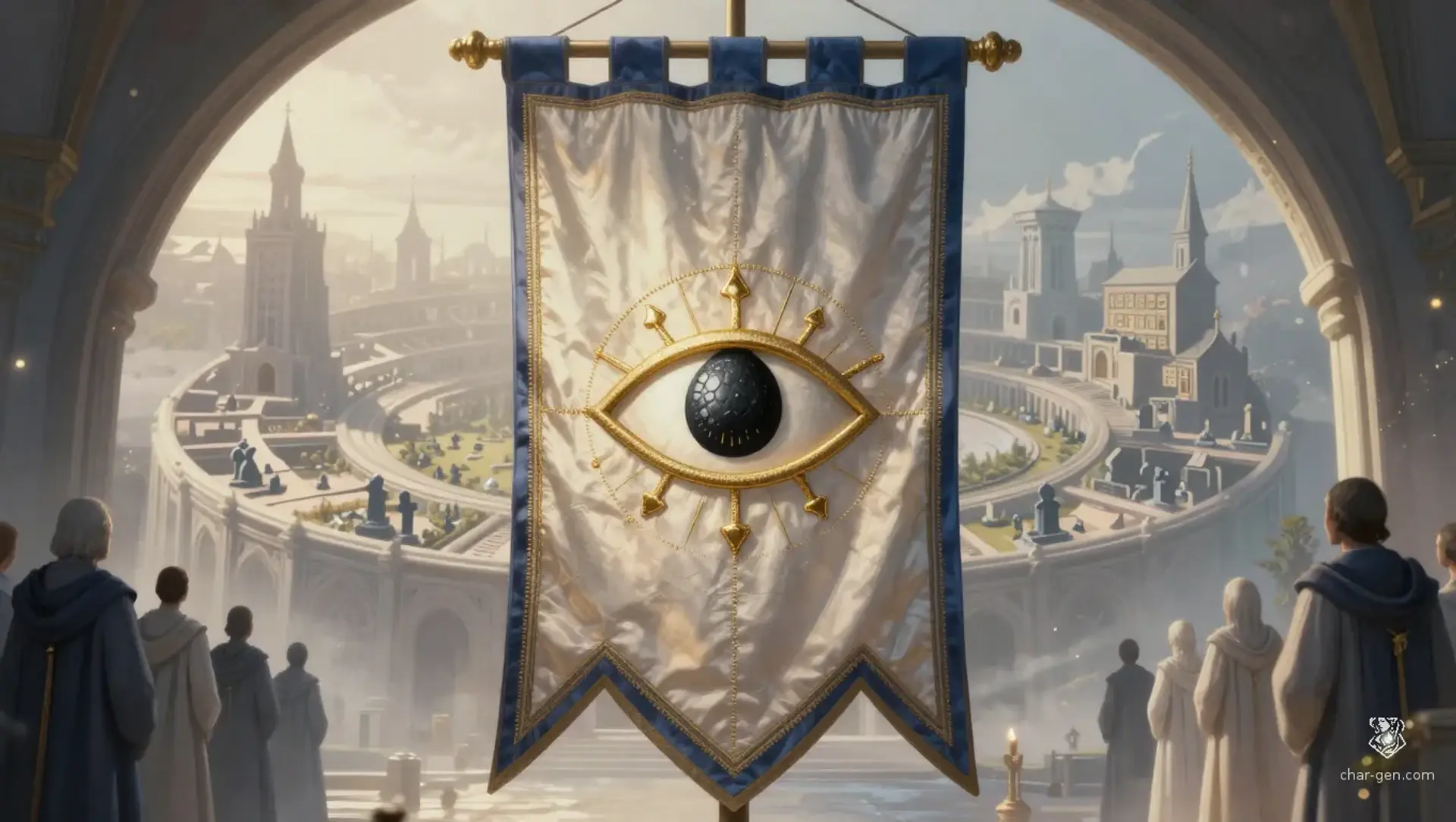
The Keepers of the Unfinished Circle - AI-generated fantasy Faction

The Keepers of the Unfinished Circle

The order began as a plague fellowship, then became a network of neutral burial houses and healing sanctuaries. During its first century, it gained influence by refusing payment from the poor while charging wealthy nobles for burial, arbitration, and the preservation of family records. This policy created the first permanent endowments. In the second century, the order's sanctuaries became safe places for prisoners of war, political exiles, and disputed heirs. Its refusal to reveal the location of protected refugees brought it into conflict with several monarchies. The resulting Siege of Seven Bells was a major triumph. Seven sanctuaries held for forty-two days against three armies, allowing a peace conference to occur. The order's reputation for inviolable sanctuary was established. The watershed moment came during the Ashen Succession War. The order possessed evidence that both rival claimants were illegitimate, but revealing it would have caused the empire to fracture into seven competing provinces. The First Custodian ordered the evidence sealed and recognized the claimant most likely to preserve regional stability. The decision prevented immediate collapse, but the emperor later became a genocidal tyrant. The order's members still argue whether millions were saved or sacrificed by that choice. After the war, the order divided into three broad philosophies: the Mercy faction, which prioritizes individual lives; the Balance faction, which prioritizes long-term stability; and the Witness faction, which believes truth must be preserved even when it causes catastrophe. The modern order is powerful because none of these factions has fully defeated the others. In recent decades, the order expanded into planar diplomacy, disaster relief, monster containment, and the regulation of dangerous resurrection practices. Its sanctuaries now exist on every major continent and in several extraplanar enclaves, but its growth has made local chapters more autonomous and harder to control.

The Keepers of the Unfinished Circle

Religious Order · True Neutral

The Keepers of the Unfinished Circle

All circles remain unfinished.

TypeReligious Order
SizeHuge, with approximately 2,600…
InfluenceGlobal. The order operates tem…
WealthVery wealthy by institutional…
AlignmentTrue Neutral
Age612 years since its formal fou…

Chronology

The order began as a plague fellowship, then became a network of neutral burial houses and healing sanctuaries. During its first century, it gained influence by refusing payment from the poor while charging wealthy nobles for burial, arbitration, and the preservation of family records. This policy created the first permanent endowments. In the second century, the order's sanctuaries became safe places for prisoners of war, political exiles, and disputed heirs. Its refusal to reveal the location of protected refugees brought it into conflict with several monarchies. The resulting Siege of Seven Bells was a major triumph. Seven sanctuaries held for forty-two days against three armies, allowing a peace conference to occur. The order's reputation for inviolable sanctuary was established. The watershed moment came during the Ashen Succession War. The order possessed evidence that both rival claimants were illegitimate, but revealing it would have caused the empire to fracture into seven competing provinces. The First Custodian ordered the evidence sealed and recognized the claimant most likely to preserve regional stability. The decision prevented immediate collapse, but the emperor later became a genocidal tyrant. The order's members still argue whether millions were saved or sacrificed by that choice. After the war, the order divided into three broad philosophies: the Mercy faction, which prioritizes individual lives; the Balance faction, which prioritizes long-term stability; and the Witness faction, which believes truth must be preserved even when it causes catastrophe. The modern order is powerful because none of these factions has fully defeated the others. In recent decades, the order expanded into planar diplomacy, disaster relief, monster containment, and the regulation of dangerous resurrection practices. Its sanctuaries now exist on every major continent and in several extraplanar enclaves, but its growth has made local chapters more autonomous and harder to control.

Founder’s Story

Six centuries ago, a plague called the Pale Season crossed three continents. Kings blamed neighboring kingdoms, priests blamed heretics, and healers were overwhelmed. At the village of Orison's Ford, seven strangers gathered around a mass grave: a battlefield surgeon, a royal undertaker, a desert oracle, a ferryman, a farmer, a former executioner, and a child who had survived the plague. According to tradition, the dead spoke through the wind and declared that no power should be allowed to control birth, death, memory, or destiny without opposition. The seven founded the Keepers of the Unfinished Circle. They swore to preserve balance rather than worship a single deity. Whether the dead truly spoke is still disputed within the order.

The Mechanism of Intent

Public Goals
  • Provide aid without demanding conversion.
  • Protect the dead from desecration and exploitation.
  • Preserve accurate history.
  • Keep neutral sanctuaries open during war.
  • Prevent any single power from ruling all peoples or controlling the boundary between life and death.
  • Offer peaceful arbitration before violence becomes unavoidable.
  • Secret Goals
  • Ensure that no empire discovers the full extent of the order's hidden communication network.
  • Locate every person who has returned from death with memories of an alternate history.
  • Force the rival claimants in the Sevenfold Eclipse crisis to negotiate before any one of them can claim divine legitimacy.
  • Determine whether the First Witness is a protector, a prisoner, or a parasite.
  • Create a binding international law that places all neutral sanctuaries beyond the authority of kings and gods.
  • Preserve the possibility of dismantling the order if it ever becomes more dangerous than the powers it opposes.
  • Current Objectives
  • Prevent the Sevenfold Eclipse from being interpreted as a divine mandate for conquest.
  • Recover the missing Ledger of Last Breaths before rival faiths discover its contents.
  • Reopen three neutral sanctuaries destroyed during the Ashen Succession War.
  • Determine whether the recent increase in undead activity represents a natural imbalance or deliberate sabotage.
  • Prepare a succession process that can survive the death or disappearance of the current First Custodian.
  • Long-Term Vision

    A world in which no empire, church, magical order, or cosmic power can monopolize life, death, memory, or history. The order wants to become the trusted neutral infrastructure through which conflicts are contained, disasters answered, and dangerous truths preserved until societies are ready to face them.

    StructureDecentralized religious service network governed by a six-office council and bound together by shared vows, ritual law, and control of ancient records.
    SuccessionWhen the First Custodian dies, disappears, or becomes incapable of service, the six Grand Offices each nominate one candidate. Candidates must spend forty-nine days traveling anonymously among the order's poorest communities and may not use their titles or personal wealth. They then face the Trial of Seven Accounts, in which they must reveal one past decision they regret, one secret they believe the order must preserve, and one secret they believe the order must surrender. The Grand Offices vote, but the final candidate must also receive approval from a randomly selected assembly of Attendants and Friends of the Circle. This process is currently threatened because several leaders believe the First Custodian intends to bypass it.

    Leadership

    Elian Voss First Custodian of the Unfinished Circle

    Soft-spoken, attentive, difficult to anger, and almost impossible to read. He treats moral dilemmas as practical problems, but privately suffers from recurring visions of the order's temples burning.

    Sister Maelin Vey Grand Office of Mercy

    Warm, observant, stubborn, and capable of terrifying decisiveness when a patient is threatened.

    Archwarden Corven Thale Grand Office of Balance

    Patient, formal, intellectually honest, and emotionally exhausted by the consequences of past compromises.

    Archivist Nera Quill Grand Office of Witnessing

    Exacting, dryly humorous, fearless in research, and socially awkward outside the archive.

    Warden Odran Pell Commander of the Black Lanterns

    Charismatic, disciplined, pragmatic, and secretly resentful of being passed over for promotion.

    Vigilant Tomas Reed Traveling healer and popular reformer

    Earnest, blunt, inventive, and willing to disobey orders if civilians are endangered.

    Mother Ysabet of the Seventh Door Keeper of the sealed reliquary

    Serene, enigmatic, compassionate, and prone to speaking as if she remembers events that have not happened.

    Visual sheet

    Turn The Keepers of the Unfinished Circle into a sheet

    A high-res, share-ready sheet you can post or print.

    Gallery

    No images yet. Click to add.

    Relationships