Skip to content
Wenna Hale - AI-generated fantasy NPC

Wenna Hale

Human · Druid · Level 5

Wenna Hale

Village midwife, healer, and keeper of the salt spring
“That soil is behaving like milk left in the sun.”
AC13
HP33/33
Init
STR
DEX
CON
INT
WIS
CHA
ConditionsNone

At the table

Voice

A dry, grain-edged voice that sounds as if it has spent a lifetime calling across a mill and a crowded birthing room. Her breath rasps when she is startled, but her instructions remain clear and firm.

Her voice has a dry, grainy edge, shaped by years of speaking over millstones, weather, and the hurried noise of childbirth. She places words carefully, with a plain village cadence and little ornament. When rattled, her breath snags in a papery rasp and she breaks sentences into short instructions. The rasp is not a whisper: she can still make herself heard across a room.

Speech patterns

Uses ordinary household comparisons to explain danger: 'That soil is behaving like milk left in the sun.'
Asks a question, waits for the full answer, then asks the question the speaker was avoiding.
Calls people by their full names when she is worried and by their childhood nicknames when she is trying to soften a refusal.
Does not promise a cure; promises what she will do before the next sunrise.

How to play them

Offer Wera a specific task or honest information rather than vague sympathy. She will share food, shelter, and practical knowledge freely, but insists that anyone seeking the spring understand the risk. If shown genuine concern, she may admit that her legs are worsening. If pressured to abandon the hamlet, she asks what will happen to the people who cannot travel.

Goal

Keep the salt spring usable long enough to teach another person how to draw and test its brine, then persuade Zora to come home before the road closes.

Motivation

To make her remaining time useful without letting fear decide the future of Ninth Bell.

Secret · GM only

Appearance

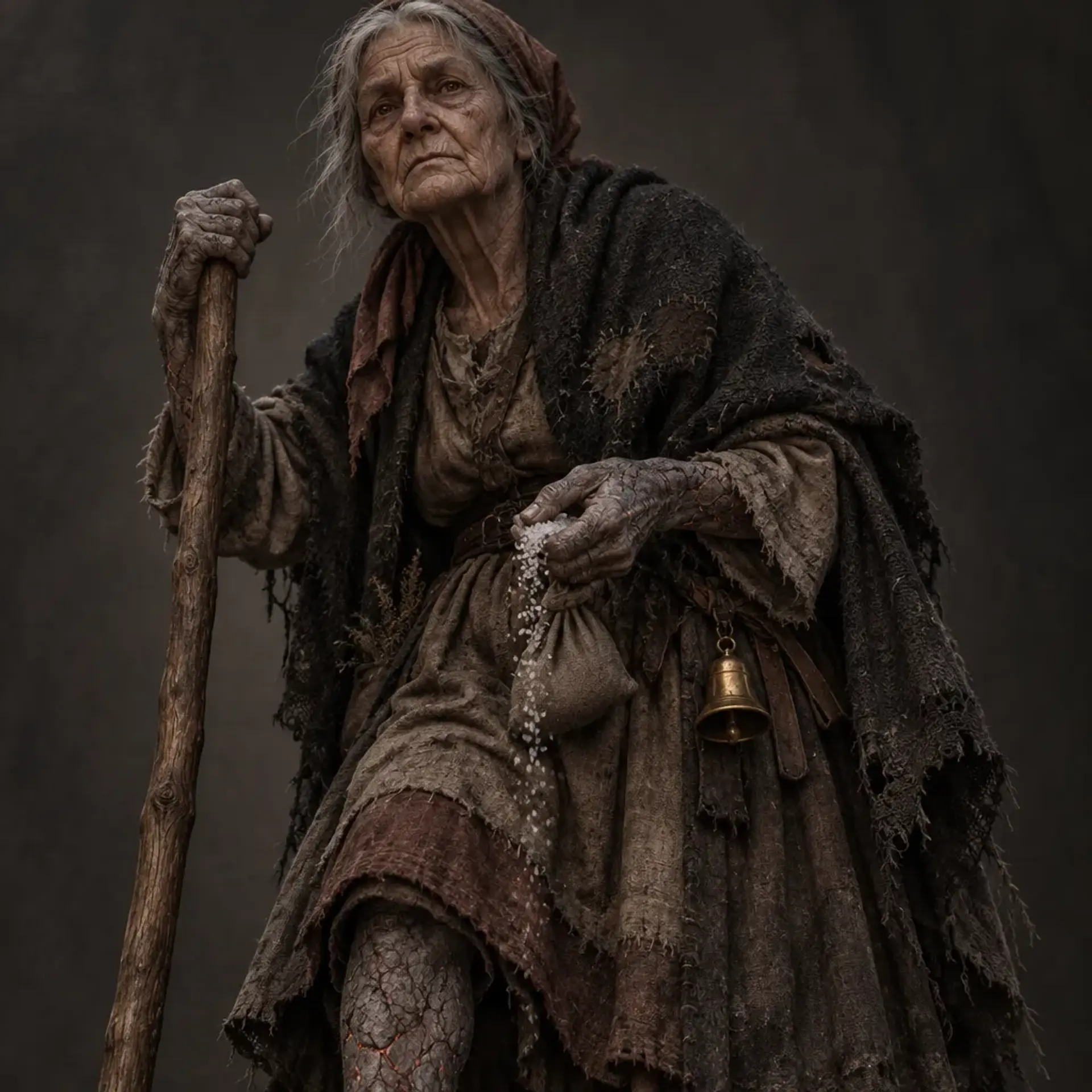
Wera looks as if the village's dry, poisoned earth has slowly climbed her body. Her feet and lower legs are ash-grey, fissured like sun-baked clay; in the deepest cracks, a dull red glow pulses when she is tired. The grey thins across her knees and hands, leaving her face mostly human-coloured, deeply lined, and worn by grief. She is thin and stooped, but plants her feet with stubborn care, as if the ground might try to move beneath her. Her grey hair is tied back under a faded wool headscarf. She wears a patched peasant dress and a dark shawl, and holds a cloth salt pouch in one hand, with a few grains always sifting between her fingers. The unexpected detail is a small brass handbell on her belt, polished bright from years of use as a midwife's signal, not a weapon. Her presence leaves the impression of someone who has already mourned the worst and is still making plans.

Clothing

A faded wool headscarf, patched peasant dress, and worn dark shawl. The hem is dusted with grey soil; a cloth pouch of salt and a polished brass handbell hang at her belt.

Body language

She leans into her staff, but her chin remains lifted. Her fingers keep working at the salt pouch even while she listens. When she is rattled, her breath catches in a dry, papery rasp and the red light in her leg-cracks brightens; she steadies herself by touching the brass bell without ringing it.

Height
5 ft. 1 in.
Build
Thin and stooped, with wiry forearms and a surprisingly firm stance.
Eyes
Tired hazel-brown
Hair
Grey, tied back beneath a faded wool headscarf
Skin
Mostly human-coloured on her face, fading into ash-grey, cracked skin from her lower legs upward
Age
Seventy-four
Gender
Female
Size
Small

Distinguishing features

Ash-grey, cracked skin climbs from her feet and lower legs toward her face, with a faint dull red glow deep in the fissures.
Her breaths have a dry rasp that catches when she is startled.
A polished brass handbell hangs at her belt, a remnant of her years as a midwife.
Salt grains regularly fall from the pouch in her hand, leaving a pale trail on her shawl.

Personality

14 traits and drives

Wera is tender with the frightened and unsparing with the evasive. She has accepted that she may die, but refuses to accept that the hamlet must; she can comfort a grieving stranger and then scold them for wasting clean water. In a quiet mood, she tells small stories about people who are gone. Under pressure, she becomes brisk and managerial, assigning jobs before anyone can panic.

Alignment
Neutral Good

Quirks

Taps each doorframe twice with her staff before entering, a habit from years of checking whether a house is safe for a birth.
Counts grains of salt in groups of nine when she is thinking hard, then loses count and starts again without comment.
Keeps her brass bell polished but never rings it unless someone is in immediate danger.
Leaves a cup of water on the ground for a dog that died years ago, then insists it is for the roots.
Names every new crack in her skin after a village landmark, as though keeping a map.

Habits

Keeps a mental count of who has eaten, who has slept, and who has gone too long without speaking.
When the blight is near, tests the ground with the end of her staff before stepping forward.
Offers practical help before comfort, then becomes unexpectedly blunt if someone refuses both.
At night, sits outside the chapel with her bell in her lap, listening for a sound she has never explained.

Traits · 4

She can sit patiently with grief, but has little patience for someone using grief as an excuse to endanger others.
She speaks of her own death as a practical possibility, yet gets furious when anyone treats her as already gone.
She welcomes questions about plants and medicine, but distrusts anyone who asks about the spring without asking about the villagers.
She is generous with food and stingy with promises.

Flaws · 3

She withholds bad news until she believes there is a useful action to take.
Her stubborn loyalty can turn into refusal to accept help.
She judges people by what they do in a crisis and is slow to revise that judgment.

Fears · 3

That the blight will reach the spring before she can teach anyone else to draw its brine safely.
That Zora will return only after Wera is no longer able to recognize her.
That the villagers will mistake her worsening condition for proof that hope was foolish.

Wants and needs · 4

Needs someone reliable to learn how to draw brine from the spring without worsening its contamination.
Wants Zora to come home, though she fears asking will make her daughter feel trapped.
Needs the hamlet's families to decide whether they will stay or leave before the next frost.
Wants the reeve's agent to stop treating the spring as property to be claimed.

Combat

AC 13 · HP 33 · 25 ft.

Wera avoids a fair fight. She uses Entangle or Spike Growth to divide opponents, keeps allies standing with Healing Word, and uses ranged attacks from behind cover. If cornered, she casts Thunderwave to make space, then retreats toward ground she has already tested. She will not pursue a fleeing enemy unless they threaten the spring or a helpless villager.

Wenna Hale

Small humanoid (human), neutral good
Armor Class13
Hit Points33
Speed25 ft.
Level5
STR
DEX
CON
INT
WIS
CHA
Saving ThrowsIntelligenceWisdom
SkillsMedicineNaturePerceptionInsightSurvival
SensesPassive Perception 14
Languages
Common,
Druidic
Spellcasting. Wera is a 5th-level Druid. Her spellcasting ability is Wisdom (spell save , to hit with spell attacks). She has four 1st-level, three 2nd-level, and two 3rd-level spell slots.
Custom. Salt-Sick. Wera has advantage on saving throws against disease and against effects that would transform her body. When she finishes a Long Rest, she can expend a pinch of salt to stabilize one creature she can touch that has 0 Hit Points.
Custom. Blight's Warning. Wera can sense, within 30 feet, whether a plant or patch of soil is tainted by the local blight. This sense does not reveal the cause or how to cure it.

Spells

Elementalism (cantrip, transmutation). Cantrip. A flick of elemental force deals damage of a chosen acid, cold, fire, lightning, or thunder type to a creature within range, subject to the spell's normal rules.
Druidcraft (cantrip, transmutation). Cantrip. Wera creates a momentary natural effect, such as stirring a breeze, opening a flower, or making a small harmless sound.
Poison Spray (cantrip, necromancy). Cantrip. A creature within range makes a Dexterity saving throw or takes poison damage and has its Speed reduced by 10 feet until the start of Wera's next turn.
Healing Word (level 1, abjuration). 1st level. A creature Wera can see within range regains Hit Points. This spell has no effect on Undead or Constructs.
Charm Person (level 1, enchantment). 1st level. A creature Wera can see within range makes a Wisdom saving throw or becomes Charmed for the duration, subject to the spell's normal ending conditions.
Thunderwave (level 1, evocation). 1st level. Each creature in the area makes a Constitution saving throw, taking thunder damage on a failed save or half as much on a success, and is pushed away from Wera on a failed save.
Entangle (level 1, conjuration). 2nd level. Grasping weeds and vines fill the area. Creatures there make Strength saving throws or have the Restrained condition for the duration, subject to the spell's normal rules.
Cure Wounds (level 2, abjuration). 2nd level. A creature Wera touches regains Hit Points. This spell has no effect on Undead or Constructs.
Spike Growth (level 2, transmutation). 2nd level. A patch of ground becomes hazardous with grasping plants and thorns. Creatures moving through the area take piercing damage for every 5 feet they travel, subject to the spell's normal rules.
Scorching Ray (level 2, evocation). 3rd level. Wera calls forth three rays of fire, each of which can target a creature or object within range and deals fire damage on a hit.
Warding Wind (level 2, evocation). 3rd level. Wera creates a protective aura around herself. When a creature within 10 feet hits her with a melee attack, the creature takes radiant damage.
Wild Shape (level 2, transmutation). 3rd level. Wera transforms into a Large or smaller Beast she has seen before, following the spell's normal rules and limits.
Gust of Wind (level 3, evocation). 3rd level. Wera creates a wall of wind that deflects ranged attacks and makes passage difficult, following the spell's normal rules.
Summon Beast (level 3, conjuration). 3rd level. Wera summons a protective spirit that appears as a small, ash-grey animal. It can restore Hit Points to nearby allies or harm nearby foes, following the spell's normal rules.

Actions

Salt-Flint Dart. Melee or Ranged Spell Attack: to hit, reach 5 ft. or range 60 ft., one target. Hit: force damage. Wera flicks a hard, red-lit grain of salt from her pouch. This is a custom magical attack.
Spellcasting. Wera casts a prepared spell of 1st through 3rd level, expending a spell slot. Her prepared spells are listed in the spells field.
Staff. Wera makes one Salt-Flint Dart attack, or casts one of her cantrips, if available.

Reactions

Not Yet. When a creature Wera can see within 30 feet takes damage, she casts Healing Word on it as a reaction, expending a spell slot. This is a custom NPC timing adjustment to the spell; Wera cannot use this reaction if she has already cast a leveled spell on her turn.
Salt at the Threshold. When a creature Wera can see moves within 5 feet of her, she casts Thunderwave at 1st level, expending a spell slot. She can use this reaction only if she has not cast a leveled spell since the end of her previous turn.

Services they sell

Treats ordinary injuries and fever with herbs, clean bandages, and patient attention.
Identifies plants, soil, and water affected by the local blight.
Can guide travelers through safe paths around the hamlet's worst-tainted ground.

Rewards they can give

A jar of spring brine that can be used as a plot clue or as the component for a custom remedy.
A map to the old chapel and the buried entrance to the spring.
Wera's practical knowledge of the blight, including which signs mean a field can still be saved.
Her recommendation to the villagers of Ninth Bell, who can provide food and shelter.

Equipment

  • Hazel staff (weapon and spellcasting focus)A plain walking staff used for balance and as a focus for her druidic magic.
  • Spring salt (material)A small cloth pouch containing salt from the old spring; she portions it carefully.
  • Midwife's bell (tool)A polished bell once used to summon help during difficult births.
  • Travel-worn clothes (clothing)A patched dress, wool headscarf, dark shawl, and sturdy shoes.

Possessions

A cloth pouch of salt from the old spring
A hazel walking staff
A polished brass midwife's bell
Ilko's wooden spoon
A folded map showing the old chapel and the spring
A small bundle of dried feverfew and yarrow

Background

Wera grew up in the hamlet of Ninth Bell, where her mother taught her which roots soothed fever and which ones merely made a dying person sleep. She became a midwife, a keeper of seed, and the person called to sit beside the ill when the rest of a household could not bear to. Her husband, Ilko, was a patient miller who could make a meal from almost nothing. Their daughter, Zora, left for the city years ago after a quarrel over Wera's refusal to abandon the hamlet. The blight arrived three winters back, first as rust-coloured dust in the well and then as a grey crust on the fields. During the first outbreak, Wera watched a child die while the adults argued over whether the sickness was natural. She dug up an old salt spring beneath the ruined chapel and found that its brine slowed the greying. Carrying a pail of it home, she fell through a cracked floor into a hot underground fissure. The blight took hold in her feet and legs, but she crawled out with a brine-soaked cloth and used it to save three villagers. Since then, she has learned enough druidic craft from the spring's strange growths to fight the blight, though never enough to cure it. Ilko died last thaw. Wera has not told Zora how bad the infection has become, and the village's remaining families are divided between leaving and staying. The nearest reeve's agent, Toma, wants to seize the spring for a distant estate.

Role in the story

A grieving village healer and reluctant guide to the blight's origin. Wera can give the party a human reason to care about Ninth Bell, teach them how to reach the spring, and force a choice between a short-term defense that harms her and the risk of losing the hamlet entirely.

“She became a midwife, a keeper of seed, and the person called to sit beside the ill when the rest of a household could not bear to.”
From their background
Faction
No formal faction. Wera is the informal healer and seed-keeper of Ninth Bell, a hamlet marked as a stop on an old survey map as Ninth Bell.

Known connections

Ilko, her late husband, taught her to listen for trouble in the mill's turning stones. His old mill is now the only dry shelter for several families.
Zora, her estranged daughter, lives in the market town of Dava and believes Wera is too proud to leave the hamlet.
Toma, a reeve's agent, has orders to claim Ninth Bell's spring for his employer, but quietly brings medicine to his sick younger brother.
The families sheltering at the old mill disagree about whether Wera's spring is salvation or the source of the blight.
Major secret · GM only
Minor secrets · GM only

Media

0 images

No images yet.

Visual sheet

Turn Wenna Hale into a sheet

A high-res, share-ready sheet you can post or print.