
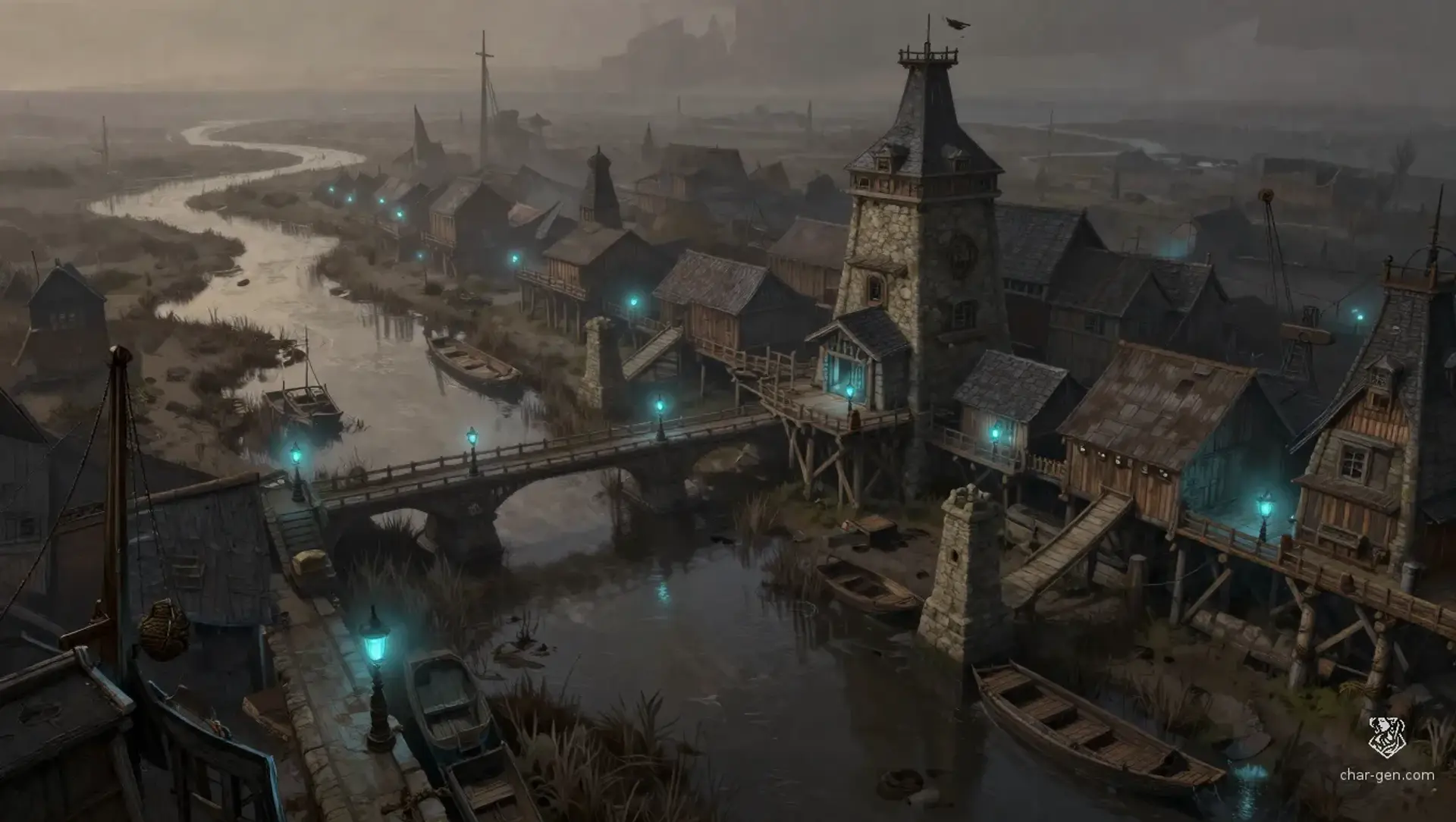
Brackenford
Brackenford is a riverside city-state built where an old imperial ford meets black peat marsh and a stubborn trade road. Barges come here because the causeway beneath the mud still makes the crossing safer than the wide river, if you know the marks. The city lives on tolls, warehouse rent, peat salt, boatbuilding, and marsh herbs, but blighted goods, blue lamps, and whispering water are making everyone nervous.
Brackenford
- Population
- 18,000
- Rule
- Marsh-Lord Edric Wane
- Wealth
- Prosperous on the…
- Defence
- Moderate
Overview
Brackenford is a riverside city-state built where an old imperial ford meets black peat marsh and a stubborn trade road. Barges come here because the causeway beneath the mud still makes the crossing safer than the wide river, if you know the marks. The city lives on tolls, warehouse rent, peat salt, boatbuilding, and marsh herbs, but blighted goods, blue lamps, and whispering water are making everyone nervous.
Atmosphere
Brackenford feels busiest at dusk, when barge bells sound from the quay and the lamps come on with a sickly blue flame. Bargemen, clerks, peat cutters, and ferry hands rub shoulders in streets that smell of wet rope, tar, mud, and boiled eel. The city is practical first and superstitious second. People keep working while pretending not to hear the water whisper under the cobbles.
Culture
- The River Mother
- Saint Vey, patron of ferrymen
- The Ashen Ledger, a temple cult of honest counting
- Humans
- Dwarves
- Halflings
- Half-elves
- A few marsh-born folk of mixed ancestry
Economy
Boatbuilding, Toll collection, Warehousing, Peat cutting, Canal transport
- Boats and river skiffs
- Peat-cut salt
- Marsh herbs and bitter tonics
- Stored grain and wool in good years
- Tar, rope, and pitch
Iron tools, Fine cloth, Wine and lamp oil, Dry timber, Grain in bad winters
Geography
Ways in and out
Places to see
- The West QuayA raised stone quay where barges tie up under toll poles carved with old flood marks. Merchants argue here in full view of everyone, because public shame is cheaper than private violence.
- The Buried CausewayA sunken lane of cracked stone visible only when the river drops low. Children dare each other to walk it, and old ferrymen refuse to point at it after dark.
- The Ledger VaultA damp archive under the Counting Hall where sealed ledgers, bridge grants, and ferry charters are kept in oiled chestwood boxes. It smells of wax, river mud, and paper gone old before its time.
- The North CutA black peat field outside the north wall where families cut fuel and medicinal root. At night the marsh water there glows faintly blue, and no one stays after moonrise unless paid well.
Power
4 factionsGovernment
Laws
Trouble
- The city is losing trade confidence, but the council is fighting over whether the blight is a curse, sabotage, or theft.Goods are spoiling in sealed stores, and the merchant factors want the wardens to hide it. The marsh-lord fears a public inspection because the rotten cargo all seems to come from the same dock line tied to his own kin.Involves
Marsh-Lord Edric Wane, Lysa Marr, Tolan Vey
- If the truth about the buried road becomes public, several families lose their claim to the ford and the council’s legitimacy cracks.The old causeway markers under the mud are being uncovered by sinkholes and illegal digging. Edric wants them buried again, while the canal wardens insist the stones are the key to stopping the whispers and floods.Involves
Marsh-Lord Edric Wane, Hedra Sorn, Brother Caldus Reed
Factions
- River CouncilGovernmentThe River Council is the city’s governing knot, made of merchant factors, canal wardens, temple scribes, and the marsh-lord’s seat. They keep Brackenford running by compromise, favors, and public account books no one fully trusts.GoalsKeep tolls high enough to fund repairs, keep the council balanced, and prevent panic about the blight until a solution can be sold as stability.Allies
Temple Scribes, Ford Guard
RivalsPeatward Clan, Mud-Cart League
- Peatward ClanOld landed familyOld marsh families claim they are the only ones who understand the ford, the floodgates, and the buried causeway. They control ferry rights, flood markers, and family shrines built on older stones than the city admits.GoalsPreserve hereditary control over the marsh approaches and stop the new warehouses from digging or dredging near the causeway.Allies
Mud-Cart League
RivalsRiver Council, Temple Scribes
- Canal WardensInfrastructure and security guildThe canal wardens keep the locks, towpaths, and inspection barges. They are practical, underfunded, and increasingly blamed for every delayed shipment, spoiled crate, and drowned laborer.GoalsGet authority to close the old causeway access and quarantine the worst blight before it spreads through the warehouses.Allies
River Council
RivalsMud-Cart League, Peatward Clan
- Mud-Cart LeagueLabor factionThe Mud-Cart League is a rough alliance of haulers, stevedores, sawyers, and ferry hands who do the city’s worst work for the least respect. They know which ledgers are padded and which cargoes come in wet for a reason.GoalsForce lower tolls, expose warehouse fraud, and gain a voice in council decisions that currently treat them as disposable labor.Allies
Canal Wardens
RivalsRiver Council, Peatward Clan
Defences
- Mud-brick riverwall
- Three locktowers over the canals
- Timber palisade along the marsh road
- A chain boom across the ford in wartime
Law and order
People and places
12 entriesCouncil clerkTervin Bale Human Man
A narrow-shouldered clerk whose hands are always damp from the archive room. He wants the city’s ledgers to stay balanced because he thinks order is the only thing keeping the council from tearing itself apart. He fears that if the causeway records are opened, his own family’s rise will look like theft.
Merchant factorLysa Marr Human Woman
A hard-eyed warehouse factor who wears good boots and poor patience. She wants to keep cargo moving and profits hidden until the blight is understood. She fears a public inspection would expose how much spoiled goods she has already sold onward. Her visible habit is counting under her breath whenever someone mentions the marsh.
Canal warden captainHedra Sorn Half-elf Woman
The canal warden captain is broad in the shoulder and thin in the sleep. She wants to seal the old access pits before the blight spreads and the marsh floods them open. She fears the wardens will be made scapegoats if the whispers in the water prove true. She always carries chalk and marks every suspicious lock herself.
Hereditary lordMarsh-Lord Edric Wane Human Man
An older marsh-lord with reed-gray hair, a soft voice, and the kind of face that makes people lower theirs first. He wants the old families respected because he believes they alone remember what was buried with the ford. He fears the city will uncover the causeway and wake something meant to stay below.
Temple scribeBrother Caldus Reed Human Man
A temple scribe with ink-black sleeves and river-gray eyes. He wants the city to confess its sins before the blight becomes a true curse. He fears the temple will lose authority if the causeway mystery turns out to be an old political crime instead of a holy warning. He speaks in careful phrases and never smiles with his mouth.
River outfitterThe Riverhook Kept by Sella Marr
A practical shop for dock crews, ferrymen, and traders that stocks rope, hooks, tar, lanterns, oilskins, patch kits, and hard-wearing river gear. The owner keeps prices fair because a failed buckle or lantern can sink a crew. She wants the city’s river workers organized enough to resist the factors before winter turns the docks brutal.
Repair yardBram's Repair Yard Kept by Bram Holt
A cluttered repair yard near the ferry steps where planks are patched, oars shaped, and tools traded for honest labor tokens. The owner specializes in quick fixes that hold long enough to get a boat home. He wants the city to stop cutting corners on floodwood and hull seams, because he knows what a bad repair looks like when the river takes its due.
TavernThe Cooper's Rest Kept by Mara Cooper
The best rumor market in Brackenford, a wide timber tavern on pilings where wet boots dry by the hearth and no conversation stays private for long. The back wall is covered with a hand-drawn map of the river that Mara updates from memory and scraps of gossip. People come for drink, but they stay because it is the only place where truth sometimes outpaces the council.
Council houseThe Counting Hall Run by Tervin Bale
A long stone hall built beside the quay where cargo is counted, debts are read aloud, and council votes are recorded in ledgers kept under seal. The place smells of ink, river silt, and wet wool. Everyone hates it and needs it.
TavernThe Cooper's Rest Run by Mara Cooper
A broad timber tavern on pilings above the river, noisy from dawn to midnight. Bargemen, carters, and off-duty watchmen drink here because rumors move faster than beer. The back room has a map wall no one admits is accurate.
Supply shopThe Riverhook Run by Sella Marr
A compact shop packed with rope, tar, hooks, lanterns, oilskins, netting, and patched river gear. The owner caters to dock workers and small traders who cannot afford poor quality, because a bad buckle can drown a man as quickly as a blade.
WorkshopBram's Repair Yard Run by Bram Holt
A low-fronted shop near the ferry steps that mends hull planks, shapes oars, and sells used tools to anyone with honest hands and a half-decent trade token. The place is always damp, always busy, and full of nails in jars. Most of the city’s workers know the back door better than the front.
Events
Lately
- Three barges from upriver arrived with sealed cargo that stank of salt and rot though the manifests were clean.Merchants are accusing one another of fraud, and the council has started quietly checking every warehouse seal.
- A watchman was found asleep in a lock tower while blue water lapped at his boots and no tide was due.The wardens have doubled patrols, but people are whispering about enchantment, bribery, or something under the city.
- A peat crew uncovered carved stone in the marsh and then refused to go back, even for double pay.That work site has become a flashpoint between the Peatward Clan and the canal wardens.
Calendar
- First FloodmoonToll ReckoningThe river council blesses the tollstones and opens the warehalls for public tallying. Debt notices are read aloud in the square, and the poor listen as if for funerals.The twist · GM only
- Midsummer, third nightLantern CrossingBoatbuilders launch painted skiffs into the ford with lanterns tied to their prows. The ferrymen sing the old crossing songs that predate the city charter.The twist · GM only
- Late HarvestMarsh TitheThe marsh houses present salt, peat bricks, herbs, and smoked fish to the council in exchange for road rights and flood labor. The temples distribute broth to workers before the first frost.The twist · GM only
- Deep Winter, after the first freezeLock NightThe canal wardens shut the bargelocks and quarter extra guards on the bridges. Families settle debts, and the city grows quieter except for the water under the causeway.The twist · GM only
History
Brackenford was built by people who survived by controlling crossings, then grew rich by making everyone else pay for the same trick. The official story says the city rose from grit and clever trade, but the older story says the ford was already important before the empire, and the causeway was only ever partly lost. That old fact is becoming dangerous again.
- FoundingThe First CrossingsFerry-clan survivors settled the ford after an imperial retreat left the crossing half-broken and undefended. They began with poles, rope, and rafts, then built the first counting shed on a dry rise above the marsh.
- Early city yearsThe Causeway FoundWorkers striking peat drainage found dressed stone under the mud, straight as a king’s wall. The council later declared it an old imperial causeway and used the discovery to justify tolls, though the first maps called it something else.
- Seventy years agoThe Quiet FloodA winter flood broke the outer quay and killed dozens, but the official record blamed a storm no one else remembers. Several families gained warehouse lots the following spring, which still feeds gossip.
- Last six monthsThe Blue SpoilBlue lamp-glow, sour ale, and sudden spoilage began spreading through dockside stores. Temples called it a spiritual warning, merchants called it sabotage, and the canal wardens started hearing water talk back at night.
Secrets
3 secrets · 5 rumours- Secret 1 · GM only
- Secret 2 · GM only
- Secret 3 · GM only
Rumours
Plot hooks
4- 1The Spoiled LoadA warehouse client hires the party to escort a shipment of grain through the city before it spoils. Halfway there, the seals are intact but the grain has gone damp and blue in the center. Someone wants the loss blamed on the escorts, and the real trail leads to a locked warden tunnel under the quay.
Investigation · Starts with Lysa Marr · Reward: Payment in gold pieces, a letter of credit, and a favor from the warehouse factors
- 2The Opened MudHedra Sorn asks the party to inspect a sinkhole near the old ford markers before the wardens seal it. In the hole are imperial stones, fresh tool marks, and river water that repeats the same whisper every few minutes. If the party reports honestly, the marsh-lord panics; if they keep quiet, someone else will reach the site first.
Exploration · Starts with Hedra Sorn · Reward: Access to restricted docks and wardens' travel permits
- 3Rumor at the Cooper's RestMara Cooper offers free rooms if the party listens to her regulars and identifies who is spreading false rumors about a coming flood. The complication is that the rumor is partly true, but the real threat is a planned warehouse riot meant to cover a theft of toll records.
Social intrigue · Starts with Mara Cooper · Reward: Discounted lodging, useful contacts, and a bundle of local rumors
- 4The Ringing ShrineBrother Caldus Reed claims a small shrine in the marsh has started ringing when no one is there, and he wants witnesses before the temple sends an armed escort. The hidden complication is that the shrine stands over an old flood gate keyhole, and opening it may reveal whether the blight is a curse or a deliberate ward gone wrong.
Mystery · Starts with Brother Caldus Reed · Reward: Temple blessing, sanctuary, and access to forbidden records
Media
0 imagesNo images yet.
Turn Brackenford into a sheet
A high-res, share-ready sheet you can post or print.