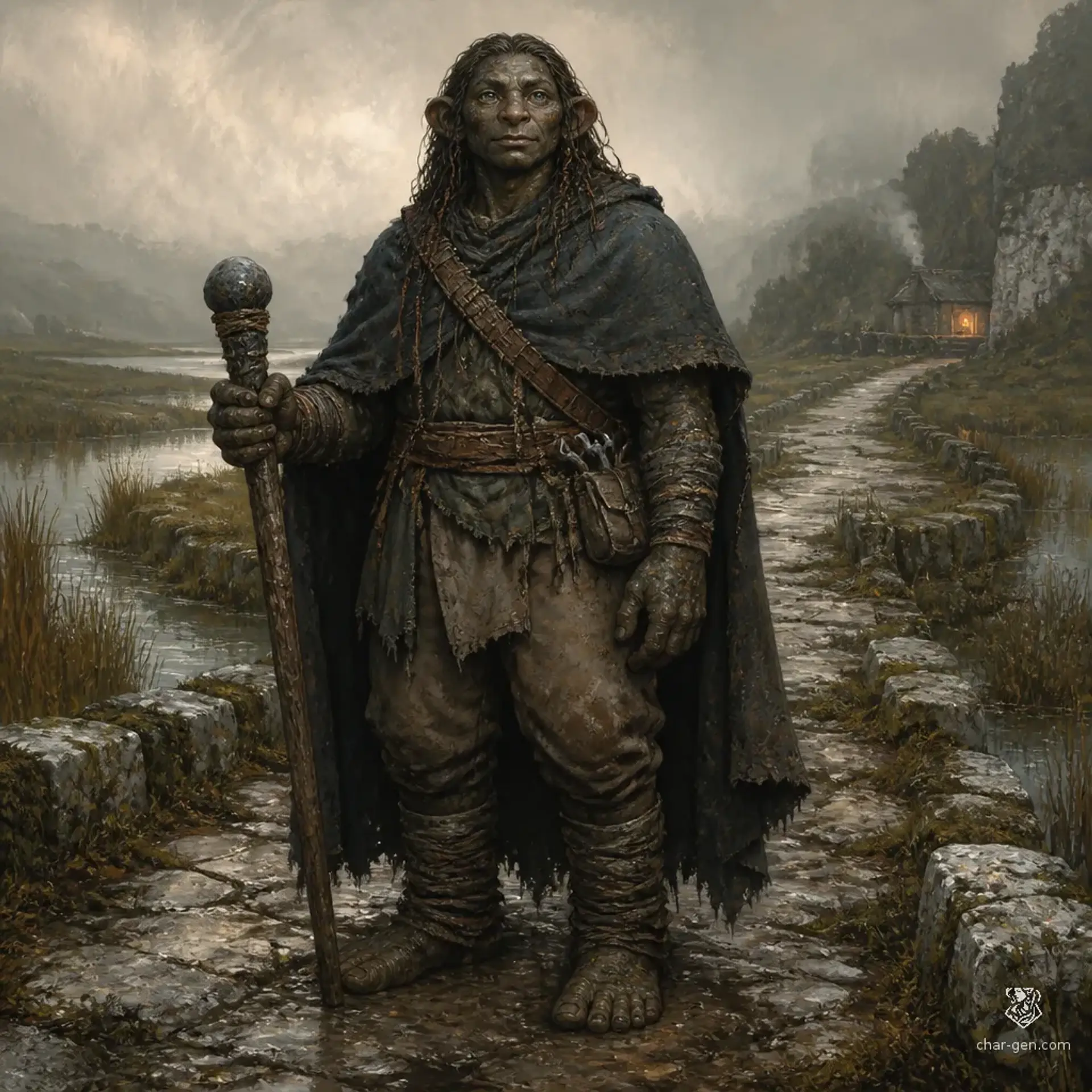
Most Mirebound live 75 to 95 years. They mature physically at much the same pace as humans, though their communities consider a person fully established only after completing a threshold journey in late adolescence.
Darkvision
60 ft.
Habitat
Temperate valleys, highland marshes, forested ravines, limestone hills, and the edges of old roads where water and stone meet.
humanoid
mundane
subtle
adaptable
stewardship
wetlands
highlands
community
SizeMedium
Speed30 ft.
LifespanMost Mirebound live 75 to 95 years. They mature physically at much the same pace as humans, though their communities consider a person fully established only after completing a threshold journey in late adolescence.
Creature TypeHumanoid
Darkvision60 ft.
Mirebound are the patient people of wet roads, broken hills, and stubborn hearths. They can tell when a bridge is unsafe by the way its stones answer a footstep, and they judge a traveler by how carefully that traveler closes a gate behind them. Their communities preserve old knowledge through work rather than ceremony, yet every practical task carries a story. A Mirebound adventurer leaves home not to escape responsibility, but to discover which responsibilities the wider world has forgotten.
Physical Description
Mirebound are compact, sturdy humanoids with long limbs, wide hands, and dense musculature suited to climbing, hauling, and wading. Their skin ranges from peat-brown and gray-green to warm umber, often marked by natural mottling that resembles lichen or river stones. Hair is usually thick and dark, though silver, copper, and reed-gold shades are common. Their eyes are large and reflective, with colors including amber, slate, deep green, and cloudy blue. Fine ridges along the ears and collarbones help them sense subtle vibrations in earth and timber. They are not amphibious, but they move through mud, rain, and steep terrain with practiced ease.
Society & Culture
Mirebound society is organized around households, craft circles, and seasonal councils. Children belong to their birth families but are raised with assistance from neighbors, while elders retain authority through demonstrated knowledge rather than inherited rank. Hospitality is formalized: a guest receives warmth, water, and a place to sleep before questions are asked. Disputes are settled through witness, restitution, and public labor. Wealth is measured in dependable tools, stored food, trusted relationships, and the number of people who would answer a call for help.
Religion & Alignment
Mirebound religion centers on the Hearth Below, an ancestral concept describing the unseen web of soil, memory, water, and obligation that supports all living things. Their rites honor local springs, the dead, useful tools, and those who protect travelers. They have no universal pantheon, and many adopt the gods of neighboring peoples while interpreting them through Mirebound ideas of stewardship. Most tend toward neutral, good, or lawful alignments, though any alignment can be found among them.
Homelands & Architecture
The Mirebound build low, durable settlements around springs, stone-lined canals, and communal hearthhouses. Their architecture uses half-sunken foundations, living-root supports, rain channels, and broad roofs layered with sod or reed. Important buildings are designed to be repaired rather than admired, and every settlement includes a public storehouse, a council hearth, and a sheltered road for winter travel.
Relationships With Other Peoples
Mirebound are cautious but rarely hostile toward outsiders. They respect people who keep promises, mend what they damage, and share burdens without being asked. They often find highly individualistic cultures bewildering, while others may mistake their communal obligations for timidity or meddling. Mirebound settlements commonly maintain old trade friendships with human, halfling-like, and dwarf-like communities, though relations with powerful landlords and extractive empires are frequently strained.
Visual sheet
Turn Mirebound into a sheet
A high-res, share-ready sheet you can post or print.