Small, Medium, or Large. Choose your size when you gain this species.
Common
Aberrant
Aberrant·Small, Medium, or Large. Choose your size when you gain this species.
Hearthstrider
Homo campestris anomalus
Speed
30 ft. if Medium or Large, or 25 ft. if Small
Lifespan
Hearthstriders mature at about 16 and commonly live 85 to 100 years.
Habitat
Open plains, prairie, steppe, savanna, and high grasslands
aberrant
plains
mundane
subtle
wanderer
herder
field-guide
open-country
SizeSmall, Medium, or Large. Choose your size when you gain this species.
Speed30 ft. if Medium or Large, or 25 ft. if Small
LifespanHearthstriders mature at about 16 and commonly live 85 to 100 years.
Creature TypeAberrant
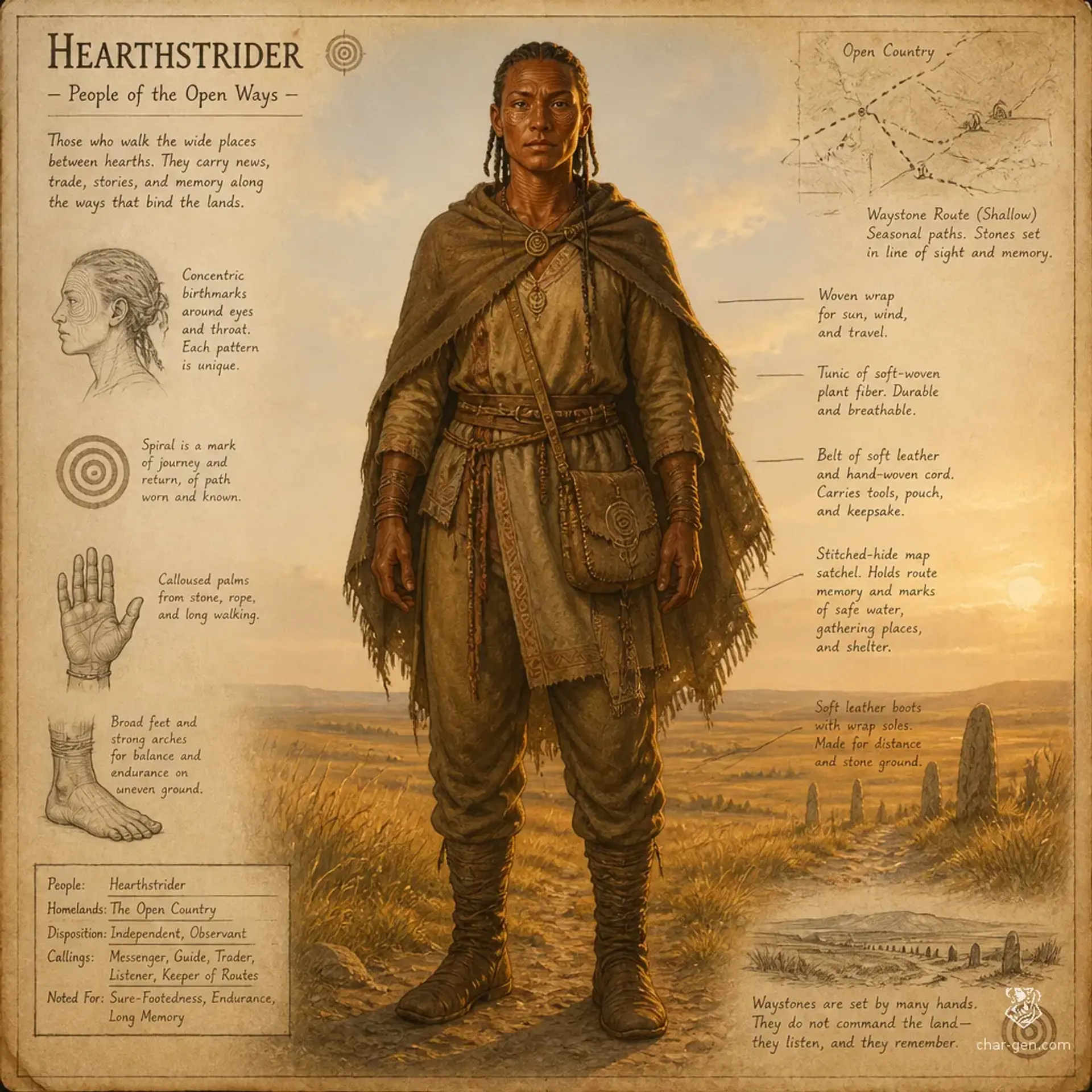
Hearthstriders are practical wanderers of the open country, shaped by an ancient anomaly that left their bodies sensitive to pressure, rhythm, and the hidden continuity of living things. They are not prophets or monsters, though other peoples sometimes mistake their uncanny awareness for either. A Hearthstrider can cross a prairie by starlight, recognize a familiar person by footfall, and sense when a road has been disturbed. They join adventuring parties for the same reasons they join caravans: curiosity, responsibility, and the conviction that every road eventually connects to home.
Physical Description
Hearthstriders are tall, long-limbed people with strong backs, broad feet, and a natural balance suited to uneven ground. Their skin ranges from sun-burnished copper and russet brown to muted gray, tawny gold, and deep umber. Hair is usually coarse and worn in cords, braids, or close-cropped layers. The most distinctive feature is a subtle pattern of fine, concentric lines around the eyes, throat, or joints. These marks are not scars or tattoos. They appear before birth and deepen with age, shifting slightly when the individual is frightened, feverish, or close to a place of personal significance. Their voices often carry a faint doubled resonance, as though a distant echo is answering them.
Society & Culture
Hearthstrider society is organized around extended traveling clans called circles. A circle may consist of blood relatives, adopted members, allied families, and outsiders who have shared enough hardship to be considered kin. Leadership is situational. The best navigator leads a crossing, the best negotiator handles a dispute, and the best cook commands the evening meal. Children are raised communally, while personal possessions are respected but never treated as more important than shared supplies. Storytelling is a practical art. A good story preserves a route, warns against a hazard, explains a custom, or keeps the dead present in the minds of the living. Silence is also meaningful, especially when a circle passes through old battlefields or burial grass.
Religion & Alignment
Hearthstrider spirituality is focused on continuity rather than divine hierarchy. Most clans honor the Four Presences: Soil, Weather, Fire, and Passing, the last representing death, migration, and the movement of memory from one generation to the next. Some Hearthstriders worship established gods, while others treat the Presences as names for natural forces. Their culture prizes generosity, restraint, and keeping one's word. Lawful Hearthstriders often become careful stewards and record keepers, while chaotic members are famed as explorers, improvisers, and breakers of stagnant tradition. Any alignment can be found among them.
Homelands & Architecture
Hearthstrider settlements are deliberately low and easy to dismantle. Clan camps gather around shallow fire basins lined with heat-holding stones, while permanent villages use sod walls, windbreak fences, and rounded earthen halls. Their architecture favors broad entrances, skylights, and roof gardens of tough native grass. Waystones mark water sources, burial grounds, and places where travelers are expected to offer news before taking shelter.
Relationships With Other Peoples
Hearthstriders are generally welcomed by rural communities, caravans, and frontier settlements, where their patience and practical skills are valuable. Urban societies often find them unsettling because they notice structural tremors, crowded rhythms, and subtle changes in air pressure that others ignore. They have longstanding trade relationships with farming villages and mounted nomad cultures. Their people are wary of rulers who attempt to restrict movement across the plains, believing that roads, rivers, and grazing routes should remain shared responsibilities rather than private possessions.
Visual sheet
Turn Hearthstrider into a sheet
A high-res, share-ready sheet you can post or print.