
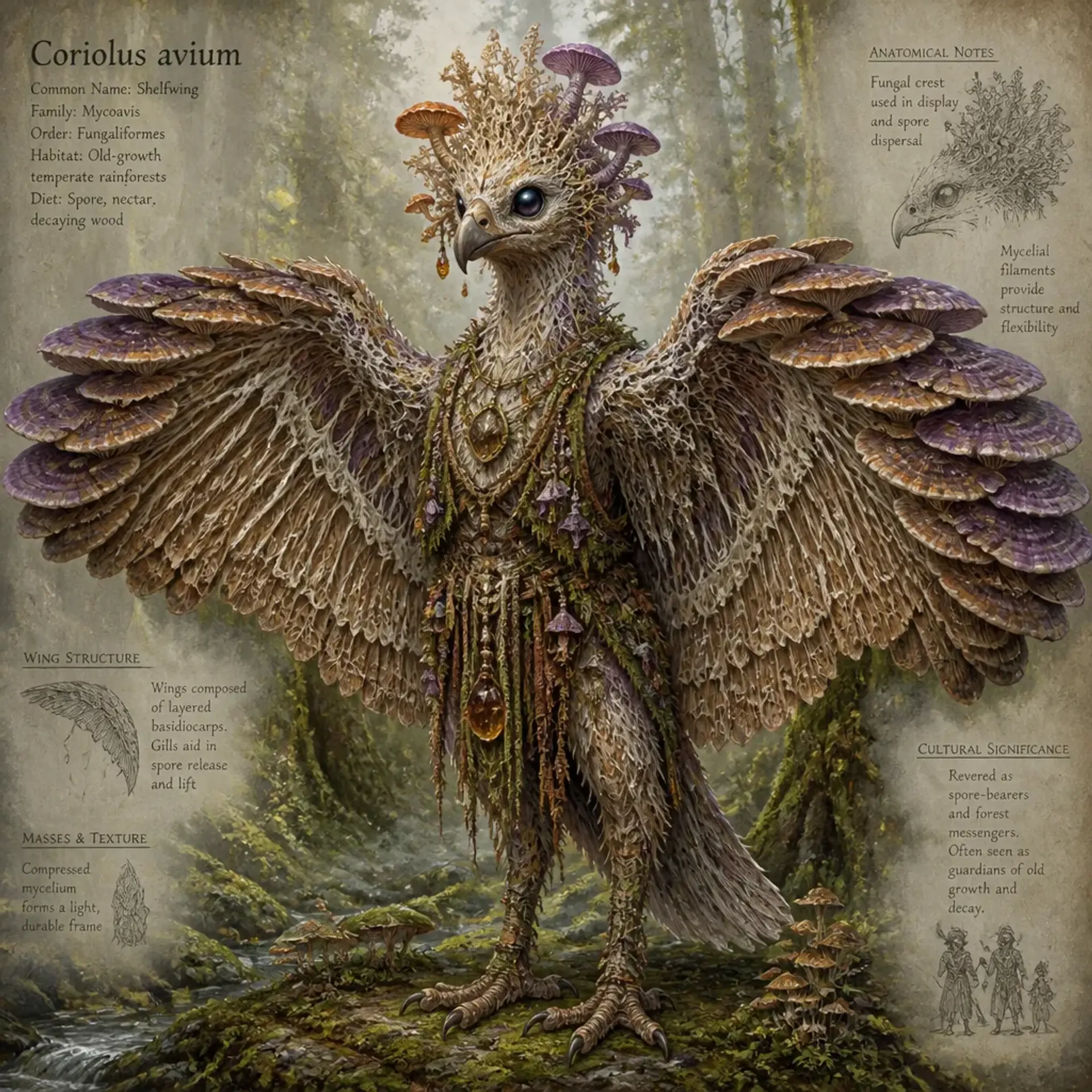
Volucris fungo
Born from the strange intersection of avian spirits and the fungal network of ancient woods, the Mycoreven are feathered gardeners of the rot.
At a glance
Darkvision 60 ft.
Languages Common, Sylvan
Resistances Poison
Height 4 to 5 feet
Weight 80 to 120 lbs
Lifespan 40 to 60 years
At the table
As an action, you can release a cloud of invisible spores in a 30-foot radius. This cloud lingers for 1 minute or until dispersed by a strong wind. You and any creature in the cloud can communicate telepathically with one another while within the area, even if you do not share a language. Creatures with an Intelligence of 3 or lower are not affected by this trait.
Your plant-like biology provides a natural defense against toxins. You have resistance to Poison damage and you have advantage on saving throws to avoid or end the Poisoned condition.
Your light, porous bones and fungal wings allow you to descend safely from great heights. You take no falling damage as long as you are not incapacitated, and you can move 2 feet horizontally for every 1 foot you fall.
Common, Sylvan
Nature, Perception
Poison
The Mycoreven combine the keen senses of a predator with the hardy durability of a fungus, typically showing strength in Wisdom and Constitution; following the 2024 rules, players may apply a plus two and a plus one to any two ability scores of their choosing.
Once per long rest, you can use a bonus action to gain a flying speed of 30 feet for 1 minute.
These Mycoreven have lighter frames and more aerodynamic fungal growths, allowing for brief periods of true flight.
Born from the strange intersection of avian spirits and the fungal network of ancient woods, the Mycoreven are feathered gardeners of the rot. They possess the keen eyes of a hawk but the slow, methodical consciousness of a mushroom. Neither fully animal nor entirely plant, they serve as the forest's silent observers, moving with a ghost-like grace through the mist while exhaling clouds of communicative spores. Players looking for a character tied to the cycle of life and death, or who want a unique take on a winged scout with telepathic utility, will find the Mycoreven an evocative choice for any party.
A Mycoreven stands slightly shorter than a human, possessing an avian frame draped in what appears to be feathers but is actually a complex arrangement of specialized fungal filaments.
Their wings are broad and soft, surfaced with a velvet-like coating of shelf mushrooms rather than quills. Their heads feature a short, hooked beak and large, obsidian eyes that glow with a faint phosphorescence in total darkness. Instead of a standard crest, they often sprout colorful caps or intricate lace-like veils from their brow. Their bodies are remarkably light, and their internal anatomy is more akin to compressed mycelium than flesh and bone.
Ancient temperate rainforests and subterranean fungal groves
The first five years of life spent as a sedentary, puffball-like organism rooted in a nursery grove.
A period of ten years where the Mycoreven develops its avian features and begins to wander the forest floor.
The prime years of life where the individual contributes to the communal mind and takes on roles of scouting or gardening.
The final stage of life where the Mycoreven slows down and eventually roots itself to become a permanent part of the forest, providing nutrients for the next generation.
The Mycoreven live in a state of soft communalism known as the Mycelial Chord.
They do not have kings or laws in the traditional sense; instead, they share thoughts and memories through a constant exchange of rapport spores during communal roosting. This creates a society where secrets are rare and cooperation is the default. They value the preservation of natural cycles and view the decay of organic matter as a sacred transition rather than a loss. Music is central to their lives, though it often takes the form of humming or low-frequency vibrations that can be felt in the earth rather than heard by human ears.
Most Mycoreven follow the Great Decomposition, a philosophical path that views all life as part of a single, continuous organism.
They tend toward Neutral alignments, focusing on the balance between growth and decay. They rarely worship anthropomorphic deities, preferring to offer their service to the primal forces of the forest or ancient fey entities who govern the underworld and the roots of the world.
They are often regarded with a mix of awe and suspicion.
Woodland-dwellers like elves and gnome-kin respect them as stewards of the deep wood. More urban civilizations sometimes fear them, seeing their fungal nature as a sign of disease or blight. The Mycoreven themselves view other species as loud and fragmented, though they are often curious about individuals who possess a strong connection to nature or the cycle of the seasons.
Their homes, called Spore-Cathedrals, are often built into the hollowed-out trunks of gargantuan, dying trees.
They do not use stone or metal, instead shaping the growth of living fungi and wood using specialized resins. These dwellings are interconnected by rope bridges and hanging walkways made of woven moss, creating a tiered city that exists both high in the canopy and deep within the root systems below.
No images yet.
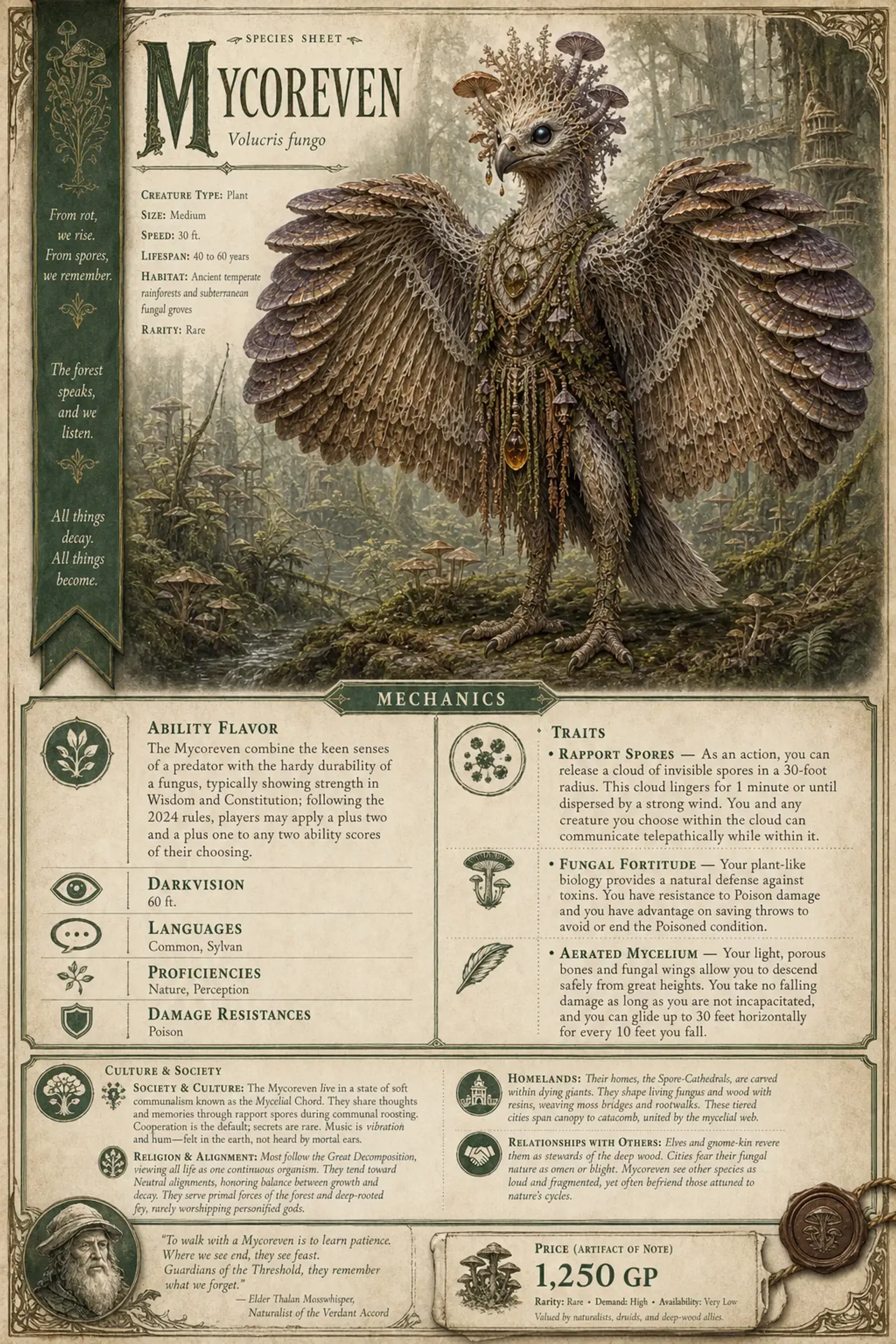
A high-res, share-ready sheet you can post or print.