
The Ashen Rune Engine
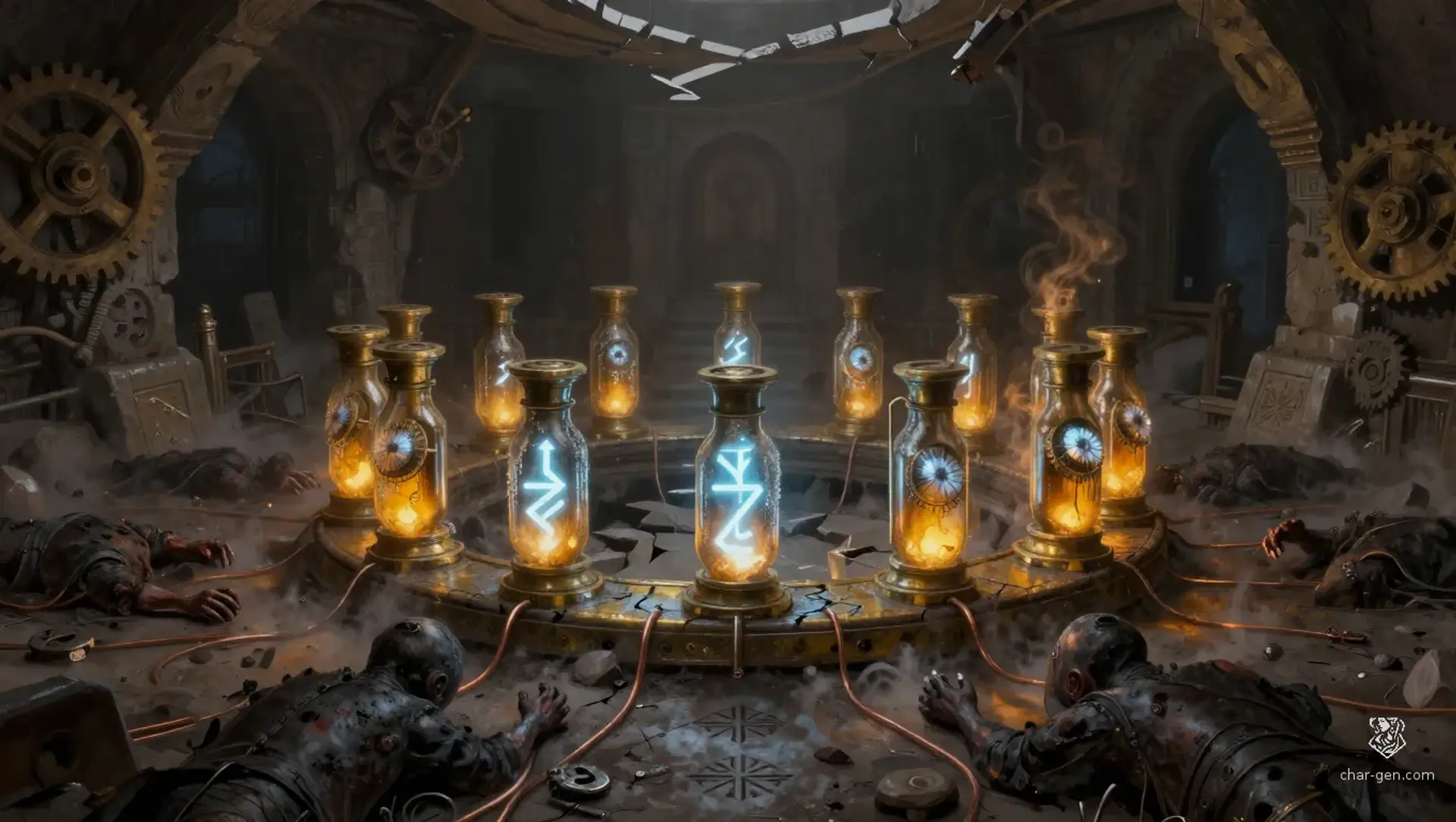
The Ashen Rune Engine is a clockwork alchemical hazard built to read the final commands of dead operatives. It reacts to movement, spoken commands, and the placement of runes, causing its pylons to inject volatile compounds into the air. The corpses around it are a warning and a control interface. Each body clutches one rune, and taking the wrong rune can make the engine treat the intruder as a fresh test subject.
The Ashen Rune Engine
Defenses
Detection
“A ring of waist-high brass pylons surrounds a cracked stone dais. Each pylon contains a glass vial of amber alchemical fluid, a rotating clockwork iris, and a socket shaped like a rune. Around the dais lie several blackened corpses, their fingers still clenched around single stone or metal runes. Fine copper wires run from the corpses to the pylons, disappearing beneath the rubble.”
Standard Engagement
The hazard activates when a creature steps onto the dais, removes a rune without first severing its copper wire, inserts an unrecognized object into a pylon socket, or causes a loud impact within the chamber. Once activated, it remains active until disabled or destroyed.
On initiative count 20, roll or choose one active pylon. The pylon uses one effect from the following sequence: first Amber Vapor, second Clockwork Flare, third Rune Compulsion, then repeat. The DM may select a different effect if a character has inserted or removed a rune. If no creature is within 60 feet, the engine remains dormant. If three or more pylons are active, the regulator also uses Gearshock each round.
The hazard resets at dawn if at least one pylon and the central regulator remain intact. It reconstitutes its alchemical fluids and reconnects severed corpse wires. If all four pylons are disabled but the regulator survives, it restarts after 10 minutes.
The targeted pylon vents alchemical vapor in a 15-foot cone. Creatures in the cone must make a DC 14 Constitution saving throw, taking 10 (3d6) poison damage and becoming poisoned until the end of their next turn on a failed save, or taking half damage without the poisoned condition on a success.
The pylon releases a flash of rune-lit flame in a 10-foot-radius sphere centered on itself. Creatures in the area must make a DC 14 Dexterity saving throw, taking 10 (3d6) fire damage on a failed save, or half as much on a success. Unattended flammable objects ignite.
The engine locks onto the nearest creature holding a rune. That creature must succeed on a DC 14 Wisdom saving throw or be compelled to move up to 10 feet toward the nearest active pylon, using its reaction if available. This movement does not provoke opportunity attacks. On a success, the creature is immune to this effect until the start of its next turn.
The regulator emits a grinding pulse. Until the start of the hazard's next turn, the area within 20 feet of the dais is difficult terrain, and creatures concentrating on spells must succeed on a DC 12 Constitution saving throw to maintain concentration.
A creature carrying a rune is considered marked by the engine. The engine always selects the nearest marked creature for Rune Compulsion, if possible.
If a pylon's glass vial is shattered, the pylon immediately vents its current alchemical mixture. Creatures within 5 feet must make a DC 14 Dexterity saving throw, taking 7 (2d6) acid or fire damage, determined by the fluid's color. The pylon is then disabled until repaired.
When the central regulator is reduced to 0 hit points, all active pylons discharge at once. Every creature within 20 feet of the dais must make a DC 15 Dexterity saving throw, taking 21 (6d6) mixed acid, fire, and lightning damage on a failure, or half as much on a success. The engine is destroyed afterward.
Speaking a clear command while holding a rune can alter the engine's target if the speaker succeeds on a DC 15 Charisma (Intimidation or Deception) check. On a success, the next pylon activates against a target chosen by the speaker. On a failure, the engine immediately uses Rune Compulsion against the speaker.
Turn The Ashen Rune Engine into a sheet
A high-res, share-ready sheet you can post or print.