
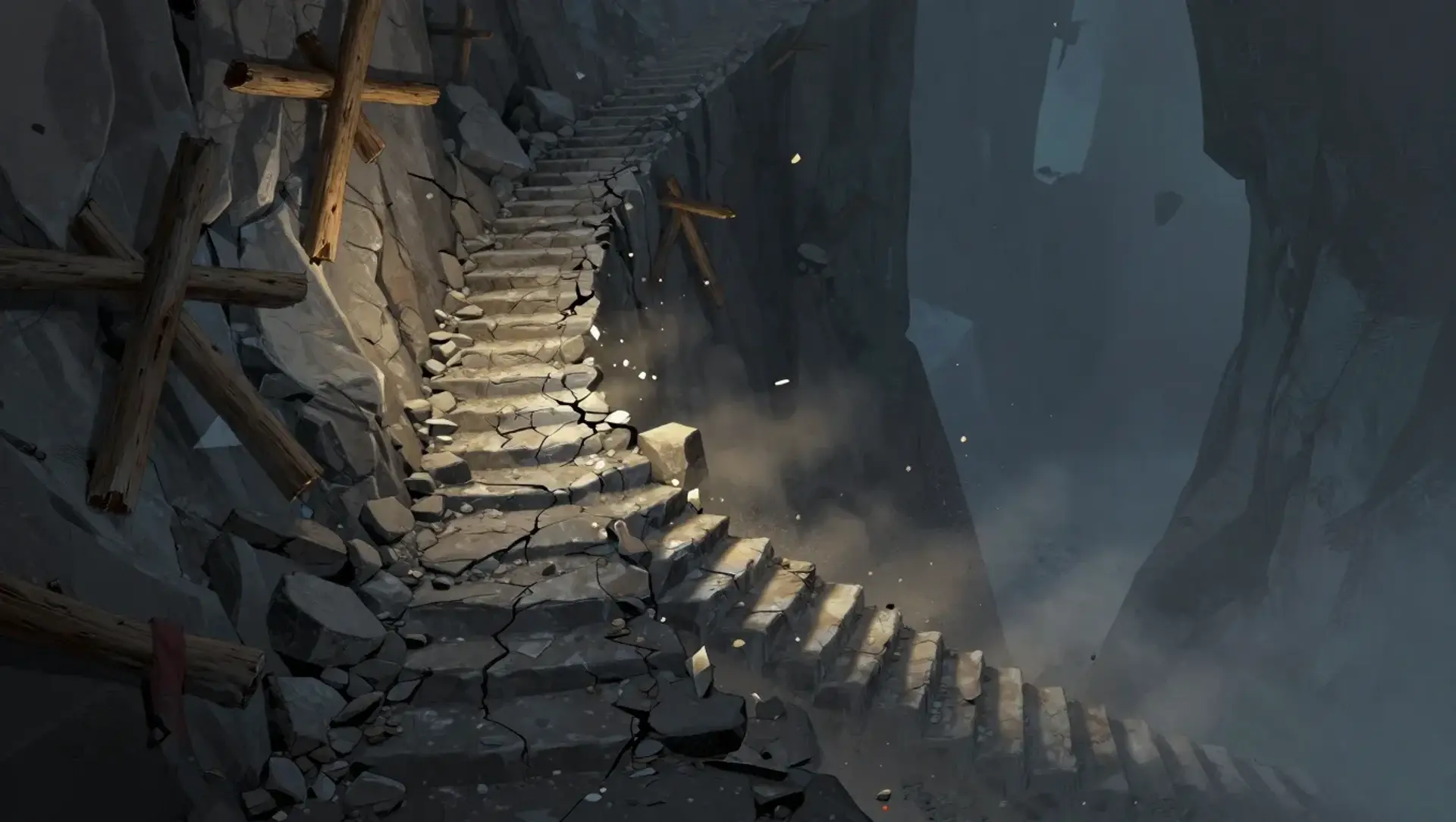
Collapsed Switchback
The Collapsed Switchback is a broken ascent or descent where narrow turns, shattered braces, and unstable ledges turn movement into a hazard. The passage is still passable, but every step risks fresh collapse, falling rubble, or a slide toward the drop. It is meant to make the party choose between speed, caution, and risk, while rewarding careful scouting and creative improvisation.
Collapsed Switchback
Defenses
Detection
“A zigzag mountain or fortress stair has given way in places, leaving a broken ribbon of steps, splintered timber braces, and waist-high rubble that forces travelers to squeeze along the outer edge. Loose boards creak underfoot, pebbles skitter into the drop below, and the whole passage seems to breathe with the threat of another collapse.”
Standard Engagement
A creature moves onto the unstable switchback, shifts too much weight onto a cracked span, or causes a jolt by fighting, dashing, or forcing a heavy object across it.
At the end of each round that one or more creatures are on the unstable section, the hazard checks for further failure. If at least one creature moved more than 10 feet on the section this round, or if a creature dashed, shoved, or fought on the ledge, roll a d20. On a 10 or lower, one section collapses. Creatures in that section must make the hazard's saving throw.
The hazard remains unstable until properly stabilized or until 1d4 hours of settling, weather, or vibration causes the area to shift again, at which point the DM can reactivate one section or the whole span.
A creature that moves through the collapsed section at normal speed must succeed on a DC 13 Dexterity saving throw or lose its footing. On a failure, it falls prone, takes 1d6 bludgeoning damage from the slide and impact, and must stop moving at the edge of the unstable section. If the creature was climbing, balancing, or moving along a ledge, it also slips 10 feet toward the drop or into the rubble unless some other obstacle prevents it.
If a creature fails the save by 5 or more, or if the DM decides the ledge has finally given way, a 10-foot section crumbles. Each creature on that section must make the same saving throw, taking 2d6 bludgeoning damage and falling prone on a failure. A creature that is adjacent to the open edge may instead be knocked into a lower position, a safe landing, or a precarious perch, depending on the terrain.
The switchback is usually treated as difficult terrain. A creature that moves carefully at half speed gains advantage on saving throws against the hazard for that movement.
A creature carrying a heavy load, wearing bulky armor while climbing, or moving in poor visibility has disadvantage on the first save it makes against the hazard each round.
If the hazard is triggered during combat, creatures that are forced to move, shoved, or frightened onto the ledge are especially vulnerable. The DM can call for the save whenever a creature is compelled to move without choosing its footing.
Turn Collapsed Switchback into a sheet
A high-res, share-ready sheet you can post or print.