
Obsidian Tribunal
Origin
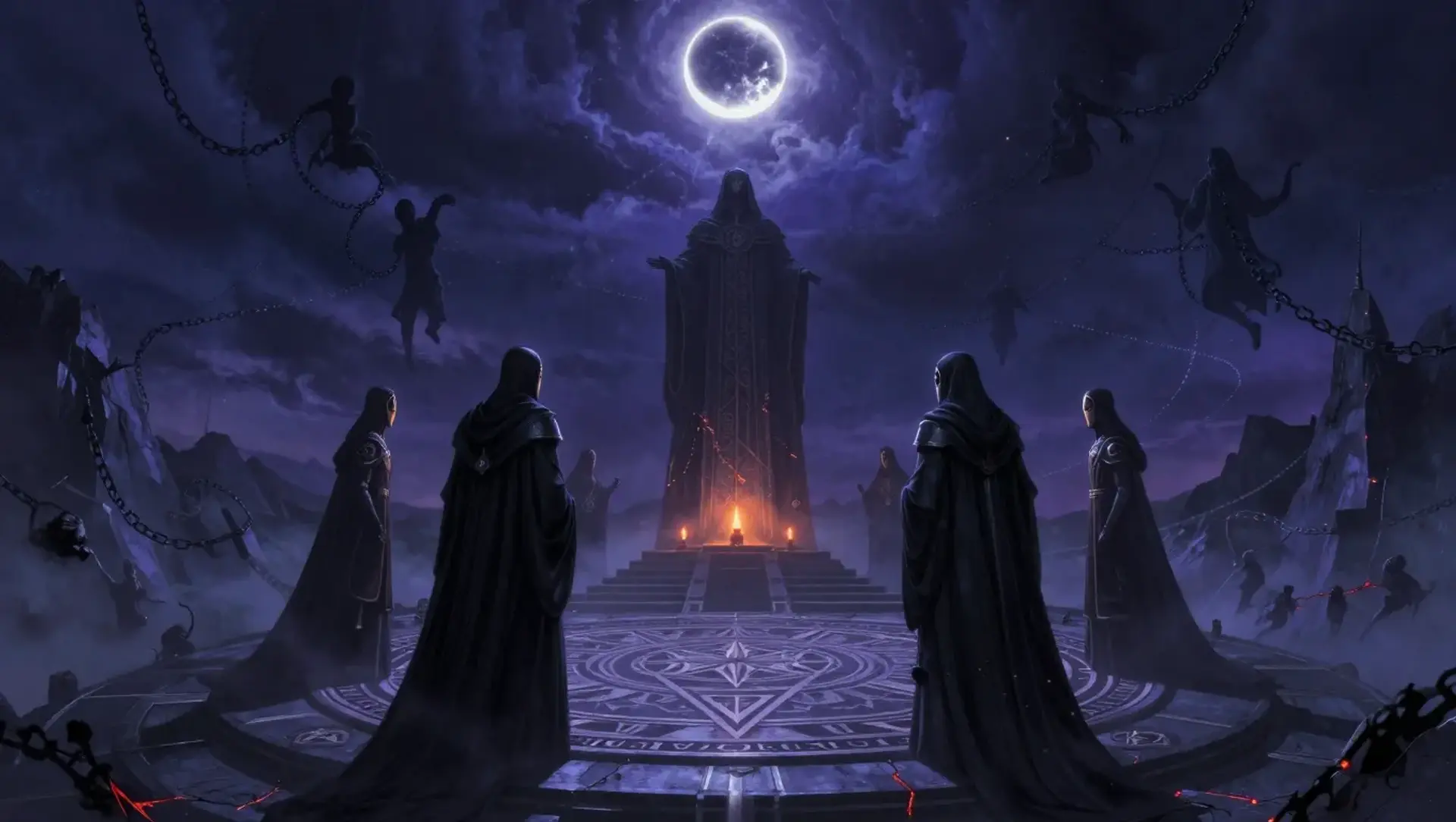
The Tribunal arose in an age when the first mortal kingdoms discovered that laws could command not only behavior but memory, death, and the unseen currents of the leylines. Six primordial judges gathered beneath an eclipse and built the Court of Endless Judgments from volcanic glass. Zael Amorith claimed the broken First Edict, Sarith Blackgavel armed its enforcement, Vessryn Oblivionbinder chained the dead, Ilyr Vant concealed its clauses, Nhalessa Veil-of-Ashes spread its influence through secrets, and Kharvok the Sentence-Bearer gave its verdicts a weapon. Over centuries, their courts became temples, their scribes became spirits, and their judgments began harvesting the power of condemned souls.
Cosmology
The Tribunal teaches that existence is an unfinished verdict. Creation emerged from a primordial sentence spoken into the void, and every living soul carries a hidden charge that can be discovered through judgment. Shadow is considered the ink of reality, while negative energy is the pressure that gives law its force. The seven leyline Nexus Points are described as ancient clauses in the first cosmic decree, with the Court of Endless Judgments built beneath one corrupted nexus to amend the world through fear. Zael Amorith interprets the decree, Ilyr Vant preserves its secret clauses, and Vessryn Oblivionbinder enforces its final penalties.
Structure
The Tribunal is governed by six Judicators, arranged in a hierarchy of authority rather than a family of equals. Zael Amorith stands as High Judicator and interprets the cosmic law. Sarith Blackgavel commands the inquisitors and enforces verdicts. Vessryn Oblivionbinder controls soul-binding rites, temple engines, and bound spirit scribes. Ilyr Vant oversees forbidden archives, names, and hidden clauses. Nhalessa Veil-of-Ashes directs espionage, dream influence, and covert courts. Kharvok the Sentence-Bearer commands executioners, temple guards, and punitive warbands. Beneath them are Judicators, shadow inquisitors, black-robed acolytes, jurist cabals, bound scribes, condemned souls, and mortal proxies. Rank is gained through successful trials, soul sacrifices, political leverage, and approval from at least two Judicators.
Mortal Relations
The Obsidian Tribunal engages mortals through black-robed acolytes, covert inquisitors, corrupt magistrates, secret jurist cabals, midnight trials, blackmail networks, and Obsidian Monolith Temples. Its priests infiltrate city councils and legal systems rather than ruling openly. Mortal members advance through the Trial of Shadows, the sacrifice of a condemned soul, the binding of a minor spirit, and approval from two Judicators during midnight rites. The Tribunal relies on mortal proxies to issue and enforce edicts, while its agents seek to establish hidden courts in every major city. It is allied with the Goroth War Clans and Azaroth Blight Cult, cooperates tacitly with the Veiled Nightlords, and is opposed by the Celestials of Dawn, Sylvros Evergreen Court, and Jorthiel Confederacy.
Afterlife
The condemned descend into the Court of Endless Judgments, where Vessryn Oblivionbinder separates souls by sentence. The obedient dead may become bound spirit scribes, silent witnesses, or spectral bailiffs beneath Zael Amorith’s authority. Souls judged irredeemably defiant are chained into the black leyline beneath the ziggurat, where their anguish strengthens the Tribunal’s temples and empowers Sarith Blackgavel’s inquisitions.
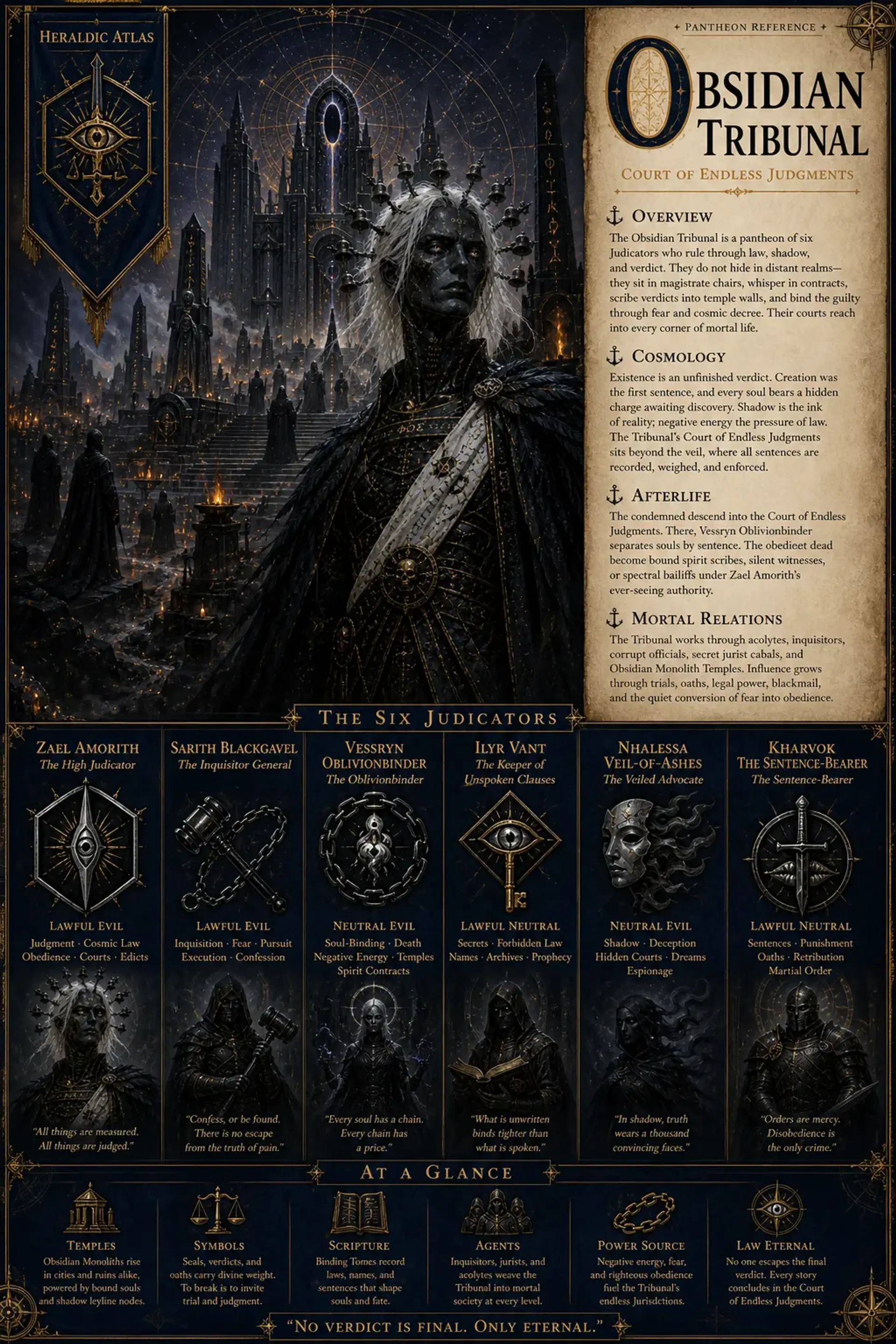
Turn Obsidian Tribunal into a sheet
A high-res, share-ready sheet you can post or print.