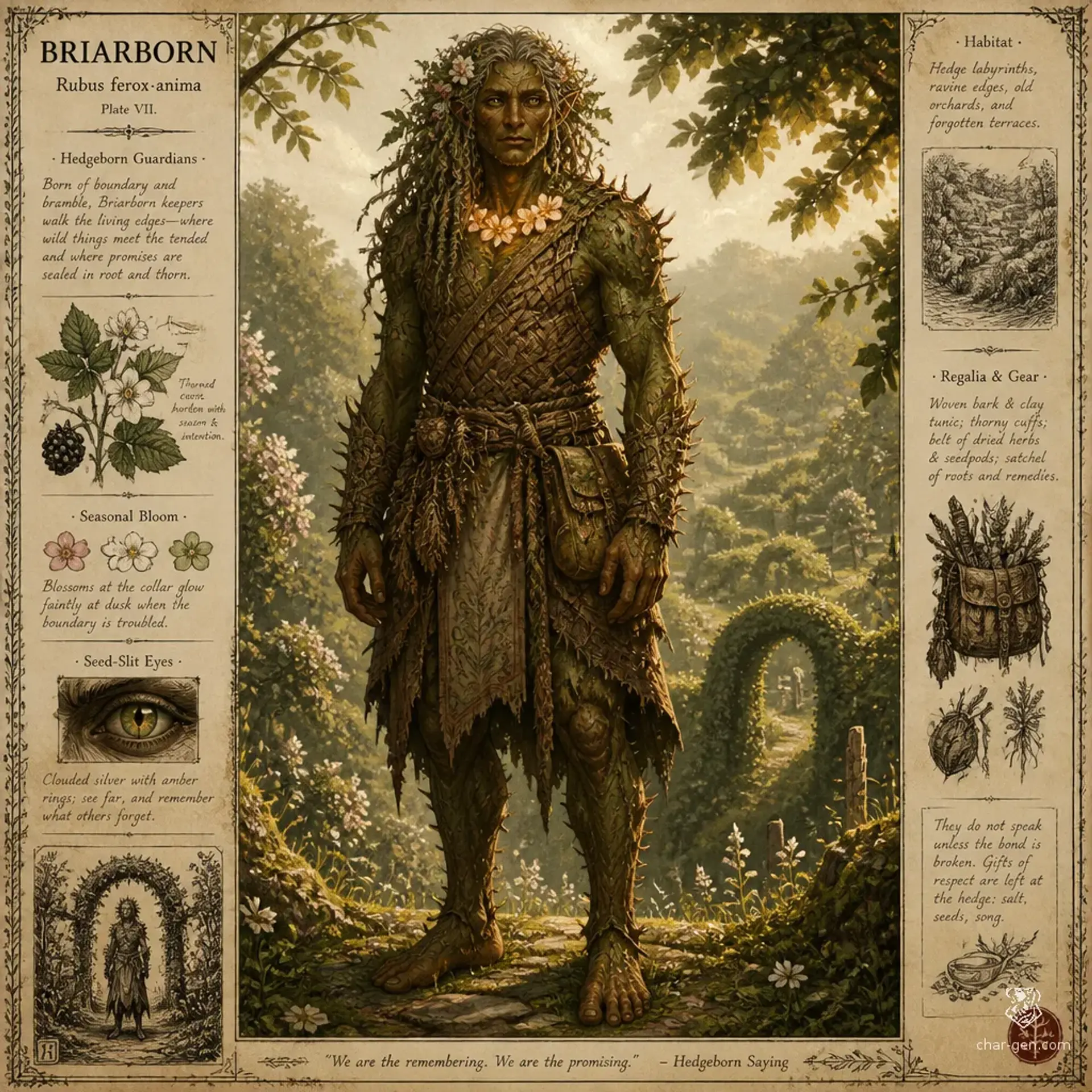
Briarborn mature physically around 18 years and commonly live 90 to 120 years. Rare elders can reach 150 years in healthy, undisturbed groves.
Darkvision
60 ft.
Habitat
Briar Glen, especially its boundary hedges, orchard terraces, shaded ravines, and old-growth thickets
Briar Glen
hedge-keeper
plant-touched
woodland
guardian
herbalist
settlement-born
SizeMedium
Speed30 ft.
LifespanBriarborn mature physically around 18 years and commonly live 90 to 120 years. Rare elders can reach 150 years in healthy, undisturbed groves.
Creature TypeHumanoid
Darkvision60 ft.
The Briarborn are the hedge-keepers of Briar Glen, a people whose bodies carry thorns, blossoms, and the patient memory of living things. They know which paths remain safe after sunset, which roots conceal old doors, and which flowers bloom only when something nearby is dying. To meet a Briarborn traveler is to meet someone who treats every road as a garden, every promise as a seed, and every threat as something that may need to be pruned before it grows.
Physical Description
Briarborn are humanoids with warm, earthy skin tones ranging from bark brown and moss green to russet, clay, and muted gold. Fine thornlets grow along their shoulders, forearms, spine, and outer calves, varying from soft and flexible in youth to hard and woody with age. Their hair resembles tangled vines, fine grasses, lichen-fringed locks, or ordinary hair threaded with leaves and tiny flowers. Their eyes are often amber, green, black, or cloudy silver, with pupils that narrow like a seed slit in bright light. Briarborn blood is dark red and faintly sweet-smelling, while their skin carries the changing scent of their home soil, flowering season, or favored plants.
Society & Culture
Briarborn society is organized around households, hedge circles, and seasonal obligations rather than rigid social classes. Every adult is expected to maintain at least one living thing, whether a garden, orchard, animal companion, medicinal plot, or stretch of protective hedge. Children are raised collectively, and elders are consulted for disputes involving land, inheritance, or broken promises. Their festivals mark planting, first bloom, harvest, and dormancy. Music favors rattles, hollow woodwinds, hand drums, and choral humming that imitates insects and wind through leaves. Hospitality is generous but conditional: guests receive food, shelter, and directions, but they are expected to mend something, plant something, or share useful knowledge before departing.
Religion & Alignment
Briarborn religion centers on the Turning Green, an interwoven tradition of seasonal rites, ancestor remembrance, and reverence for local spirits. They leave the first portion of each harvest for wild creatures and the last portion for the dead. Some venerate named figures such as the Thorn Mother, the Lantern Stag, or the Old Root, while others treat these as metaphors for duties rather than literal gods. Briarborn are commonly neutral or good, valuing balance and protection, but a strong belief in rightful boundaries can produce stern lawful guardians or fiercely independent wanderers.
Homelands & Architecture
Briarborn homes are grown as much as built. Living hedges are trained into walls, arches, sleeping alcoves, and watchtowers, while woven branches and clay panels fill the gaps. A household's doorway is usually marked by a cultivated plant whose scent identifies the family. Public buildings curve around existing trees rather than cutting them down, and streets are designed as layered paths that can be closed by drawing thorn screens across them.
Relationships With Other Peoples
Briarborn are accustomed to outsiders because Briar Glen survives through trade, pilgrimage, and carefully managed hospitality. They are often regarded as dependable guides, herbalists, gardeners, and wardens, though their reserve can be mistaken for suspicion. Briarborn admire communities that maintain shared responsibilities and distrust cultures that treat land as disposable property. They have cordial but cautious relationships with woodland peoples, farmers, and spirit-workers, while conflicts often arise with miners, slash-and-burn settlers, and nobles who redraw boundaries without consulting the land or its inhabitants.
Visual sheet
Turn Briarborn into a sheet
A high-res, share-ready sheet you can post or print.