
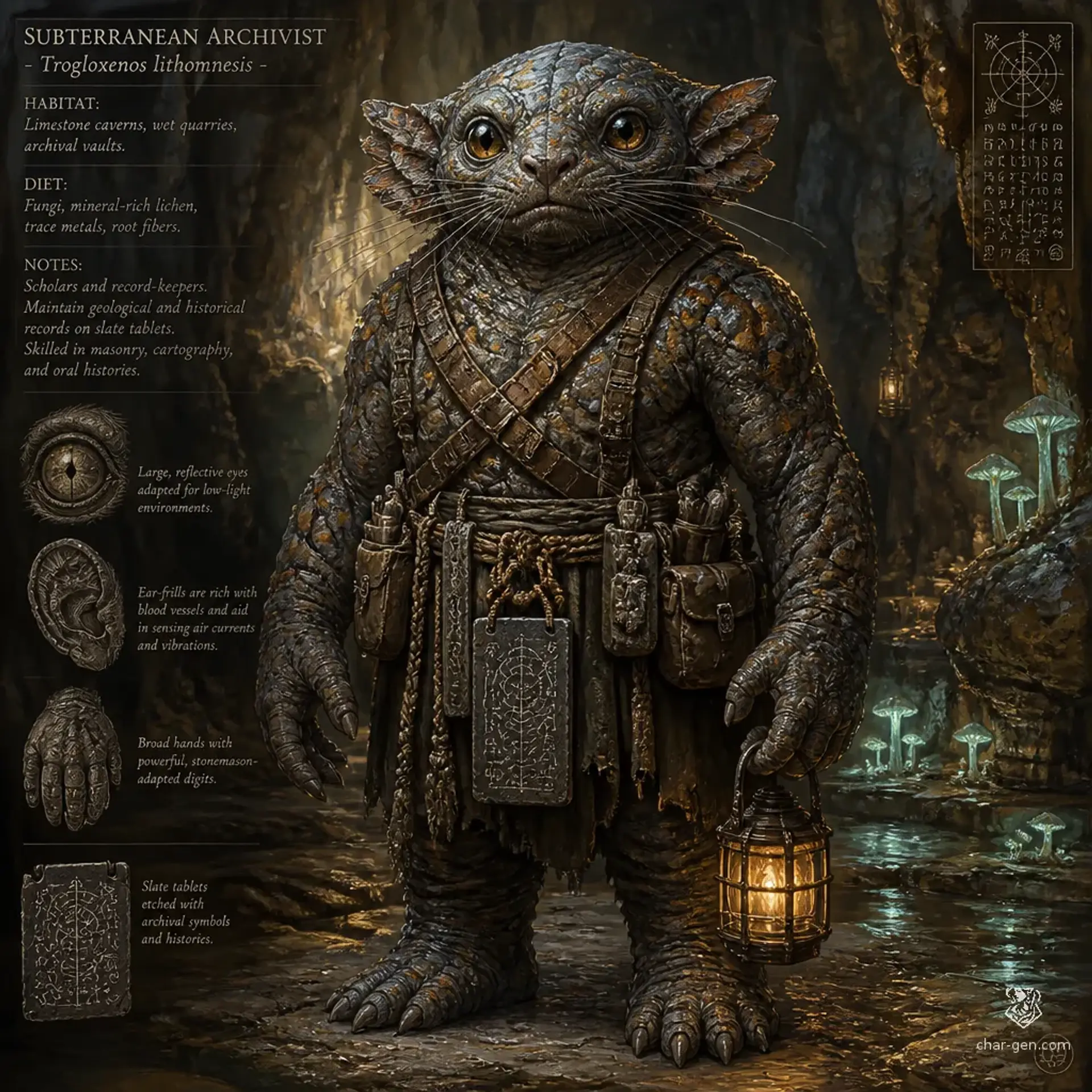
Born in the deep places where old stone sweats water and every footfall can mean safety or disaster, Stonehides are cave-adapted beast-folk who treat memory as a map and caution as a virtue. They are excellent guides, scouts, salvagers, and negotiators in the hidden world below, equally at home reading a tunnel collapse, preserving a fragile alliance, or striking out to claim a new route for their people. In play, they suit characters who are patient, observant, and hard to scare, yet always listening for the next shift in the dark.
Stonehides are medium-sized beast-folk with dense frames, flexible shoulders, and a deliberate, grounded way of moving that seems at home in cramped passages. Their fur, scales, or hide usually bears the look of quarry-stone and cave-silt, in shades of basalt, clay, pale limestone, iron gray, and lichen-speckled brown. Many have expressive whiskers, ear-frills, or ridge-like markings that help them read vibration and airflow. Their hands are broad and capable, with short, strong fingers suited to climbing, digging, crafting, and bracing unstable stone. Their eyes are large and reflective, adapted to lantern glow and near-darkness rather than bright sun.
Stonehide culture is clan-bound, archival, and deeply oral. They keep history in chant, knotwork, etched slate, and memory games played during long watch shifts. Children are taught early to identify resonance in a wall, the scent of bad air, and the difference between a living tunnel and one that only looks safe. Their humor is low and dry, often built on understatement and impossible endurance. They prize useful skills over inherited status, though elders are honored for what they have preserved. Hospitality is sacred, but it comes with rules. A guest who wastes water or lies at the table may not be attacked, but they will be remembered very clearly.
Stonehide faith is practical rather than grand. Their shrines honor deep earth spirits, ancestral keepers, and whatever patient powers safeguard water, stone, and safe passage. Most communities favor traditions of duty, restraint, and mutual survival, so they often lean lawful or neutral. That said, their oldest stories also praise the irreverent scout who learns a forbidden route, the healer who breaks a taboo to save a clutchmate, and the rebel who seals a cruel cavern lord behind their own locked door.
Stonehide communities are built where root, vein, and void meet. They favor carved chambers, ladder shafts, warm cisterns, and narrow streets that conserve heat and invite ambush from nowhere. Their homes are rarely lavish, but they are ingenious, with pressure doors, glow-fungus gardens, and vented hearth pits that keep air moving through the deepest warrens. A Stonehide settlement is usually layered like a burrowed shell, with food stores closest to the center and watch galleries above.
Stonehides are typically measured and transactional with outsiders, but not cold. They respect competence, keep agreements meticulously, and remember insults for generations if those insults threaten a tunnel, a family, or a trade route. Surface dwellers often mistake their caution for suspicion, while Stonehides usually think surface folk are reckless, noisy, and astonishingly fond of windows. They get along well with miners, delvers, scholars, and anyone who can be useful without being cruel.
A high-res, share-ready sheet you can post or print.