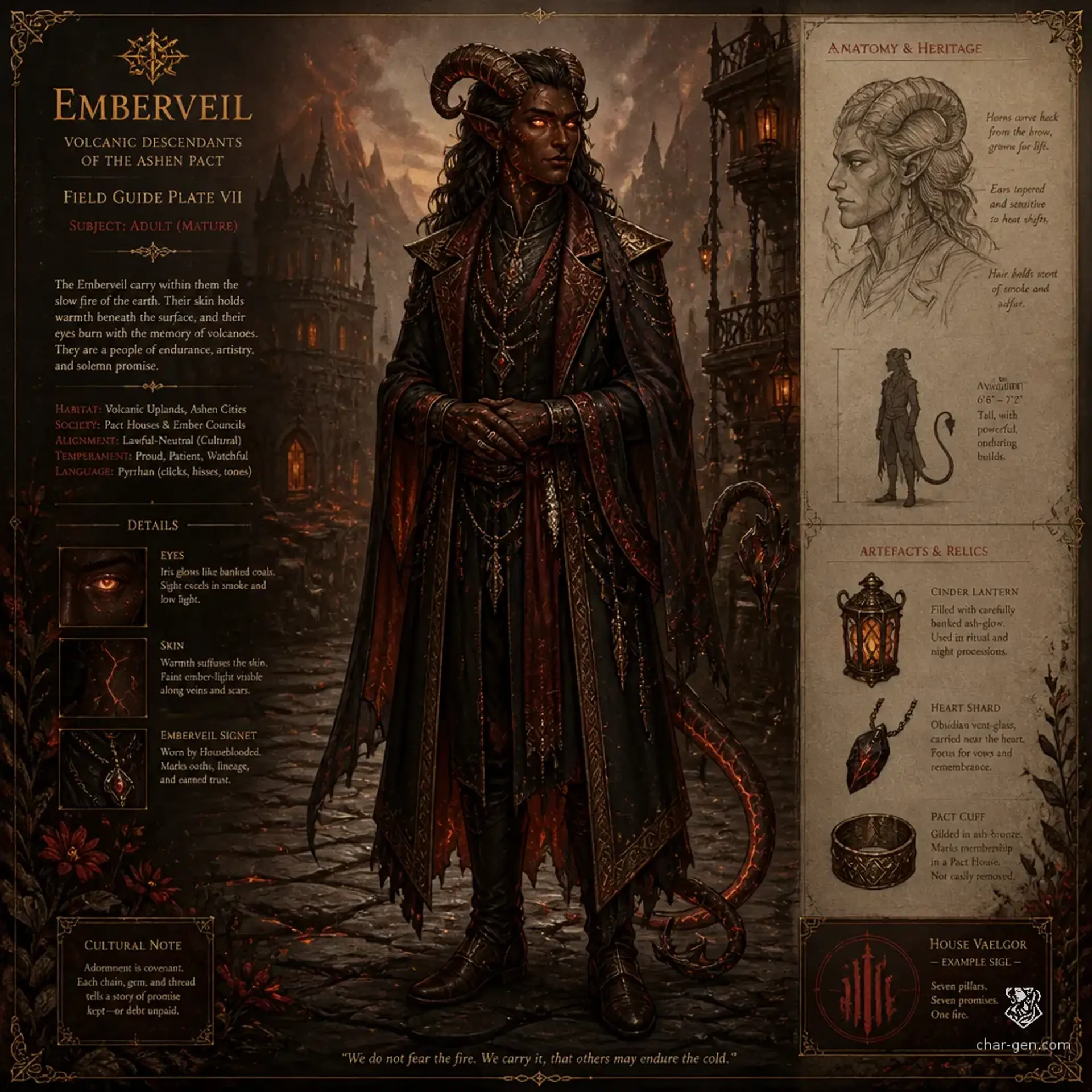
Emberveil mature at about 18 years and commonly live 80 to 110 years.
Darkvision
60 ft.
Habitat
Dense cities, volcanic uplands, abandoned fortresses, borderlands, and communities built near old magical disasters.
humanoid
fire-touched
fiend-marked
urban
social
supernatural
horned
SizeMedium
Speed30 ft.
LifespanEmberveil mature at about 18 years and commonly live 80 to 110 years.
Creature TypeHumanoid
Darkvision60 ft.
The Emberveil are descendants of mortals touched by forbidden fires, celestial embers, hungry spirits, and bargains made before history learned to write them down. They are not born wicked, though many societies insist otherwise. Each Emberveil must decide whether ancestry is a chain, a warning, a weapon, or simply an old story. Their horns and luminous eyes make them difficult to ignore, but their greatest inheritance is subtler: an instinct for hidden motives, a talent for surviving judgment, and a warmth that can comfort or consume.
Physical Description
Emberveil are graceful humanoids marked by the lingering influence of otherworldly fire and old pacts. Their skin ranges from warm bronze and russet to charcoal, plum, gray, and deep umber, sometimes showing faint lines of coppery light beneath the surface. Most possess horns that curve back from the brow, though shapes vary from swept crescents to short ridges or branching antlers. Their eyes may glow like banked coals, molten amber, pale silver, or blue-white flame. Tails are common but not universal, and many Emberveil bear pointed ears, sharpened teeth, or small patches of scale-like skin. Their bodies are otherwise fully humanoid. Smoke-scented hair, unusually warm hands, and a tendency to cast reddish shadows are common but not universal traits.
Society & Culture
Emberveil culture places unusual importance on names, promises, and chosen presentation. A birth name is considered an inheritance, while a self-chosen name is considered a declaration. Families preserve detailed genealogies, but public discussion of an ancestor's crimes is often expected rather than forbidden. Masks, veils, painted horns, jeweled chains, and formal coats are popular because they allow an Emberveil to control how others first perceive them. Their festivals feature lantern processions, dramatic recitations of family history, and contests in which participants confess a secret while the crowd decides whether it deserves forgiveness. Emberveil are often skilled mediators, performers, investigators, courtiers, and spies, professions that reward emotional insight and the ability to remain composed beneath scrutiny.
Religion & Alignment
Emberveil do not share a single faith. Some honor gods of judgment, fire, contracts, night, or liberation, while others revere ancestral spirits and household hearths. A common devotional practice is the Keeping of Names, in which the dead are remembered aloud during winter gatherings. Emberveil tend toward passionate, self-directed moral outlooks, but any alignment can be found among them. Those raised under constant suspicion may become compassionate defenders of the accused or ruthless believers in preemptive control.
Homelands & Architecture
Emberveil homelands are usually layered settlements built around a central archive, shrine, or public hearth. Their buildings favor narrow windows, covered walkways, steep roofs, and courtyards designed to contain heat and smoke. Decorative ironwork often depicts open eyes, broken chains, and curling flames. In older districts, doors are painted with family colors, while newer neighborhoods favor plain fronts to emphasize chosen identity over ancestry.
Relationships With Other Peoples
Emberveil are welcomed in some cosmopolitan centers and treated with wary fascination in others. Their reputation varies sharply by region. In one town they may serve as judges, performers, and negotiators; in another they may be blamed for crop failures, political scandals, or any supernatural event without an obvious culprit. Emberveil communities often form strong alliances with other marginalized peoples, while remaining cautious around institutions that maintain bloodline registries or hereditary offices. They are especially sympathetic to half-blooded, adopted, and magically altered people who are forced to explain themselves to strangers.
Visual sheet
Turn Emberveil into a sheet
A high-res, share-ready sheet you can post or print.