Small or Medium, chosen when you select this species
Common
Humanoid
Humanoid·Small or Medium, chosen when you select this species
Veyrani
Veyranis campestris
Speed
30 ft.
Lifespan
Veyrani mature physically at about 18 years and commonly live 80 to 100 years. Exceptional elders may survive for 130 years.
Habitat
Plains
humanoid
plains
nomadic
pastoral
weatherwise
animal-bonded
common
SizeSmall or Medium, chosen when you select this species
Speed30 ft.
LifespanVeyrani mature physically at about 18 years and commonly live 80 to 100 years. Exceptional elders may survive for 130 years.
Creature TypeHumanoid
The Veyrani are horizon-born wanderers who measure life in migrations, promises, and remembered songs. They cross the grasslands with patient confidence, reading weather in the air and history in the tracks beneath their feet. To travel with a Veyrani is to gain a vigilant scout, an uncompromising host, and a companion who believes every road leads somewhere worth understanding.
Physical Description
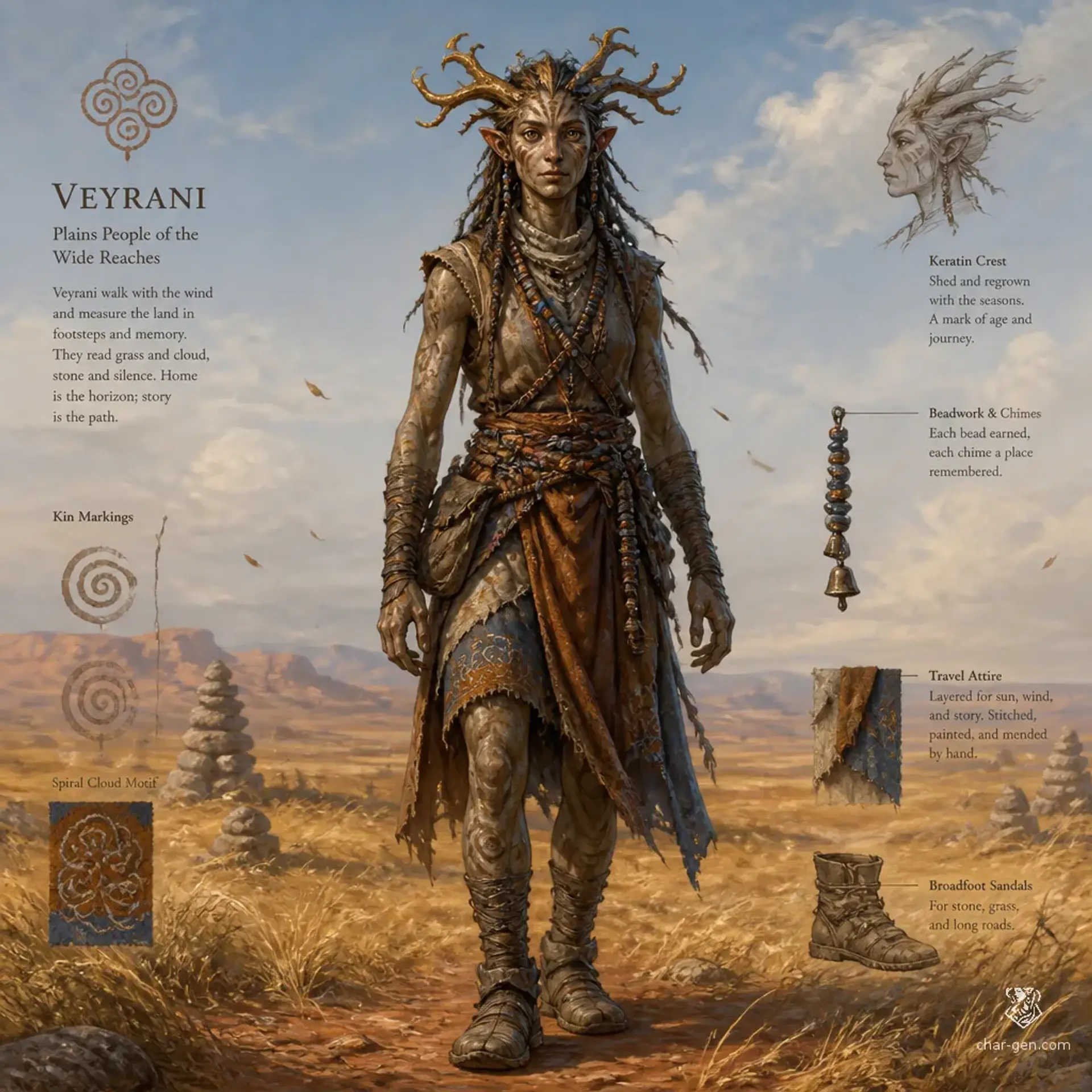
Veyrani are lean, long-limbed humanoids adapted to distance, heat, and sudden weather. Their skin ranges from pale clay to deep umber, often marked by natural bands or mottling that resemble grass shadows. Most have large, expressive eyes in shades of amber, gray, green, or storm blue. A flexible crest of keratin rises from the brow and crown, resembling swept-back horns, short antlers, feathers, or ridged bone depending on the lineage. The crest is warm to the touch and subtly changes color with health, emotion, and temperature. Their hair is usually coarse and dark, though copper, silver, and sun-bleached shades are common. Veyrani feet are broad and resilient, suited to long travel over hard ground. Their voices carry unusually well across open terrain, and many can produce a soft overtone while singing that resembles distant wind through reeds.
Society & Culture
Veyrani society is organized into traveling clans, household circles, and temporary alliances formed around water, trade, defense, or seasonal work. Their most important social unit is the herd, a term that includes relatives, sworn companions, adopted outsiders, and sometimes valued animals. Leadership is situational. A skilled navigator leads on the road, a healer leads during illness, and an experienced negotiator speaks when two clans meet. Veyrani children learn through observation and participation rather than formal schooling. Songs preserve law, genealogy, and geography, while bead patterns record personal achievements and obligations. Disagreement is expected, but public arguments are traditionally followed by a shared task so that conflict does not become a permanent division.
Religion & Alignment
Veyrani spirituality centers on the belief that every living thing leaves a pressure upon the world, like a footprint in damp soil. Their shrines are often circles of stones, suspended chimes, or poles wrapped in offerings that flutter in the wind. They honor ancestral guides, weather spirits, river-mothers, herd guardians, and the patient intelligence of the land. Many Veyrani are drawn toward good and neutral alignments because hospitality and reciprocity are central virtues, but ambitious chiefs, uncompromising oathkeepers, and storm-worshiping mystics can follow any moral path.
Homelands & Architecture
The Veyrani homeland is the Ravelgrass, a vast plain of gold reeds, red earth, seasonal rivers, and stone outcrops that hum in high winds. Their camps are arranged in broad circles around communal fires, with sleeping tents facing outward so every household can see the horizon. Veyrani architecture favors portability, shade, and repair. When they build permanent structures, they use low stone foundations, woven grass walls, earth-colored plaster, and tall wind towers that whistle warnings when storms approach. Roads are considered temporary agreements with the land, marked by cairns, buried bells, and lines of painted stones.
Relationships With Other Peoples
Veyrani often approach other peoples through the customs of hospitality. They are quick to offer food, directions, and a place near the fire, but they remember every promise made in return. They admire communities that maintain strong mutual obligations and distrust societies built around rigid ownership or permanent exclusion. Settled farmers may view them as unreliable wanderers, while merchants value their knowledge of routes and weather. Veyrani relationships with horsefolk, shepherds, caravaners, and other pastoral peoples are usually warm, though disputes can arise over grazing rights, sacred springs, and who has authority over a shared road.
Visual sheet
Turn Veyrani into a sheet
A high-res, share-ready sheet you can post or print.