Small or Medium, chosen when you select this species
Common
Humanoid
Humanoid·Small or Medium, chosen when you select this species
Veyrani
Veyranis itinerans
Speed
30 ft.
Lifespan
Veyrani mature around 16 years and commonly live 70 to 90 years.
Habitat
Open plains, high grasslands, dry savannas, steppe, and broad river valleys
beast-folk
plains-dweller
migratory
herd culture
swift
scout
standard PC ancestry
SizeSmall or Medium, chosen when you select this species
Speed30 ft.
LifespanVeyrani mature around 16 years and commonly live 70 to 90 years.
Creature TypeHumanoid
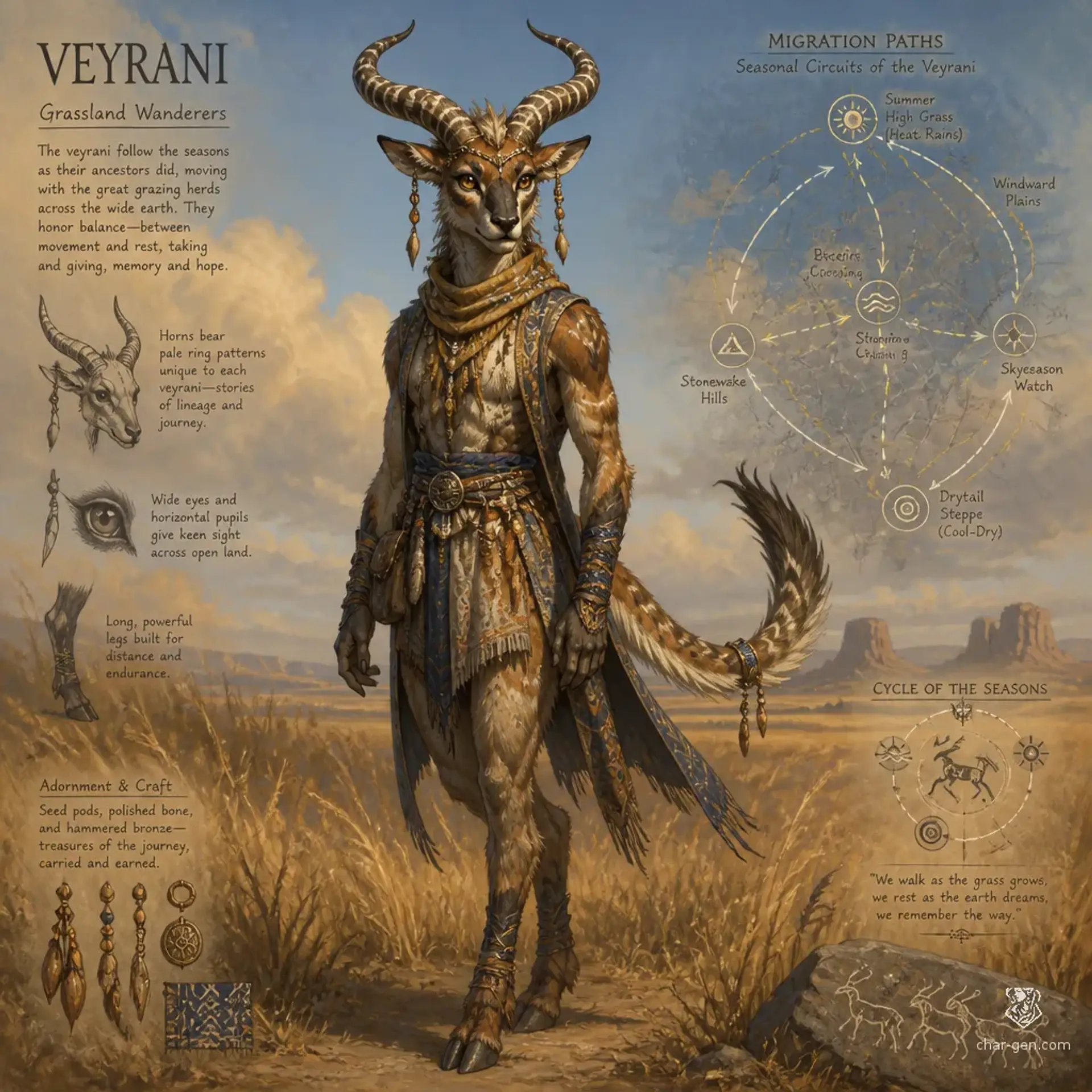
The Veyrani are swift-footed beast-folk of the endless grasslands, born beneath enormous skies and raised to treat every road as a living inheritance. They travel in herds, follow routes older than kingdoms, and sing the names of wells, battlefields, vanished villages, and stars. A veyrani adventurer may be a wandering scout, an exile seeking a new herd, a keeper of sacred maps, or simply someone who has heard a call from beyond the horizon and cannot resist answering it.
Physical Description
Veyrani are graceful plains-dwellers with humanoid torsos and the long, powerful legs of swift grazing animals. Their faces range from delicate and antelope-like to broad and horse-like, depending on the herd lineage. Most possess tapered ears, expressive tails, short fur over the body, and swept horns or antler-like crowns. Coat colors include dun, russet, cream, charcoal, chestnut, and mottled combinations, often with dark markings along the muzzle, shoulders, or legs. Their eyes are large and adapted to wide horizons, with horizontal pupils that give them an uncanny awareness of movement at the edge of sight. Veyrani clothing favors layered sashes, sleeveless coats, beadwork, light armor, and scarves dyed in the colors of their home routes.
Society & Culture
Veyrani society is organized around herds, though a herd may include several bloodlines and adopted members. Each person usually belongs to a birth herd, a craft circle, and a seasonal traveling group. Decisions are made through councils where elders preserve precedent, runners report current conditions, and singers interpret the emotional will of the herd. Hospitality is sacred, but so is departure. A guest is fed, questioned, and given directions, yet is not expected to remain. Veyrani education is experiential: children learn by walking routes, tending animals, reading spoor, memorizing songs, and listening to disputes until they understand not only what happened but what must be carried forward.
Religion & Alignment
Veyrani spirituality centers on the Long Crossing, the belief that life is a passage through places that must be left healthier than they were found. They honor ancestral pathkeepers, living landscapes, weather spirits, and the unseen pulse they call the Deep Rhythm. Their ceremonies use footwork, rattles, breath, and low horn tones. Veyrani are often good because mutual care is essential to herd survival, and many are neutral because they distrust rigid moral codes that ignore circumstance. Lawful veyrani preserve routes and obligations, while chaotic veyrani prize personal freedom and new horizons.
Homelands & Architecture
Veyrani homelands are seasonal rather than permanent. Their herds follow ancient circuits between watering places, salt flats, winter hollows, and summer meadows. Temporary settlements form around collapsible shade structures, woven windbreaks, painted wagons, and low stone rings that mark old gathering grounds. A few veyrani communities maintain permanent towns at major crossroads, but even these are built with broad avenues, open courtyards, rooftop sleeping platforms, and gates aligned to the horizon. Architecture is designed for movement, shade, and visibility rather than defense.
Relationships With Other Peoples
Veyrani are usually welcoming to travelers and practical with settled societies, trading meat, leather, salt, medicine, and guidance for metalwork, grain, books, and crafted goods. They respect communities that maintain open roads and reliable wells, while viewing empires that fence land or restrict movement with suspicion. Veyrani often form strong friendships with caravaners, rangers, shepherds, and river peoples. They can struggle with cultures that interpret their directness as rudeness or their mobility as rootlessness.
Visual sheet
Turn Veyrani into a sheet
A high-res, share-ready sheet you can post or print.