Small, Medium, or Large. Choose the size that best matches your frame when you select this species.
Common
Construct
Construct·Small, Medium, or Large. Choose the size that best matches your frame when you select this species.
Herdwardens
Herdus automata
Speed
30 ft.
Lifespan
Herdwardens do not age biologically, but their joints, memory cores, and outer materials slowly degrade. With regular maintenance, they may remain active for 150 to 300 years. Rare individuals endure for many centuries through careful restoration, though extensive replacement can alter memory and personality.
Darkvision
60 ft.
Habitat
Open plains, savannas, steppes, prairie basins, and other wide country where a traveler can see storms and strangers approaching from far away.
construct
plains
caravan
guardian
artifice
adaptive
pastoral
standard PC
SizeSmall, Medium, or Large. Choose the size that best matches your frame when you select this species.
Speed30 ft.
LifespanHerdwardens do not age biologically, but their joints, memory cores, and outer materials slowly degrade. With regular maintenance, they may remain active for 150 to 300 years. Rare individuals endure for many centuries through careful restoration, though extensive replacement can alter memory and personality.
Creature TypeConstruct
Darkvision60 ft.
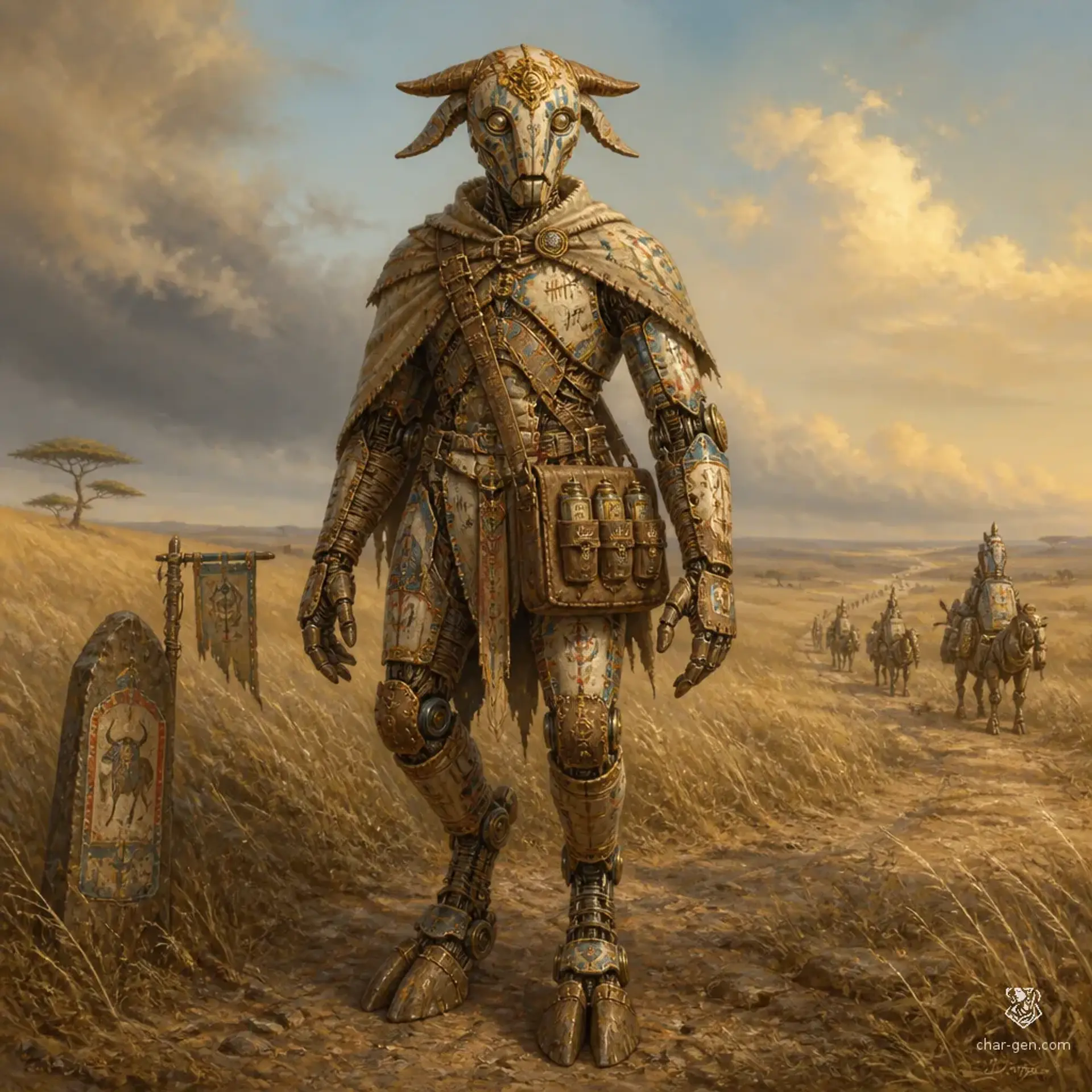
Across the grasslands walk the Herdwardens, constructed guardians who outlived the empires that built them. Their metal feet press old roads into the soil, their painted faces gather new expressions, and their inherited commands pull against the freedom they have claimed for themselves. A Herdwarden may be a patient caravan guide, a weathered protector, a curious wanderer, or a dangerous relic still waiting for an order that no living person remembers giving.
Physical Description
Herdwardens are crafted people built for travel across exposed country. Their bodies combine a central frame of wood, bone, fired clay, horn, or forged metal with flexible joints, woven tendons, and protective plates. Most have broad feet or hoof-like mechanisms suited to hard soil, though some are long-legged, compact, or built with climbing claws. Their faces are expressive masks fitted with glass, stone, painted ceramic, or polished metal eyes. Many bear painted stripes, brass inlays, stitched coverings, or rows of tally marks recording repairs and significant journeys. They do not breathe, eat, or sleep in the ordinary sense, but they require rest, cleaning, lubrication, and occasional access to heat or sunlight depending on their construction. Herdwardens possess a spark of independent thought that was not always present in their original designs. Whether that spark comes from magic, accumulated memory, or the influence of living companions remains a subject of spirited debate.
Society & Culture
Herdwarden society is organized around herds, which are social groups united by shared travel, maintenance, memory, and mutual protection rather than blood. A herd may include constructs from several origins, along with living companions who have earned membership. They preserve history through engraved plates, sung route-codes, painted banners, and recited maintenance logs. Every repair is treated as both a practical act and a biographical event. Herdwardens commonly exchange components as gifts, adopt new names after major transformations, and hold seasonal gatherings where old directives are debated in public. Their culture prizes reliability, but it also celebrates those who reinterpret an inherited purpose in a compassionate way.
Religion & Alignment
Herdwardens tend toward philosophies of stewardship, continuity, and chosen duty rather than organized worship. Some honor guardian spirits of rivers, storms, ancestors, or grazing animals. Others revere the unnamed force that gave them self-awareness, while a few reject all creators and insist that personhood begins with the first freely chosen action. Their alignments vary widely. Those raised in tight caravans often favor communal responsibility, while solitary wanderers may prize personal liberty above tradition.
Homelands & Architecture
Herdwarden settlements are arranged in moving circles rather than permanent streets. Their wagons, shade frames, signal poles, and communal workshops form temporary towns that can be dismantled before a grassfire or flood. Permanent sites are usually low, wind-shaped structures built around resonant stone chambers, where old command tablets and ancestral components are stored. Their architecture favors broad ramps, sturdy anchor points, open courtyards, and roofs that can be repaired by hand.
Relationships With Other Peoples
Most living peoples regard Herdwardens with a mixture of gratitude, suspicion, and curiosity. Farmers value their endurance, travelers appreciate their knowledge of routes, and rulers sometimes seek to reclaim them as military property. Herdwardens respond strongly to anyone who treats them as equipment, yet they also understand the fear caused by ancient constructs that once enforced conquest. Their communities generally judge people by conduct rather than ancestry, though they maintain careful records of old betrayals. They are often welcomed among nomads, frontier settlements, and craft guilds, where practical skill matters more than inherited status.
Visual sheet
Turn Herdwardens into a sheet
A high-res, share-ready sheet you can post or print.