About 80 years, with some elders living beyond 100 when floods, fever, and war spare them.
Darkvision
60 ft.
Habitat
Floodplains, deltas, marsh-country, river cities, and the first dry hills beyond a watershed. They travel readily, but most are never more than a day or two from moving water for long.
humanoid
riverborn
wetlands
guides
lorekeepers
navigators
reeds
floodplains
standard-pc
dnd-5e-2024
homebrew-ancestry
SizeMedium
Speed30 ft.
LifespanAbout 80 years, with some elders living beyond 100 when floods, fever, and war spare them.
Creature TypeHumanoid
Darkvision60 ft.
River readers are the living memory of waterside folk, born to notice what others overlook. They read flood signs in cracked earth, hidden roads in reeds, and old promises in the shape of a current. At the table, they feel like scouts, mediators, lore-keepers, and patient survivors who can turn a crossing, a drought, or a forgotten story into the heart of an adventure.
Physical Description
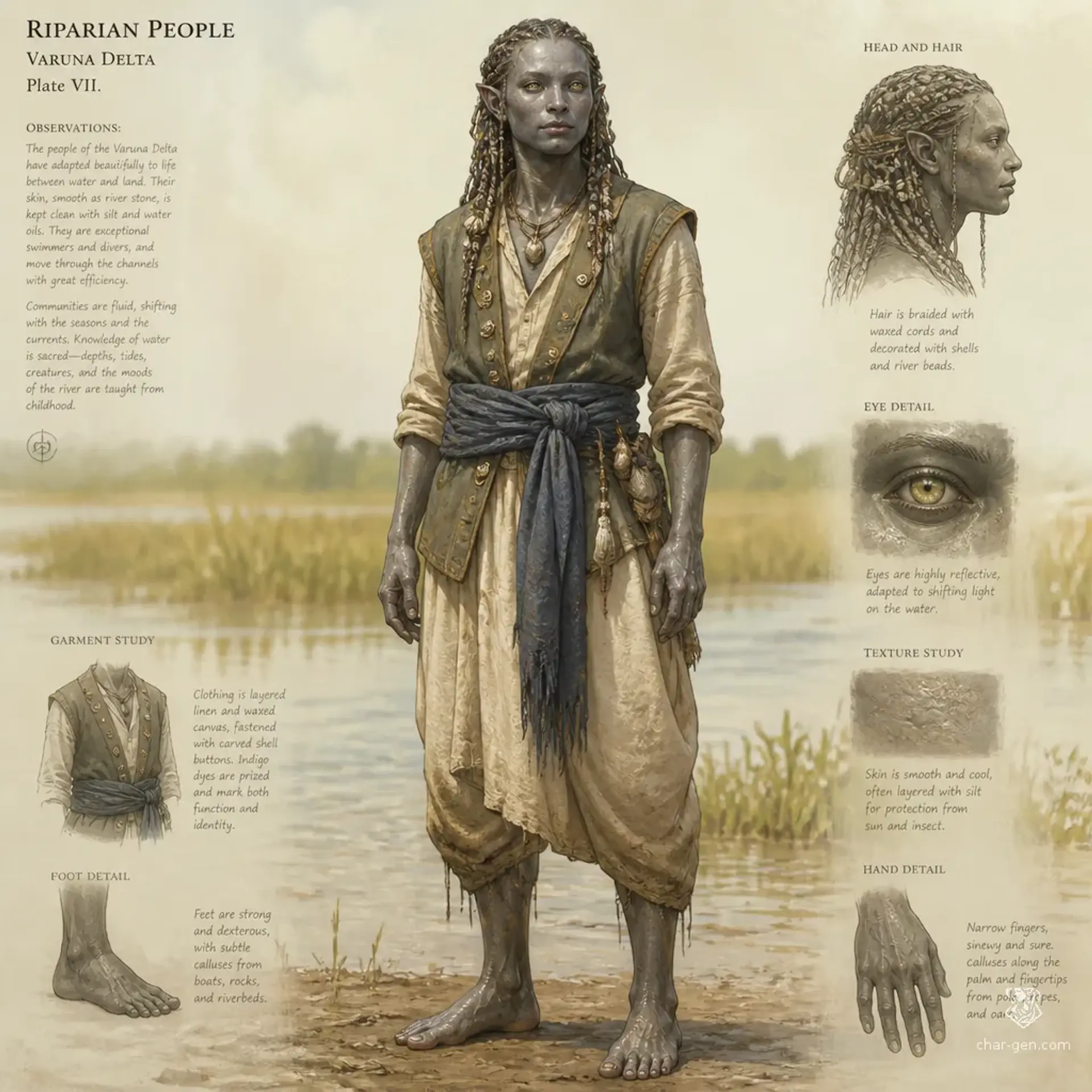
River readers are lithe humanoids with smooth, water-resistant skin tones that range from reed-brown to pale clay and riverstone gray. Their hair is often thick, straight, or tightly curled, and usually kept braided, wrapped, or bound with cords that can be loosened in a hurry. Their eyes frequently reflect light unusually well, making them seem attentive even in dim places. Many have narrow hands, strong feet, and callused fingertips from paddles, nets, ropes, or reed-working. Their clothing favors layered linen, waxed canvas, shell buttons, and dyed sashes that identify family, ferry, or settlement. A common saying among them is that a river reader can be recognized by the mud on their hem and the patience in their face.
Society & Culture
River reader society is organized around water rights, seasonal movement, and the keeping of records. Children learn to identify plants, weather, and river sounds before they are taught formal letters. Public memory is sacred, so marriage contracts, funerals, land disputes, and naming ceremonies often happen near water. They maintain ledger houses where births, debts, routes, and omens are preserved in waterproof bundles. Storytelling is both entertainment and civic duty, because a useful tale may save a village when the river changes course. Their humor is dry, their hospitality is generous, and their criticism can be devastatingly polite.
Religion & Alignment
River readers do not share a single faith, but many honor river-spirits, ancestor shrines, and deities of travel, harvest, or tides. Their outlook is usually pragmatic rather than zealous. They tend to respect balance, continuity, and the consequences of stewardship, so they are often drawn toward good or neutral alignments, though a river reader raised in a harsh borderland may become as hard and changeable as a winter flood.
Homelands & Architecture
River reader homelands are built for change. Homes stand on pilings, floating barges, terraced embankments, or stone ribs above flood lines. Their architecture favors movable shutters, high shelves, rain chains, rope bridges, and wall niches for charts, offerings, and emergency lamps. A settlement is judged not by grandeur, but by how well it survives the next swollen season.
Relationships With Other Peoples
River readers are often valued as guides, archivists, and negotiators, though outsiders sometimes mistrust their habit of noticing everything. They get along well with merchants, ferrymen, farmers, and anyone who respects practical knowledge. They can clash with rulers who prefer straight borders, fixed records, and easy answers, since river readers know that water rarely honors such things. Among themselves, they prize repayment, hospitality, and the patient settling of disputes through witness and memory rather than force.
Visual sheet
Turn River Readers into a sheet
A high-res, share-ready sheet you can post or print.