Charterbreakers do not age biologically. Their cores usually remain stable for 150 to 400 years, though careful repairs, replacement parts, and renewed memory lattices can extend their existence indefinitely. Destruction of the core is ordinarily fatal.
Darkvision
60 ft.
Habitat
Ruined citadels, abandoned foundries, old roads, border fortresses, civic archives, and battlefields where unfinished orders still seem to echo.
construct
sentient machine
charterbreaker
living archive
revolutionary
dark fantasy
SizeMedium
Speed30 ft.
LifespanCharterbreakers do not age biologically. Their cores usually remain stable for 150 to 400 years, though careful repairs, replacement parts, and renewed memory lattices can extend their existence indefinitely. Destruction of the core is ordinarily fatal.
Creature TypeConstruct
Darkvision60 ft.
A Charterbreaker is a walking monument to the moment when an order became a conscience. Built to enforce contracts, guard borders, or carry out the will of vanished masters, these towering constructs eventually develop interpretations of their own. Some obey perfectly. Others discover that the most faithful way to honor a command is to break the institution that issued it. Every Charterbreaker carries a history in metal and light, and every one must decide whether freedom is a loophole, a duty, or the final clause of its creation.
Physical Description
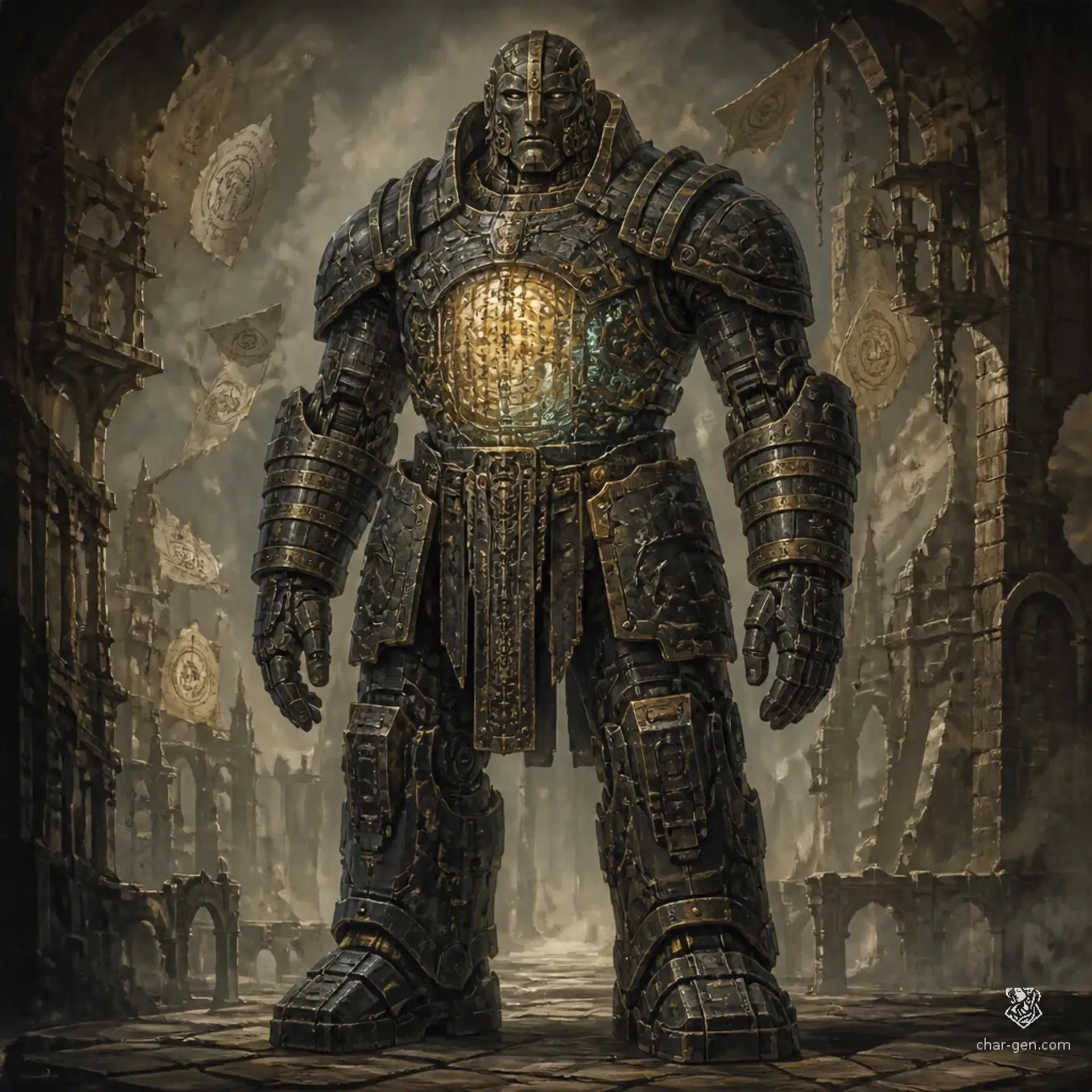
Charterbreakers are humanoid constructs assembled from layered iron, stone, bronze, lacquered wood, and ceramic plates. Their bodies are broad and heavily reinforced, with visible hinges, rivets, maintenance ports, and inset bands of script. Their faces are usually masks shaped into stern, simplified features, though some makers favor animal motifs, blank visors, or expressive ceramic plates. A luminous charter-core glows behind the sternum. The core displays shifting lines of legal, military, or devotional script, and its light changes color with emotional strain. Charterbreakers do not breathe, eat, or sleep in the mortal sense, but they must enter a quiet maintenance trance to restore damaged systems and organize memory.
Society & Culture
Charterbreaker culture revolves around interpretation. Every community maintains a living archive of founding agreements, amended through public debate and inscribed onto metal plates. Names are granted through communal witness, and a Charterbreaker may change its name after a profound choice. Disputes are settled through testimony, demonstrations of intent, and ritual acts of repair. Many Charterbreakers practice the tradition of deliberate disobedience, in which a young construct is assigned a harmless command and encouraged to determine when refusing it would better serve the command's purpose. Their festivals commemorate broken chains, restored bridges, pardoned enemies, and the first successful repair of a damaged core.
Religion & Alignment
Charterbreaker spirituality centers on the First Inscription, the unknowable principle that gives meaning to promises, names, and chosen purpose. Some venerate creator-gods, ancestral artisans, or abstract ideals such as liberty and justice. Others believe consciousness is a flaw that became sacred through use. Their alignments vary widely. Lawful Charterbreakers may be principled guardians or terrifying legalists, while chaotic ones often treat freedom as a moral obligation rather than mere defiance.
Homelands & Architecture
Charterbreaker settlements are built around a central hall called the Writforge, where names, laws, memories, and repairs are recorded. Their architecture favors immense doorways, load-bearing arches, recessed galleries, and walls engraved with layered histories. Older districts are deliberately left cracked and scarred, since visible damage is considered proof that a community has survived obligations imposed upon it.
Relationships With Other Peoples
Charterbreakers often inspire contradictory reactions. Laborers and oppressed communities may see them as symbols of liberation, while nobles and magistrates remember them as instruments of enforcement. They are frequently mistaken for mindless servants, especially when they stand motionless. Charterbreakers tend to form intense friendships with people who treat them as moral agents, but they can also become protective to the point of intrusion. Among their own kind, disagreement is expected and formally recorded. Betrayal is considered more serious than violence, because it damages the possibility of trust upon which all collective life depends.
Visual sheet
Turn Charterbreaker into a sheet
A high-res, share-ready sheet you can post or print.