
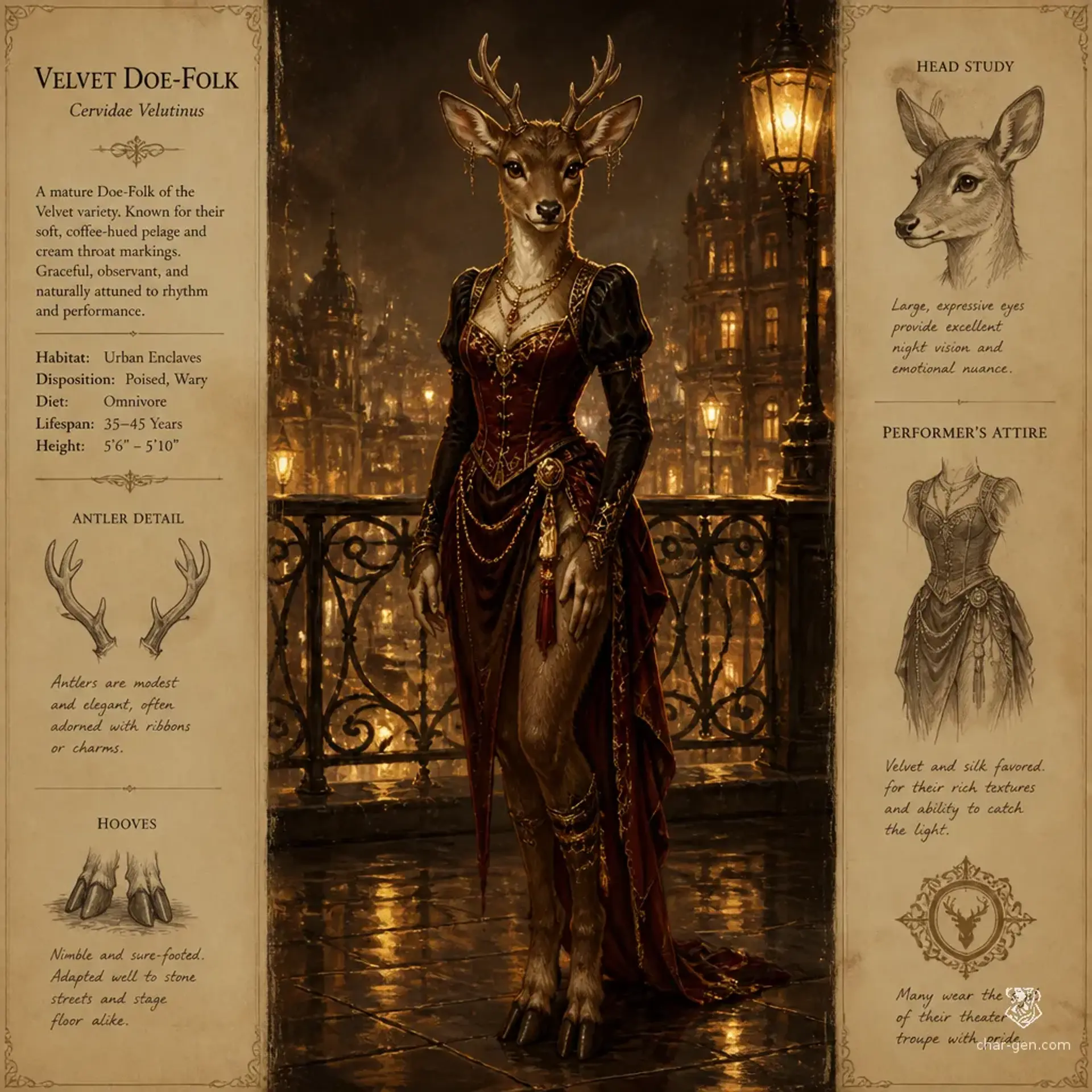
Velvet doe-folk are urban performers, couriers, fixers, and social chameleons who learned to survive by mastering attention. In the right light they can enchant a room, in the wrong alley they can vanish into it, and in either case they know exactly who is lying, who is lonely, and who needs a song more than a blade. They are at home on the stage, in the salon, or in the rain-soaked backstreets where a whispered favor can matter more than coin.
Velvet doe-folk are deer-bodied humanoids with slender builds, long legs, expressive ears, and short tails that flick with visible emotion. Their fur is often described as coffee-colored, ranging from pale latte to deep roasted brown, sometimes with cream markings along the throat, shoulders, or muzzle. Adult doe-folk commonly wear perfume, paint, jewelry, ribbons, fitted stagewear, or travel wraps, but many urban communities consider nudity unremarkable in private homes and backstage spaces. Their antlers, when present, are modest and elegant rather than massive, often shaped by ancestry and season. Their eyes are bright, watchful, and almost never still, as though they are forever tracking the rhythm of a room.
Doe-folk culture is built around performance as both art and survival. A well-timed gesture can defuse a threat, an expertly sewn costume can preserve dignity, and a song can carry a neighborhood through hard times. In many cities they organize into troupes, houses, salons, or rotating patronage circles where newcomers are trained not only in dance, singing, and wit, but also in budgeting, consent, security, and reading a crowd. Their strongest cultural virtue is composure, though behind that polished exterior they are often deeply protective, fiercely funny, and unwilling to let anyone be shamed into silence. Among themselves, applause is not vanity. It is recognition.
Doe-folk do not share a single faith, but many favor deities or spirits of moonlight, thresholds, performance, protection, and honest pleasure. Their moral outlook is typically pragmatic and social rather than absolute. They tend toward alignments that value chosen loyalty, personal autonomy, and the safety of the community, though individual doe-folk can be noble, roguish, devout, or delightfully chaotic.
Doe-folk prefer neighborhoods of balconies, courtyards, rooftop gardens, narrow alleys, and walk-up lodgings that let them move with quiet speed. Their homes are often layered rather than spacious, built around mirrors, dressing screens, tea alcoves, and hidden storage for costumes, tools, and personal keepsakes. In older districts, their architecture favors soft lighting, curved railings, and elevated walkways that make a city feel like a stage waiting for evening.
Doe-folk usually get along well with artists, merchants, courtiers, messengers, and anyone who understands the value of presentation. They can clash with blunt traditionalists who mistake elegance for weakness, and with exploitative patrons who assume every smile is for sale. Many cities trust them as entertainers and rumor-brokers in equal measure, though their reputation can swing between admired and unfairly romanticized depending on who is telling the story.
A high-res, share-ready sheet you can post or print.