Small or Medium, chosen when you select this species
Common
Humanoid
Humanoid·Small or Medium, chosen when you select this species
Mireglass Folk
*Vitreohomo urbanis*
Speed
30 ft., climb 30 ft.
Lifespan
Mireglass folk mature at approximately 18 years and commonly live 90 to 120 years. Their elders remain mentally alert for much of their final decades, though their bodies gradually become more translucent around the eyes, hands, and throat.
Darkvision
60 ft.
Habitat
Urban districts, old capitals, canal cities, market towns, subterranean neighborhoods, and dense industrial settlements
urban
humanoid
community-minded
resilient
artisan
city-dweller
SizeSmall or Medium, chosen when you select this species
Speed30 ft., climb 30 ft.
LifespanMireglass folk mature at approximately 18 years and commonly live 90 to 120 years. Their elders remain mentally alert for much of their final decades, though their bodies gradually become more translucent around the eyes, hands, and throat.
Creature TypeHumanoid
Darkvision60 ft.
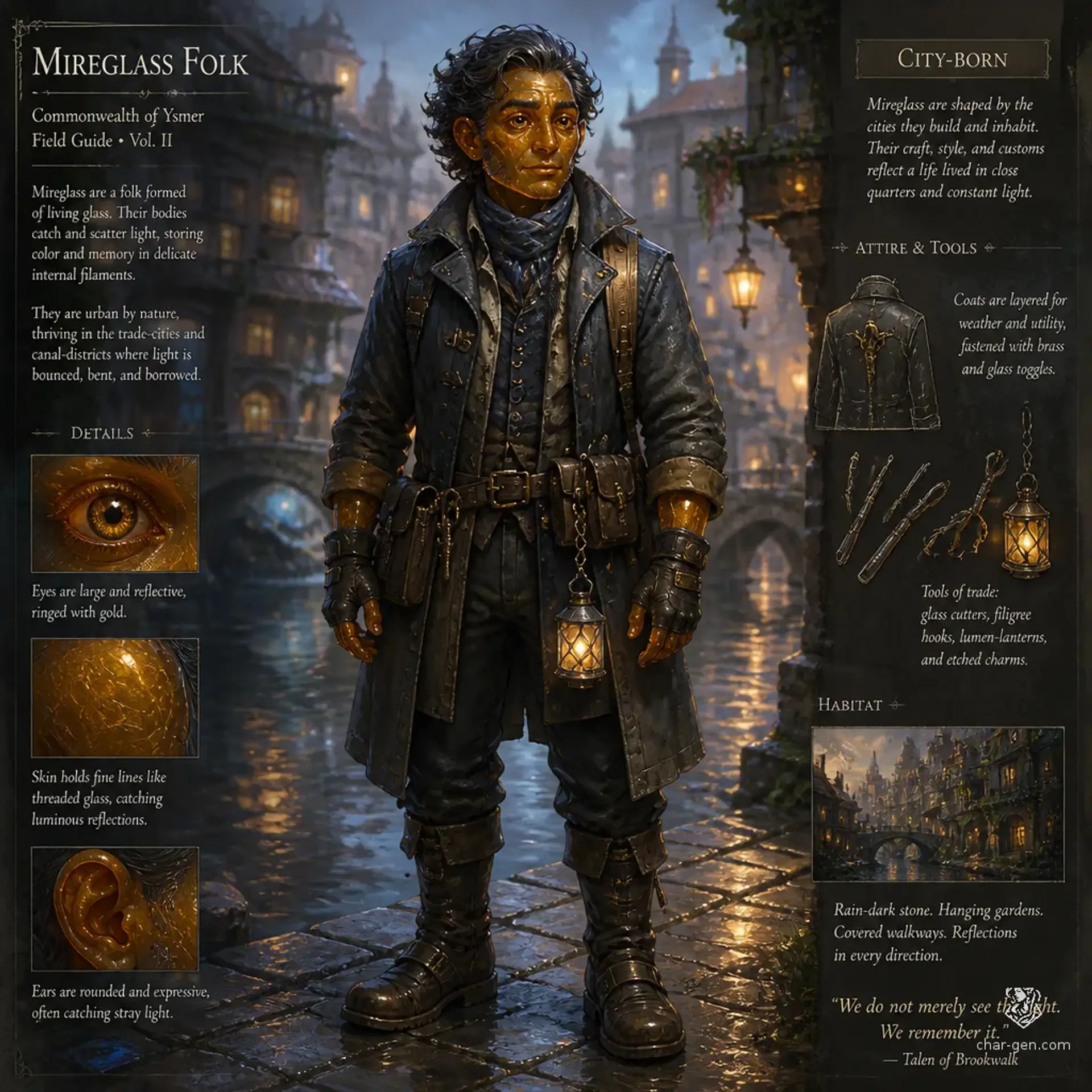
The Mireglass folk are the living architecture of civilization: patient, sharp-eyed people whose families have grown alongside cities for generations. They know which baker leaves bread out after midnight, which magistrate can be bribed with flattery, which alley floods first, and which old wall is hollow behind the plaster. They carry their neighborhoods within them, defending community with the stubbornness of stone and adapting to change with the flexibility of glass.
Physical Description
Mireglass folk are humanoids with broad variation in height and build, united by a subtle mineral quality in their appearance. Their skin may be warm brown, slate gray, cream, green-black, or translucent at the knuckles and temples. Fine lines beneath the skin often catch the light like threads of colored glass. Their eyes are large and reflective, commonly showing rings of amber, blue, rose, or smoky violet around dark pupils. Hair grows in dense, glossy strands and may harden slightly at the tips with age. Most have rounded ears, strong hands, and compact frames suited to ladders, stairwells, crowded streets, and long hours of labor. When frightened or angry, faint luminous patterns appear across their skin, resembling reflections from unseen windows.
Society & Culture
Mireglass culture is organized around neighborhoods rather than bloodlines alone. A household may include relatives, apprentices, lodgers, foster children, business partners, and trusted friends, all bound by shared meals and mutual obligations. Children are taught practical urban knowledge early, including how to cross a crowded street, identify unsafe water, find shelter during a fire, and ask for help without shame. Reputation matters, but so does the ability to repair a damaged reputation through visible service. Festivals often celebrate civic labor: the reopening of a bridge, the cleaning of a canal, the lighting of a new street, or the completion of a public building. Their greatest insult is to call someone a drain on the district, meaning a person who takes from the community without maintaining it.
Religion & Alignment
Mireglass spirituality centers on hearths, thresholds, fountains, bells, bridges, and other places where lives meet. Many revere a varied household of local spirits rather than a single universal deity, leaving offerings of clean water, repaired tools, flowers, or the first portion of a meal. Others follow formal temples and understand their gods as guardians of cities, travelers, artisans, or the dead. Mireglass folk are often drawn toward good or neutral alignments, but their loyalty to community can produce stern, lawful traditions or fiercely protective acts of rebellion.
Homelands & Architecture
Mireglass homelands are not single kingdoms but layered districts woven into larger cities. Their architecture favors courtyards, shared kitchens, covered walkways, rooftop gardens, bathhouses, and buildings joined by bridges. Windows are often made from colored glass or thin sheets of polished mineral, both for beauty and privacy. A Mireglass neighborhood is designed to keep people within earshot of one another, because isolation is considered both dangerous and sorrowful. Their oldest structures are built around wells, cisterns, public ovens, and meeting halls, each treated as a civic heart.
Relationships With Other Peoples
Mireglass folk are comfortable among nearly every people because urban life has always required cooperation across cultural boundaries. They often become translators, brokers, innkeepers, contractors, neighborhood leaders, and fixers. Their hospitality is sincere but structured, with clear expectations about reciprocity. They admire wandering peoples who bring news and new techniques, though they may view permanent isolation as unhealthy or suspicious. Relations with aristocrats and distant rulers are often complicated. Mireglass folk respect competent authority but distrust anyone who makes decisions about a neighborhood without walking its streets.
Visual sheet
Turn Mireglass Folk into a sheet
A high-res, share-ready sheet you can post or print.