Small or Medium, chosen when you select this species
Common
Humanoid
Humanoid·Small or Medium, chosen when you select this species
Hearthwardens
Civitalis focarius
Speed
30 ft.
Lifespan
Hearthwardens mature at roughly 16 years and commonly live 70 to 95 years. A few reach their second century, usually through careful habits, excellent medicine, and an impressive refusal to retire.
Darkvision
You can see in dim light within 60 feet of you as if it were bright light, and in darkness as if it were dim light. You discern colors in darkness only as shades of gray.
Habitat
Urban
urban
humanoid
community-minded
subtle
mundane
adaptable
SizeSmall or Medium, chosen when you select this species
Speed30 ft.
LifespanHearthwardens mature at roughly 16 years and commonly live 70 to 95 years. A few reach their second century, usually through careful habits, excellent medicine, and an impressive refusal to retire.
Creature TypeHumanoid
DarkvisionYou can see in dim light within 60 feet of you as if it were bright light, and in darkness as if it were dim light. You discern colors in darkness only as shades of gray.
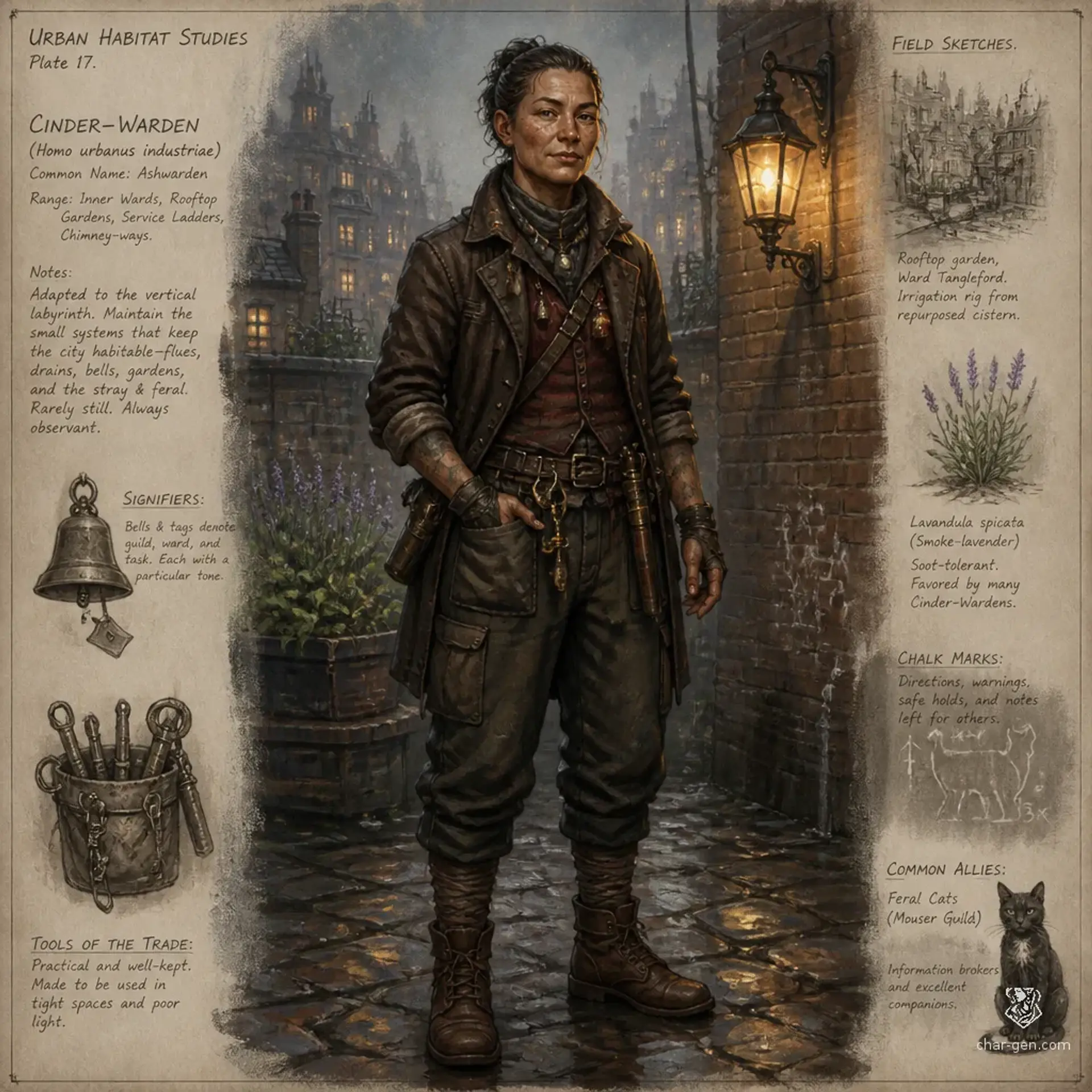
Hearthwardens are the people who make a city livable. They know which baker leaves out day-old bread, which stairwell collapses in wet weather, and which watch officer can be trusted after midnight. Built for crowded streets and hard seasons rather than wilderness or war, they carry the memory of whole neighborhoods in their habits, dialects, and family recipes. A Hearthwarden adventurer may leave home to protect it from afar, to repay an old kindness, or simply because every city has secrets hidden behind its walls.
Physical Description
Hearthwardens are a broad, varied people whose appearance reflects centuries of urban intermarriage and adaptation. They may be compact and sturdy, long-limbed and narrow, or tall enough to look imposing in a crowded lane. Their skin ranges from brick red, umber, and olive to pale gold and slate brown, often marked by freckles, soot-darkened creases, or pale scars from old accidents. Hair is commonly worn short, braided, wrapped, or tied back for work. Many have unusually sensitive fingertips and ears, allowing them to notice vibrations through walls, changes in air pressure, or the subtle groan of an unsafe floor. Their clothing favors layered fabrics, reinforced seams, deep pockets, and colors that conceal dust without appearing drab.
Society & Culture
Hearthwarden society is organized around blocks, courtyards, guild halls, neighborhood associations, and extended households rather than strict clans. A person may belong to several overlapping communities, each with its own customs and expectations. Children are watched by whoever is nearby, meals are frequently shared, and news travels through a dense network of vendors, caretakers, porters, musicians, and repair workers. Hearthwardens value competence, reliability, and the ability to recognize when a problem is becoming dangerous. They dislike waste, not from austerity alone, but because every discarded object might have served someone. Their disputes can be intense, yet reconciliation is considered a civic skill.
Religion & Alignment
Hearthwarden religion is usually local, practical, and communal. Devotion may center on household spirits, saints of bridges and bakeries, ancestral guardians, civic gods, or the belief that every act of care strengthens an unseen web of protection. Their festivals mark the first market of spring, the lighting of winter lamps, the cleaning of public wells, and the remembrance of disasters survived. Hearthwardens have no common alignment, though traditions of mutual aid often encourage compassionate and community-minded behavior. A selfish Hearthwarden is viewed not as evil by default, but as someone who has forgotten the obligations that make a life meaningful.
Homelands & Architecture
Hearthwardens thrive in old cities, river ports, walled market towns, and sprawling industrial districts. Their homes are rarely grand, but they are cleverly adapted to available space: rooms above bakeries, cellar apartments, rooftop gardens, converted watch posts, and narrow houses joined by interior passages. Hearthwarden architecture favors shared courtyards, visible entrances, sturdy stairs, plentiful hooks, and small features that make a building safer during fire, flood, or unrest. Even wealthy Hearthwardens often maintain a modest room in the district where their family began.
Relationships With Other Peoples
Hearthwardens tend to form relationships through repeated presence rather than grand declarations. They remember favors, debts, birthdays, shop closures, and family disputes with equal precision. Other peoples often find them dependable but nosy, welcoming but difficult to deceive. Hearthwardens are especially comfortable with travelers, laborers, merchants, and displaced communities, while they treat isolated aristocrats and secretive institutions with cautious curiosity. They are not naturally provincial, but they believe anyone who lives among others owes some responsibility to the people around them.
Visual sheet
Turn Hearthwardens into a sheet
A high-res, share-ready sheet you can post or print.