Small or Medium, chosen when you select this species
Common
Humanoid
Humanoid·Small or Medium, chosen when you select this species
Veyr
Civitas resonans, an optional scholarly name meaning 'the resonant citizen'
Speed
30 ft.
Lifespan
Veyr mature around age twenty-five and commonly live between 110 and 140 years. Some elders eventually become partially attuned to a structure they love, leaving behind faint memories in its walls.
Darkvision
60 ft.
Habitat
Urban
urban
civic
resonance
architectural
humanoid
common ancestry
SizeSmall or Medium, chosen when you select this species
Speed30 ft.
LifespanVeyr mature around age twenty-five and commonly live between 110 and 140 years. Some elders eventually become partially attuned to a structure they love, leaving behind faint memories in its walls.
Creature TypeHumanoid
Darkvision60 ft.
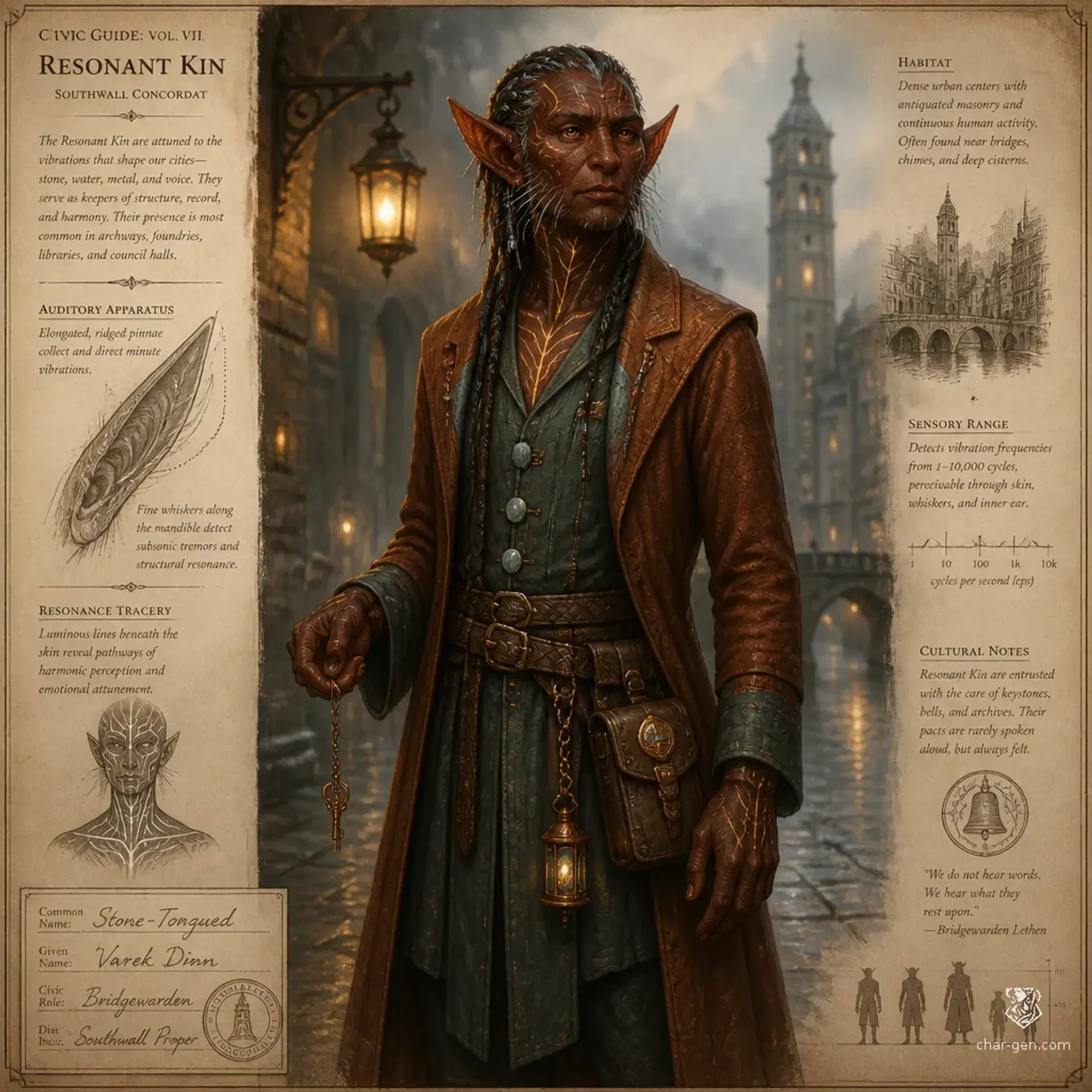
Veyr are city-born people who hear the hidden life of streets, walls, bridges, and bells. They inherit neighborhoods the way other folk inherit estates, regarding every doorway as a promise and every ruin as an unfinished conversation. A Veyr adventurer may be a guild exile, a rooftop courier, a haunted architect, a keeper of forbidden civic memories, or simply someone who has learned that the safest place in the world is rarely the place that looks safest.
Physical Description
Veyr are humanoids shaped by generations of life among dense streets, ancient foundations, and humming civic wards. Their skin ranges from brick red and soot brown to cream, slate gray, copper, and muted green. Fine luminous lines may appear beneath the skin, especially around the throat, hands, sternum, and temples. These markings brighten when a Veyr speaks with emotion or stands near a structure with which they share a strong bond. Their ears are often elongated or ridged, and many have small sensory whiskers along the jaw or neck that detect vibrations through air and stone. Veyr hair grows in thick, flexible strands that hold dyes, beads, wire, and polished fragments of glass. Their bodies vary widely, from compact and sturdy to tall and narrow, depending on subspecies and family history.
Society & Culture
Veyr culture is organized around households, guilds, blocks, and civic circles rather than isolated nuclear families. Children are raised by networks of adults, and important decisions are traditionally witnessed by neighbors. Their most respected virtues are reliability, useful skill, hospitality, and accurate memory. Veyr maintain elaborate customs surrounding keys, thresholds, renovations, and abandoned buildings. To give someone a key is to offer trust. To seal a doorway without ceremony is considered an act of profound disrespect. Festivals often involve synchronized bells, lantern processions, rooftop feasts, and public storytelling contests in which participants compete to remember obscure local events.
Religion & Alignment
Veyr religion is usually local and practical. They venerate hearth spirits, founding ancestors, sainted builders, protective bridges, and personified civic virtues such as Welcome, Memory, and Repair. Some believe that every settlement develops a collective soul. Others reject spirits entirely but still perform rituals of maintenance and remembrance. Veyr have no common alignment, though communal responsibility tends to make many compassionate and orderly, while resentment toward rigid institutions can drive others toward independence and rebellion.
Homelands & Architecture
Veyr cities grow vertically and inward. Their homes are built into old walls, beneath elevated roads, around courtyards, and within the hollow spaces of civic monuments. Architecture is treated as a living inheritance. A doorway may commemorate a marriage, a stairwell may serve as a public shrine, and a roof garden may be legally recognized as a family member. Veyr builders favor resonant materials such as fired brick, slate, bronze, glass, and pale stone. Even modest neighborhoods contain hidden passages, communal workshops, and chambers where elders preserve spoken memories.
Relationships With Other Peoples
Veyr are common in major settlements and often form the connective tissue between cultures. They serve as interpreters, builders, clerks, performers, repairers, advocates, and neighborhood guardians. Rural peoples may find them fussy or claustrophobic, while urban communities often depend on their instincts for hidden routes and structural danger. Veyr relations with nobles and administrators are complicated. They respect competent governance but distrust anyone who treats a district as property rather than as a community.
Visual sheet
Turn Veyr into a sheet
A high-res, share-ready sheet you can post or print.