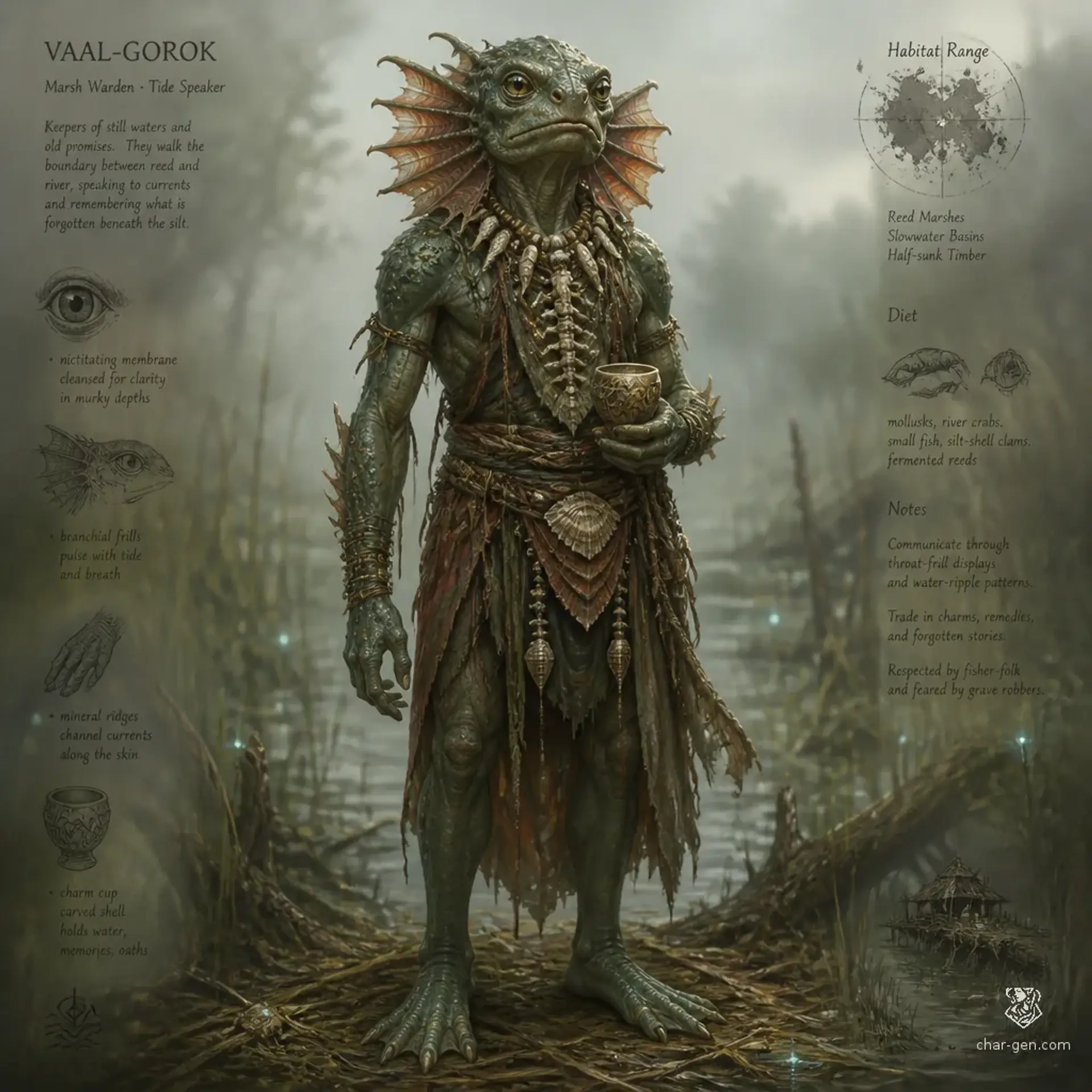
Marrowkin mature at about 16 and commonly live 80 to 100 years. Exceptional elders may reach 120 years, though their bodies become increasingly adapted to cool water and damp environments.
Darkvision
60 ft.
Habitat
The Marrowwater Basin, especially its reed marshes, flooded forests, slow rivers, peat islands, and half-submerged ruins.
amphibious
marsh-dweller
river culture
ancestral memory
swimmer
wetland guardian
SizeMedium
Speed30 ft., swim 30 ft.
LifespanMarrowkin mature at about 16 and commonly live 80 to 100 years. Exceptional elders may reach 120 years, though their bodies become increasingly adapted to cool water and damp environments.
Creature TypeHumanoid
Darkvision60 ft.
The Marrowkin know that every body of water keeps a history. They were born among flooded forests and bone-white riverbeds, where villages drift with the seasons and the dead are remembered through water, not stone. A Marrowkin adventurer may be a patient guide, a shrine-diver, a flood-displaced heir, or a stubborn investigator following a current that should not exist. Wherever they go, they bring the Basin's quiet resilience, its old obligations, and the unsettling certainty that something beneath the surface is listening.
Physical Description
Marrowkin are amphibious humanoids with smooth, finely pebbled skin and elongated hands suited to swimming, climbing wet timber, and delicate craftwork. Their coloration ranges from river-stone gray and peat brown to moss green, rust red, blue-black, and pale cream. Most bear branching throat-frills that flare when they are excited, angry, ill, or speaking in ceremonial tones. Their eyes have broad pupils and a reflective inner membrane, giving them an uncanny gleam in darkness. Small ridges of mineralized tissue often grow along the shoulders, spine, or forearms, resembling delicate plates of ivory or shell. These growths are harmless and are commonly carved, painted, or threaded with beads. Marrowkin breathe air but can remain underwater for roughly ten minutes before needing to surface.
Society & Culture
Marrowkin society is organized around raft-clans, each defined less by blood than by shared maintenance of a place, vessel, shrine, or trade route. Children are raised by broad households, and adoption is common after floods, raids, and family migrations. Every adult learns at least one survival craft, one form of water stewardship, and one way to preserve memory. Their ceremonies use taste, rhythm, and reflected light. A marriage may be sealed by exchanging cups of water from each partner's childhood home. A public apology often requires repairing a communal structure. Marrowkin leaders are expected to be competent custodians first and charismatic speakers second. Social status comes from what one has kept alive, guided safely, or returned to the community.
Religion & Alignment
Marrowkin religion centers on the Returning Current, a belief that memory, nourishment, and responsibility move through the world like water. The dead are not worshiped as distant gods, but consulted through dreams, ripples, bone chimes, and the behavior of sacred animals. Most communities honor local river-mothers, drowned saints, ancestral ferrymen, and spirits of particular springs. Their faith encourages compassion and communal responsibility, though individual Marrowkin range across every alignment. Those who become evil are often driven by possessiveness, hoarding water, controlling passage, or using ancestral authority to dominate the living.
Homelands & Architecture
Marrowkin settlements are built to move. Their largest homes are broad reed rafts lashed around buoyant timber cores, while permanent villages stand on stilts driven deep into the Basin's soft floor. Doorways are hung with strings of polished vertebrae, not as threats, but as records of family, migration, and promise. Important buildings are designed around water chambers, echo wells, and open channels that allow fish, frogs, and cleansing currents to pass through the structure. During floods, entire neighborhoods can be untethered and guided to safer ground.
Relationships With Other Peoples
Marrowkin are practical and courteous toward outsiders, but they distrust cultures that drain wetlands, dam rivers without consultation, or treat burial sites as sources of treasure. They trade fish, medicinal algae, dyes, ferry services, and weather knowledge throughout the surrounding regions. Humans and other short-lived peoples often mistake Marrowkin patience for passivity, while long-lived peoples sometimes find their clan obligations unusually immediate and demanding. Marrowkin communities welcome useful allies quickly, but genuine belonging is earned through repeated acts of care.
Visual sheet
Turn Marrowkin into a sheet
A high-res, share-ready sheet you can post or print.