Typically 120 to 160 years, with elders sometimes living longer if their health and grove remain strong.
Darkvision
60 ft.
Habitat
Living forests, root-cities, mist gardens, canopy farms, and fungal groves built around old growth and slow water.
forest
wardens
gardeners
scouts
folk
humanoid
nature-magic-adjacent
root-culture
woodland
healers
archivists
bridge-builders
living-architecture
uncommon-ancestry
SizeMedium
Speed30 ft.
LifespanTypically 120 to 160 years, with elders sometimes living longer if their health and grove remain strong.
Creature TypeHumanoid
Darkvision60 ft.
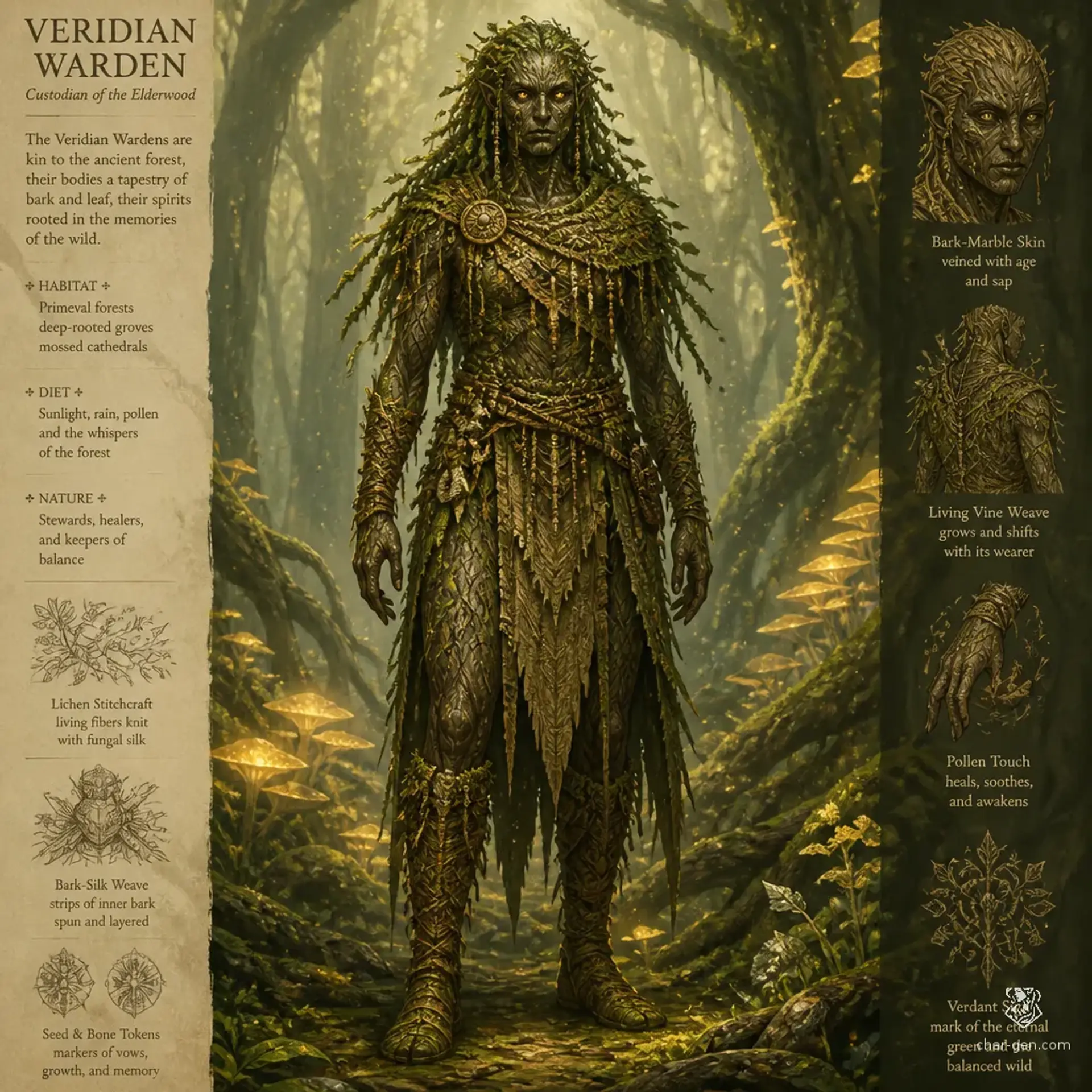
Verdant Loomfolk are the forest's archivists, climbers, and patient defenders, a people who learn the language of roots long before they learn the politics of crowns. They are the sort of folk who can mend a bridge with living vine, read a buried oath from the way a trunk healed around a nail, and smile politely while deciding whether a stranger is a threat, a guest, or a future friend. Play one when you want a character shaped by memory, stewardship, and the quiet violence of protecting something that grows.
Physical Description
Verdant Loomfolk are slender, broad-shouldered humanoids whose skin often carries faint patterns like leaf veins, bark marbling, or moss-dark freckles. Their hair tends to grow in dense, soft masses that resemble tussled grass, braided fibers, or trailing fronds, and many decorate it with seed beads, dried flowers, or polished bone tokens. Their eyes are large and reflective, often green, amber, or gray-blue, adapted for low forest light. Many have fine, sensitive fingertips and callused palms from climbing, weaving, and pruning. In season, their skin may flush with floral scent or release a faint pollen shimmer when excited, frightened, or deeply moved.
Society & Culture
The Gossamer Root Circle is organized less like a nation and more like a living network of obligations. Each household serves a function in the greater grove, such as tending seedlings, charting waterways, shaping bridges, or preserving memory songs. Status is earned through service, successful stewardship, and the ability to solve problems without scarring the land. Loomfolk value apprenticeship and cross-training, because every adult is expected to know how to harvest, heal, climb, and repair in a crisis. Their festivals follow the bloom calendar, and their political disputes are often settled through witnessed vows, symbolic grafting, or competitions of repair rather than destruction. Public shame matters, but so does public forgiveness. A wrong can be pruned if the offender proves they can help the grove grow again.
Religion & Alignment
Their faith is rarely about distant gods alone. Most Loomfolk honor ancestral spirits, grove-saints, and the patient intelligence of growing things. They prefer rites of renewal, offering, pruning, and remembrance to grand displays of zeal. Alignment is varied, but their culture strongly rewards care, restraint, and reciprocity. Even those with harsh tempers often justify themselves as defenders of balance rather than seekers of cruelty.
Homelands & Architecture
The Gossamer Root Circle builds where wood, vine, and fungus can be trained rather than conquered. Their homes are grown, not raised, from coaxed trunks, lattice bridges, and woven root chambers that swell and narrow with the seasons. Doorways are often living archways that recognize household scents. Floors are layered with bark mats, stitched moss, and suspended vine-netting to keep rooms dry while allowing air to pass. Great halls are usually hollowed from ancient living trees, with lanterns hung in resin cups and memory knots tied into the beams. Nothing in a true Loomfolk settlement is meant to be permanent in the human sense. Homes are pruned, moved, and regrown as the forest changes.
Relationships With Other Peoples
Loomfolk usually greet outsiders with measured hospitality, especially those who respect plants, soil, and living things. They admire patient artisans, reliable scouts, and healers who know when to cut and when to let a wound close on its own. They distrust log-hungry industrialists, careless arsonists, and anyone who treats a forest as scenery. With other woodland peoples they are often cooperative but formal, since the Circle values obligations, boundaries, and seasonal contracts. They can find city folk baffling, but not always unwelcome; many Loomfolk enjoy learning how people build without roots, even if they privately think the methods are alarmingly reckless.
Visual sheet
Turn Verdant Loomfolk into a sheet
A high-res, share-ready sheet you can post or print.