Medium or Small, chosen when you select this species
Common
Humanoid
Humanoid·Medium or Small, chosen when you select this species
Shadari
Homo umbravestis
Speed
30 ft.
Lifespan
Shadari mature at roughly the same pace as humans and commonly live 80 to 100 years. Elders who spend decades practicing shadow merging may appear younger than their true age, though their memories often become increasingly dreamlike.
Darkvision
Darkvision 60 ft.
Habitat
Twilight forests, volcanic ravines, moonless coastlines, deep urban districts, and borderlands where the Material Plane brushes against realms of darkness.
humanoid
shadow
infernal-blooded
stealth
magic
twilight
SizeMedium or Small, chosen when you select this species
Speed30 ft.
LifespanShadari mature at roughly the same pace as humans and commonly live 80 to 100 years. Elders who spend decades practicing shadow merging may appear younger than their true age, though their memories often become increasingly dreamlike.
Creature TypeHumanoid
DarkvisionDarkvision 60 ft.
The Shadari are heirs to a bloodline that treats darkness as both mantle and mirror. Their shadows can stretch across walls, swallow a silhouette, carry a whispered message, or briefly replace flesh with smoke. To outsiders they may appear ominous, secretive, or touched by sinister powers. To the Shadari, shadow is shelter, memory, and an honest record of what the light fails to show. A Shadari adventurer leaves the safety of clan dusk to learn whether their gift is a curse, a weapon, or a path toward becoming something no ancestor has yet imagined.
Physical Description
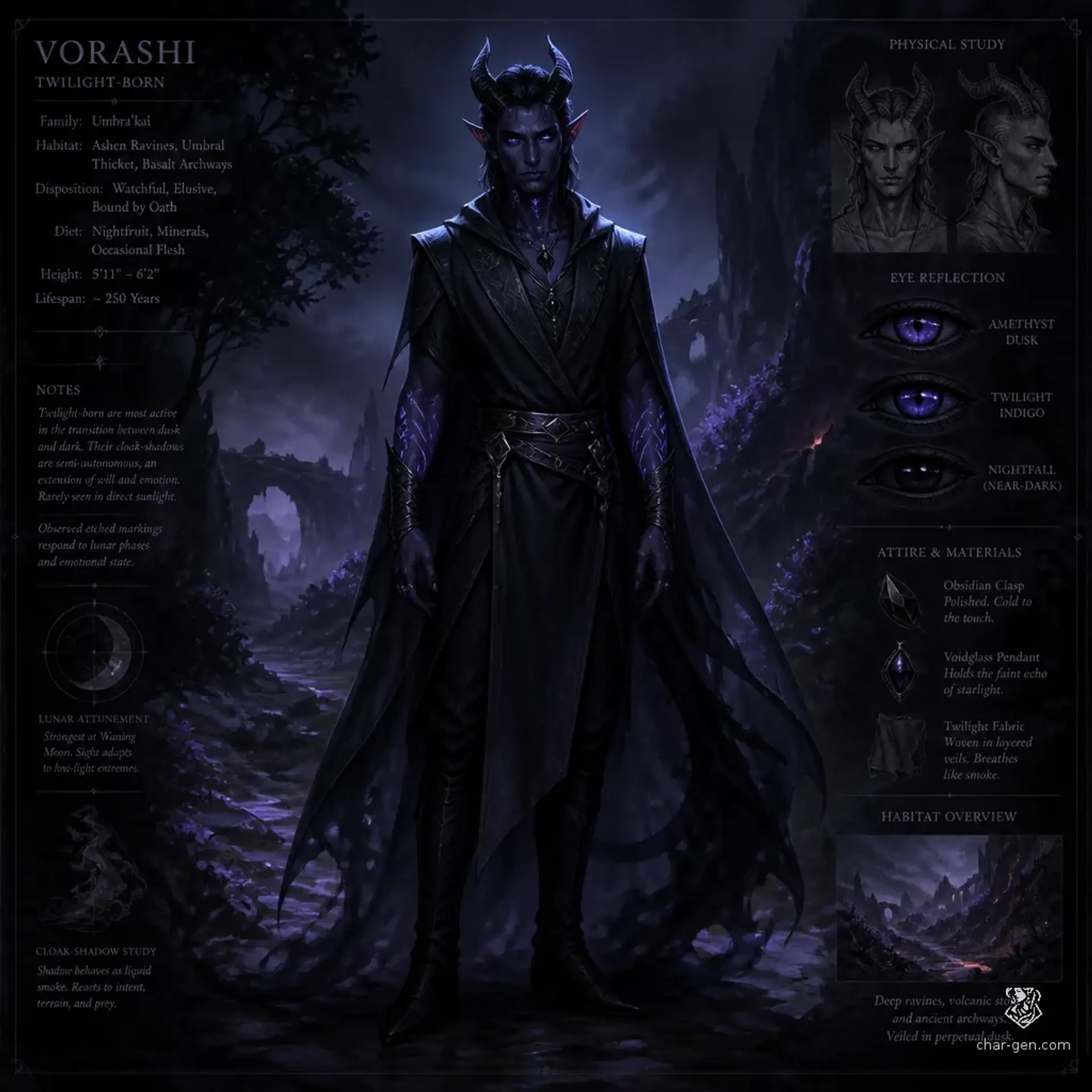
Shadari resemble slender humans or other humanoids with an unmistakable otherworldly cast. Their skin ranges from warm umber and charcoal gray to dusky violet and deep blue-black. Horns are common, though their shapes vary from swept-back points to short ridges like a crown of obsidian. Their eyes often have silver, amethyst, ember-red, or colorless irises, and their pupils may widen until the entire eye seems dark. Many have tails, pointed ears, sharp canines, or faintly luminous markings, but no single feature defines the bloodline. Every Shadari shadow is subtly independent. It may lag behind a gesture, lean toward a whispered name, or ripple when the character feels strong emotion.
Society & Culture
The Shadari organize themselves into extended clans whose members share homes, histories, and a carefully maintained body of secrets. Secrets are ranked by danger rather than prestige. A harmless family recipe may be shared freely, while a dangerous name might be entrusted to only three living people. Their most respected figures are Veilkeepers, elders who preserve memories through shadow theater, oral history, and magically recorded silhouettes. Festivals are held at dusk and feature masked dances, lantern puzzles, shadow plays, and contests of silent movement. Shadari children are taught that darkness is not the same as evil, but that hidden power always demands accountability.
Religion & Alignment
Shadari spirituality centers on the First Shadow, a mythic presence said to have sheltered the earliest ancestors from a terrible celestial fire. Some interpret the First Shadow as a deity, others as an ancestral force, and still others as a metaphor for privacy, resilience, and the unseen labor that sustains civilization. Religious observances involve covered lamps, whispered names, and communal storytelling in near darkness. Shadari favor no single alignment. Their culture prizes restraint and responsibility, but individuals may become compassionate protectors, calculating opportunists, rebellious idealists, or terrifying tyrants.
Homelands & Architecture
Shadari settlements are built around controlled darkness rather than open courtyards. Homes use narrow windows, covered walkways, polished black stone, and pale reflective tiles that create safe paths without banishing every shadow. Clan halls often contain shadow-vaults, chambers where important records are stored as enchanted silhouettes cast onto walls. Their cities favor layered streets, hanging bridges, concealed gardens, and lanterns with adjustable shutters. A well-designed Shadari building gives a resident many ways to be seen, hidden, or merely suggested.
Relationships With Other Peoples
Shadari are often met with suspicion because their appearance and abilities resemble the folklore of night spirits, oathbreakers, and cursed nobles. Many respond by cultivating impeccable manners and visible generosity, while others embrace their unsettling reputation as useful armor. They generally maintain strong ties to their clans, but clan loyalty is not absolute. Shadari culture has a long tradition of adopted family, and those who defend a Shadari community may be treated as kin regardless of ancestry. They tend to respect people who can keep a confidence without becoming ruled by secrecy.
Visual sheet
Turn Shadari into a sheet
A high-res, share-ready sheet you can post or print.