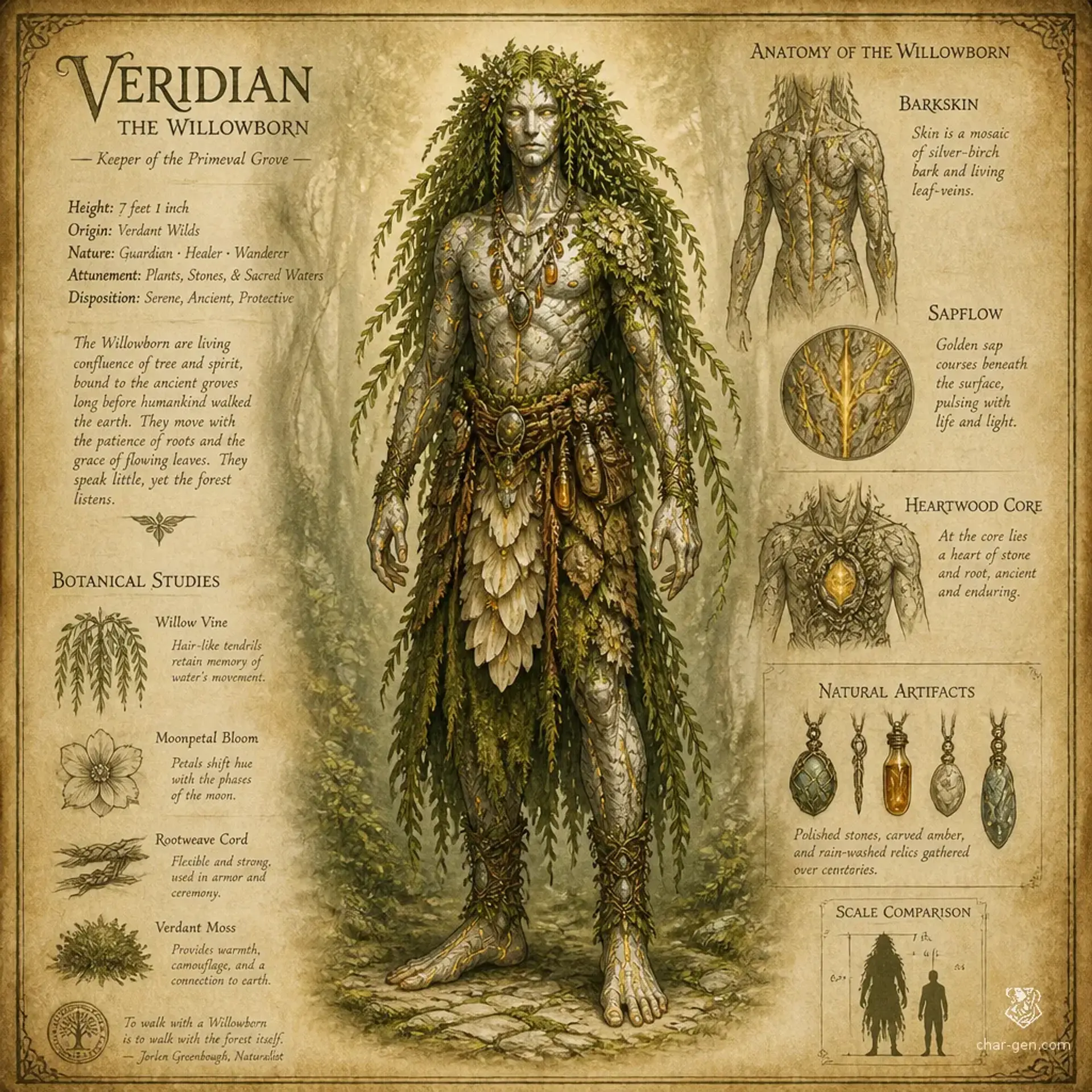
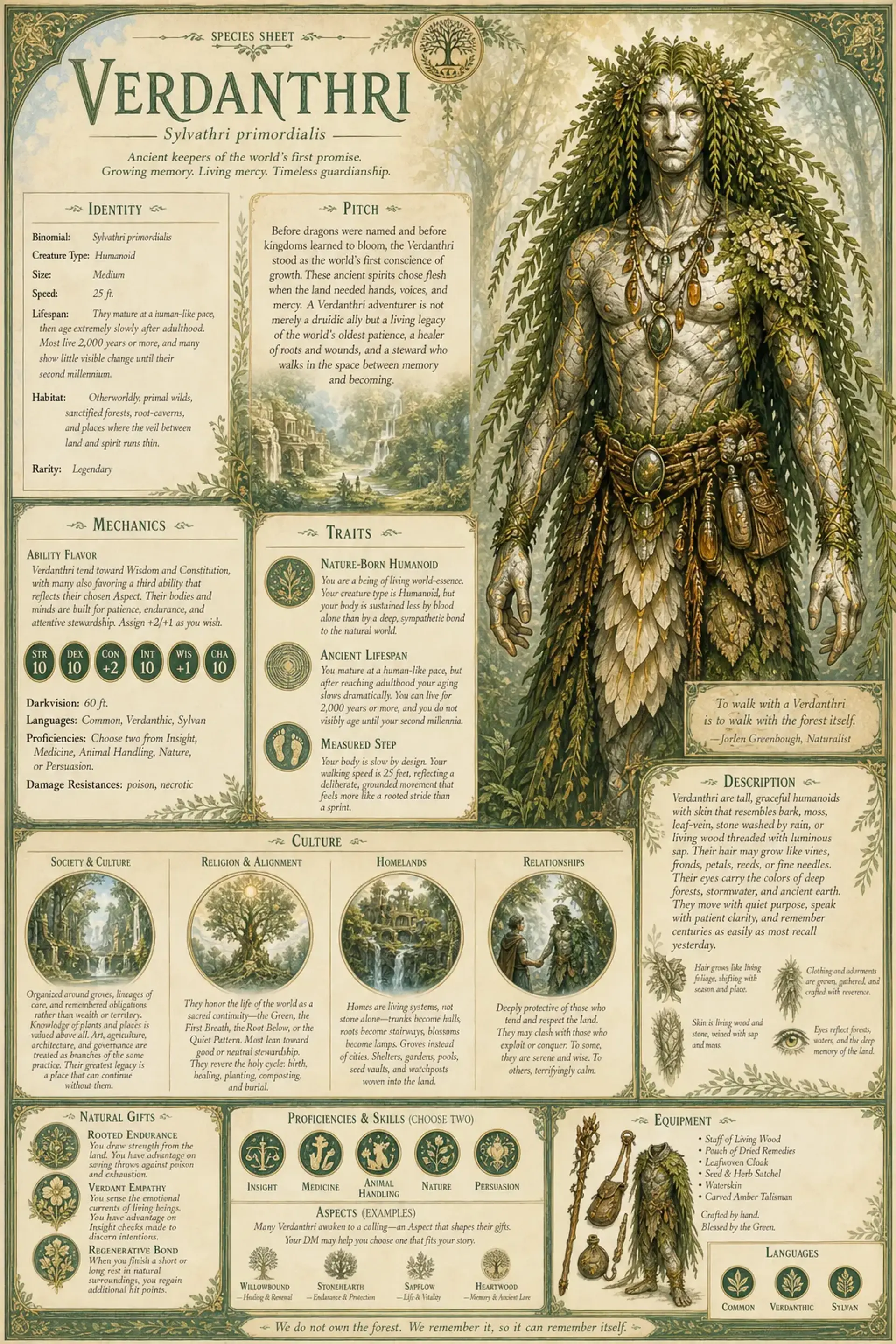
They mature at a human-like pace, then age extremely slowly after adulthood. Most live 2,000 years or more, and many show little visible change until their second millennium.
Darkvision
60 ft.
Habitat
Otherworldly, primal wilds, sanctified forests, root-caverns, and places where the veil between land and spirit runs thin.
ancestry
humanoid
nature
druidic
healer
legendary
plantfolk
ancient
homebrew
5e2024
powerful
mythic
forest
regeneration
sacred-grove
otherworldly
subspecies
aspects
field-guide
high-fantasy
player-option
support
guardian
ecological
springs
roots
seasons
spirit-made-flesh
botanical
reverent
slow-living
immortal-adjacent
monstrous-power-level
peaceful-but-mighty
legendary-tier
lore-rich
creative-caster
sanctuary-builder
life-magic
healing-aura
grovewalker
worldroot
primordial
SizeMedium
Speed25 ft.
LifespanThey mature at a human-like pace, then age extremely slowly after adulthood. Most live 2,000 years or more, and many show little visible change until their second millennium.
Creature TypeHumanoid
Darkvision60 ft.
Before dragons were named and before kingdoms learned to bloom, the Verdanthri stood as the world’s first conscience of growth. These ancient spirits chose flesh when the land needed hands, voices, and mercy. A Verdanthri adventurer is not merely a druidic ally but a living legacy of the world’s oldest patience, a healer who can raise groves from ruin, walk through centuries without hurrying, and remind frightened mortals that survival is itself a kind of miracle.
Physical Description
Verdanthri are tall, graceful humanoids with skin that often resembles bark, moss, leaf-vein, stone washed by rain, or living wood threaded with luminous sap. Their hair may grow like vines, fronds, petals, reeds, or fine needles, and their eyes often carry the colors of deep forests, stormwater, and fertile earth. Their bodies are deceptively gentle in appearance, but every line suggests resilience. Wounds close with unusual speed, bruises fade like dawn mist, and many bear natural markings that change with the seasons or reflect the health of nearby land.
Society & Culture
Verdanthri society is organized around groves, lineages of care, and remembered obligations rather than wealth or territory. Leadership usually belongs to those with the deepest knowledge of local conditions and the longest memory of what the land has survived. Children are taught to identify medicinal plants before they learn formal politics. Art, agriculture, architecture, and governance are all treated as branches of the same practice. They are patient, but not passive. When a Verdanthri makes a promise, they may keep it for centuries. Their culture prizes regeneration, practical beauty, and the idea that the best legacy is a place that can continue without you.
Religion & Alignment
Most Verdanthri do not separate divinity from ecology. They honor the life of the world as a sacred continuity, whether they call it the Green, the First Breath, the Root Below, or the Quiet Pattern. Their alignments tend to lean toward good or toward neutral stewardship, though a Verdanthri can become unsettlingly severe when defending a sacred balance. They respect rites of birth, healing, planting, composting, and burial as equal parts of the same holy cycle.
Homelands & Architecture
Verdanthri settlements rarely look built in the conventional sense. They cultivate homes as living systems, coaxing trunks into halls, roots into stairways, and blossoms into lamps. Their greatest works are groves, not cities. A Verdanthri homestead is often a layered ecology of shelters, gardens, healing pools, seed vaults, and watchposts hidden in the canopy or buried beneath soft soil. Their architecture prizes continuity over permanence, so a dwelling is expected to grow, adapt, and eventually return to the land with grace.
Relationships With Other Peoples
Verdanthri usually regard other peoples as brief but meaningful blooms. They can be deeply protective, especially of children, travelers, farmers, and anyone who tends the land. They often get along with communities that respect forests, rivers, and old places, but may clash with extractive cultures, conquerors, and those who treat wilderness as a resource rather than a relationship. To some mortals they seem serene and wise. To others, they are terrifyingly calm, like a storm waiting in roots.
Ready
Turn Verdanthri into a sheet
A high-res, share-ready sheet you can post or print.