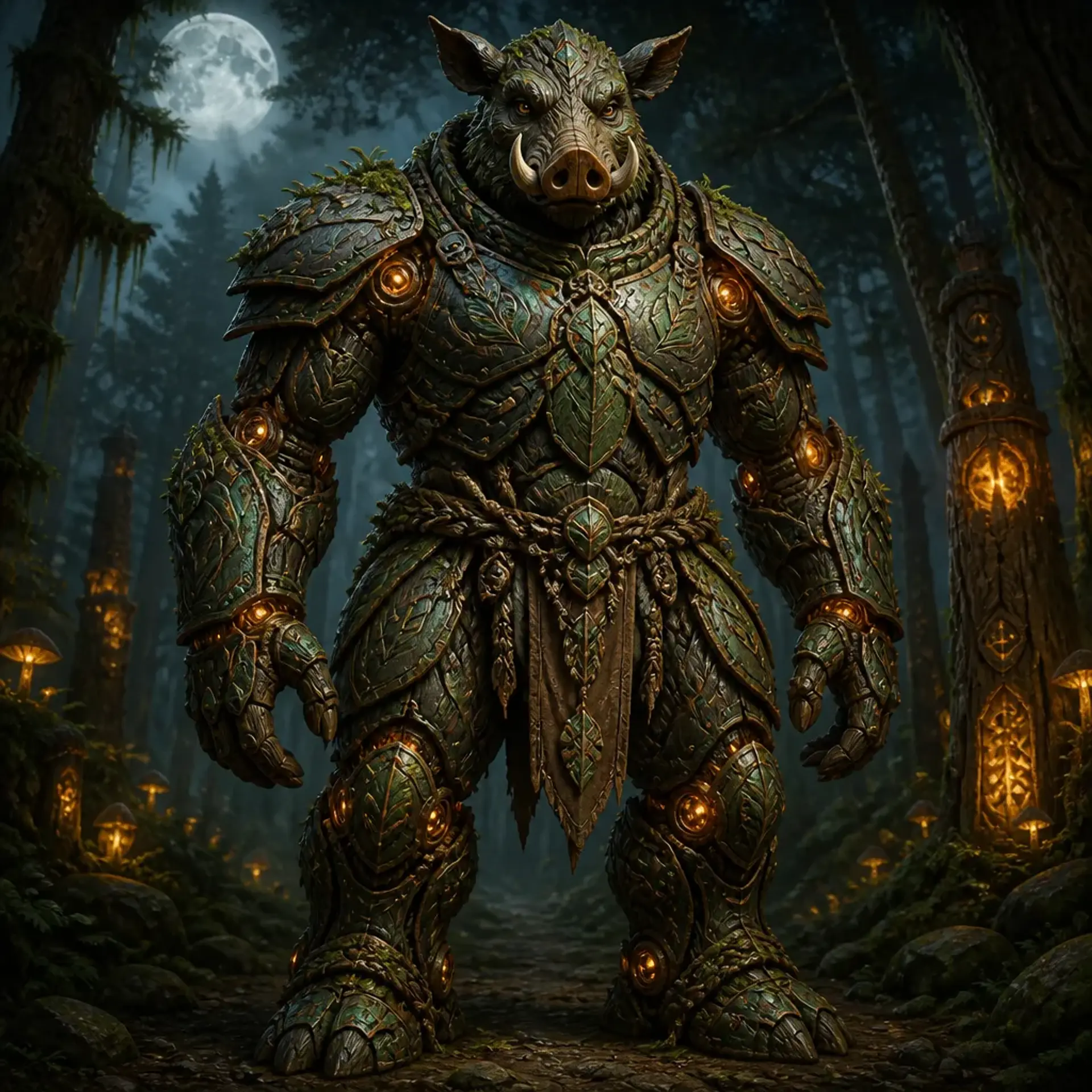
A constructed forest-blooded being can endure for centuries if well maintained, with many living 180 to 300 years before joints, charms, or heart-cores begin to slow. Some last much longer when lovingly repaired, while neglected bodies may fail decades earlier.
Darkvision
60 ft.
Habitat
Old-growth forests, misty uplands, root-choked ruins, and sacred groves where living wood and hidden craft have grown together.
construct
forest
boar-like
guardian
artisan
sentinel
homebrew
medium
dnd2024
standard pc
SizeMedium
Speed30 ft.
LifespanA constructed forest-blooded being can endure for centuries if well maintained, with many living 180 to 300 years before joints, charms, or heart-cores begin to slow. Some last much longer when lovingly repaired, while neglected bodies may fail decades earlier.
Creature TypeConstruct
Darkvision60 ft.
Bracken-tusked grovekin are living constructs made to defend forests, crossroads, and buried sanctuaries, but most have long since become more than their original purpose. They are slow to anger, relentless once roused, and deeply at home in the hush of ancient trees, where every scar on their body feels like a chapter in a larger story. Play one as a steadfast guardian, a thoughtful artisan, or an awakened sentinel learning whether it was built for obedience or for freedom.
Physical Description
Bracken-tusked grovekin are medium-bodied construct folk shaped to resemble broad-shouldered boar-humanoids with moss-flecked hide, plated shoulders, and short, expressive tusks of polished bone, wood, or pale alloy. Their frames are built from layered materials rather than flesh alone, often combining carved hardwood, cured leather, braided root-fiber, and warm metal nodes at the joints. Their faces are surprisingly expressive, with hinged brows, keen little eyes, and snouts that catch scent as well as sentiment. Many bear lichen tattoos, verdigris seams, or inlaid leaf motifs that mark repairs, family lines, and vows. They do not age in quite the same way as mortal beings, but their surfaces weather beautifully, darkening like old bark and showing a patina that their people consider honorable.
Society & Culture
Their culture is built around tending, not owning. Every member is expected to know basic maintenance, at least one practical trade, and one story that explains how they came to be. They keep memory in carved rings, notched beams, and repair scars left visible on the body rather than hidden. A repaired seam is not shameful, it is proof that a life has been worth preserving. Their gatherings are loud by their standards and still remarkably restrained by everyone else's, with long pauses between remarks, shared food, and a habit of touching foreheads or tusks in greeting. They admire courage, but they prize endurance, good judgment, and the ability to keep a pact when the forest turns against you. Many are content to spend years in a single valley if that valley has work worth doing.
Religion & Alignment
They do not share one faith, but many honor the powers of growth, craft, memory, and the moonlit cycles that govern seed, sap, and rest. A notable number revere ancestral makers as much as deities, tending shrines to the hands that shaped them. Their alignment trends toward lawful or neutral ideals, not from coldness but from a deep instinct that every living system needs structure to endure. That said, many individuals become fierce protectors of freedom when they realize that rules can serve a forest or crush it.
Homelands & Architecture
Their homelands are usually places where a forest has swallowed an ancient workshop, shrine, or fortress and made it into something green. They favor architecture that honors both bark and beam, with homes set into hill sides, platforms lashed between colossal trunks, and forges hidden under canopies of woven vine. Doors are often low and reinforced, hallways broad enough for a braced charge, and public halls lined with carved posts that record births, vows, and migrations. Their settlements rarely look finished to outsiders, because the people believe a home should be able to grow, heal, and be repurposed without losing its memory.
Relationships With Other Peoples
They are generally respected by druids, foresters, and rural folk who value a dependable ally, though some city dwellers mistake them for animated statues or dangerous beasts. Loggers, poachers, and reckless artificers often earn their mistrust quickly. They tend to bond easily with other protective peoples, scout cultures, and anyone who understands the dignity of maintenance and repair. Their patience can be disarming, but once they decide a friendship is real, they guard it with almost ceremonial seriousness.
Visual sheet
Turn Bracken-Tusked Grovekin into a sheet
A high-res, share-ready sheet you can post or print.