Small or Medium, chosen when you select this species
Common
Humanoid
Humanoid·Small or Medium, chosen when you select this species
Lanternkin
Homo lucernae
Speed
30 ft.; climb 30 ft. on suitable urban surfaces
Lifespan
Lanternkin mature around age 16 and commonly live 80 to 100 years.
Darkvision
60 ft.
Habitat
Urban
urban
humanoid
lantern
community
agile
observant
common ancestry
SizeSmall or Medium, chosen when you select this species
Speed30 ft.; climb 30 ft. on suitable urban surfaces
LifespanLanternkin mature around age 16 and commonly live 80 to 100 years.
Creature TypeHumanoid
Darkvision60 ft.
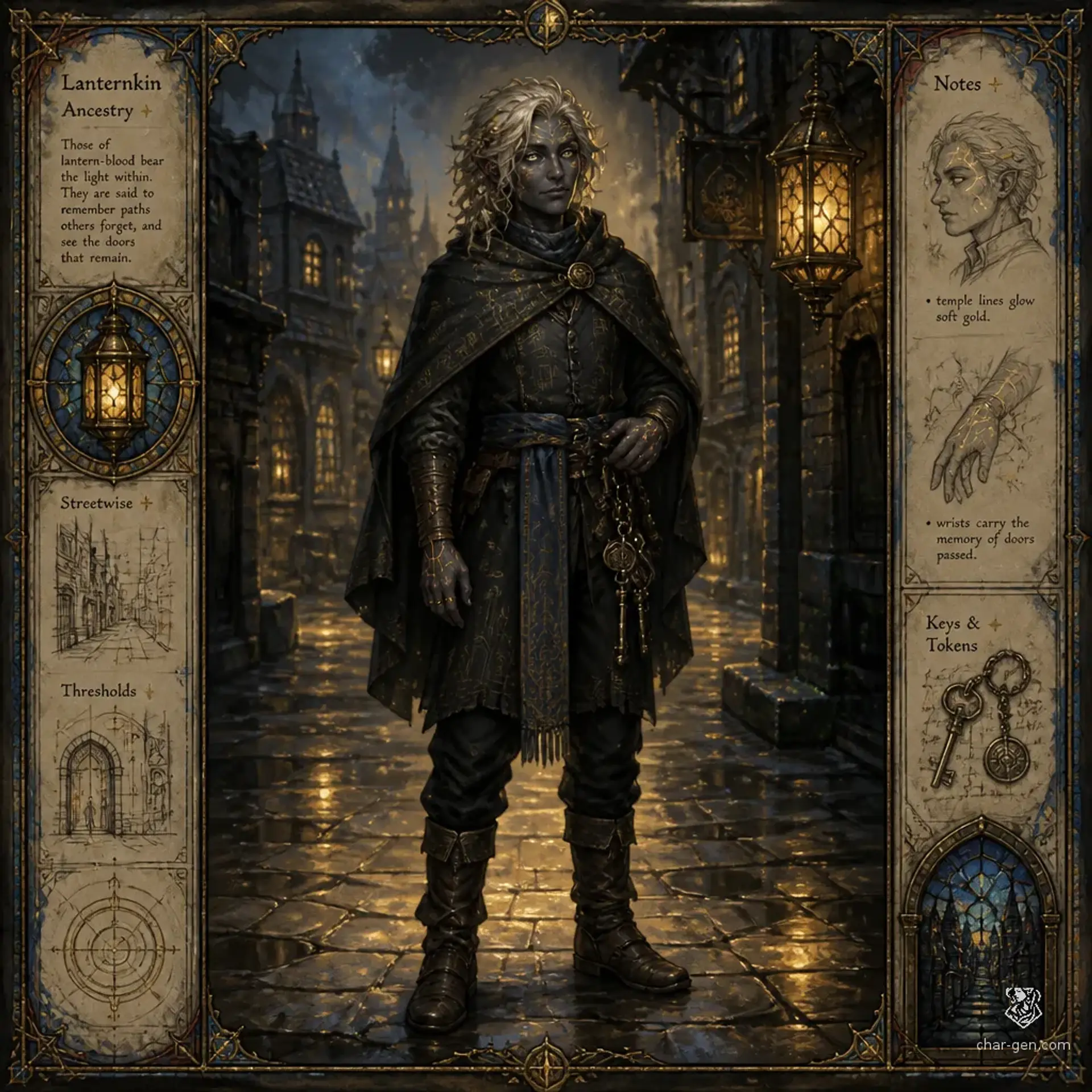
Lanternkin are city-born wanderers whose bodies remember the language of streets. They read a neighborhood by its echoes, smell danger in disturbed dust, and carry the glow of old lamps beneath their skin. To a lanternkin, a city is not a collection of buildings but a living pact between the people who inhabit, repair, protect, and remember it. They may be locksmiths, investigators, couriers, architects, smugglers, priests, or rebels, but wherever they go, they look for the hidden routes that connect one life to another.
Physical Description
Lanternkin are compact to tall humanoids with broad variations in build, complexion, and facial structure. Their skin often bears subtle undertones of ash gray, copper, umber, ivory, or deep blue, and many have fine luminous lines at the temples, wrists, or throat. These markings brighten with strong emotion and fade during sleep. Their eyes are large and reflective, with irises that resemble colored glass. Hair ranges from ordinary human shades to smoky white, burnished brass, or glossy black. Lanternkin possess unusually sensitive fingertips and can distinguish masonry, metal, wood, and fabric by touch alone. Their bodies are warm but rarely sweat, allowing them to remain comfortable in crowded, poorly ventilated neighborhoods.
Society & Culture
Lanternkin society is organized around neighborhoods rather than bloodlines. A person may belong to a birth family, an adopted household, an apprenticeship circle, a civic guild, and a rooftop community all at once. Hospitality is considered a public service, and most lanternkin homes maintain a spare bed or sheltered alcove for someone caught outside after dark. Their most respected professions are those that preserve connection: messengers, lamplighters, archivists, mediators, physicians, builders, and street cooks. Disputes are commonly settled through witnessed exchanges of favors, public storytelling, or temporary shared labor. To refuse every form of obligation is considered deeply antisocial.
Religion & Alignment
Lanternkin religion centers on guardianship, memory, and the safe return of travelers. Some venerate ancestral lights, believed to be the lingering spirits of those who kept a community alive during famine, siege, or fire. Others honor deities of craft, thresholds, knowledge, or civic order. Lanternkin tend toward practical and community-minded outlooks, but their traditions support every alignment. A lawful lanternkin may become a magistrate or meticulous archivist, while a chaotic one may serve as a rooftop courier, street performer, or revolutionary.
Homelands & Architecture
Lanternkin communities thrive in old cities, especially those built over ruins, canals, catacombs, or layered foundations. Their homes are narrow and tall, with folding balconies, interior courtyards, roof bridges, and concealed service corridors. A proper lanternkin building includes several ways to leave, a communal workroom, and a place where guests can sit without blocking the household's view of the street. Their districts are marked by colored lamps, engraved drain covers, hanging bells, and small shrines built into walls.
Relationships With Other Peoples
Lanternkin are valued as guides, interpreters, repairers, and discreet problem-solvers. Other urban peoples often consider them dependable but difficult to surprise. Rural communities may mistake their constant scanning and route-planning for suspicion or arrogance. Lanternkin usually form strong ties with humans, goblin-kin, stone-blooded folk, and other peoples who make their homes in dense settlements. They are wary of aristocracies that treat cities as possessions, though individual lanternkin may serve noble houses as trusted stewards, spies, or engineers.
Visual sheet
Turn Lanternkin into a sheet
A high-res, share-ready sheet you can post or print.